• العربية
  • فارسی
Brand
  • Iran Insight
  • Politics
  • Economy
  • Analysis
  • Special Report
  • Opinion
  • Podcast
  • Iran Insight
  • Politics
  • Economy
  • Analysis
  • Special Report
  • Opinion
  • Podcast
  • Theme
  • Language
    • العربية
    • فارسی
  • Iran Insight
  • Politics
  • Economy
  • Analysis
  • Special Report
  • Opinion
  • Podcast
All rights reserved for Volant Media UK Limited
volant media logo

Iranians voice mistrust as criticism of Pezeshkian’s cabinet mounts

Aug 18, 2024, 20:31 GMT+1Updated: 16:07 GMT+0
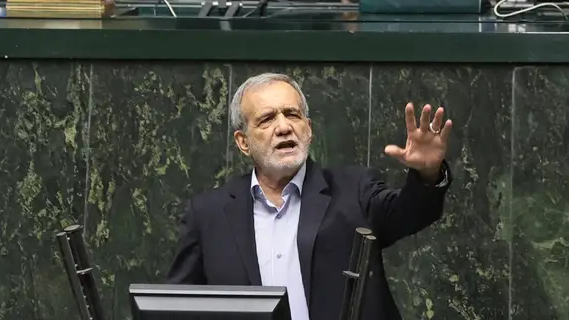
President Masoud Pezeshkian addressing parliament on August 17

Growing criticism of Masoud Pezeshkian’s cabinet selections has sparked a wave of public distrust in the Islamic Republic’s political process, with citizens accusing officials of deceiving the electorate.

The backlash follows remarks from Iranian lawmaker Qasem Osmani, who acknowledged during Saturday’s parliamentary session, which marked the first day of cabinet approval debates, that people feel betrayed by the election results.

Osmani, a Pezeshkian supporter, directly criticized Pezeshkian during the session, accusing him of abandoning the electorate after the elections. "People say you deceived us in the elections," Osmani said. "You spoke about our pains, we thought you sympathized, but after the elections, you forgot all our pains."

Iran International asked its audience for their thoughts on Osmani’s statement. The responses reveal widespread frustration, with citizens viewing the entire political system as fundamentally deceptive.

One citizen responded with a voice message, stating, "The Islamic Republic regime is founded on corruption, and the corrupt are running it."

Another citizen stated, "Anyone who has voted in any election in the Islamic Republic has been deceived."

A third citizen traced the roots of this deception to the early days of the Islamic Republic, stating, “Ruhollah Khomeini, the founder of the Islamic Republic, began deceiving the people in 1979,” a pattern that, they believe, persists to this day.

A fourth citizen expressed even deeper disillusionment, arguing that the Islamic Republic’s deceit extends beyond just elections. "To say they’ve been deceived is an understatement; it’s much worse than that," he remarked.

"The Islamic Republic is committed to nothing but fulfilling its own desires, which have always been in direct opposition to the will of the people."

Pezeshkian, who was supported by the 'reformist' wing of Islamic politicians, promised voters that his government will be composed of experts and that he would address some of the electorate's main grievances. But when he announced his cabinet, people realized it was stacked with the same former officials and IRGC generals.

The parliamentary debates over Pezeshkian's cabinet nominees are set to continue through Wednesday, August 21.

As the debates unfold, the widening divide between the state and the people highlights the escalating tension, raising critical questions about the future direction of the Islamic Republic. Pezeshkian’s leadership, shaped by the directive of Supreme Leader Ali Khamenei and emerging from a heavily boycotted election, faces increased scrutiny amid ongoing anti-regime sentiment.

Most Viewed

Hardliners push Hormuz ‘red line’ as US blockade tests Iran’s leverage
1
INSIGHT

Hardliners push Hormuz ‘red line’ as US blockade tests Iran’s leverage

2

Iran International says it won’t be silenced after London arson attack

3
VOICES FROM IRAN

Hope and anger in Iran as fragile ceasefire persists

4

US sanctions oil network tied to Iranian tycoon Shamkhani

5

Iran halts petrochemical exports to supply domestic market

Banner
Banner

Spotlight

  • Hardliners push Hormuz ‘red line’ as US blockade tests Iran’s leverage
    INSIGHT

    Hardliners push Hormuz ‘red line’ as US blockade tests Iran’s leverage

  • Ideology may be fading in Iran, but not in Kashmir's ‘Mini Iran'
    INSIGHT

    Ideology may be fading in Iran, but not in Kashmir's ‘Mini Iran'

  • War damage amounts to $3,000 per Iranian, with blockade set to add to losses
    INSIGHT

    War damage amounts to $3,000 per Iranian, with blockade set to add to losses

  • Why the $100 billion Hormuz toll revenue is a myth
    ANALYSIS

    Why the $100 billion Hormuz toll revenue is a myth

  • US blockade targets Iran oil boom amid regional disruption
    ANALYSIS

    US blockade targets Iran oil boom amid regional disruption

  • Iran's digital economy battered by prolonged blackout
    INSIGHT

    Iran's digital economy battered by prolonged blackout

•
•
•

More Stories

Iran's threat of escalation risks regional war, UK and France warn

Aug 18, 2024, 18:11 GMT+1

The British and French foreign ministers have warned about the mounting danger of a full-scale regional conflict due to Iran's escalatory rhetoric, calling on all parties to show restraint.

In a joint op-ed published in the Guardian on Saturday, UK Foreign Secretary David Lammy and French Foreign Minister Stéphane Séjourné stress that Iran's threats of escalation could trigger a wider and more destructive war in the Middle East.

“Iranian threats of further escalation mean the risks of a full-scale regional war are rising,” the ministers cautioned. They described the current situation as a “destructive cycle of violence,” with the potential for a single miscalculation to ignite a deeper and more unmanageable conflict.

Since the assassination of Hamas leader Ismail Haniyeh in Tehran on July 31, Iran has been threatening retaliation against Israel. However, recent media reports suggest that internal divisions within Iran are causing hesitation regarding further escalation. Additionally, it appears that pressure from the Biden administration may be influencing Iran to reconsider its stance.

The European ministers underscored the implications any Iranian aggression could have, potentially undermining ceasefire negotiations related to Gaza. They emphasized that “it’s never too late for peace” and warned that an all-out regional conflict would serve no one's interests. "All parties must exercise restraint and focus on diplomatic solutions," they argued.

The situation in Gaza remains critical, with the ongoing war leading to civilian casualties. Hostages taken by Hamas during the October 7 attack are still held captive, including several French and British nationals. Meanwhile, the conflict between Israel and Hezbollah has intensified, further complicating the regional stability.

In response to these threats, the foreign ministers visited Israel in a joint diplomatic mission, marking the first time in over a decade that British and French top diplomats traveled together to the region. Their visit to Israel underscores a renewed commitment to collaborative action aimed at enhancing regional and European security.

As permanent members of the UN Security Council, the UK and France called for engagement with US-led diplomatic discussions, emphasizing the importance of adhering to UN Security Council Resolution 1701.

The ministers also acknowledged the role of American, Egyptian, and Qatari mediators in facilitating ongoing negotiations. They stressed that only “a deal can restore communities’ sense of security. Only a deal can open up the space for progress towards a two-state solution – the only long-term route to safety, security and dignity for Israelis and Palestinians alike.”

“There can be no delays or excuses,” the foreign ministers declared. “We must all come together and reconnect in the interests of peace.”

Over a million cross from Iran to Iraq in controversial pilgrimage

Aug 18, 2024, 16:30 GMT+1

The annual 'Arbaeen Walk,' a significant Shiite pilgrimage to Iraq for the Arbaeen ceremony, has commenced, with over a million pilgrims crossing the border from Iran.

Arbaeen marks the end of a 40-day mourning period following Ashura, the religious observance that commemorates the killing of Imam Hossein, the grandson of Prophet Mohammad, in 680 AD.

Majid Mirahmadi, the director of Iran's Central Headquarters of Arbaeen, announced Thursday that more than 1.5 million Iranian and foreign pilgrims have departed the country through six border crossings with Iraq.

He further emphasized that over 2.6 million Iranians have registered for the pilgrimage, typically attracting up to 20 million Shia Muslims from Iran, Iraq and elsewhere annually.

Iran’s clerical establishment is founded on a religious ideology that venerates Ali, the fourth Caliph after Prophet Mohammad, and his son Hossein as the rightful successors to Mohammad as leaders of Muslims. Consequently, religious symbolism is deeply interwoven with the political fabric of the Islamic Republic.

The Shiite leadership places significant emphasis on Ashura and other religious observances as pivotal moments for mobilizing public support and reinforcing its political authority through various ceremonies.

The "Arbaeen walk," while now a prominent event, is acknowledged even by Iran's hardliners as a phenomenon that has only gained significant momentum in the past decade rather than being rooted deeply in history.

Iran's Supreme Leader Ali Khamenei has placed considerable emphasis on Arbaeen, describing it as "beyond description, utterly unparalleled," and a "vast and astonishing demonstration of unity" with no equivalent worldwide.

He has criticized Western observers who often fail to comprehend this event's significance, leading their media to maintain years of silence—a calculated "conspiracy of silence."

“Not only in our era but throughout history, there is no record of a gathering like this [the Arbaeen procession], where such an event occurs annually, each year with even greater zeal than the last; it is truly unparalleled,” Khamenei said during a speech in 2019.

In the years following the fall of Saddam Hussein's regime, and particularly after the rise of ISIS, which precipitated Iran's intervention in Iraq, the Islamic Republic has meticulously orchestrated efforts to maximize participation in this ceremony, which many say never existed in history.

Observers note that Tehran leverages this strategy as a means to project the influence of the Shia-led Islamic Republic within Iraq, serving political objectives.

The head of the Central Arbaeen Committee announced in July that 12 trillion tomans (approximately $230 million) had been allocated to facilitate the Arbaeen pilgrimage.

Meanwhile, amid an economy crippled by sanctions and mismanagement, Iran faces severe budget constraints, with one-third of its population living in "extreme poverty."

Additionally, newly appointed Vice President Mohammadreza Aref authorized the allocation of 4 trillion rials (approximately $760k) to support the event, which will culminate in ceremonies in the Iraqi cities of Karbala and Najaf in late August.

The funds are earmarked to "mitigate unforeseen incidents, prevent the spread of contagious diseases, and address heat-related health risks at border crossings and along the pilgrimage route." But this is just a negligible part of what Iran spends in feeding, transporting and supporting the pilgrims. Although there are no official figures, it is estimated that the government spends at least $500 million annually.

This is while one of the most pressing crises currently facing Iran—an escalating electricity shortage that is crippling businesses and homes during an intense heatwave—the CEO of the Kermanshah Province Electricity Distribution Company announced that the electricity supply for Arbaeen pilgrims in the province has been secured, with 90 billion rials (approximately $172k) allocated to ensure reliable lighting along the pilgrimage routes and at related facilities.

These decisions have intensified public criticism of the Iranian authorities, with many questioning their decisions and priorities and arguing that these challenges further exacerbate the nation's already dire circumstances.

Iran’s FM-designate pledges to uphold Khamenei’s policies

Aug 18, 2024, 14:15 GMT+1

Parliamentary committees gave their seal of approval to Abbas Araghchi, the foreign minister-designate, as he vowed to uphold the Supreme Leader's policies and continue supporting Iran’s "Axis of Resistance."

During the second day of hearings for President Masoud Pezeshkian’s proposed cabinet, two key ministers received votes of confidence from relevant parliamentary committees. First was Intelligence Minister Esmail Khatib, and during the afternoon session, former nuclear negotiator Abbas Araghchi.

The 63-year-old diplomat, who has served for almost 40 years in the foreign ministry, left no doubt that his duty is to carry out the Islamic Republic’s policies under Ali Khamenei’s direction. "The 'Diplomacy of Resistance,' which is derived from the 'School of Resistance' and the result of the heroic efforts of Martyr Qasem Soleimani in designing the 'Axis of Resistance,' will be at the forefront of the foreign policy of the fourteenth government,” he said.

Araghchi emphasized: We will not lose our way, and unwavering, continuous, and comprehensive support for the cause of Palestine and the Lebanese Resistance, as well as other resistance movements fighting against the oppressive and criminal policies of the Zionist regime, will be at the top of our agenda.

He also vowed to "utilize all our political and diplomatic capacities to…garner support from regional countries and achieve the recognition of the Axis of Resistance actors on the international stage as popular and liberation movements."

Araghchi informed lawmakers that during the six rounds of nuclear talks with the West in 2021, he strictly adhered to Khamenei’s directives and the December 2020 parliamentary law requiring the lifting of US sanctions. He emphasized that, in line with Khamenei’s guidance, his foreign ministry would pursue "an honorable path" to lifting the sanctions. Notably, the foreign minister-designate consistently referred to these efforts as "sanctions-lifting talks" rather than nuclear negotiations.

He also vowed to do his utmost to circumvent sanctions or work to have them lifted. “Regarding sanctions, our policy is based on the recent guidance of the Supreme Leader in his meeting with the honorable members of parliament, focusing on neutralizing the impact of sanctions while simultaneously working to have them lifted. Foreign policy efforts aimed at neutralizing and rendering sanctions ineffective will support the government's objectives,” he stated.

Some regime politicians in Iran have argued that Araghchi’s appointment signals Tehran’s readiness for negotiations with the West. In an earlier meeting with parliamentary committees last week, Araghchi made two points: the 2015 nuclear deal (JCPOA) is beyond revival, and Iran should temper its hostility toward the United States.

However, there was another angle in Araghchi’s remarks last week. He did not mention the need for reaching any agreement that could address the concerns of the United States. Instead, he underlined that diplomatic and military pressure is needed to have the sanctions lifted.

On Sunday, Araghchi emphasized that he will be Khamenei’s “soldier” and expressed pride that Iran’s power has increased in the region and beyond. He also indicated his full agreement with Khamenei’s policy of alliance with China and Russia. "China, Russia, and other countries that have stood by us during difficult times and sanctions, as well as emerging powers and new arenas in Africa, Latin America, and East Asia, will be priorities in the foreign relations of the fourteenth government.”

Regarding relations with Europe, Araghchi repeated Tehran’s position, which aims to de-couple the Europeans from the United States. “If Europe corrects its improper and hostile behavior towards the Islamic Republic of Iran, it will be included in our list of priorities. Finally, our policy toward the United States will be one of 'managing hostility’."

Iran coerces confession from woman shot by police over hijab

Aug 18, 2024, 12:30 GMT+1

Iran’s state security forces have forced 31-year-old Arezou Badri, who was shot by police for allegedly violating hijab rules, to give a coerced confession despite her critical condition in hospital, Iran International has learned.

Badri, who is hospitalized with severe injuries to her spine and lungs, was pressured into confessing while in extreme pain, unable to sit or eat, sources told Iran International on Sunday.

Sources revealed that Badri, who broke down in tears from pain multiple times during the forced confession, was threatened by security agents and coerced into a video interview. The agents also forced her close family members, including her sister, to make coerced confessions.

Badri was shot on July 22 while returning home with her sister in Nour County, northern Mazandaran Province.

Reports obtained by Iran International reveal that police opened fire from the rear driver's side of the car stopped on a dirt road, striking Arezou Badri in the back and severely damaging her spinal cord and lungs.

A seizure order had been issued for the vehicle in which Badri was a passenger, allegedly due to a violation of Iran's mandatory hijab law. Police issue vehicle seizure alerts if the driver or a passenger are seen without hijab in a car.

Mazandaran Provincial Police confirmed the shooting, claiming the driver continued to flee despite police orders, leading officers to open fire "according to the law on the use of weapons."

Meanwhile, Ahmadreza Pourkhaghan, head of the Judicial Organization of Iran's Armed Forces, announced that the officer who shot Badri is currently in prison under temporary detention.

Despite this development, President Masoud Pezeshkian, who had promised during his election campaign to stop hijab patrols and violence against women for violations, has remained silent on the incident, amid growing calls on social media for him to address it.

Sources told Iran International that a court hearing regarding the family's complaint has been held, but the family is dissatisfied with the proceedings and is under pressure to drop the case.

Badri, a sales associate and mother of two, was initially taken to a local hospital in Nour before being transferred to Imam Khomeini Hospital in Sari, and eventually to Vali-e-Asr Hospital in Tehran under tight security.

Arezou Badri
100%
Arezou Badri

Exclusive information received by Iran International revealed that Badri had undergone another surgery on Wednesday due to fluid buildup in her lungs, and her condition remains critical.

Additionally, security forces on Thursday prevented her family from leaving their hotel to visit her in the hospital. They were allowed to leave the hotel on the next day, but were denied visitation when they arrived. Sources said that before allowing the visit, several members of parliament sought to meet with the family to gain their cooperation.

Iranian authorities have long been notorious for using forced confessions as a tactic to silence dissent and push their narrative. These confessions, often extracted under duress or torture, are frequently broadcast on state media to cover up abuses and justify harsh crackdowns.

The case of Badri is the latest example, underscoring the state’s reliance on coercion to control the narrative and suppress opposition.

Badri’s story has been widely viewed as yet another example of the Iranian state's escalating violence against women over the mandatory hijab, fueling further outrage within the country and drawing condemnation from rights groups.

In December 2022, amid nationwide protests sparked by the death of Mahsa Amini in morality police custody, the European Union sanctioned Iran's state broadcaster, IRIB, for “producing and broadcasting the forced confessions of detainees.”

The United States in November 2022, extended its 2013 sanctions against IRIB to include several IRIB officials for their role in airing coerced confessions.

Iranian president's approach riddled with contradictions

Aug 18, 2024, 10:55 GMT+1
•
Majid Mohammadi

Iran’s new president, Masoud Pezeshkian, was scheduled to present the core of his executive plan during a 2.5-hour speech on the first day of the parliament proceedings to review his plan and cabinet.

However, due to the commotion and disorder in the parliamentary session, he reduced his speech to just 53 minutes, struggling to even read his notes correctly. He ceded the remainder of his time to parliament members to defend him, despite there being ample time under parliamentary rules for both support and opposition.

In his speech, Pezeshkian did not outline a specific plan, contrary to the parliament's expectations. Instead, he stated that his plan is the Seventh Development Plan (approved by the parliament) and the policies endorsed by Ali Khamenei—documents that no one in the current parliament would dare to review or criticize. Moreover, Khamenei’s declared policies and the development plan are general wish lists, not road maps to get things done.

Yet, his remarks, much like his statements during the debates, reveal four key confusions and contradictions that are likely to trouble his administration over the next four years, some of which are already evident in the composition of his cabinet.

Tribe or nation-state

To persuade his Islamist audience, Pezeshkian frequently cites passages from the Qur'an and centuries-old Shiite texts to justify his decision-making process. However, he seems unaware that the words of the Prophet of Islam and the First Shia Imam were articulated within the context of a tribal society in Hijaz, Arabia, 14 centuries ago. Even if these teachings were effective in that era, they cannot serve as a roadmap for the present day. Pezeshkian fails to grasp that Islamism and strict textualism reduce the worldview of Islamists to that of a single Arab tribe, the Quraish, which no longer reflects the complexities of modern life.

Religious texts offer guidance and sermons, not blueprints for effective governance. They do not address the complexities of legislative processes, policy-making, or decision-making in response to evolving needs, principles, institutional contributions, and public opinion.

Foreign enemy or internal ruling class?

Pezeshkian frequently oscillates between blaming imperialism and sanctions for hindering "Islamic rights and justice" and acknowledging the weaknesses, problems, and incompetence of Iran’s rulers. This back-and-forth leaves his administration's direction unclear—whether its focus will be on combating the "system of global domination" or addressing corruption, inefficiency, discrimination, and waste within the ruling class.

As a result of this back and forth, Pezeshkian sidesteps the root causes of the country's problems—namely, anti-Western foreign policy, regional expansionism, and the nuclear agenda. He avoids addressing the diversion and expenditure of resources toward international conflicts and propaganda, the more than one trillion dollars lost due to the nuclear program, and the economic isolation that has shuttered trade opportunities with the world. These issues go far beyond mere differences or incompetence within the ruling class; they are systemic flaws that cannot be ignored.

National unity or gang cohesion

In defending his cabinet and governance approach, Pezeshkian portrays his administration as a government of national unity. However, his unwavering adherence to the opinions and policies of Ali Khamenei and the composition of the cabinet suggest a factional and clique-driven government. Ali Khamenei has consistently represented the interests of Iran's most totalitarian and authoritarian factions, never playing a cross-factional role.

In Pezeshkian’s proposed cabinet, influential factions and mafias within the government have been allocated power in proportion to their influence within Khamenei’s office and the IRGC’s economic empires, military-industrial complexes, and the repression and propaganda apparatus. As a result, Pezeshkian’s administration is neither a government of national unity nor one representing the unity of the Islamic Ummah; rather, it is a government of factional cohesion. In this view, the "nation" is synonymous with the ruling elite and the factions within its ranks.

Implementation or non-implementation: that's the question

Whenever Pezeshkian addresses the country's problems and crises, he retreats to the Islamic idealism of the 1970s. This idealism holds that all issues stem from neglecting Islamic principles, which lead to "wrong and injustice." Khamenei paved the way for Pezeshkian to assume the presidency and secure victory in the engineered elections, aiming to revive this failed Islamic idealism.

In Pezeshkian’s view, the ultimate remedy lies in the word of God, as conveyed by the Prophet, the first Shia Imam, and today, by the Supreme Leader whose decrees are enforced by the state. However, the lived experience under the Islamic Republic has demonstrated that Iran’s current problems and crises are rooted in a government that enforces Sharia orders and rulings to secure absolute, unaccountable power. This approach is at odds with modern common sense, meritocracy, the rule of law, and the principles of limited government.