• العربية
  • فارسی
Brand
  • Iran Insight
  • Politics
  • Economy
  • Analysis
  • Special Report
  • Opinion
  • Podcast
  • Iran Insight
  • Politics
  • Economy
  • Analysis
  • Special Report
  • Opinion
  • Podcast
  • Theme
  • Language
    • العربية
    • فارسی
  • Iran Insight
  • Politics
  • Economy
  • Analysis
  • Special Report
  • Opinion
  • Podcast
All rights reserved for Volant Media UK Limited
volant media logo

Iran’s Araghchi touted as ‘pragmatic’ in US relations
Aug 16, 2024, 20:48 GMT+1Updated: 16:08 GMT+0
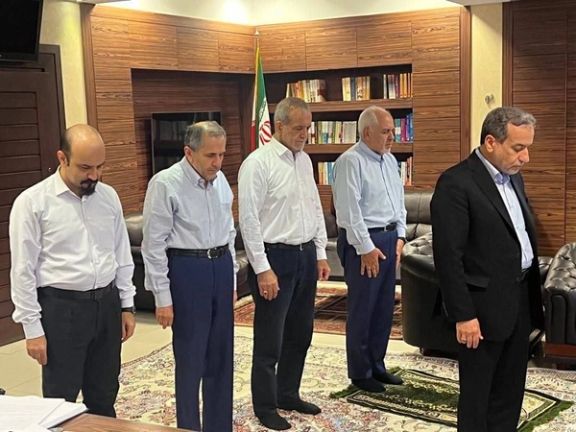
Araghchi leading president Pezeshkian and Zarif in prayers in July

A prominent conservative political figure in Iran suggests that the nomination of Abbas Araghchi as the new Foreign Minister signals Tehran's readiness for negotiations with the West.

Abbas Salimi Namin stated in an interview with the Khabar Online website in Tehran that Araghchi's inclusion in the cabinet could accelerate the push for negotiations aimed at lifting US sanctions against Iran.

In his meeting with Iranian lawmakers ahead of the parliament's (Majles) vote of confidence on President Pezeshkian's ministers, Araghchi's comments were summarized by Iranian and international media into two key points: the 2015 nuclear deal (JCPOA) is beyond revival, and Iran should temper its hostility toward the United States.

The media in Tehran have also opined that Araghchi's appointment as Foreign Minister indicates that Iran is likely to adopt a pragmatic approach to its relations with the United States.

However, there was another angle in Araghchi’s remarks. He did not mention the need for reaching any agreement that could address the concerns of the United States. Instead, he underlined that diplomatic and military pressure is needed to have the sanctions lifted.

Salimi Namin in his interview said that the Majles will certainly give its vote of confidence to Araghchi and this will impact the minister's ability to negotiate for the lifting of sanctions on Iran.

While many observers and lawmakers in Iran are pessimistic about the result of the vote of confidence for some of Pezeshkian's ministers, almost all who have spoken publicly about the matter, including Mohammad Bagheri Banai, a member of the "independent" MPs fraction are adamant that Araghchi will face any challenge.

Salimi Namin further said that like former president Ebrahim Raisi, Pezeshkian has also promised to open up to the world in a bid to solve the nation's financial problems. That comparison might not bode well for the future of US-Iran relations, as the Raisi administration effectively scuttles the nuclear talks in Vienna by constant deals, which finally ended when Russia invaded Ukraine.

Namin reiterated that Araghchi's appointment will strengthen support for trying to have the sanctions lifted. This, in other words, means that Iran is no longer going to work toward what it called "reviving the JCPOA," as it appears that Tehran has finally realized that the United States is no longer interested in the 2015 nuclear deal and is looking for a new package deal that would address several regional security issues as well.

In another development, according to Nameh News, a 2021 videoshowing the hardline editor of Kayhan newspaper, Hossein Shariatmadari strongly defending Araghchi has gone viral on social media. The video shows Shariamadari in a talk show on the IRGC- linked Ofogh channel of the Iranian state TV saying Arghchi's views are different from those of former Foreign Minister Mohammad Javad Zarif.

Shariatmadari also praised the former nuclear negotiator for what he called "not giving any concession to US negotiators during the Vienna talks" in 2014 which led to the signing of the 2015 nuclear deal. "Without him, we would have lost many things," said Shariatmadari.

Meanwhile, Iran's Former ambassador to the United Nations, Majid Takht Ravanchi has said that the situation for both Iran and the United States is different from what it was ten years ago. As far as an agreement with Iran is concerned, the US Congress will make it difficult for any government in Washington to make a deal with Tehran. Ravanchi reiterated however that in Washington only hardliners believe the Iranian regime is illegitimate and others are open to talks with Tehran.


Most Viewed

Iran negotiators ordered to return after internal rift over Islamabad talks
1
EXCLUSIVE

Iran negotiators ordered to return after internal rift over Islamabad talks

2
ANALYSIS

US blockade enters murky phase as tankers spoof signals and buyers hesitate

3
ANALYSIS

Why the $100 billion Hormuz toll revenue is a myth

4

US tightens financial squeeze on Iran, warns banks over oil money flows

5
ANALYSIS

US blockade targets Iran oil boom amid regional disruption

Banner
Banner

Spotlight

  • Hardliners push Hormuz ‘red line’ as US blockade tests Iran’s leverage
    INSIGHT

    Hardliners push Hormuz ‘red line’ as US blockade tests Iran’s leverage

  • Ideology may be fading in Iran, but not in Kashmir's ‘Mini Iran'
    INSIGHT

    Ideology may be fading in Iran, but not in Kashmir's ‘Mini Iran'

  • War damage amounts to $3,000 per Iranian, with blockade set to add to losses
    INSIGHT

    War damage amounts to $3,000 per Iranian, with blockade set to add to losses

  • Why the $100 billion Hormuz toll revenue is a myth
    ANALYSIS

    Why the $100 billion Hormuz toll revenue is a myth

  • US blockade targets Iran oil boom amid regional disruption
    ANALYSIS

    US blockade targets Iran oil boom amid regional disruption

  • Iran's digital economy battered by prolonged blackout
    INSIGHT

    Iran's digital economy battered by prolonged blackout

•
•
•

More Stories

End 'culture of impunity' in Iran, human rights authorities urge UN

Aug 16, 2024, 17:35 GMT+1

A group of world-leading experts on human rights and international law, including current and former UN officials, have called for actions that would help bring justice to those who suffered in Iran’s mass killing of political prisoners 35 years ago.

In an open letter to the UN High Commissioner for Human Rights Volker Türk, 285 distinguished individuals and 28 organizations have endorsed a “landmark report” by Javaid Rehman, the UN Special Rapporteur on Iran, which accuses the Islamic Republic of “ongoing crimes against humanity.”

“The Special Rapporteur’s report opens a pathway to justice and an end to impunity in Iran,” the open letter published Friday reads. “In line with his recommendations, we urge Your Excellency to use your good offices and call on the Human Rights Council to establish an international accountability mechanism to take actionable measures aimed at ending impunity for Iran’s atrocity crimes, chief among them the 1988 massacre.”

In 1988, thousands of political prisoners were summarily and extrajudicially executed on the orders of Iran’s first Supreme Leader, Rouhollah Khomeini. The precise number of those killed is unknown but estimated to be between 3,000 and 5,000, based on extensive research by human rights groups.

“The willful executioners implemented Khomeini’s fatwa in full knowledge that they were committing international crimes by systematically and deliberately murdering political prisoners all across the country in a coordinated manner,” Rehman wrote in his latest report.

Welcoming Rehman's report, the signatories of the letter have commended the former special rapporteur for challenging the “culture of impunity in Iran” by affirming that the 1988 massacre constitutes “ongoing crimes against humanity.”

Signatories of the open letter to the UN High Commissioner on Human Rights include the Presidents of the International Bar Association (IBA), the International Commission of Jurists (ICJ), and the International Association of Genocide Scholars (IAGS), and the Secretary General of the World Organization Against Torture (OMCT).

“In light of the Special Rapporteur’s landmark report, we also encourage the co-sponsors of the Canadian-led annual UN Third Committee resolution on Iran to include a specific reference to the 1988 massacre in this year’s resolution to meaningfully counter the ongoing culture of impunity in Iran,” they write in their letter.

Iran has never acknowledged that such crimes were committed and have even prosecuted those seeking justice. No official of any rank has ever been investigated, let alone tried, in relation to the 1988 massacre in Iran.

The only person to have ever stood trial for the killings is Hamid Nouri, a former prison official arrested in Sweden. In 2022, a court in Stockholm sentenced Nouri to life in prison for his role in the 1988 mass executions in Iran. The court found him guilty of “grave breaches of international humanitarian law and murder.”

Nouri's conviction was deemed a landmark victory for those Iranians who had sought truth and justice for more than three decades. However, in June 2024, the Swedish government extradited Nouri to Iran in exchange for the release of two of its citizens that were prisoned in Iran.

Why Iran persists in electricity exports despite shortages?

Aug 16, 2024, 16:04 GMT+1
•
Amirhadi Anvari, Dalga Khatinoglu

Earlier this year, amid growing warnings of a significant electricity shortage, Iran announced that its power lines had been connected through Turkey to Greece and Bulgaria, paving the way for electricity exports to Europe.

Meanwhile, after enduring a month of severe summer electricity shortages, Iran limited its electricity exports to Iraq in late July. However, it is unclear whether the level of Iran’s electricity exports to its western neighbor has increased since then.

Iran also exports electricity to Pakistan and Afghanistan.

The question arises: why does the Iranian government persist in exporting electricity despite a 17,000-megawatt power deficit—equivalent to 20% of domestic demand—while local industries face halved electricity supply and widespread outages are being enforced in residential areas?

Iran's power sector in dire need of money

This issue can be examined within the context of the government's reliance on electricity revenue and the substantial disparity between domestic and international electricity prices.

For instance, this year the government is selling each kilowatt-hour of electricity at less than one cent to the residential sector, whereas the price of exported electricity is 8 cents.

Last year, Iran exported 3 TWh of electricity, which is less than 1% of the country’s total electricity production, generating $300 million in revenue.

On the other hand, Iran’s electricity company, Tavanir, is a loss-making entity and has no choice but to continue exporting electricity at higher prices.

For instance, Tavanir’s expenses for 2022 exceeded 1,000 trillion rials (approximately $1.7 billion at the free market rate), while its revenues were just over $1.2 billion.

The low price of subsidized domestically sold electricity has caused Iran’s Ministry of Energy’s debt to semi-private power producers to peak at $1.5 billion.

In addition to exporting electricity, Iran also imports it from Azerbaijan, Armenia, and Turkmenistan. In the mid-2010s, Iran had a net electricity export of 8 terawatt-hours (TWh), but due to rising electricity shortages, this figure dropped to just 1 TWh in 2022 (4 TWh exported and 3 TWh imported). The Ministry of Energy stopped publishing electricity trade statistics after the third quarter of 2023, but in the spring of last year, Iran recorded 1.2 TWh of exports and 0.8 TWh of imports, indicating that the electricity trade balance remained positive at least until that time.

It is not exactly clear how much revenue the Iranian government earned from net electricity exports last year, but estimates suggest that Iranian industries have suffered about $8 billion in damages due to intermittent power cuts.

Last year, Iran’s summer electricity deficit was 12,000 MW, but this year it has reached 17,000 MW, and naturally, the damage to industries, such as steel, will be significantly higher than last year.

The government does not clarify whether the $300 million revenue from electricity exports last year justifies the $8 billion loss to industries and the partial shutdown of government offices. Additionally, it remains unclear how much the government spent on electricity imports last year, but according to Azerbaijan’s official statistics, its electricity export price for Iran is 3 cents, while Iran’s own export prices is about 8 cents/kwh.

Retaining customers despite own shortages

Another point is that Iran has excess electricity in other seasons of the year and must retain foreign customers to ensure revenue from electricity exports outside the summer months. For this reason, even during peak summer electricity shortages, Iran is compelled to continue exporting electricity.

The situation is similar in the gas sector; Iran experiences severe gas shortages in the winter and replaces gas with large volumes of pollutant mazut and diesel fuels in power plants and industries. However, to maintain its customers (Iraq and Turkey), Iran continues its gas exports during the winter as well.

Energy exports as a tool of influence

More importantly, the Islamic Republic has consistently used energy as a political tool and leverage over its customers. A prominent example is the repeated threats by the Islamic Republic over the past two decades to cut off gas swap operations between Azerbaijan and Nakhchivan through Iranian territory. Ultimately, Azerbaijan signed a contract several years ago to transfer gas through Turkey to Nakhchivan, and this pipeline is nearing completion.

Regarding Iraq, keeping this country dependent on Iranian electricity and gas, as well as preventing river flows from Iranian territory into Iraq, effectively allows the Islamic Republic to exert pressure on the Baghdad government.

Even with Turkey, Iran has repeatedly and suddenly halted gas deliveries during the winter, causing damage to industries in eastern Turkey due to gas shortages. As a result, Turkey halved its purchase of Iranian gas last year and significantly increased its gas imports from Azerbaijan and Russia. The gas contract between Iran and Turkey is set to expire in two years.

Proposed energy minister blamed for worsening Iran's power crisis

Aug 16, 2024, 14:55 GMT+1

Iranian President Masoud Pezeshkian is under intense scrutiny as a media outlet boldly blames his proposed Minister of Energy, Abbas Aliabadi, for the nation’s ongoing energy crisis.

This criticism comes amid growing concerns about the composition of Pezeshkian's cabinet, casting doubt on its ability to effectively navigate the challenges ahead. The backlash from both the media and the public has grown so intense that Pezeshkian has called on the nation to withhold judgment, urging citizens to evaluate the cabinet based on its future performance rather than immediate perceptions.

"In selecting Aliabadi for the Ministry of Energy, the electricity crisis is set to worsen, virtually guaranteeing the failure of Pezeshkian's administration," wrote the Tehran-based Rouydad24 news outlet on Thursday. The outlet further warned that "the fallout from this decision will be keenly felt by the Iranian people in the next four years, just as the lingering effects of his extended leadership at Mapna are now exposing the nation to this summer's searing heat."

Aliabadi, who has been proposed as Minister of Energy, previously served as Iran's Minister of Industry, Mines, and Trade under the hardline government of Ebrahim Raisi in 2023. His appointment even stirred discontent within Raisi's government, with many questioning the rationale behind his selection. Aliabadi stepped in following the impeachment and subsequent dismissal of Raisi's previous minister by parliament, a move that only added to the controversy surrounding his role.

Rouydad24 described the country’s ongoing energy crisis as one of Aliabadi's "greatest betrayals to Iranians," asserting that "the current situation alone serves as a compelling indicator of Aliabadi's managerial abilities and capacity to govern."

This criticism is made as Iran grapples with its most severe heatwave in half a century, which has led to widespread power outages nationwide. The government, already burdened by a staggering fiscal deficit, is struggling to address the crisis.

The roots of Iran's energy crisis run deep, with years of underinvestment and systemic mismanagement at the heart of the problem. The halt in investment in the electricity sector, coupled with stagnation in the development of new power plants and an aging, deteriorating grid, has resulted in a significant electricity shortage. The country now faces a crippling 14,000-megawatt deficit, leaving ordinary citizens to bear the brunt of prolonged blackouts and extreme heat.

Experts warn that the government's continued failure to address these critical issues is pushing Iran toward an increasingly unsustainable future. The situation underscores the urgent need for comprehensive reforms in Iran's energy policy to avert further catastrophe.

Adding to the controversy, Aliabadi's fifteen-year tenure as CEO of the Mapna Group, a major Iranian conglomerate responsible for constructing power plants and oil facilities, is now under scrutiny. The group’s ties to the Islamic Republic's political elite have raised alarms, particularly following revelations by the German newspaper Bild in April. The report suggested that Mapna Group's Düsseldorf-based subsidiary, Mapna Europe, may be involved in circumventing international sanctions.

Further concerns were raised by the British government, with Mapna Europe GmbH reportedly appearing on a European list of companies suspected of engaging in activities related to the production or procurement of weapons of mass destruction. Bild's investigation suggested that the Islamic Republic might be using Mapna Europe, along with its subsidiaries in Dubai, China, and Turkey, to conduct suspicious transactions aimed at evading international sanctions.

Aliabadi, a member of the Islamic Revolutionary Guard Corps (IRGC) and an alumnus of Iran’s defense educational institutions, resigned from his role at Mapna shortly after assuming his government position. However, Bild asserted that Aliabadi continues to exert influence over Mapna Europe's operations behind the scenes, further complicating his already contentious nomination.

Iran pushes its stakes in Gaza ceasefire talks under Trump’s shadow

Aug 16, 2024, 11:05 GMT+1

Iran seems to be indirectly involved in the Gaza ceasefire talks in Qatar, having threatened to attack Israel if a truce isn't reached to prevent its ally Hamas from facing military defeat.

Although Tehran was not attending the talks, Qatari prime minister, Sheikh Mohammed bin Abdulrahman Al Thani, spoke with Iran’s acting foreign minister Ali Bagheri-Kani to brief him on the first day of negotiations. Talks are continuing Friday, with some observers saying that a successful outcome will not be easy.

Iranian government-controlled media was largely silent about Tehran’s stance and role in the negotiations, limiting itself to brief reporting about the talks.

More attention was focused on what former US President Donald Trump and the Republican candidate in November said about Iran at a press conference he held at a golf club on Thursday.

Trump, in his typical fashion held out both a stick and a carrot for Tehran. “I'm not looking to be bad to Iran. We're going to be friendly I hope with Iran. Maybe but maybe not. But we're going to be friendly I hope we're going to be friendly, but they can't have a nuclear weapon…and we were all set to make sure that they don't.”

Iran’s Islamic regime insiders have been visibly nervous about Trump’s return, expecting him to be tough in enforcing sanctions. Trump has insisted that under his watch Tehran would not have had the financial resources to organize the October 7 attack on Israel. After he imposed crippling oil export sanctions in 2018, Iran’s main source of revenues dried up. Following President Joe Biden’s election, China began buying large shipments of Iranian oil, boosting Tehran’s exports from around 250,000 barrels per day in 2019-2020 to around 1.5 million currently. This has provided Iran with up to $60 billion in additional revenues.

Trump made it clear on Thursday that he will try to reduce the Chinese imports of Iranian oil. “I said to China and everybody else if you buy from Iran you can't do business in the United States and I'm not looking to be bad to Iran we're going to be friendly I hope with Iran maybe but maybe not but we're going to be friendly,” he said.

He once again emphasized that his main demand is major Iranian concessions over its nuclear program. “They can't have a nuclear weapon and we were all set to make sure that they don't have a nuclear weapon because once they do it's a whole different world it's a whole different negotiation.”

Iran has acted cautiously after the killing of Hamas leader Ismail Haniyeh last month in Tehran. Despite repeated threats to harshly retaliate against Israel, it has so far refrained from an escalation that could turn into a costly military conflict not only with Israel but also the United States.

Instead, it uses the threat of an attack on Israel to get concessions from the United States, which has committed itself to preventing a wider conflict. President Joe Biden has indicated that a Gaza ceasefire can prevent Iran's potential retaliation. This position appears to be a response to Iran’s repeated demands of a Gaza ceasefire, while Hamas is still holding around 100 Israeli hostages.

According to the Washington Post, Hezbollah will not launch any retaliation during the Gaza cease-fire talks to avoid being blamed for disrupting a potential agreement. 'The retaliation can wait; it is not urgent or has a time limit,' a source told the paper.

The fear of a wider war it cannot win was apparent in Supreme Leader Ali Khamenei’s remarks this week, when he urged his followers not to be intimidated by the perception of adversaries having superior military power. Khamenei condemned "enemy’s psychological warfare" aimed at forcing Iran to reconsider retaliation against Israel in the wake of Haniyeh’s assassination.

US reiterates commitment to defend Israel amid Iran’s threats

Aug 15, 2024, 23:02 GMT+1

In response to continuing threats from Iran and its proxies against Israel, the United States has bolstered its military presence in the Middle East to deter potential aggression, the Pentagon said on Thursday.

“We are moving additional capabilities in the region so that regional tensions can calm. We are bolstering our security presence should we need to defend Israel if Iran were to attack,” Deputy Pentagon Press Secretary Sabrina Singh told Iran International reporter Aref Yaghoubi on Thursday during a press briefing.

Since the killing of Ismail Haniyeh in Tehran on July 31, the Islamic government has been threatening a harsh punishment against Israel, which it says was responsible for the explosion that killed the Hamas leader.

When asked about the Pentagon’s strategies to counter potential threats from Iran’s proxies in Syria, Iraq, Lebanon, and Yemen if they were to coordinate an attack with Iran against Israel, Singh stressed that the US is committed to defending its interests and allies, including Israel.

“If there were to be an attack on our forces whether it be in Iraq or Syria. We aways reserve that right to respond at a time and place of our choosing.”

Singh reiterated the Pentagon’s warning to Tehran, stating, “We’ve been very clear with Iran directly, publicly, and privately that we don’t want to see this broaden out into a regional war.”

Singh declined to comment on recent remarks by Iran’s Supreme Leader Ali Khamenei, who had warned against Iran showing weakness in response to the killing of Ismail Haniyeh in Tehran. However, she emphasized that the US stands ready to defend Israel. “We are bolstering our security presence to ensure Israel’s protection if Iran were to attack. We don’t want to see that happen.”

Khamenei on Wednesday said that any non-tactical retreat—be it military, political, or economic—invites "divine wrath," as per the Holy Quran.

The Pentagon also addressed concerns about Iran's potential coordination with regional proxies and allies, including Russia. Singh acknowledged the deepening military cooperation between Moscow and Tehran, which has been a key supplier of weapons for Russia’s war in Ukraine.

“We’ve seen a deepening co-operation between Iran and Russia as Russia continues to engage in its unlawful war in Ukraine. We’ve seen Russia continue to seek weapons out from Iran”

While Singh did not comment on specific developments, she highlighted that any threat against Israel would be met with a robust US response.

The spokesperson dismissed doubts about the effectiveness of the US deterrence, citing the success of previous defensive operations during Iran’s April 13 missile and drone attack on Israel. “We demonstrated our airpower… Over 90% of what was shot toward Israel was taken down by either our forces, partner forces, or Israeli forces. If I were Iran, I would be thinking about that.”

As tensions mount, the US has been calling for restraint and de-escalation as it vows to support Israel against an attack. “If Israel were attacked, we would absolutely come to Israel’s defense,” Singh stated.





