• العربية
  • فارسی
Brand
  • Iran Insight
  • Politics
  • Economy
  • Analysis
  • Special Report
  • Opinion
  • Podcast
  • Iran Insight
  • Politics
  • Economy
  • Analysis
  • Special Report
  • Opinion
  • Podcast
  • Theme
  • Language
    • العربية
    • فارسی
  • Iran Insight
  • Politics
  • Economy
  • Analysis
  • Special Report
  • Opinion
  • Podcast
All rights reserved for Volant Media UK Limited
volant media logo

Pezeshkian’s vice-president accused of ‘misogyny’

Maryam Sinaiee
Maryam Sinaiee

Iran International

Aug 15, 2024, 14:16 GMT+1Updated: 16:08 GMT+0
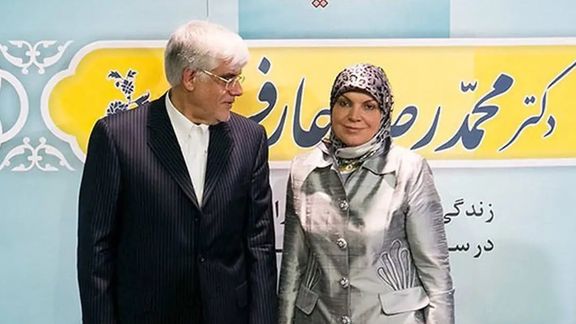
Vice-President Mohammad-Reza Aref and his wife Hamideh Moravvej Farshi

Vice-President Mohammad-Reza Aref has been accused of ‘misogyny’ after saying the Iranian society is not ready to give women leadership roles.

“Our society is not yet psychologically ready for women’s leadership,” Aref remarked in a video clip released by several media outlets during a ceremony bidding farewell to outgoing Women’s and Family Affairs Deputy Ensieh Khazali and introducing her successor, Zahra Behrouz-Azar.

The controversial remark was made in response to Khazali who criticized the reform-oriented Pezeshkian’s government for nominating only one female minister although there had been no female ministers in Ebrahim Raisi’s hardline-dominated government.

Some media and social media users interpreted Aref’s remarks as an excuse not to use more women in the higher echelons of Pezeshkian’s government that was supposed to be more reform oriented. Many also accused him of ‘misogyny”.

A longer version of the speech was later released, which suggested that Aref was actually criticizing the limited role of women in the government, rather than endorsing it. “Look at the indicators of girls versus boys’ academic progress. I’m sure our girls are ahead in most areas,” he stated, adding that the government's ideal is "no discrimination between men and women."

Aref also appeared to be expressing a concern that hardliners may not accept Farzaneh Sadeghi-Malvajerd, Pezeshkian’s only female cabinet nominee. “Let us get a vote of confidence for this one and later use [more women in such posts],” he says in the fuller version.

Sadeghi-Malvajerd, 55, who Pezeshkian has nominated to lead the Ministry of Roads and Construction is currently a deputy minister. In his speech, Aref said those opposed to her appointment ask whether a female roads and construction minister will be required to visit road construction sites.

If approved by the parliament, she will be the second female minister in the more than four-decade-long history of the Islamic Republic where not only politicians but also some influential Shia religious ‘sources of emulation’ strongly oppose giving women leading roles in the government.

Many, including the so-called ‘Islamic feminists’ oppose ‘patriarchal interpretations of Sharia’ which they say prevent women from running for president or female judges from presiding in courts of justice and the unwritten rules that do not allow women to be appointed to positions of power in the government.

Iranian women have also been fighting for decades against highly discriminatory laws, including family and inheritance laws, that are based on Sharia or only Shia tradition.

Some critics such as journalist Elahe Khosravi who believes Aref is oblivious to the Woman, Life, Freedom movement say the Vice-President has unjustly blamed the “society” and accused people of prejudice instead of admitting that it is the ruling establishment that has deprived women of their rights and opposes their progress.

“Aref is right. Our society is not prepared for women’s leadership because we are still stuck with the Islamic Republic and the repugnant absolute rule of the Islamic jurist,” student and women’s rights activist Motahare Goonei tweeted. A woman who demands more than what the “patriarchal system allows” is considered a criminal and punished, she said.

Another critic on X accused Aref of lying about the Iranian society. “Who says the society does not accept women’s leadership? He has put forth a false premise and lied about the people and the society. It would be okay if he said clerics oppose it as the society and people have no objection to women’s leadership.”

During the presidential debates, Pezeshkian criticized hardliners in the parliament of blocking a Rouhani administration bill to stop violence against women, discrimination against women, and harsh enforcement of hijab and promised to use more women in his government.


Most Viewed

100 days after carnage: Iran economy reels from war, inflation, unemployment
1
INSIGHT

100 days after carnage: Iran economy reels from war, inflation, unemployment

2
INSIGHT

Ghalibaf defends Iran-US talks amid hardline backlash

3
EXCLUSIVE

Iranian assaulted in London amid concern over threats to regime critics

4

IRGC fires at Indian vessel in Hormuz

5
INSIGHT

A nation in limbo: 100 days after the massacre, has the world moved on?

Banner
Banner

Spotlight

  • War-hit homeowners feel abandoned as Iran’s reconstruction aid fades

    War-hit homeowners feel abandoned as Iran’s reconstruction aid fades

  • 100 days on: the anatomy of Iran’s January crackdown
    INSIGHT

    100 days on: the anatomy of Iran’s January crackdown

  • Ghalibaf defends Iran-US talks amid hardline backlash
    INSIGHT

    Ghalibaf defends Iran-US talks amid hardline backlash

  • 100 days on: why Iran’s January protests spread across social classes
    ANALYSIS

    100 days on: why Iran’s January protests spread across social classes

  • From instability to influence: Pakistan’s pivotal role in US-Iran diplomacy
    ANALYSIS

    From instability to influence: Pakistan’s pivotal role in US-Iran diplomacy

  • A nation in limbo: 100 days after the massacre, has the world moved on?
    INSIGHT

    A nation in limbo: 100 days after the massacre, has the world moved on?

•
•
•

More Stories

Woman shot by Iran police over hijab paralyzed, family told to stay silent

Aug 15, 2024, 14:16 GMT+1
•
Azadeh Akbari

The family of Arezou Badri, a 31-year-old woman shot by Iran’s police on July 22 for allegedly violating mandatory hijab laws, is under intense government pressure to withdraw their complaint.

Badri, a mother of two, was left paralyzed after the shooting, an incident that has ignited outrage both within Iran and on the international stage.

The family's complaint regarding Badri, who suffered severe spinal cord injuries and remains hospitalized at Valiasr Hospital in Tehran, was heard in a court this week. However, the family remains dissatisfied with the outcome and the judicial process.

Iran International has learned that she underwent another surgery on Wednesday to remove fluid accumulated in her lungs, and her condition remains critical.

According to our sources, the Badri family members have been summoned by intelligence and security agencies, pressured to stay silent, and urged to withdraw their complaint.

Sources revealed that the family, including Badri's sister, is under intense pressure from security agencies to deliver a coerced confession on camera regarding Badri's situation.

The attack on Badri took place when she was stopped at a police checkpoint while returning home with her sister after work in Noor, Mazandaran province.

According to reports and images obtained by Iran International, the police opened fire after stopping the car on a dirt road, striking Badri in the back.

A warrant for the confiscation of Badri's vehicle over an earlier alleged hijab violation led police to open fire from the rear driver's side. Sources told Iran International that Badri was initially taken to a hospital in Noor before being transferred to Imam Khomeini Hospital in Sari. Since then, her family has faced intense pressure from security forces to stay silent about the shooting and her condition.

After several days, plainclothes security officers moved Badri to Tehran for further treatment, where her spinal condition remains critical. During visits, security officers reportedly confiscate the Badri family’s mobile phones to prevent them from taking photos or videos.

The Information Center of the Mazandaran Police Command confirmed the police shooting at the car in which Badri was a passenger, stating that the driver "continued to flee despite police orders, prompting the police to shoot at the car according to the law on the use of firearms."

Sources informed Iran International that despite police claims that Badri’s car had tinted windows, they were down at the time of the incident due to the heat and lack of air conditioning in the vehicle.

Amnesty International on Wednesday called for a thorough investigation into reports that Badri was shot and left paralyzed by police while enforcing compulsory veiling laws in Iran. The organization urged that "those responsible be held to account," highlighting the urgent need to abolish veiling laws and address Iran’s "impunity crisis."

Prominent Iranian activist and journalist Masih Alinejad denounced the attack on Badri, writing on X that "the morality police shot this woman and paralyzed her over a hijab." Alinejad stressed that "regardless of who is president" in Iran, women continue to suffer for simply showing their hair, urging others to "be her voice."

Israeli Foreign Minister Israel Katz also weighed in, describing the attack on Badri as a reflection of Iran’s Supreme Leader Ali Khamenei’s “murderous dictatorship,” which he said oppresses citizens and enforces “radical Islam.”

The incident is reminiscent of previous cases, such as that of Armita Geravand, a 16-year-old who was injured and went into a coma after being attacked by hijab enforcement officers at Tehran's Shohada Metro Station on October 1 of last year. She died on October 27 after 28 days in Fajr Military Hospital.

Similarly, in September 2022, Mahsa Zhina Amini, a 22-year-old woman, fell into a coma after being arrested by Iran’s morality police. Amini was reported dead on September 16 at Kasra Hospital which sparked nationwide protests, leading to the "Woman, Life, Freedom" uprising.

US indicts Iranian American for exporting military components to Iran

Aug 15, 2024, 11:20 GMT+1

The US Justice Department has indicted a 68-year-old Iranian-American for the illegal export of US-manufactured aircraft components, including military-grade parts, to Iran.

Jeffrey Chance Nader was apprehended on Tuesday in California and according to the indictment, he conspired with others to purchase and illegally export nearly three dozen aircraft components from the United States to Iran. Many of the parts are crucial for the operation of military aircraft like the F-4 fighter jet, used by Iran's armed forces.

Assistant Attorney General Matthew G. Olsen of the Justice Department’s National Security Division emphasized the seriousness of the charges, stating, “This action demonstrates the Justice Department’s commitment to keeping military-grade equipment out of the hands of the Iranian regime. We will aggressively investigate, disrupt, and hold accountable criminal networks that supply sensitive technology to hostile and repressive governments in contravention of US sanctions.”

The sentiment was echoed by US Attorney Matthew M. Graves for the District of Columbia, who highlighted the broader implications of Nader’s actions.

“Attacks by Iran and its proxies on US allies in the Middle East and its ongoing supply of Russia with drones and other technology to be used in its illegal war against Ukraine demonstrate why we must do all that we can to stop Iran from acquiring US parts, services, and technology," he said.

The indictment reveals that Nader acted on purchase orders from customers in Iran, using his California-based company, Pro Aero Capital, to falsely present himself as the end-user of the components.

He attempted to ship the parts to the United Arab Emirates (UAE), where they were intended to be transshipped to Iran but were intercepted by US authorities, preventing the items from reaching their intended destination.

The case is part of a broader pattern of US law enforcement targeting networks that attempt to supply Iran with advanced technology. Just last week, the DOJ indicted two Iranians brothers Shahab Mir’kazei and Yunus Mir’kazei and a Pakistani national, Muhammad Pahlawan, for providing material support to Iran’s weapons program.

The US also recently announced a $10 million reward for information leading to the identification or location of six Iranian government hackers responsible for a series of cyberattacks on US water utilities last fall.

They are accused of compromising industrial control systems, specifically targeting the Vision series of programmable logic controllers (PLCs) produced by Israel-based Unitronics. These PLCs are extensively used across various sectors, including water and wastewater management, energy, food and beverage production, manufacturing, and healthcare.

According to a State Department statement, the six individuals, who are associated with Iran’s Islamic Revolutionary Guard Corps (IRGC) and its Cyber-Electronic Command (IRGC-CEC), are being actively sought in connection with the attacks.

Future prisoner swaps between the US and Iran could complicate the long-term impact of such indictments, however. In past instances, high-profile detainees have been released in exchange for some dual nationals held in Iran, raising concerns about the lasting efficacy of such legal actions.

In September, a deal was finalized involving the transfer of $6 billion in Iranian funds—previously held in South Korea—to banks in Doha. As part of the agreement, five Iranians were released from US custody, though three of them opted not to return to Iran.

Among the Americans freed by Iran were Siamak Namazi, who endured nearly eight years in Tehran's notorious Evin prison before his release.

An unknown number of dual-nationals are being held in Iran under trumped-up charges of espionage as the government continues its policy of diplomatic hostage-taking.

Iranians turn to gold and foreign currencies to preserve assets

Aug 15, 2024, 10:50 GMT+1
•
Dalga Khatinoglu

As Iran's economic situation continues to deteriorate and the rial loses value, citizens have increasingly turned to purchasing gold, foreign currency, and moving capital out of the country.

Over the past year, the Iranian rial has lost 20% of its value, and in the past three years under President Ebrahim Raisi, it has plummeted by 60%.

The crisis in the stock and real estate markets has discouraged people from investing in these sectors, leading to the withdrawal of over 1,600 trillion rials ($2.6 billion, based on the current USD rate in open markets) from the stock market over the past three years.

In just the first week of August, approximately 20 trillion rials ($33 million) were withdrawn from the Iranian stock market. The real estate market is also in a severe recession, exacerbated by Iran's chronic electricity shortages in the summer and significant gas deficits in the winter. These energy shortages have particularly impacted the construction sector, with power cuts in cement factories causing cement prices to double and halting construction and housing projects nationwide.

With the worsening economic conditions, particularly in the industrial and construction sectors, citizens are increasingly investing in gold, foreign currencies, or moving their capital abroad to preserve their assets. According to the World Gold Council, Iranian citizens’ purchases of gold coins and bars have surged from 25.5 tons in 2011 to nearly 42 tons in 2022, and 44.4 tons last year. In the first half of this year alone, they have purchased more than 22 tons of gold coins and bars.

Iranian's gold purchase (tons)
100%

On the other hand, data from the Central Bank shows that capital flight from the country has been on an upward trend since the imposition of US sanctions against Iran in 2018, rising from $350 million in 2018 to $15 billion last year. In the first nine months of the last fiscal year (March 2023–January 2024), capital flight reached $20.1 billion, a historical record.

No official reports have been published on Iranians' foreign currency holdings, but it appears that government restrictions on the supply of hard currencies like the euro and US dollar have not deterred people from converting their rial assets into foreign currencies. Despite a government ban on holding more than 10,000 euros or dollars, many citizens feel compelled to convert their rial savings into foreign currencies to protect their wealth.

Lotfollah Siahkali, a member of the Parliament’s Industries Commission, stated last year that Iranian citizens held $60 billion in foreign currency reserves, while the Central Bank's governor cited a much lower figure of $16 billion. This discrepancy suggests that even the government may not have an accurate understanding of the amount of foreign currency held by the public in Iran’s chaotic financial system.

Regardless of the exact figure, the presence of even $16 billion in foreign currency stored in people's homes poses a significant challenge for the Iranian economy, which is already grappling with a liquidity shortage in the industrial and construction sectors. This amount is equivalent to half of Iran’s oil export revenues from last year. If the $60 billion estimate is accurate, it would represent approximately 16% of Iran’s GDP.

The core issue is that Iranians lack trust in the Islamic Republic and its flawed economic policies, making it unlikely that people will reintegrate their foreign currency assets into the country’s economy. It's important to note that these figures represent the savings of a small segment of Iran’s affluent population. According to official statistics, more than half of the population lives below the poverty line, struggling to afford basic necessities.

Meanwhile, the government faces a massive budget deficit each year and is forced to borrow from the Central Bank and other financial institutions, exacerbating liquidity issues and further devaluing the rial. Central Bank data shows that from 2021 to 2023, government debt to the country’s banks has more than doubled, exceeding 13,000 trillion rials ($22 billion). Additionally, the Iranian government owes $100 billion to the National Development Fund. As a result, liquidity has also doubled, and the rial has lost 60% of its value.

Hardline lawmakers poised to block Iran's Reformist ministers

Aug 15, 2024, 09:08 GMT+1

Remarks by media commentators and key Iranian lawmakers indicate that parliamentary opposition is focused primarily on four of the ministers proposed by Iran’s new president Masoud Pezeshkian.

Two reformists on the president’s list; Mohammad Reza Zafarghandi as Miniser of Health and Ahmad Maydari as Minister of Labor, as well as female nominee Farzaneh Sadegh as Minister of Housing and Urban Planning, are likely to face the strongest opposition in the Iranian Parliament (Majlies).

There is also Alireza Kazemi for the Ministry of Education, who is a hardliner but without the minimal credentials needed for the post.

Ahmad Fatemi, a member of the Majles Social Affairs Committee, stated that lawmakers hold a negative view toward Ahmad Maydari and Zafarghandi. He also noted significant opposition to Ms. Sadegh’s nomination but he insisted that the opposition is based on technical matters rather than gender issues. Others have a different opinion and believe hardliners would oppose almost any female candidate.

He added that there is also some opposition to Mohsen Paknejad as oil minister due to his possible links to former centrist oil minister Bijan Zanganeh, but Paknejad has assured the lawmakers that he is not associated with Zanganeh.

Commentator Jahanbakhsh Mohebbinia criticized the qualifications of several proposed ministers, stating that they fall short of the standards expected for cabinet positions and can only be generously described as experts. He accused some nominees of being opportunists who secured their spots through lobbying by Pezeshkian's political rivals, suggesting that their inclusion on Pezeshkian's list raises suspicions.

Journalist Zaynab Ghobishavi noted that, aside from three ministers with reformist backgrounds, the remaining candidates for ministerial posts largely belong to factions best described as Pezeshkian's rivals. Iran International TV's prominent news bulletin, First Title, identified Maydari, Zafarghandi, and Gholamreza Nouri Ghezelche (nominated for the Ministry of Agriculture) as the only "reformists" on Pezeshkian's list.

Although Intelligence Minister nominee Esmail Khatib and Interior Minister nominee Eskandar Momeni are facing the most serious criticism from the press and public, Mohebbinia stated that both are unlikely to encounter any issues in securing a vote of confidence from the Majles.

Massoud Zehabioun, a member of the task force to propose candidates to the president has said that despite parliamentary opposition to Ms. Sadegh's nomination as roads minister, she is in a better position in terms of her educational credentials and work experience than the two previous road ministers. She has studied Urban Planning and has a long experience in working as a Deputy Minister of Roads and Urban Planning.

If Sadegh secures the Majles' vote of confidence, she will become the second woman to hold a ministerial position in the Islamic Republic. The first was Marziyeh Vahid Dastgerdi, who served as Health Minister in President Ahmadinejad's cabinet.

Zehabioun emphasized that Sadegh's nomination should be evaluated based on her expertise rather than any bias against female officials. Meanwhile, Sobhan Nazari, a transportation activist, praised Ms. Sadegh's career progression, attributing it to her expertise and sound decision-making.

Teachers Trade Union activist Ali Poursoleiman has characterized Alireza Kazemi criticized Alireza Kazemi, labeling him as "a dogmatic, inefficient, and unsuccessful manager." He urged Pezeshkian to reconsider Kazemi's nomination to protect his own public reputation. Poursoleiman also recommended that Pezeshkian appoint a woman as Minister of Education to demonstrate his commitment to gender equality.

Iranian journalist Leila Farhadi wrote that the inclusion of Kazemi on Pezeshkian's list was both controversial and surprising to observers. She added that Kazemi's plans for the ministry's future appear to be merely a rehash of documents previously presented to the Majles by former ministers.

Iranians question new ministers' competence and record

Aug 14, 2024, 20:10 GMT+1

Amid widespread criticism from the media and public regarding the composition of his cabinet, President Masoud Pezeshkian has urged the nation to withhold judgment and evaluate the cabinet based on its future performance.

Ham Mihan newspaper which supports Pezeshkian wrote on Tuesday that the combination of the cabinet eliminates any hope for change in Iran.

Sunni leader Molana Abdolhamid said that the list of Pezeshkian’s ministers has disappointed the people. Abdolhamid also wrote that not including religious and ethnic groups in the cabinet leads to disappointment and prevents national accord.

Earlier, many journalists and social media activists criticized Pezeshkian’s choices and expressed the belief that this cabinet is likely to be short-lived.

The centrist Entekhab website has quoted President Pezeshkian as saying that he and his aides have made every effort to select the most suitable candidates from the available pool.

However, critics have already expressed concerns about the appointment of Intelligence Minister Esmail Khatib, a leftover from the previous administration and other military officials appointed to ministerial posts.

Senior Iran International analyst Morad Veisi said that the choice of ministers has proved three things: First, that the majority of people who refused to vote in the election and believed that voting will not change anything were right. Second, even the reformists who encouraged others to vote have now realized that voting has not changed anything in Iran. And third, it proved that the main problem in Iran is the system and the fact that Supreme Leader Ali Khamenei controls everything.

Veisi argues that potential voters have come to realize that even changing presidents won't bring any significant change as long as Khamenei holds power. The selection of candidates in Pezeshkian's cabinet, according to Veisi, proves that the election has brought no real change.

For instance, the appointment of IRGC General Eskandar Momeni as Interior Minister suggests that the government's stance on suppressing protests and enforcing the compulsory hijab will remain unchanged. Veisi notes that Momeni's role, which includes heading the National Security Council and overseeing provincial security, will continue to be dominated by IRGC influence, just as it was under the previous administration, where key security positions were also held by IRGC generals.

Momeni's background as Iran's deputy police chief and a senior commander of the Special Forces, responsible for quelling dissent, further indicates a continuation of hardline tactics. Additionally, Veisi highlights that Momeni previously commanded the Morality Police, the main force enforcing the hijab mandate, signaling that the repressive measures against women who defy this law are unlikely to change.

"This comes after Pezeshkian had pledged during his campaign to relax the compulsory hijab rules and ease restrictions on Iranians' access to the Internet, particularly social media. Meanwhile, as debates and criticisms about the new cabinet continue, the previous cabinet remains in place. On Monday, incumbent Culture Minister Mohammad Mehdi Esmaili announced that his ministry has finalized a document to regulate movie supervision. In essence, Esmaili's statement suggests a further tightening of censorship in Iran, allowing the outgoing government to implement these measures without the new administration being held accountable."

These two examples justify the concern that is being expressed by many Iranians, particularly on social media about their fears of further repression on social activism and freedom of expression in Iran. Instead of addressing the concerns, Pezeshkian wants Iranians to wait for another four years and then judge the cabinet based on their performance, mindless of the fact that nearly all of the proposed cabinet members have already a track record of inefficiency as ministers, deputy ministers and state officials. A few have also a record of having been implicated in financial corruption cases and this leaves little hope in the future for many Iranians.