• العربية
  • فارسی
Brand
  • Iran Insight
  • Politics
  • Economy
  • Analysis
  • Special Report
  • Opinion
  • Podcast
  • Iran Insight
  • Politics
  • Economy
  • Analysis
  • Special Report
  • Opinion
  • Podcast
  • Theme
  • Language
    • العربية
    • فارسی
  • Iran Insight
  • Politics
  • Economy
  • Analysis
  • Special Report
  • Opinion
  • Podcast
All rights reserved for Volant Media UK Limited
volant media logo

Military officials converge amid looming Iranian threat to Israel
Aug 5, 2024, 17:07 GMT+1Updated: 16:13 GMT+0
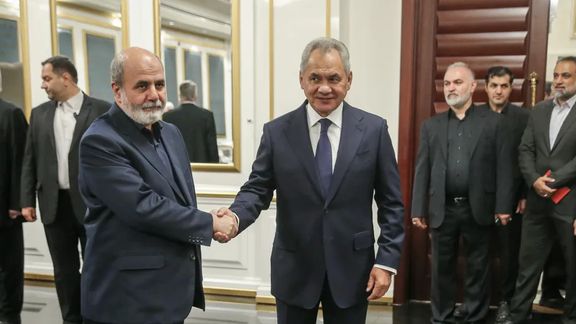
Sergei Shoigu, (R) the Secretary of Russia's National Security Council, arrived in Tehran on Monday, August 5, 2024, and was received by his Iranian counterpart Ali Akbar Ahmadian (L) amid escalating tensions between Iran and Israel.

As tensions escalate in the Middle East, high-ranking military officials from the United States and Russia have converged in the region for emergency planning.

The catalyst for the urgent visits appears to be the looming threat of an Iranian attack on Israel, predicted to occur 'imminently', according to US intelligence.

A high-ranking Russian delegation led by Sergei Shoigu, the Secretary of Russia's National Security Council, arrived in Tehran. The purpose of the visit, according to the Secretariat of the Supreme National Security Council of Iran, is to strengthen political and security ties and to discuss regional and international issues. However, the timing of Shoigu's arrival coincided with heightened military preparations and international concern.

Meanwhile, Michael Erik Kurilla, the commander of the United States Central Command (CENTCOM), arrived in Israel on Saturday. Although a US official stated that Kurilla's trip was planned before the recent surge in tensions, it is now expected to serve as a crucial opportunity to bolster the international coalition defending Israel.

Earlier, Pentagon spokesman Pat Ryder announced that US Secretary of Defense Lloyd J. Austin discussed regional tensions with Israeli Defense Minister Yoav Gallant on Sunday.

On Monday, US Secretary of State Anthony Blinken and his Qatari counterpart Mohammed bin Abdulrahman Al Thani spoke on the phone to discuss the possible attacks by Iran and Hezbollah against Israel, stressing the need for de-escalation, according to Axios journalist Barak Ravid.

French President Emmanuel Macron said he has spoken with UAE President and Saudi Crown Prince on the situation.

"We call on all stakeholders to show responsibility and restraint to avoid a regional conflagration. No one has any interest in escalation," he said.

During a visit to the underground command center of the Israeli Air Force, Israeli Defense Minister Yoav Gallant highlighted the country's readiness to transition swiftly to offensive operations if necessary.

"Our enemies are carefully considering their every move because of the capabilities you have demonstrated over the past year. Nevertheless, we must be prepared for anything – including a swift transition to offense," he said.

Several countries have advised citizens to leave Lebanon and Iran. The situation has led to airlines, including Lufthansa, Delta, and others, suspending flights to the region due to the escalating risks.

In Lebanon, the World Health Organization has delivered 32 tons of medical supplies in anticipation of potential war casualties, reflecting the increasing likelihood of a broader conflict involving Hezbollah and Israel.

Workers unload medical supplies delivered by the World Health Organization for any potential health crisis resulting from hostilities, in Beirut, Lebanon, August 5, 2024.
100%
Workers unload medical supplies delivered by the World Health Organization for any potential health crisis resulting from hostilities, in Beirut, Lebanon, August 5, 2024.

"The goal is to get these supplies and medicines to various hospitals and to the health sector in Lebanon, especially in the places most exposed (to hostilities) so that we can be ready to deal with any emergency," Lebanon’s Health Minister Firass Abiad told reporters at the airport landing strip where the aid arrived.

Meanwhile, Beirut airport has seen a surge in people attempting to leave the country, indicating widespread fear of an impending full-scale war.

Iranian officials have at the same time continued their inflammatory rhetoric. On Monday, Ali Bagheri Kani, the Acting Foreign Minister of Iran, held a meeting with Khaled Qaddoumi, the representative of the Hamas movement in Tehran. The visit, part of a broader consultation with various ambassadors and foreign mission heads in Tehran, underscores Iran's intention to launch the attack very soon.

Kani emphasized the “moral imperative” to oppose what he described as the "occupation of Palestinian land and the genocide of a nation," framing the situation as one where indifference and appeasement would only “enable further evil.”

Speaking to his Bahraini counterpart, Bagheri Kani said Iran would be "rewarding" Israel if it remains silent following the killing of Ismail Haniyeh. "Therefore, the Islamic Republic considers reciprocal action to be its right, based on international rules and norms," he said.

Hossein Salami, commander-in-chief of the Islamic Revolutionary Guard Corps, criticized Israel's recent actions, calling for a harsh response to what he termed as an Israeli mistake.

"If the Israelis receive a firm response, they will understand that killing Haniyeh was a mistake… The Israelis are constantly making calculation errors, and they have repeated this mistake once again," he said.

Iranian Foreign Ministry spokesman Nasser Kanaani also underscored Iran's determination to retaliate, emphasizing that no external messages were needed to justify their actions.

Backed by the US and an international coalition, Israel braces for a potential Iranian assault, similar to that created in the face of the April 13 bombardment towards Israel. At the time, most of the 350 projectiles were intercepted.


Most Viewed

100 days after carnage: Iran economy reels from war, inflation, unemployment
1
INSIGHT

100 days after carnage: Iran economy reels from war, inflation, unemployment

2
INSIGHT

Ghalibaf defends Iran-US talks amid hardline backlash

3
INSIGHT

A nation in limbo: 100 days after the massacre, has the world moved on?

4
ANALYSIS

From instability to influence: Pakistan’s pivotal role in US-Iran diplomacy

5
ANALYSIS

100 days on: why Iran’s January protests spread across social classes

Banner
Banner

Spotlight

  • War-hit homeowners feel abandoned as Iran’s reconstruction aid fades

    War-hit homeowners feel abandoned as Iran’s reconstruction aid fades

  • 100 days on: the anatomy of Iran’s January crackdown
    INSIGHT

    100 days on: the anatomy of Iran’s January crackdown

  • Ghalibaf defends Iran-US talks amid hardline backlash
    INSIGHT

    Ghalibaf defends Iran-US talks amid hardline backlash

  • 100 days on: why Iran’s January protests spread across social classes
    ANALYSIS

    100 days on: why Iran’s January protests spread across social classes

  • From instability to influence: Pakistan’s pivotal role in US-Iran diplomacy
    ANALYSIS

    From instability to influence: Pakistan’s pivotal role in US-Iran diplomacy

  • A nation in limbo: 100 days after the massacre, has the world moved on?
    INSIGHT

    A nation in limbo: 100 days after the massacre, has the world moved on?

•
•
•

More Stories

Iran's executes at least 300 in first half of 2024 with 49 in July alone

Aug 5, 2024, 17:01 GMT+1

At least 300 people were executed in Iran in the first seven months of 2024 following a record number of killings in 2023.

A significant increase in executions was noted in July, with 49 people executed, according to a new report by Norway-based Iran Human Rights Organization (IHRNGO) on Saturday.

Thirty-six people were executed in just the last 11 days of the month.

The surge follows a period of relative decline after the death of President Raisi and the presidential elections from May 19 to July 5.

The organization's 15-year statistical analysis shows a consistent decline in executions in the weeks leading up to elections, believed to be a tactic to boost voter turnout.

Mahmood Amiry-Moghaddam, the director of IHRNGO, expressed grave concern over a new wave of executions targeting activists from Iran’s ethnic minority communities and prisoners sentenced to death on drug-related offenses.

"We are particularly worried about the new wave of executions of Kurdish civil activists and drug death row prisoners in the coming weeks and months," Amiry-Moghaddam said.

Five of the 300 executed this year were accused of spying for Israel, and five were Kurdish-Sunni political prisoners.

Of those executed on espionage charges this year with links to Israel as alleged by Iran’s judiciary this year included Pejman Fatehi, Mohsen Mazloum, Mohammad (Hazhir) Faramarzi and Wafa Azarbar, who were executed in Ghezel Hesar Prison in Karaj, west of Tehran in January.

Their execution caused widespread global condemnation with rights groups arguing their execution was based on confessions obtained under torture and without a fair trial.

Out of the total executions in Iran so far this year, 20.67 percent were from ethnic minorities, with 14 percent being Baluch (42 individuals) and 6.67 percent Kurdish (20 individuals). Additionally, 6.67 percent of the executed were Afghan nationals (20 individuals).

The report highlights that 172 of these executions were for drug-related offenses. At least 15 women were executed with ten hanged for drug-related offences.

Executions for drug-related charges have risen annually since 2021, though there was a 20 percent decrease in the first seven months of 2024 compared to the same period last year.

According to Amnesty International, Iran carried out 853 executions in 2023, marking the highest number in eight years. Amnesty International noted that 64 percent of the executions in 2023 were for crimes that did not warrant the death penalty under international law, including drug-related offences, robbery, and espionage​.

Iranians criticize government for expenditures on pilgrimage

Aug 5, 2024, 15:17 GMT+1
•
Maryam Sinaiee

The government of President Masoud Pezeshkian is under fire for continuing to allocate huge sums to support the ‘Arbaeen Walk’ to Iraqi holy cities and offering perks to the annual event's participants.

The Arbaeen ceremony, marking the end of the 40-day mourning period following Ashura—the religious ritual commemorating the third Shia Imam, Hussain ibn Ali, grandson of Prophet Muhammad, who was killed in 680 AD—is one of the world's largest annual gatherings. Iranian officials say that around four million people travel to Iraq for the event.

Criticism was sparked by the announcement that the newly appointed Vice-President Mohammadreza Aref had ordered 4 trillion rials (around $650,000) to support the event which culminates with ceremonies in the Iraqi cities of Karbala and Najaf on August 25 this year.

The money will be spent to "prevent unforeseen incidents, contagious diseases, and heat strokes at border points and along the pilgrimage path.”

“Why? Arbaeen was not this government’s promised concern. Leave Arbaeen to the people,” Mohammad-Taghi Fazel-Meybodi, a reformist cleric, posted on X, arguing that the “justice” promised by Pezeshkian and his government would be allocating the budget for the education of children in Sistan and Baluchestan province where many children are deprived of an education.

Pilgrims are offered free food along the way
100%
Pilgrims are offered free food along the way

In a tweet Sunday, Iranian journalist Fateme Karimkhan contended that the negative reactions to the expenditure were unfounded. “More than four million Iranians will participate in the Arbaeen Walk and the government would have been responsible to make plans for their protection even if they were to take a domestic route,” she argued.

Most Iranian pilgrims travel to the border, where free parking facilities are provided, and take the walk to the cities of Najaf and Karbala from there while some others fly directly to these cities.

The Islamic Republic has made extensive plans and allocated huge sums in the past decade to encourage and fund the annual event as a show of Shia political power and influence.

Hossein Tayebifar, Acting Representative of Supreme Ali Khamenei in the Revolutionary Guards (IRGC), said on July 28 that the event was “the biggest deterrent operation in the world against the conspiracies of the enemies of Islam.” Some officials and clerics say the Arbaeen gathering is one of the manifestations of the Shia “soft power’.

The cost to the public includes massive budgets for infrastructure works such as building and maintenance of roads and service stations as well as provision food, water and field and mobile hospitals along the main routes and in Iraq, and mobilization of the Revolutionary Guards (IRGC), the regular army and other bodies to provide the security of the event, and state propaganda.

Iranian pilgrims waiting at Mehran border to enter Iraq
100%
Iranian pilgrims waiting at Mehran border to enter Iraq

The government also allocates Iraqi currency at cheaper rates and no-interest loans to pilgrims to encourage more people to participate. As in the past few years, the government will sell 200,000 Iraqi dinars (around $120 at open market rates) to pilgrims at the discounted rate of 370 rials to the dinar against 450 rials in the open market.

Many government organizations, municipalities, and city councils separately allocate special budgets for the event. The City Council of Mashhad, for instance, approved a budget of 150 billion rials ($5 million) for services in the Iraqi holy city of Najaf in 2023 and dispatched over 500 city cleaners and 350 bus drivers there.

Other perks include ‘pilgrimage leave’ for civil servants and free internet and roaming mobile services during the event.

If four million or more participate in the event as predicted, the discount in foreign currency rates and the loans could cost the government hundreds of millions of dollars or more depending on the number of participants.

It was also revealed last week that the Ministry of Labor and Social Affairs had ordered various government agencies as well as the government retirement fund to contribute to the costs of holding the procession.

“I declare it here that I’m not happy with using the assets of the retirement fund, even as much of as one rial, for anything other than what the funds were established for,” a retired teacher posted on X. Others have pointed out that those who benefit from the perks of Arbaeen should be mindful that any money taken from the fund without their consent will be ‘haram’ - or religiously forbidden.

President Pezeshkian has also ordered all government bodies involved in the matter to abide by their commitments but has also suggested that his government wants to minimize its own role in holding the event.

“We can increase people’s participation [in supporting the event] and the government will withdraw as much as possible ... Where people cannot help, the government should assist and support them. There is no reason for the government to get involved and create more problems where people can help,” he said Saturday at a meeting of the ‘Arbaeen Taskforce’ formed a few years ago of which the vice president and several ministers are members.

Joining FATF won't solve Iran's problems, says Chamber of Commerce chief

Aug 5, 2024, 13:18 GMT+1

Despite discussions around Iran's potential accession to the Financial Action Task Force (FATF), the country must do more to attract foreign investment, the head of the country's chamber of commerce has said.

The Secretary-General of the Iranian Committee of the International Chamber of Commerce (ICC), Mohammad Khazaei, emphasized that Iran's performance in luring foreign investors has been lackluster, and the statistics on foreign investment currently publicized may not be accurate.

In recent years, Iran has been placed on the financial watchdog's 'blacklist' for failing to comply with transparency standards and international conventions aimed at preventing money laundering and the financing of terrorism.

In an interview with an ILNA, Khazaei highlighted that while the quality of financial transfers through banking networks, and issues such as FATF and SWIFT, are significant, they are not the only barriers to foreign investment in Iran.

He noted that Iranian traders often express frustration over difficulties in financial transactions or their inability to receive funds from international banks, forcing them to use exchange offices instead.

FATF identifies problematic and high risk countries in terms of financial dealings. It lists countries, “with serious strategic deficiencies to counter money laundering, terrorist financing, and financing of proliferation".

Khazaei explained, "However, issues like FATF, SWIFT, and banking transactions are just one aspect of foreign investment. In attracting foreign investors, various other factors must also be considered and addressed, such as the security of the political environment, judicial and legal security, guarantees provided by governments and investees to foreign investors, and ensuring the return of the principal investment and its profit."

The Financial Action Task Force (FATF) is an international organization established by the G7 member countries to safeguard the international financial system. Its recommendations influence banking policies in most countries and guide businesses aiming to protect their own integrity and reputations. Consequently, Iran's status on the FATF blacklist has had a significant negative impact on its international banking operations.

He pointed out that even if Iran resolves its issues with FATF, it does not guarantee a surge in foreign investments, as other critical obstacles remain. For instance, previous foreign investments in Iran's renewable energy sector have faced challenges. Khazaei recounted instances where the Central Bank of Iran failed to provide the necessary foreign currency to pay agreed profits to investors, or where the national electricity company, Tavanir, could not pay for purchased electricity, highlighting domestic inefficiencies as major deterrents to foreign investment.

The former head of the Investment and Technical and Economic Assistance Organization of Iran stressed the importance of fulfilling commitments to attract foreign investment. "Fulfilling commitments in attracting foreign investment is crucial, and in this regard, the government must implement the guarantees given to foreign investors. One guarantee is that the investor should be able to convert and transfer their profits out of the country," Khazaei stated.

He also emphasized the need for stable laws, political security, social security, and stable exchange rates to attract investment.

Mehdi Hosseini, an energy expert, echoed similar sentiments in another interview with ILNA, critiquing Iran's current diplomatic stance. He argued that Iran's focus should not be exclusively on either the West or the East but should instead maintain a balanced approach.

Iran, under the rule of Ali Khamenei, a staunch anti-West cleric, has strengthened its ties with Russia, providing drones and possibly other weapons for Moscow's war against Ukraine. Additionally, Iran has been attempting to expand economic relations with China; however, Beijing has approached these efforts cautiously due to American economic sanctions on Iran.

The Biden administration, along with European powers, has expressed deep concern over Iran's expanding military ties with Russia. They have stated that any resumption of nuclear talks with Tehran is contingent upon Iran altering its policy of supplying weapons to Moscow in its war on Ukraine.

Hosseini highlighted Russia's weak economy and expressed doubt if Iran can benefit anything by close economic ties with Moscow. He pointed out that despite Iran's attempts to engage with China, no significant investments have materialized, largely due to China's cautious stance given US sanctions on Iran.

Hosseini questioned the efficacy of Iran's current foreign policy, stating, "In all these long years with numerous resolutions passed against us at the UN, where have China and Russia been? Have they vetoed the resolutions?"

He suggested that Iran needs to reassess its policy and strive for a balanced relationship between East and West to effectively attract foreign investment and secure economic growth.

He said that focusing solely on the East, especially Russia and China, is "an unbalanced policy that makes us dependent on countries from which we gain nothing, even if they have positive intentions".

Iranian voices call for security probe and overhaul after Haniyeh's killing

Aug 5, 2024, 10:48 GMT+1

Some Tehran media and politicians continue to demand answers over security lapses that allowed the assassination of Hamas leader Ismail Haniyeh in a government guesthouse in Tehran last week.

While many Iranian officials and politicians call for a strong retaliation against Israel for Haniyeh’s brazen killing by an explosive projectile while he was sleeping, a few insiders insist that the priority should be to understand how such an operation was possible.

One of these voices is an influential commentator and former senior lawmaker Heshmatollah Falahatpisheh who spoke to Etemad newspaper.

"The most important scenario to consider regarding the assassination of Haniyeh is the scenario of infiltration. This issue needs to be carefully analyzed and evaluated. I hope that the scenarios being presented by some experts on state television and in certain radical media outlets are not being used as an excuse to avoid accountability," Falahatpisheh said.

He is one of a dozen or so commentators allowed to often speak out on government-controlled media about sensitive issues. He often voices opinions critical of some government policies, including its foreign policy.

Iranian politician and commentator Heshmatoolah Falahatpisheh. Undated
100%
Iranian politician and commentator Heshmatoolah Falahatpisheh

Iranian security and intelligence officials remained largely silent in the first three days after the assassination about the exact circumstances and what kind of weapon was used. This led to plenty of speculation both in the Iranian and foreign media. The New York Times went as far as claiming that a bomb placed in the guesthouse two month earlier killed Haniyeh, not any projectile fired from the air or the ground.

Finally, on Saturday, the Revolutionary Guard issued a statement rejecting this scenario and announcing that Haniyeh was killed by a small and short range projectile fired from the vicinity of the compound.

However, criticism of security and intelligence agencies continue. Javad Emam, a politician from the Reform Front in a tweet asked President Pezeshkian to act. "The assassination and martyrdom of Ismail Haniyeh on Iranian soil was a warning about the incompetence and inefficiency of certain parts of the country's intelligence and security apparatus."

Emam urged Pezeshkian to make personnel and other changes.

"First, take action to reorganize the intelligence and security forces, and if necessary, reselect them.

Second, where possible, and not in a rushed manner, work towards merging parallel intelligence agencies to prevent further costs to the country due to lack of coordination and the actions of inexperienced personnel.

Third, by establishing truth-finding committees and punishing those at fault, and following the example of several important national cases, work to restore a sense of security in society,” he argued.

Falahatpisheh, in turn, mocked statements by officials who periodically claim they have demolished enemy networks within the country. One such statement by the intelligence minister was made just days before the Haniyeh incident.

"A while ago, one of the officials openly stated that they had uncovered and neutralized all areas of Zionist infiltration in the country. However, incidents like the assassination of Martyr Haniyeh show that there are still specific security vulnerabilities that need to be addressed urgently. Addressing these gaps and deficiencies should be one of the key priorities for the new administration," the former lawmaker stated.

Despite these calls for a serious investigation and holding security officials responsible for the failure to protect a high-level foreign guest, so far there is no sign of action. What occupies most headlines in Iran is the issue of a retaliatory attack against Israel.

Young and female Iranians excluded in male-dominated, aging government

Aug 5, 2024, 07:15 GMT+1

The appointments of Mohammad Reza Aref, Mohammad Javad Zarif, and Mohammad Jafar Ghaempanah, all in their 60s and 70s, to senior roles by President Masoud Pezeshkian have sparked debates about the age gap between Iran's leadership and its younger population.

Aref (74) was appointed as Iran's senior vice president, Zarif (64) as deputy for strategic affairs, and Ghaempanah, who is in his 60s, as vice president for executive affairs.

According to the latest figures available, Iranian between the ages of 20-39 comprise 31 million people, or more than one third of the population. Also, A 2020 study also showed that those between 25 to 40 years old comprised the largest part of the population.

Last week, when the first partial list of President Pezeshkian's proposed cabinet ministers was leaked to the press, critics noted that the average age of a majority of his potential cabinet ministers was higher than 62.

In a commentary on the Etemad Online website, pro-reform commentator Abbas Abdi wrote that the Iranian society is young and its male and female members are pluralist with a diversity of attitudes while those in top posts in the government are generally old males who share a single attitude on most issues.

In the commentary headlined "A young and diverse society and old and monolithic government," Abdi wrote that most Iranian managers are conservatives. However, he noted that hardline conservatives in the previous government were generally younger than officials in the governments formed before 2021.

He further noted that women have always had a very small share of government positions in Iran and men who did not subscribe to the official ideology were almost non-existent in the government.

Abdi recalled a debate about the lack of women university chancellors in Iran, despite women making up more than half of the students and 10 percent of the faculty. Someone argued that the issue wasn't simply gender discrimination. But Abdi questioned whether all the men in those positions truly deserved their roles based on merit. He concluded that we can only address gender discrimination if we can confidently say that all of those men earned their positions fairly.

Abdi, a member of Pezeshkian’s steering committee tasked with assessing politicians' qualifications for ministerial posts, added that more than 80 percent of candidates know in advance that they are not "qualified" for these roles due to restrictive criteria. Of the remaining 20 percent, half are uninterested in serving as cabinet ministers because they realize they won't be able to fully utilize their capabilities. This leaves only 10 percent of candidates, a number that shrinks to less than 5 percent when the names are submitted to parliament for a vote of confidence.

What Abdi did not say openly is the fact that regime insiders dominate government posts and ideological as well as political loyalty severely restrict the field of potential candidates.

"This is a catastrophic way of treating the country's human resources," Abdi said, noting that this approach has its most damaging impact on Iranian youth. Women and those who hold views different from the official ideology are also affected, effectively barred from meaningful participation in the country's affairs, and often driven to leave the country.

According to the pro-hardliners Hamshahri daily, the Raisi Administration was Iran's youngest government with an average age of 43 that was at least 10 years younger than its predecessor, the Rouhani Administration. However, the Raisi government was stacked with ambitious hardliners who mostly did not have qualifications for top government positions.

Zarif had promised to keep most cabinet ministers under 50, but the names circulating in unverified reports—such as Abdolnaser Hemmati (proposed Economy Minister), Es'haq Jahangiri (proposed Oil Minister), and Hossein Alai (proposed Industry Minister)—are all in their late 60s or mid-70s.