• العربية
  • فارسی
Brand
  • Iran Insight
  • Politics
  • Economy
  • Analysis
  • Special Report
  • Opinion
  • Podcast
  • Iran Insight
  • Politics
  • Economy
  • Analysis
  • Special Report
  • Opinion
  • Podcast
  • Theme
  • Language
    • العربية
    • فارسی
  • Iran Insight
  • Politics
  • Economy
  • Analysis
  • Special Report
  • Opinion
  • Podcast
All rights reserved for Volant Media UK Limited
volant media logo

Iran's president-elect reaffirms support for Hamas, Houthis
Jul 14, 2024, 19:50 GMT+1
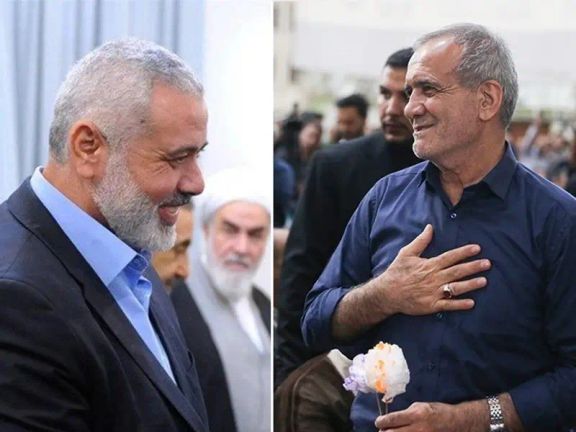
Iran's President-elect Masoud Pezeshkian (R) and Hamas leader Ismail Haniyeh (L)

Iran's President-elect Masoud Pezeshkian on Sunday reiterated the Islamic Republic's support for the Palestinian Hamas militant group as well as Yemen's Tehran-backed Houthis.

While Pezeshkian has not identified himself as a reformist nor has he officially aligned with any reformist factions, Western media has recently portrayed him as a "reformist" or "moderate." However, his actions and statements since his election victory align with the policies set by Khamenei, including supporting the anti-Israel "Resistance Front."

In a phone conversation with Hamas chief Ismail Haniyeh on Sunday, Pezeshkian said the Islamic Republic will never leave the Palestinian nation alone in these difficult times."

This was their first phone call following Israel's Saturday strike targeting Hamas military chief Mohammed Deif.

Pezeshkian had earlier on Wednesday reiterated Tehran's support for its proxy groups fighting Israel, a move that once again signals Iran's major policies are dictated by Khamenei, leaving presidents with little room for change.

Similar sentiments were conveyed to Syrian President Bashar al-Assad and Hezbollah Secretary General Hassan Nasrallah, demonstrating Pezeshkian's commitment to the so-called Axis of Resistance.

Praise for Houthis amid ship attacks

In a separate call with Houthi military leader Mahdi al-Mashat on Sunday, Pezeshkian said the "people of Iran and free nations appreciate the actions of the Yemenis under the current difficult circumstances." He also expressed hope for expansion of relations between the two sides.

Iran has been arming, training, and funding the Houthi militia, which have been launching attacks against commercial vessels since the beginning of Israel-Hamas war in Gaza Strip last year.

Over 60 targeted attacks on vessels, along with missile and drone launches, have resulted in the deaths of four sailors and the kidnapping of dozens. These attacks followed a call from Iran’s Supreme Leader Ali Khamenei for Muslim nations to blockade Israeli trade.

In his phone call with al-Mashat, the Iranian president-elect criticized certain Muslim countries for acting “based on their own interests and merely issue statements" in the wake of Israel's war on Gaza.

“Naturally, free nations will judge those rulers who have not taken action to stop the crimes of the Zionist regime against the Palestinian people," he said.

The comments echo similar statements by Khamenei who has criticized other Islamic countries for not severing all relations with Israel and "being soft" on the Jewish state.


Most Viewed

Ideology may be fading in Iran, but not in Kashmir's ‘Mini Iran'
1
INSIGHT

Ideology may be fading in Iran, but not in Kashmir's ‘Mini Iran'

2
INSIGHT

Hardliners push Hormuz ‘red line’ as US blockade tests Iran’s leverage

3
VOICES FROM IRAN

Hope and anger in Iran as fragile ceasefire persists

4

Iran International says it won’t be silenced after London arson attack

5

US sanctions oil network tied to Iranian tycoon Shamkhani

Banner
Banner

Spotlight

  • Hardliners push Hormuz ‘red line’ as US blockade tests Iran’s leverage
    INSIGHT

    Hardliners push Hormuz ‘red line’ as US blockade tests Iran’s leverage

  • Ideology may be fading in Iran, but not in Kashmir's ‘Mini Iran'
    INSIGHT

    Ideology may be fading in Iran, but not in Kashmir's ‘Mini Iran'

  • War damage amounts to $3,000 per Iranian, with blockade set to add to losses
    INSIGHT

    War damage amounts to $3,000 per Iranian, with blockade set to add to losses

  • Why the $100 billion Hormuz toll revenue is a myth
    ANALYSIS

    Why the $100 billion Hormuz toll revenue is a myth

  • US blockade targets Iran oil boom amid regional disruption
    ANALYSIS

    US blockade targets Iran oil boom amid regional disruption

  • Iran's digital economy battered by prolonged blackout
    INSIGHT

    Iran's digital economy battered by prolonged blackout

•
•
•

More Stories

Iran’s exiled prince urges UK to list IRGC as terrorist organization

Jul 14, 2024, 16:10 GMT+1

Iran’s exiled Prince Reza Pahlavi called on the new British government to classify the Islamic Revolutionary Guard Corps (IRGC) as a terrorist organization, arguing that the proscription will boost democrats in Iran.

The IRGC is currently designated as a terrorist group by the United States, Bahrain, Canada, Israel, Saudi Arabia, and Sweden. The European Union is also considering a similar listing based on an initiative by Germany. The UK has sanctioned the IRGC “in its entirety,” yet London has not declared it a terrorist organization.

In an article published in The Telegraph, Iran's exiled prince emphasized that the IRGC has a long history of exporting “radical revolution,” including hostage-taking, assassination attempts, and terrorist attacks, which have also impacted Britain. He praised Canada’s recent decision to list the IRGC as a terrorist group and called on Britain to lead Europe in taking similar action.

Highlighting the IRGC's involvement in funding and supporting terrorist activities by groups like Hamas, Hezbollah, and the Houthis, as well as its support for Russia's invasion of Ukraine, Pahlavi argued that the evidence against the IRGC is “unequivocal.” He also condemned the IRGC’s repression of the Woman, Life, Freedom movement in Iran.

The former UK government, led by the Conservative prime minister Rishi Sunak, had considered proscribing the IRGC but decided against it on a number of occasions, arguing that listing the IRGC as a terrorist organization would hinder diplomatic dialogue with Tehran.

The Iranian prince dismissed the Sunak administration's stance, asserting that decades of appeasement have only emboldened them.

Pahlavi's plea comes amid political shifts in Iran, following the death of former President Ebrahim Raisi in a helicopter crash and the rise of Masoud Pezeshkian as his successor.

In his article, Pahlavi warned against viewing Pezeshkian as a reformist, describing him as a staunch supporter of the Supreme Leader and the Islamic Republic’s hardline policies.

“The Islamic regime is rattled, weak, and desperate. This is why they have allowed a so-called ‘reformer’ to win the presidency. He is a fig leaf. Western democracies should not fall for this political maneuver,” the prince said.

He also stressed the need for Western nations to support the Iranian people's desire for democracy and freedom, urging them to increase pressure on the Islamic Republic rather than easing it.

The prince called for a policy of maximum support for the Iranian people's fight for democracy, akin to the policies that helped end apartheid in South Africa and communist regimes in Eastern Europe.

Pahlavi concluded by envisioning a democratic, secular Iran at peace with its neighbors and contributing to regional prosperity, urging Britain to take the first step by listing the IRGC as a terrorist organization.

Last month, a report by The Telegraph said the UK’s Labour Party intends to proscribe Iran’s Revolutionary Guard as a terrorist entity, if it wins the general election.

The leading figures in the Labour Party do not share the Conservatives' hesitation and would be willing to back a change in the law that would allow for the IRGC’s proscription.

Proscribing the IRGC as a terrorist group would mean it would become a criminal offence in Britain to belong to the group, attend its meetings or carry its logo in public. The IRGC is already subject to British sanctions.

Iranian pediatrician dies amid medic suicide crisis

Jul 14, 2024, 14:19 GMT+1

An Iranian pediatrician has taken her own life in Yazd, central Iran, amid a growing suicide crisis within the nation's medical community.

Dr Noor Foroughi Nasab was a resident of the pediatric department of Shahid Sadoughi Hospital and the mother of a young child. "The deceased had a history of suicide and the relevant authorities were aware of her condition," said Mohammadreza Asadi, a member of the board of directors of Iran's Medical Council (IRIMC), according to KhabarOnline.

Recent figures provided by Tejarat News, a non-independent news outlet, indicate that a doctor has taken their own life approximately every 10 days since the beginning of the Persian New Year in late March this year.

Experts have attributed the increased suicides in Iran to the systemic reluctance and neglect of Iranian authorities to address workers' conditions.

As pay and working conditions worsen in Iran, reports reveal a 200% increase in doctors applying for immigration compared to five years ago.

The Iranian Psychiatric Scientific Association has highlighted that 16 medical residents took their own lives last year alone. According to medical journal The Lancet, the head of the Iranian Psychiatric Association has accused the Ministry of Health of withholding exact numbers of suicides.

Tehran newspaper criticizes Pezeshkian’s pro-East foreign policy

Jul 14, 2024, 12:31 GMT+1

After two days of praise from government-controlled media in Tehran for President-elect Masoud Pezeshkian’s foreign policy statement, a major conservative newspaper on Sunday criticized his pro-East stance.

Pezeshkian set out his government’s foreign policy in an open letter to the world on Friday, praising the Eastern powers and attacking the West, only a day after NATO concluded its summit with unequivocal criticism of China, Russia and Iran.

The media in Tehran covered the statement in a very positive light, highlighting Pezeshkian’s message that the West should make concessions to Iran’s government. Even commentators who usually recommend a balanced foreign policy were either mostly silent or expressed their agreement with Pezeshkian.

However, on Sunday the conservative daily Jomhouri Eslami rebuked the new president for once again emphasizing the importance of close ties with Beijing and Moscow.

“The emphasis on relations with China and Russia and the extraordinary praise for the 25-year and 20-year long-term agreements with China and Russia, respectively, are weaknesses in Pezeshkian's statement,” the paper run by conservative cleric Masih Mohajeri said.

Although some in Iran and abroad have labeled Pezeshkian a “reformer” or “moderate,” he has so far adhered closely to the positions long espoused by Supreme Leader Ali Khamenei. Over the weekend, he reinforced his image as a staunch religious figure by repeatedly attending Shiite Ashura mourning ceremonies in the capital, while his aides were working on the make-up of his cabinet.

The conservative newspaper argued that Pezeshkian must surely be aware the excessive strengthening of relations with Russia and China in recent years, have been weaknesses of the two previous Iranian governments and “have consistently faced criticism and objections from the media and experts.”

The article continued by stating that paying "excessive" tribute to Russia and China has led these two powers to take Iran for granted. This was evidenced by their siding with the United Arab Emirates in its territorial claims on three Iranian islands in the Persian Gulf.

“Given this bitter reality, the strong emphasis on strengthening relations with these two countries cannot be accepted. What is acceptable is an emphasis on a balanced policy in international relations and establishing relationships with countries based on their loyalty to Iran's national interests,” the newspaper stated.

The US State Department announced after Pezeshkian’s victory that it does not consider it as a major factor to alter US policy. "The elections will not have a significant impact on our approach to Iran... Our concerns about Iran’s behavior are unchanged. At the same time, we remain committed to diplomacy when it advances American interests," a State Department spokesperson told Iran International.

White House spokesman John Kirby made a similar statement, saying the US is not ready to resume nuclear talks.

“They’re still supporting terrorist groups like Hamas and Hezbollah. They’re still supporting the Houthis as the Houthis attack ships in the Red Sea. They’re still attacking shipping as well. And they’re still supplying drones and drone technology and drone expertise to the Russians so that the Russians can continue to kill innocent Ukrainians like they did over the weekend,” Kirby told a press conference on July 8. “So no, no.”

Tehran-Moscow relations at historic peak, says Iran

Jul 14, 2024, 11:54 GMT+1

In a move to bolster their strategic alliance amid ongoing tensions with the West and extensive sanctions, Iranian officials are deepening ties with Russia.

During a meeting at the Institute of Oriental Studies of the Russian National Academy of Sciences in Moscow, Iranian Foreign Ministry Spokesperson Nasser Kanaani emphasized the importance of the relationship.

"We are now on the path of fighting the totalitarianism and unilateralism of the Western governments led by the United States," Kanaani stated.

Kanaani hailed the current state of Iran-Russia relations as one of the most robust in their history.

"Relations between the two countries are in one of the best historical periods" he reiterated.

He did not mention issues of contention such as Russia's siding with the United Arab Emirates over islands Iran claims as its own.

He also did not mention the stalled Iran-Russia cooperation agreement which Iran has gone to great lengths to say is merely under review.

Emphasizing enhancing bilateral ties, Kanaani highlighted said this week, "We fully support the expansion of cultural relations between our two countries".

A recent report by Chatham House, a British think tank based in London, suggested that the future of Iranian-Russian relations hinges on the stance of the next Iranian president.

Iranian president-elect, Masoud Pezeshkian, set out his government’s foreign policy in an open letter to the world Friday, praising eastern powers and attacking the west.

Iran has become a major military partner for Russia, supporting Putin in the war on Ukraine by providing drones used on civilian areas. It has resulted in global sanctions for both countries.

Amid record heatwave, Iran facing mass power shortages

Jul 14, 2024, 11:20 GMT+1

Iran is facing its most severe heatwave in 50 years causing nationwide power outages as the government struggles with billions of dollars' worth of deficit.

Mostafa Rajabi Mashhadi, Managing Director of Tavanir, the state electricity company in charge of the national power grid, emphasized the need for $5 billion annually to sustain the electricity production cycle.

However, Reza Khatibi, an economic journalist, told Iran International that this is only part of the issue. While the annual cost to meet electricity demand is $5 billion, an additional $3 billion is needed due to Iran's energy imbalance, totaling $8 billion annually.

“However, these budgets cannot be met due to Iran's limited revenue impacted by sanctions and the government's prioritization of funding proxy groups in the region. This economic pressure is making it increasingly difficult to cover energy costs, with the future and well-being of the people not being the country's priority,” Khatibi said, highlighting the severity of the economic challenges.

Media sources report that the residential grid experienced unannounced power cuts despite temperatures exceeding 50 degrees Celsius (122 Fahrenheit). In some central Tehran areas, power cuts have extended to four hours, up from the previous maximum of two hours during hot seasons. The power supply situation in southern provinces is even more critical, leading to the closure of some government offices. The outages have significantly disrupted industries, causing considerable disruption and eliciting complaints from business owners.

Several Iranian citizens have shared videos and voiced their frustrations regarding the daily power outages disrupting their lives. The blackouts have caused significant issues, from difficulties caring for patients at home to financial losses for businesses impacted by the interruptions.

One Iranian sent Iran International a video stating, "We have a severely ill patient at home who needs electricity for medical care equipment. These power outages have had a devastating impact on us, crippling our daily lives and creating severe hardships."

Another video received by Iran International showed a citizen in Shahriar, West of Tehran, expressing concern about daily power cuts, saying, "The government is exploiting the people, and no one is coming to our aid."

Strangled by global sanctions for its ongoing nuclear program, another Iranian commented on the power shortage: "For years, we've been sanctioned over nuclear energy, yet the Islamic Republic hasn't produced a single volt of nuclear power for electricity."

Dalga Khatinoglu, an oil, gas, and economic analyst, told Iran International that since 2011, the government aimed to add 5,000 megawatts to the country's electricity production capacity annually. Still, even half of this target has yet to be achieved.

“Iranian governments have failed to meet their commitment to a seven percent annual increase in electricity production. Iran should currently produce 500 terawatt-hours annually, but it produces less than 400 terawatt-hours," Khatinoglu said.

"To cover this deficit with imports, $3 billion per month is required, but if the money were available, the neighboring countries lack sufficient surplus electricity,” Khatinoglu explained.

Iran experiences a 20 percent electricity shortfall in summer, and annual electricity consumption increases by 5-7 percent. "Even doubling electricity production growth would only prevent the shortfall from worsening,” Khatinoglu added.

Official statistics indicate that 13 percent of Iran's electricity is lost during transmission and distribution due to an antiquated grid. This amount equals the total electricity the steel industry uses, which is a significant source of export revenue.

Many of Iran's power plants also operate inefficiently on gas or steam. Rather than modernizing the grid or upgrading to efficient combined-cycle plants, the government has opted for temporary measures such as adjusting office hours and imposing industrial power restrictions.





