• العربية
  • فارسی
Brand
  • Iran Insight
  • Politics
  • Economy
  • Analysis
  • Special Report
  • Opinion
  • Podcast
  • Iran Insight
  • Politics
  • Economy
  • Analysis
  • Special Report
  • Opinion
  • Podcast
  • Theme
  • Language
    • العربية
    • فارسی
  • Iran Insight
  • Politics
  • Economy
  • Analysis
  • Special Report
  • Opinion
  • Podcast
All rights reserved for Volant Media UK Limited
volant media logo

Iran's Supreme Leader says Iran-Russia ties stable despite government changes
Jul 4, 2024, 14:28 GMT+1Updated: 16:27 GMT+0
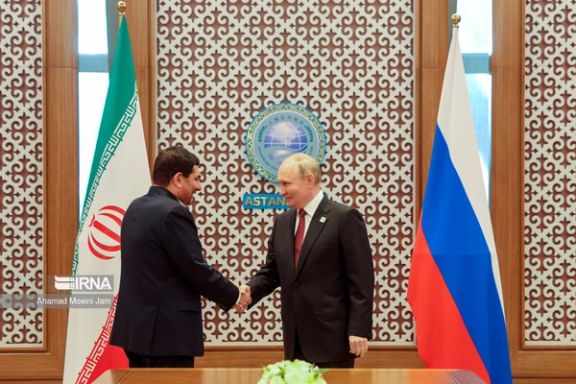
 Russian president Vladimir Putin shaking hands with Iran's acting president Mohammad Mokhber July 4, 2024.
Russian president Vladimir Putin shaking hands with Iran's acting president Mohammad Mokhber July 4, 2024.

Iran's acting president reassured Russian president Vladimir Putin that regardless of the incoming president, ties with Iran would remain "deep".

“The Supreme Leader of Iran wanted me to convey that the relationship between Iran and Russia is very deep and will not be affected by changes in government,” Mohammed Mokhber said.

Mokhber and Putin met on Thursday in Astana, Kazakhstan's capital, during the Shanghai Cooperation Organization summit.

During the meeting, Putin emphasized the unity of Russia and Iran's international agenda, stating that “our approaches towards key issues of the international agenda almost completely coincide.”

Mokhber stated that the "strategic relationship" between Iran and Russia has "completely disrupted the global balance of power," adding that "there is no longer any talk of a unipolar world."

According to Russia's foreign ministry, Moscow and Tehran are negotiating a comprehensive bilateral cooperation agreement that reflects the "unprecedented upswing" in their relations.

However, conflicting accounts emerged regarding the status of the agreement, with some Russian officials hinting that the delay might have been due to the change of government in Iran, potentially affecting the deal.

In June, Russia's foreign ministry announced a temporary suspension of work on the comprehensive cooperation agreement, while Iranian authorities maintained no interruption in its preparation.

Zamir Kabulov, a Russian foreign ministry official, remarked, "This is a strategic decision made by the leadership of both countries. The process has halted due to issues faced by our Iranian partners."

Subsequently, Iranian and Russian officials issued statements reaffirming that efforts to finalize the agreement were ongoing and dismissing reports of its suspension as exaggerated.

During late president Ebrahim Raisi's tenure, efforts to bolster ties with Russia intensified, resulting in numerous contracts aimed at expanding cooperation across various sectors.

However, tangible progress was limited as Russia, embroiled in the Ukraine conflict, faced financial constraints following global sanctions that hindered its investment capabilities in Iran.

Tehran and Moscow first established a long-term agreement in March 2001, officially known as the Treaty of the Foundation of Mutual Relations and the Principles of Cooperation between the Islamic Republic of Iran and the Russian Federation Act. Initially set for a decade, this treaty was subsequently extended twice, each time for five-year terms.

In 2021, Iran’s ambassador to Russia confirmed that both nations had agreed to extend the agreement for an additional five years, with the new expiration date set for 2026.

However, Iran has become a key supplier of drones to Russia in its war on Ukraine, building a production plant as the war looks to have no end in sight, deepening military ties between the two sanctioned states.


Most Viewed

Ideology may be fading in Iran, but not in Kashmir's ‘Mini Iran'
1
INSIGHT

Ideology may be fading in Iran, but not in Kashmir's ‘Mini Iran'

2
INSIGHT

Hardliners push Hormuz ‘red line’ as US blockade tests Iran’s leverage

3
VOICES FROM IRAN

Hope and anger in Iran as fragile ceasefire persists

4

Iran International says it won’t be silenced after London arson attack

5

US sanctions oil network tied to Iranian tycoon Shamkhani

Banner
Banner

Spotlight

  • Hardliners push Hormuz ‘red line’ as US blockade tests Iran’s leverage
    INSIGHT

    Hardliners push Hormuz ‘red line’ as US blockade tests Iran’s leverage

  • Ideology may be fading in Iran, but not in Kashmir's ‘Mini Iran'
    INSIGHT

    Ideology may be fading in Iran, but not in Kashmir's ‘Mini Iran'

  • War damage amounts to $3,000 per Iranian, with blockade set to add to losses
    INSIGHT

    War damage amounts to $3,000 per Iranian, with blockade set to add to losses

  • Why the $100 billion Hormuz toll revenue is a myth
    ANALYSIS

    Why the $100 billion Hormuz toll revenue is a myth

  • US blockade targets Iran oil boom amid regional disruption
    ANALYSIS

    US blockade targets Iran oil boom amid regional disruption

  • Iran's digital economy battered by prolonged blackout
    INSIGHT

    Iran's digital economy battered by prolonged blackout

•
•
•

More Stories

Female labor activist sentenced to death in Iran

Jul 4, 2024, 12:48 GMT+1

Sharifeh Mohammadi, a prominent labor activist imprisoned in Iran has been sentenced to death on charges of armed rebellion.

The Campaign to Defend Mohammadi wrote on Instagram, "This sentence is based on the pretext of Ms. Mohammadi's membership in an independent, public, and legal labor organization a decade ago, demonstrating the baselessness of the verdict."

The campaign’s statement called the ruling "absurd and unfounded," intended to instil fear among activists as the government continues to oppress any voices of dissent.

Mohammadi, who was arrested in December, is one of the latest in a wave of executions in a bid to quash dissent. Last year, 834 Iranians were executed, according to the United Nations. It was a record high, 50 percent higher than the previous year.

At least 22 of those were women, Iran the world's number one executioner of women. The 2023 figures were the highest since 2014 according to Iran Human Rights.

The campaign called for Mohammadi's acquittal and unconditional release, declaring, "This sentence is not only against Sharifeh but is a declaration of war and a death sentence against all social and civil activists."

In January, the UN called for an end to the "horrific wave of executions" underway, with 67 executions in May alone.

Despite vast oil reserves, Iran’s gasoline shortage worsens

Jul 4, 2024, 12:25 GMT+1
•
Dalga Khatinoglu

Iran has found itself importing gasoline since last year due to the government's inability to expand oil refineries and exacerbated by the delivering of approximately one million new, low-efficiency domestic cars into the market.

Gholamreza Dehghan Naserabadi, a member of parliament, in a statement made in June, highlighted Iran's deepening energy imbalance and projected a $2 billion gasoline import requirement for the current year. He also noted the necessity for diesel imports.

Iran's gasoil deficit was 1.5 million liters per day in 2023.

Iranian officials have indicated that the country engages in barter agreements, exchanging its dirty fuel, mazut, for foreign gasoline and gasoil.

According to Kpler, Iran exported between 230,000 to 240,000 barrels per day of mazut in 2023, slightly more than in 2022. However, the exact portion of this volume that was exchanged through barter for gasoline and gasoil has not been specified.

According to an official report from Iran's Oil Ministry, reviewed by Iran International, Iran's gasoline deficit escalated sharply in 2023. Consumption grew by 11.5%, yet refining capacity expanded by only 1.7%. Iranian refineries produced a base gasoline output of 97.5 million liters per day (ml/d) in 2023, while consumption surged to 115.5 ml/d.

To mitigate the deficit, Iran increased gasoline supply by adding 14 million liters per day through chemicals, aromatics, and MTBE (Methyl-tertiary-butyl ether), a gasoline additive known to be carcinogenic in certain animals. Despite these measures, the remaining shortfall was filled by gasoline imports or withdrawals from existing storage reserves.

Iran-gasoline production
100%

The volume of additives in Iran's base gasoline has surged from 5 ml/d in 2018 to 14 ml/d in 2023, marking a staggering 180% increase. In contrast, base gasoline production grew by only 20% during the same period. This rapid growth in non-standard additives has led to significant health and environmental concerns, as Iran's produced gasoline has become increasingly unhealthy and pollutant-laden in its efforts to compensate for fuel deficits.

While the official document does not specify the exact volume of fuel imports, some officials have confirmed that Iran imported $2 billion worth of gasoline during the last Iranian fiscal year, which ended on March 20.

According to the Oil Ministry's report, strategic gasoline reserves stood at 1.17 billion liters by the end of 2023, unchanged from the previous year but down 13% from 2018 levels.

Furthermore, the report acknowledges that only a quarter of the gasoline produced in Iranian refineries meets Euro 4 or Euro 5 standards. Out of Iran's nine crude oil refineries, only three have been built since 1979 - when Islamic Republic came to power- collectively capable of refining less than 690,000 barrels per day, which accounts for 32% of the total refining capacity. The bulk of the refining capacity was built originally with Western licenses and technology. These refineries have since relied on domestic or Chinese technologies for upgrades, with the most recent refinery, Persian Star, commencing operations in 2017.

A major reason for the rise in consumption is domestic auto manufacturing which relies on older engine technologies. Despite producing approximately one million vehicles annually, each with high fuel consumption rates, nearly all are sold domestically. However, Iran's refining capacity growth has lagged the increasing demand.

Another major reason for ever-growing consumption is the low price of gasoline. Presently, Iran maintains the world's cheapest gasoline prices. One gallon costs consumers less than 10 US cents.

In late 2019, the government attempted to address economic challenges by raising gasoline prices by 50-200%, leading to widespread and violent protests. Since then, the Islamic Republic has refrained from adjusting fuel prices, despite a 15-fold fall in the value of the Iranian rial against the dollar since 2019.

Security forces raid home, arrest sister of Iranian protester facing execution

Jul 4, 2024, 11:52 GMT+1

The sister of an Iranian protester on death row, Mojahed Kourkour, was arrested after security forces raided the family home.

His sister, Negar Kourkour, said "there is no information available about the detaining authority or the location" where Rana has been taken.

This latest raid is not an isolated incident. The Kourkour family home has been targeted by security forces before.

Mojahed Kourkour was arrested following an incident in November 2022, when shots were fired on protesters in the southwestern city of Izeh, resulting in the deaths of several residents, including nine-year-old Kian Pirfalak.

In April 2023, Iran's judiciary sentenced him to death on charges of "enmity against God" (moharebeh), "corruption on earth," and "armed rebellion against the state."

He was denied access to his chosen lawyer, and his coerced "confessions" were broadcast by state media shortly after his arrest in December 2022.

The Iranian authorities have labeled the Izeh incident a "terrorist" act, blaming opposition groups. However, Kian Pirfalak's mother contested these claims at her son's funeral, stating that government forces had fired at their family car.

Amnesty International has called on Iran's judiciary to halt Kourkour's execution and overturn his death sentence, which comes amid record numbers of state-sanctioned executions.

The organization also urged the regime to provide him with immediate access to his family, an independently chosen lawyer, and adequate medical care.

Furthermore, Amnesty International has pressed for independent observers to be allowed access to capital trials related to the protests and called for a moratorium on executions with the ultimate aim of abolishing the death penalty in Iran.

Last year, over 850 Iranians were executed in the highest numbers in years.

Family of murdered Mahsa Amini boycotts elections

Jul 4, 2024, 11:01 GMT+1

The father of Mahsa Amini, whose death in Iran's morality police custody sparked a nationwide uprising, stated his family is boycotting the sham presidential elections.

“We are not endorsing any specific candidate in this election, and we have little hope for the realization of justice in the future," Amjad Amini wrote on Instagram.

Since Mahsa’s death in September 2022, her family has been under considerable pressure from the government, including being faced with travel bans. Her father has faced multiple summons to the Intelligence Office in Saqqez since her death.

Mahsa’s uncle has also been detained by security forces, and threats have been levied against Mahsa's brother.

In December, the family's lawyer, Saleh Nikbakht, was sentenced to prison, charged with "engaging in propaganda against the Iranian regime."

The national and global outrage over Mahsa's death is one of the most significant challenges to Iran's clerical establishment since the Islamic Republic was established in 1979.

In March, a UN fact-finding mission declared that Tehran's crackdown on the 2022 protests—including killings, imprisonment, torture, and sexual violence—constitutes crimes against humanity.

The Fact-Finding Mission was established by the UN Human Rights Council in November 2022, two months after the Woman, Life, Freedom protests erupted across the country in response to the death of 22-year-old Iranian-Kurd, Mahsa.

The team concluded that Iran is responsible for "physical violence" leading to Amini's death. The Iranian authorities have denied responsibility, attributing her death to a childhood medical condition following surgery.

However, the UN report dismissed this explanation, confirming "evidence of trauma to Ms Amini's body, inflicted while in the custody of the morality police."

Iran intensifies media clampdown amid presidential election runoff

Jul 4, 2024, 08:42 GMT+1

As Iran’s presidential election runoffs approached this week, the government intensified its media crackdown to control the narrative amid historically low voter turnout in the first round on June 28.

Tehran Prosecutor's Office issued a "warning" to the management of the Tehran-based economic newspaper Jahane Sanat over "publishing an article about the election results," according to a report by Iran’s judiciary news agency, Mizan, on Tuesday.

"The judicial case of this newspaper will be investigated in this regard," added Mizan.

In April, a case was opened against Jahane Sanat for “compromising national security" for coverage of Iran’s April 13 missiles and drone attack against Israel.

Earlier in June, Iran's Press Supervision Board issued strict guidelines for media coverage of the upcoming election emphasizing that disseminating material that promotes "the boycott of elections and lower participation" and "organizing unauthorized protests, strikes, or sit-ins" constitutes a crime. These guidelines also prohibit media from publishing the results of opinion polls.

According to non-profit rights group Defense of the Free Flow of Information (DeFFI), 17 newspapers in total have received warnings. DeFFI noted that the judiciary is attempting to mitigate the negative public perception associated with terms like "declaring a crime" and "filing a judicial case." To this end, the judiciary is increasingly using less charged terms like "warning" without actually altering the level of repression or the underlying legal processes. This approach follows extensive extralegal actions against media and journalists, aiming to soften the language while maintaining strict control over the press.

Additionally, the Iranian Ministry of Interior denied press credentials to four journalists from Shargh Newspaper hours after voting began in the presidential election, effectively barring them from covering the process. Officials abruptly canceled credentials for ‘reformist’ newspapers Shargh and Hammihan reporters, according to IranWire.

Last week, Iran’s security and intelligence forces sealed the studio of the liberal-leaning Fardaye Eghtesad (Economy's Future) media outlet.

DeFFI further noted that in June 2024, security and judicial incidents against Iranian media increased ninefold to 27 in comparison to the previous month. This marked the highest level of media suppression in a single month since the beginning of 2024.

The Islamic Republic has restricted press freedom since the early 1980s. Hundreds of journalists have been arrested over the years and some have spent long years in detention.

Meanwhile, most government-controlled media associated with the regime's 'reformist' and hardliner factions continued urging people to vote in the second round on Friday. They all prominently highlighted Supreme Leader Ali Khamenei's call on Wednesday to make up for the low turnout last week.






