• العربية
  • فارسی
Brand
  • Iran Insight
  • Politics
  • Economy
  • Analysis
  • Special Report
  • Opinion
  • Podcast
  • Iran Insight
  • Politics
  • Economy
  • Analysis
  • Special Report
  • Opinion
  • Podcast
  • Theme
  • Language
    • العربية
    • فارسی
  • Iran Insight
  • Politics
  • Economy
  • Analysis
  • Special Report
  • Opinion
  • Podcast
All rights reserved for Volant Media UK Limited
volant media logo

Iran's role in Oct. 7 attack will be proven 'beyond doubt', ADL says

Negar Mojtahedi
Negar Mojtahedi

Iran International

Jul 3, 2024, 10:45 GMT+1Updated: 16:27 GMT+0
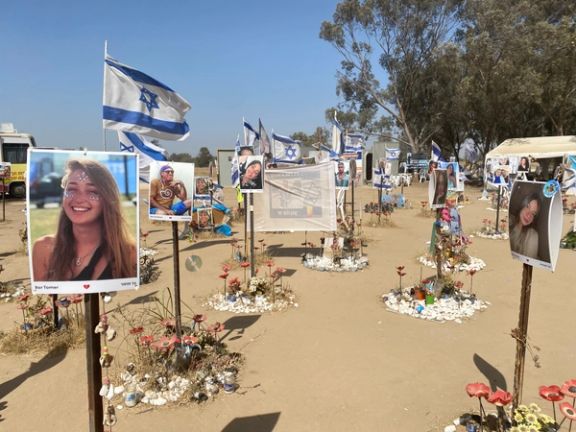
Photos of people killed and taken hostage by Hamas militants, displayed at the site near Kibbutz Re'im

A lawsuit filed in a US federal court on Monday by Jewish Anti-Defamation League (ADL), alleges Hamas could not have carried out the October 7 atrocities against Israel without the support of Iran, Syria and North Korea.

The landmark litigation was filed on behalf of more than 100 victims of the Oct. 7 terrorist attack in Israel, which killed more than 1,200 people and led to the abduction of more than 250 people.

Jonathan Greenblatt, the CEO and National Director of the advocacy group ADL, told Iran International anchor Fardad Farahzad, that the goal is to hold the three countries accountable and to seek justice for the victims and their families.

It is also a means of recording the brutality perpetrated by Hamas and its supporters to combat disinformation in an age of “denialism”, said Greenblatt.

“We will prove beyond a reasonable doubt the role that Iran, Syria, North Korea have played in propping up and preparing, supporting and training Hamas, allowing them to commit on Oct. 7th the worst act of terrorism in generations, the bloodiest day experienced by the Jewish people since the Holocaust,” he said.

Iran has not just been an ally of Hamas, but has also provided material, financial and tactical support to its proxy group according to experts.

On October 26, 2023, US Congressman Bill Huizenga, the Chairman of the House Financial Services Subcommittee on Oversight and Investigations, stated that Iran funds roughly 93% of Hamas’ budget which is about $350 million dollars per year.

In 2018, the US State Department report stated that Iran funds around $100 million a year to groups like Hamas and Palestinian Islamic Jihad.

The evidence gathered was made up of open-source intelligence, and also evidence that was uncovered and not widely known, according to Greenblatt.

“North Korean armaments that were found on the ground in Gaza. And we've got more that we'll be sharing further. This is an explosive case, and it will be impossible for the regime to deny the role that it played in this horrible event,” he stated to Farahzad,

International human rights lawyer Gissou Nia said the inclusion of North Korea is unique, but not unheard of.

"There have also been actions against North Korea. They're not quite as frequent. We see that the actions against the Islamic Republic or the Syrian regime, far outstrip the number against North Korea. But this is not a first. And I think that the report about North Korean weapons that were allegedly used in Hamas's attack on Oct. 7th is what is precipitating, North Korea being included here.”

An Associated Press investigation in October stated that Hamas likely fired weapons produced by North Korea on Oct. 7. North Korea has previously denied the link.

The ADL’s 117 page complaint also seeks to establish that North Korea advised Hamas on its extensive tunnel network, which was used during the attack.

They are also trying to prove close ties between Syria and Hamas. During the decade-long Syrian civil war, Hamas, at one point sided with the opposition but Syrian President Bashar al-Assad restored ties with Hamas in 2022, under the guidance of Iran.

Nia said US nationals can bring a suit against Iran, Syria and North Korea which are three of the four countries listed on the US State Department’s State Sponsors of Terrorism.

Foreign governments are generally considered beyond the jurisdiction of US courts, but the terrorism exception to the Foreign Sovereign Immunities Act (FSIA) allows the courts to hold these countries accountable, where immunity is not absolute.

Since the US doesn’t have diplomatic relations with Iran, the US would effectuate service via the US Interests Sections, or with countries that are acting on behalf of these countries to make sure they are served.

Nia said typically these countries do not send any counsel to defend in the courts and that results in a ruling in favor of the plaintiffs. Families typically won't see the recovery in millions of dollars in assets from these three countries, said Nia.

“There are practically no Islamic Republic assets available in the US. There really aren't Syrian regime assets, nor are there North Korea assets. So they would not be getting those assets directly from the regimes at this point, and instead they would be paid out by a victims' fund,” she said.

Greenblatt told anchor Fardad Farahzad, that the families will get "some financial recompense” through the US Victims Fund of State sponsored terror and will receive “some degree of justice.”

The 2015 Justice for United States Victims of State Sponsored Terrorism Act established the US Victims of State Sponsored Terrorism Fund, whose funds can be disbursed to victims.

The ADL's Jonathan Greenblatt said the Islamic Republic regime "will pay for their crimes."

Most Viewed

Ghalibaf defends Iran-US talks amid hardline backlash
1
INSIGHT

Ghalibaf defends Iran-US talks amid hardline backlash

2
INSIGHT

A nation in limbo: 100 days after the massacre, has the world moved on?

3
ANALYSIS

From instability to influence: Pakistan’s pivotal role in US-Iran diplomacy

4
ANALYSIS

100 days on: why Iran’s January protests spread across social classes

5

War-hit homeowners feel abandoned as Iran’s reconstruction aid fades

Banner
Banner

Spotlight

  • War-hit homeowners feel abandoned as Iran’s reconstruction aid fades

    War-hit homeowners feel abandoned as Iran’s reconstruction aid fades

  • 100 days on: the anatomy of Iran’s January crackdown
    INSIGHT

    100 days on: the anatomy of Iran’s January crackdown

  • Ghalibaf defends Iran-US talks amid hardline backlash
    INSIGHT

    Ghalibaf defends Iran-US talks amid hardline backlash

  • 100 days on: why Iran’s January protests spread across social classes
    ANALYSIS

    100 days on: why Iran’s January protests spread across social classes

  • From instability to influence: Pakistan’s pivotal role in US-Iran diplomacy
    ANALYSIS

    From instability to influence: Pakistan’s pivotal role in US-Iran diplomacy

  • A nation in limbo: 100 days after the massacre, has the world moved on?
    INSIGHT

    A nation in limbo: 100 days after the massacre, has the world moved on?

•
•
•

More Stories

Iran sanctions US officials over pro-Palestine protests

Jul 3, 2024, 09:59 GMT+1

Iran's Foreign Ministry has imposed sanctions on 11 American officials it accuses of clamping down on academic movements supporting Palestine.

In a statement on Wednesday, the ministry cited the “violation of human rights” in suppressing pro-Palestine student movements in the US as the reason for the sanctions.

Between April and June, students across the US protested against Israel’s war with Iran-backed Hamas in Gaza, following the deadly Hamas invasion on October 7, which killed 1,200 civilians. Another 250 hostages were taken to Gaza.

Israel’s subsequent retaliation has resulted in over 37,000 thousands of Palestinian deaths according to Hamas. Israel claims at least 16,000 of those are Hamas militants.

The sanctioned Americans include Linda J. Stump-Kurnick, Chief of the University of Florida Police Department and Pamela A. Smith, Chief of the Metropolitan Police Department of the District of Columbia, among others.

The meaningless sanctions mean the officials would face blocked accounts and transactions within Iranian financial systems should they be banking there, asset freezes within Iran's jurisdiction, and a prohibition on obtaining visas or entering Iran.

However, since Iran is under US sanctions for its nuclear program, no American officials would be involved in financial activity with Iran, nor would it be safe to travel there amid Iran's hostage taking policy.

Iran is also sanctioned globally for its support of Russia's war on Ukraine and its human rights abuses at home.

Iranian leaders, including Supreme Leader Ali Khamenei, have praised the Western university protests, viewing them as part of Iran’s resistance against US and Israeli policies. Khamenei has called the protesters part of Iran’s 'resistance front' against the US and Israel.

However, the Iranian government’s support for the protests has sparked backlash among Iranians, who see this stance as hypocritical. Iran's government, known for suppressing dissent, including imprisoning students and educators, is being criticized for celebrating American students' freedom of expression while denying the same rights domestically.

Iran’s acting FM threatens Israel with 'hell without return' in Lebanon

Jul 3, 2024, 09:17 GMT+1

Iran's Acting Foreign Minister threatened that Lebanon will become "a hell without return for the Zionists" if a full-scale war breaks out with Iran's proxy Hezbollah.

Ali Bagheri Kani made the remarks as fears of a third Lebanon war loom strong with drum-beating rhetoric from both sides.

Lebanon joined the war against Israel after Iran-backed Hamas's attack of October 7, in which 1,200 mostly civilians were killed in Israel and a further 240 taken hostage.

Since then, over 3,300 projectiles have been fired by Hezbollah towards Israel leaving 200,000 people displaced on both sides of the border.

It is a continuation of the war-mongering from Iran's government, with an aide to the supreme leader warning this week that Iran's proxies across the region would support the Lebanese militant movement with “all means.”

“All Lebanese people, Arab countries, and members of the axis of resistance will support Lebanon against Israel," he said in an interview with the Financial Times.

Iran's strongest and largest proxy, Hezbollah, is believed to have stockpiled over 200,000 missiles. Its leader has frequently boasted about advanced weaponry that has not yet been deployed in its persistent, albeit low-intensity, conflict with Israel over the past eight months.

Recently, Hezbollah has escalated its attacks, employing exploding drones and low-flying missiles. At least 11 civilians in Israel and dozens in south Lebanon have been killed. Around 400 Hezbollah militants and at least 15 Israeli soldiers have also died in the border war.

The assaults have occasionally overwhelmed Israel's short-range Iron Dome defense system, causing significant damage. Many of the drone attacks have resulted in extensive forest fires in Israel's agriculture-dependent northern regions.

The last major conflict between Israel and Hezbollah occurred in 2006 following the kidnapping of Israeli soldiers.

The war ended with the UN Security Council Resolution 1701, which called for Hezbollah's disarmament—a mandate that has not been enforced as the terror group has only continued to expand and has continually breached the buffer zone of the UN agreement.

Saudi wealth fund makes $36.8B profit, outshining Iran's oil revenues

Jul 3, 2024, 06:08 GMT+1

Saudi Arabia's Public Investment Fund (PIF) reported a profit of 138.1 billion riyals ($36.81 billion) for 2023, a significant turnaround from the $15.6 billion loss it posted a year earlier.

The leap highlights the kingdom's successful diversification of its economy away from oil dependency, driven by the Vision 2030 plan.

In contrast, Iran's economy continues to suffer under the weight of international sanctions, which have crippled its oil revenue streams. Iran's annual oil revenue stands at around $37 billion, almost on par with Saudi Arabia's PIF profit, but the actual cash income from crude exports to China remains undisclosed, raising suspicions about the transparency and efficiency of Iran's economic and oil export policies.

Total revenues for PIF more than doubled to $88.3 billion last year from $44 billion in 2022, driven by improvements in investment and non-investment activities across sectors such as banking, telecommunications, and gaming. Increased dividends also played a significant role in the growth. This diversification showcases Saudi Arabia's strategic approach to reducing its reliance on oil, which contrasts with Iran's continued dependence on fossil fuel revenues.

Iran's National Development Fund (NDF), established in the early 2000s to save part of oil revenues for future generations, has seen its reserves depleted. Iran's autocratic policies and economic mismanagement have led to repeated withdrawals from the NDF, especially during times of international sanctions. Despite the NDF's original purpose, the fund has been used to offset the country's budget shortfalls, highlighting a lack of foresight and planning.

Saudi Arabian flag with stock graph and an oil pump jack miniature model are seen in this illustration taken October 9, 2023.
100%
Saudi Arabian flag with stock graph and an oil pump jack miniature model are seen in this illustration taken October 9, 2023.

With around $925 billion in assets under management, PIF is Crown Prince Mohammed bin Salman's chosen vehicle to drive an ambitious economic agenda aimed at diversifying Saudi Arabia's economy. The Vision 2030 plan has funneled hundreds of billions of dollars into projects like NEOM, a massive urban and industrial development along the Red Sea coast. This project alone aims to create a high-tech hub nearly the size of Belgium, underscoring the kingdom's commitment to a future less dependent on oil.

Critics argue that Iran needs to shift towards knowledge and technology to create a sustainable economic model. However, research investment in Iranian companies remains below one percent, a contrast to the four percent recommended by experts. This lack of investment in innovation further hampers Iran's economic prospects.

Despite the lifting of most crippling sanctions in 2015 following a nuclear agreement, Iran continued to tap into its NDF reserves. During President Hassan Rouhani’s tenure (2013-2021), $30 billion was withdrawn. As former US President Donald Trump re-imposed sanctions, Iran increasingly relied on its reserves, resulting in a negative cash flow in the NDF. This persistent reliance on the NDF to shore up government finances has left the fund in a precarious state, undermining its intended purpose of providing for future generations.

Under late hardliner President Ebrahim Raisi, the pace of withdrawals from the NDF has only accelerated, further undermining Iran’s economic stability. His administration faced criticism for failing to implement necessary economic reforms and for continuing policies that have led to increased international isolation and economic hardship. This mismanagement stands in contrast to Saudi Arabia's strategic investments and economic reforms through the PIF, which showcase a forward-thinking approach that has strengthened its financial standing on the global stage.

The Iranian government's prioritization of its nuclear program and regional proxy conflicts over domestic well-being has left the country economically vulnerable and politically isolated, while its regional rival Saudi Arabia looks to a future of more investments and growth.

PODCAST - Eye for Iran: IRGC listing’s next steps and Iran elections

Jul 3, 2024, 00:47 GMT+1

Iran is facing a runoff election with historically low voter turnout of 39.9%, and Canada has listed the Islamic Revolutionary Guard Corps (IRGC) as a terrorist entity, but what are the next steps?

In this week’s episode of ‘Eye for Iran,' we dig deep into the Iran elections and the potential legacy of Iran's Supreme Leader Ali Khamenei and we also investigate what the IRGC terror listing entails and how it will be implemented.

'Eye for Iran' host Negar Mojtahedi speaks with Patrick Clawson of the Washington Institute and Melissa Lantsman, the Deputy Leader of Canada's opposition party, the Conservatives.

In this episode, Clawson tells us that Khamenei "feels much more comfortable being with the Revolutionary Guard Corps and the military than he does with clerics."

Clawson believes Khamenei consolidated power this way.

"He realized early on that it was the revolutionary guard corps and not the clerics who were going to be the center of power in the Islamic Republic," said Clawson.

Another big Iran topic has been the terror listing of the IRGC in Canada and many have a lot of questions. What does it really mean?

The listing process stems from the Anti-Terrorism Act of 2001, and is set out in section 83.05 of the Criminal Code.

Deputy Leader Melissa Lantsman of the Conservatives said she and the party have "a lot of work to do to make sure that this government stays accountable and making sure that that listing means something."

"We're going to make sure that we hold them to account on implementation on this. I'm frankly not confident. We have a government that has been charged with reports of foreign interference where they have looked the other way, where they have looked at intelligence and turned their back on it," said Lantsman.

For more watch Episode 4 of 'Eye for Iran' on YouTube or listen on Spotify.

Khatami says discontent in Iran extends beyond the 60% who didn't vote

Jul 2, 2024, 19:57 GMT+1
•
Niloufar Goudarzi

Iran’s former president Mohammad Khatami has highlighted the "unprecedented" absence of 60% of the electorate in Friday’s presidential election, stressing that dissatisfaction extends beyond just the non-voters.

“This act is a clear sign of the public's dissatisfaction with the current state of affairs and indicates the majority's discontent with the ruling system,” said Khatami. “The dissatisfaction is not limited to those who abstained from voting; many of those who did participate are also dissatisfied and voted in the hope of change."

Khatami stressed the importance of everyone participating in the second stage of the elections on July 5 to “complete the unfinished task.” He warned that abstaining could lead to the victory of an "approach harmful to the nation.”

The formerly popular reformist president announced his intention to vote for Masoud Pezeshkian, the sole reform-leaning candidate, and urged others to do the same.

The June 28 presidential election witnessed a historically low voter turnout in the Islamic Republic's history, with only a 39.92 percent participation. This broke the previous record set during the last election, when the late President Ebrahim Raisi won with a 48 percent turnout, providing a clear indication of the current political climate.

A runoff election will be held on Friday, with hardliner Saeed Jalili competing against Masoud Pezeshkian.

Khatami's call for participation in the election comes after he, for the first time in his political career, refrained from voting in the March parliamentary election, despite Supreme Leader Ali Khamenei's repeated assertions that voting is a religious duty. Previously, Khatami acknowledged that "people had the right to be disillusioned with reformists just as they are with the ruling system." This time, however, he is urging people to vote.

There is a notable difference in the current election compared to the parliamentary elections. Reformist parties and groups, such as the Etehad-e Mellat (Nation’s Unity) party, who were previously denied the opportunity to field any candidates, have now endorsed Pezeshkian. They engaged in an intensive campaign to convince voters to take part and elect Pezeshkian. Nevertheless, despite their campaign and repeated calls by Khamenei, at least 60% refused to vote according to official figures. Many Iranian on social media express doubt even about the 40% turnout, insisting that the government boosted the numbers to push the final tally to 24.5 million votes out of 61.5 million eligible.

The results showed that reformists and even the once popular Khatami have lost the trust of the majority.

The erosion of trust in reformists is evident in the public's perception of the ruling establishment, now viewed as a consolidated power structure led by Supreme Leader Ali Khamenei and the Islamic Revolutionary Guard Corps (IRGC), effectively marginalizing the president's authority.

This perspective is mirrored by the reform-leaning candidate, who has consistently acknowledged during debates that Khamenei is the ultimate decision-maker and pledged his adherence to the Leader's directives.

In the latest debate on Monday, Pezeshkian critiqued Jalili for attributing decisions to himself that were, in reality, Khamenei’s. “The final decision is made by the Leader. Don't say that something was done because I was in charge—no. If Mr. Khamenei doesn't like it and doesn't see it as appropriate, he won't allow it to happen,” Pezeshkian asserted, a stance that in theory, appears even more hardline than Jalili's.

It is worth noting that not all reformists continue to believe in “improving” the system. Key marginalized figures within the reform faction have also boycotted the election. Mirhossein Mousavi and Zahra Rahnavard, both under house arrest since 2011, abstained from voting in the presidential elections. Some imprisoned reformists such as Mostafa Tajzadeh also called for a boycott.