• العربية
  • فارسی
Brand
  • Iran Insight
  • Politics
  • Economy
  • Analysis
  • Special Report
  • Opinion
  • Podcast
  • Iran Insight
  • Politics
  • Economy
  • Analysis
  • Special Report
  • Opinion
  • Podcast
  • Theme
  • Language
    • العربية
    • فارسی
  • Iran Insight
  • Politics
  • Economy
  • Analysis
  • Special Report
  • Opinion
  • Podcast
All rights reserved for Volant Media UK Limited
volant media logo

Iranian Diaspora Stage Boycott Protest on Election Day

Niloufar Goudarzi
Niloufar Goudarzi

Iran International

Jun 28, 2024, 17:31 GMT+1Updated: 16:29 GMT+0
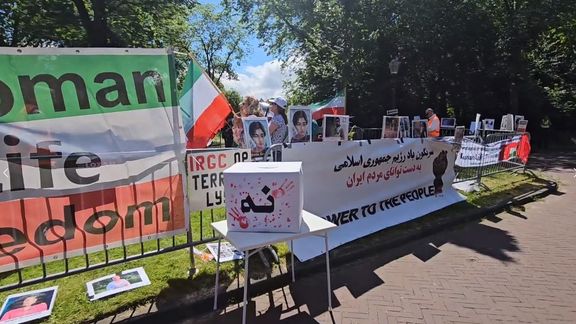
Iranian diaspora rally in the Hague, Netherlands, June 28, 2024

Activists in the Iranian diaspora mobilized internationally to protest and boycott the presidential election, resulting in confrontations and arrests at some polling stations.

In London, outside the Iranian consulate where voting for Iran's presidential election was underway on Friday, activists confronted voters, questioning their decision to participate after the bloody 2022 nationwide protests in Iran. "How can you vote after all these people were killed? You legitimize the regime by doing so," one protester was heard saying in a video shared on social media.

Metropolitan Police arrested two voting individuals outside the consulate amidst the tension. Demonstrators displayed images of victims from nationwide protests in Iran, notably from the 2022 Woman, Life, Freedom movement, which was sparked by the death of 22-year-old Mahsa Amini in police custody. The subsequent crackdown, resulting in the deaths of at least 550 protesters, has been labeled a crime against humanity by a UN fact-finding mission.

As reported by Mohsen Moheimany, an Iran International journalist who was present at the event, the arrested voters engaged in aggressive behavior and verbally attacked the protesters.

Several videos circulating on social media have documented the clashes, including one where a voter in London is seen threatening the protesters.

Also, there were reports that some protesters and voters verbally confronted one another in Paris.

The protesters equated election ink to the "blood of the youth," using the analogy as their central slogan. Election ink is typically applied to voters' forefingers to prevent electoral fraud.

Protests erupted in numerous global cities, including Bern, Amsterdam, Melbourne, Oslo, The Hague, Vienna, Stockholm, Manchester, Auckland, Sydney, Washington, and Hamburg, as demonstrators gathered outside Iranian embassies and polling stations to denounce participation in the presidential election.

Among the demonstrators in London was Azemat Ajdari, whose sister was a victim of flight PS752. This flight, which departed from Tehran amid military activity, was downed by the IRGC in 2020, killing all 176 passengers aboard.

Ajdari, positioned on the opposite side of the street facing the Iranian consulate, expressed to Iran International, "The street we are standing on symbolizes the sea of blood that separates us from the supporters of the Islamic Republic."

"We are here today because the people of Iran are subjected to the tyranny of a regime that has erected a barrier around them, stifling their voices and preventing them from being heard by the world. Our presence aims to amplify the people's voices and demonstrate that this government does not represent us," Ajdari elaborated.

Fariba Balouch, a human rights activist and another protester, shared with Iran International, "This protest stands against the Islamic Republic's facade of democracy. By being here, we stand in solidarity with the families of the victims, those whose children were killed by this regime, and all victims, including those from Zahedan's Bloody Friday."

On September 30, 2022, security forces opened fire on peaceful protesters in Zahedan, the provincial capital of Sistan-Baluchestan, marking a day known as Bloody Friday. This incident resulted in the deaths of at least 105 civilians, including 17 children.

During protests in Hamburg, Fardin Mafghodi, who was shot in the back and hands during the Woman, Life, Freedom movement and is now confined to a wheelchair, told Iran International, “Anyone who votes effectively buys bullets for the Islamic Republic to target people like me.”

Mojtaba Elhani, a political activist at the Berlin protest, stated to Iran International, “The blood of our youth obstructs the path to the polls. We have only one vote, and that is to overthrow the establishment.”

Faramarz Bahar, a political activist and organizer of the gathering in Paris, also told Iran International, “We want to show the regime that we do not care about the political factions within the system, whether reformist or fundamentalist. Our message to the Islamic Republic is clear: we have not seen justice, and we will not vote again.”

Most Viewed

Ideology may be fading in Iran, but not in Kashmir's ‘Mini Iran'
1
INSIGHT

Ideology may be fading in Iran, but not in Kashmir's ‘Mini Iran'

2
INSIGHT

Hardliners push Hormuz ‘red line’ as US blockade tests Iran’s leverage

3
VOICES FROM IRAN

Hope and anger in Iran as fragile ceasefire persists

4

US sanctions oil network tied to Iranian tycoon Shamkhani

5

Iran International says it won’t be silenced after London arson attack

Banner
Banner

Spotlight

  • Hardliners push Hormuz ‘red line’ as US blockade tests Iran’s leverage
    INSIGHT

    Hardliners push Hormuz ‘red line’ as US blockade tests Iran’s leverage

  • Ideology may be fading in Iran, but not in Kashmir's ‘Mini Iran'
    INSIGHT

    Ideology may be fading in Iran, but not in Kashmir's ‘Mini Iran'

  • War damage amounts to $3,000 per Iranian, with blockade set to add to losses
    INSIGHT

    War damage amounts to $3,000 per Iranian, with blockade set to add to losses

  • Why the $100 billion Hormuz toll revenue is a myth
    ANALYSIS

    Why the $100 billion Hormuz toll revenue is a myth

  • US blockade targets Iran oil boom amid regional disruption
    ANALYSIS

    US blockade targets Iran oil boom amid regional disruption

  • Iran's digital economy battered by prolonged blackout
    INSIGHT

    Iran's digital economy battered by prolonged blackout

•
•
•

More Stories

Iranian Authorities Cut Off Kurdish Death Row Inmate's Family Contact

Jun 28, 2024, 15:30 GMT+1

The prison authorities have barred death row prisoner Reza Rasaei from receiving phone calls and family visits for the past week, according to Dadban, a group of pro-bono lawyers in Iran defending political prisoners.

“The authorities of Dizel Abad prison in Kermanshah province have cut off Reza Rasaei's contact with his family and have not given any explanation about the reason for these restrictions,” a source close to the case told Dadban.

The group also reported intensified pressure on Rasaei's family, with increased threats of arrest being made against them.

Last year, the death sentence of Rasaei, one of the detainees from the 2022 nationwide protests, was confirmed by the Supreme Court of Iran.

Rasaei, from the marginalized Kurdish and Yarsan minorities, was sentenced to death by a Revolutionary Court on charges related to the killing of Nader Beirami, head of the Revolutionary Guards Intelligence Organization in Sanandaj, during a clash between security and law enforcement forces and protesters.

Various human rights organizations, including Dadban and Hengaw, reported that the authorities attributed Beirami’s murder to Rasaei without providing any evidence, witnesses, or documents.

Amnesty International, also, issued a warning about Rasaei's trial, noting that he was subjected to torture and ill-treatment, including electric shocks and severe beatings, to compel self-incriminating “confessions.”

Iran’s Elections Engineered by Covert IRGC Arm, New Report Says

Jun 28, 2024, 15:22 GMT+1

A covert arm of the Islamic Revolutionary Guard (IRGC) has been rigging elections and manipulating Iran's political landscape through a clandestine network of cultural and political operations, according to a new analysis by United Against Nuclear Iran (UANI).

Known as the Baqiatallah Headquarters, this apparatus works closely with the Intelligence Ministry to strategically influence the current snap election to replace former President Ebrahim Raisi, the NGO reports.

UANI says its report marks the first clear exposure of these methods of electoral manipulation.

Titled “Engineering Minds and Votes,” the 34-page report is based on original material from inside the IRGC's Baqiatallah Headquarters, including lectures, textbooks, written presentations, and speeches.

Kasra Aarabi, one of the study's authors, notes that the group was established in 2019 with the explicit objective of realizing Supreme Leader Ali Khamenei’s vision of an "ideal Islamic government and society."

The group, connected to the Office of the Supreme Leader, leads an initiative as part of Khamenei’s broader five-stage doctrine to achieve this goal.

That reportedly involves a five-year plan aimed at creating a regime-led "insider civil society" by recruiting and training four million Iranians across 800,000 groups, designed to influence and control the population.

The report also reveals that the Baqiatallah Headquarters is connected to the Office of the Supreme Leader and leverages resources from other agencies to execute its comprehensive "Middle Ring" strategy.

The five-year plan aims to create a regime-led "insider civil society" by recruiting and training four million Iranians across 800,000 groups, designed to influence and control the population to achieve Khamenei’s doctrine.

While election rigging in the Islamic Republic is not new, most famously in 2009, Aarabi says that the IRGC’s Baqiatallah Headquarters has reached "unprecedented levels of electoral rigging" in recent years.

Using tactics such as election engineering and cultural manipulation to secure the regime’s preferred outcomes and suppress opposition, the shadowy group has reportedly been instrumental in executing Khamenei’s vision. Traditionally, the members of the Guardian Council, selected by the Supreme Leader, are in charge of candidate eligibility.

UANI’s analysis, however, shows that the Baqiatallah Headquarters is now a key player in controlling narratives, vetting candidates, intimidating voters, and manipulating vote counts.

Affiliates of the covert group take on roles in election monitoring and polling stations to directly influence outcomes.

Operating at a granular level, the Baqiatallah Headquarters plays a critical role in vetting candidates.

Agents gather detailed intelligence on potential candidates, file reports to the IRGC intelligence, which processes and shares the data with the Guardian Council for final candidate eligibility decisions.

The Headquarters also reportedly runs targeted smear campaigns against candidates not aligned with Khamenei's preferences, ensuring only loyal candidates are elected.

Additionally, it supports IRGC’s cyberspace operations, including trolling social media, spreading misinformation, creating divisions among opposition groups, and trending pro-regime hashtags.

During the March 2024 parliamentary vote, former Foreign Minister Javad Zarif was recorded implicating Mohammad Ali Jafari, the commander of the Baqiatallah Headquarters, in orchestrating election engineering.

Zarif disclosed that Jafari was "behind everything," including preparing the entire candidate list for the parliamentary elections.

The report calls for the US and its allies to immediately sanction the Baqiatallah Headquarters, its leadership, affiliates and apparatus.

Opposition Accuses Trudeau Gov't of Leaking IRGC Terror Listing

Jun 28, 2024, 15:05 GMT+1
•
Negar Mojtahedi

Canada’s Conservative Deputy Leader Melissa Lantsman has accused the Liberal government of deliberately leaking its plan to designate Iran's Islamic Revolutionary Guard Corps (IRGC) as a terrorist organization.

Canada’s Public Safety Minister Dominic LeBlanc made the announcement, proscribing the IRGC as a terror organization on June 19 at a news conference in Ottawa. Before the official announcement, CBC News and Iran International English were the first outlets to break the news. 

"The government leaked that listing, and that's not usually how something as serious as this takes place," Lantsman told Iran International’s ‘Eye for Iran’ Podcast.

Lantsman stated that while she does not attribute malicious intent to the federal government for the leak, it may have given individuals with ties to the IRGC time to relocate their money or assets within Canada.

The parliamentarian, whose party has been pressuring the federal government to list the IRGC, admitted that she does not know when the government began taking action or notifying banks.

Iran International sought an interview and a response to the allegations from Canada’s Public Safety Minister for the 'Eye for Iran' podcast but received no reply in time for publication.

In a previous email correspondence, a Public Safety spokesperson told Iran International that adding an entity to the terrorist list results in “significant and immediate consequences for the entity and those associated with the entity.” 

“Canadian financial institutions, such as banks and brokerages, must immediately freeze the entity’s assets, which can then be the subject of seizure, restraint or forfeiture," the spokesperson said. 

Lantsman said “You know when you give somebody a heads up of a decision you know, it allows things to move around. Frankly the government is sloppy on this, just as they've been sloppy on foreign interference, and more than sloppy, but outright dangerous.”

When asked by Iran International’s Negar Mojtahedi during 'Eye for Iran,' whether this points to potential foreign interference within the government itself, Lantsman responded that she does not have the intelligence to suggest that, but that it’s not usual to “see something written in the newspapers before you hear it from a minister's mouth. It's usually the other way around. It should be the other way around. Canadians should expect that it's the other way around.” 

The designation of the IRGC as a terrorist group has long been sought by Iranian-Canadians and the relatives of those killed when the IRGC shot down Ukraine International Airlines Flight 752 with two surface-to-air missiles on January 8, 2020. 

The downing killed all 176 people on board, including 55 Canadian citizens and 30 permanent residents of Canada. Prime Minister Justin Trudeau resisted calls to designate the IRGC as a terrorist organization, despite his party's support for a motion to list it in 2018.

Trudeau previously cited several concerns, including the unintended consequences such a designation could have for individuals conscripted into the group. 

In an email, a Public Safety spokesperson told Iran International that “being listed as a terrorist entity does not constitute a criminal offense, however it can lead to other criminal consequences.” 

The RCMP does not investigate movements or organizations for their ideological dispositions but rather for their criminal activities, the statement said. 

The listing of the IRGC as a terrorist entity, the Public Safety spokesperson wrote, identifies individuals who have engaged in or played a “substantial role in terrorism and acts of violence.” Doing so allows the Immigration Refugees and Citizenship Canada (IRCC) to prevent these individuals from obtaining a visa, entering, or remaining in Canada.

You can watch the full podcast with Minister Melissa Lantsman on Iran International YouTube Page.

Iran Slams US Envoy's Critique of Iran's Election Fairness

Jun 28, 2024, 13:48 GMT+1

Iran's Foreign Ministry spokesman, Nasser Kanaani, criticized the US acting special envoy's criticism of Iran's snap presidential election, labeling them as "outrageous meddling."

Kanaani expressed his disapproval on Friday, stating, "The meddling statements from the US regarding our presidential elections are a blatant and outrageous intrusion."

US acting special envoy for Iran, Abram Paley asserted on Wednesday through his social media account that there is "no expectation of free and fair elections or fundamental change in Iran’s direction."

Kanaani went on to say, "The US authorities persist with such baseless remarks, but the Iranian people will respond vigorously with their active and enthusiastic participation at the polls, as they have done historically."

Paley highlighted that the Guardian Council hand-picks the six candidates and noted severe limitations on Iranian voters' access to "even the most basic freedoms; necessary features of any democracy."

"In the face of the authoritarian regime’s long history of harassing and intimidating journalists, suppressing election coverage, and denying freedom of peaceful of assembly, we support the Iranian people," he said.

Human Right Groups Slam Sweden Over Enabling Tehran's 'Hostage-Taking'

Jun 28, 2024, 11:48 GMT+1

Fifteen diaspora Iranian political and human rights organizations have criticized Sweden's release of former Iranian official Hamid Nouri, convicted of war crimes, in a prisoner exchange with Tehran.

In a letter to Swedish Prime Minister Olaf Kristerson, they warned that such agreements encourage the Islamic Republic to hold foreign citizens and dual nationals hostage.

Signatories include the Pro-Republic Iranian Society in Sweden, the Committee for the Defense of Human Rights in Iran-Austria, the Republican Iranians of Australia, and the Khavaran Justice Seekers, which represents families of thousands of prisoners killed in Iran in 1988.

The letter, published on Friday, emphasized that releasing Nouri has “severely damaged the Swedish government's reputation.”

Earlier this month, Sweden repatriated Nouri and secured the release of two Swedish citizens, Johan Floderus and Saeed Azizi, who had been detained in Iran on allegations of "spying for Israel." However, the deal did not include Ahmadreza Djalali, a Swedish-Iranian currently on death row, who has been on a hunger strike since June 26 to protest being excluded from the exchange.

Sweden’s Prime Minister expressed regret that Iran was unwilling to negotiate for Djalali’s release, acknowledging the dire situation of the hunger-striking prisoner. He also cautioned citizens against travel to Iran.

Amnesty International condemned Nouri's release, calling it a “stunning blow to survivors and relatives of victims” of the 1988 prison massacre in Iran.

Nouri had been sentenced to life imprisonment by a Swedish court in 2022 for crimes against humanity related to his involvement in the mass executions of prisoners in the 1988.

His arrest in Sweden was based on the principle of universal justice, and his trial and conviction were hailed as significant steps for international justice. However, his release has faced widespread condemnation.