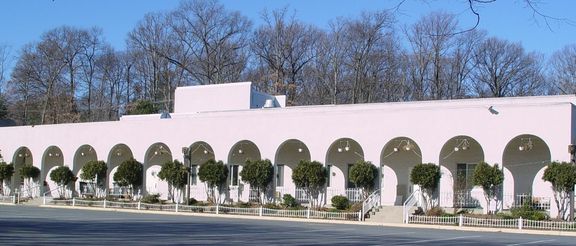
The Islamic Education Center (IEC) of Washington in Potomac, Maryland
A helicopter crash on May 19 claimed the lives of Ebrahim Raisi, Iran's eighth President, and his foreign minister, Hossein Amir-Abdollahian, leading to a series of consequential events.
Memorial services organized by the Iranian government globally in their honor, faced significant criticism from opponents of the Islamic Republic, sparking widespread discontent and controversy.
In Washington DC, a staff member of Iran's Interests Section in the US exacerbated tensions. In a video circulated on social media, Ramezan Soltan-Mohammadi was observed making a threatening gesture towards protesters, leading to an extended restraining order against him by a US court on June 17.
This incident, occurred on May 22 on the sideline of Raisi’s memorial service held by the Islamic Education Center (IEC) in Maryland, sparking renewed scrutiny into the ties between this sizeable mosque in Potomac and the Islamic Republic of Iran.
Islamic Education Center (IEC) in Maryland
Despite concerted efforts over the years by the administrative staff and board members of IEC to keep a low profile and refrain from drawing undue attention to this prominent Shia center in Montgomery County, the facility has consistently faced accusations from critics who allege it has functioned as a haven for supporters of the Islamic Republic for numerous years.
These allegations against the IEC, which also serves as a mosque, seem firmly grounded in reality.
Federal prosecutors in Manhattan initiated legal action to seize this center in 2009 for its connection to Alavi Foundation, a New York City-based organization accused of illegally providing money and services to Iran and spending millions of dollars to obtain and develop properties in violation of federal laws that ban trade with Iran, the New York Times reported.
IEC managers have endeavored to distance themselves from Alavi and have long asserted that the mosque's association with the foundation is purely that of tenant to landlord.
Furthermore, the management board has opted to enhance the organization's public image by revising its mission statement, asserting that it functions solely as a place of worship and religious center without any political affiliations. Nevertheless, there are compelling facts that contradict these assertions. Since its inception, the leaders and members of this organization have consistently shown fervent support for the Islamic Republic, demonstrating unwavering devotion and admiration for the regime in both rhetoric and actions.
Hosting Raisi’s funeral and several meticulously organized ceremonies directed by authorities in Tehran serve as undeniable examples that underscore the current bond.
Ahamad Bahraini Imam of IEC
Such is the depth of influence that throughout its operational history, the prayer leader of the center has consistently been appointed by Tehran. The current Imam, Ahmad Bahraini, who has served at the center for approximately two decades, previously held the position of Ali Khamenei's representative at Shahid Beheshti University before relocating to the United States.
His predecessor, Hojatolislam Mohammad-Reza Hejazi, sparked controversy when he was detained at Washington Dulles International Airport in 2005 while trying to depart for Iran with nearly $100,000 in cash, disregarding US tax rules.
The IEC's notable connections to Tehran include hosting prominent figures and clerics closely associated with Iran's power structure. Mohsen Qara'ati, a high-profile clergyman with ties to the regime; Mohammad Kazem Rashed Yazdi, a cleric with personal connections to Ali Khamenei; Mohsen Taj Langaroudi, a prominent loyalist cleric; and Mohsen Taheri, a well-known eulogist affiliated with the Khamenei’s office, have all been hosted by IEC and visited the US at the center's invitation.
According to Iranian International investigations, the IEC has been found to have substantial ties with the Iranian Interest Section (IIS). This section acts as the representative of the Iranian government in the absence of formal diplomatic relations between Washington and Tehran. Our interviews with knowledgeable individuals suggest that certain current or former staff members of this center, as well as their spouses, have been employed by the ISS. Additionally, over the years, the center has frequently organized non-religious activities that align with the objectives of the Islamic Republic.
The authorities of the IEC have shown no willingness to respond to the claims stated.
According to its website, the Islamic Education Center in Washington was founded as a nonprofit organization dedicated to promoting Islam through cultural and religious activities. Despite its location in Potomac, Maryland, the decision to include "Washington" in its name reflects a historical dispute stemming from the 1979 Islamic Revolution in Iran.
The Center was established amid controversy following the expulsion of several of its current members from the prominent mosque of nation’s capital due to their occupation of the premises in 1981. According to the Washington Post, the dispute originated when "about a dozen demonstrators who support Iranian leader Ayatollah Ruhollah Khomeini occupied the mosque."
As reported by the newspaper, the board of the mosque, consisting of ambassadors to the United States from more than 40 Islamic nations, took legal action. Subsequently, a Superior Court judge issued an order for the demonstrators to evacuate the premises. When they declined to comply, some of the zealous supporters of Islamic Republic were charged with criminal contempt.
With sustenance from the Alavi Foundation, followers of Khomeini who were expelled from the Islamic Center of Washington instituted their own sanctuary by acquiring and renovating a sizable facility located in an affluent Maryland area.
The Islamic Center of Washington has displayed no interest in responding to Iran International’s questions regarding the four-decade-old conflict.
Israeli Prime Minister Benjamin Netanyahu says the Islamic Republic is working on all front to destroy Israel, but the Jewish state will thwart its intentions "at any cost".
Netanyahu said on Monday that Tehran is actively working on multiple fronts to destroy Israel, highlighting the ongoing threat posed by Iranian proxy groups such as Hamas, Hezbollah, and the Houthis.
“At any cost and in any way, we will thwart Iran's intentions to destroy us,” the Israeli prime minister told the Knesset.
He described the situation as an "existential war on seven fronts," asserting that Iran is openly attempting to annihilate Israel.
Iran has long been a key supporter of both Hamas in Gaza and Hezbollah in Lebanon, providing financial aid, weapons, and training to these groups.
Since October 7, Israel has been engaged on two primary fronts: Gaza and Lebanon. Following a series of escalations, the Israel Defense Forces (IDF) have intensified their operations against Hamas in Gaza, aiming to dismantle its infrastructure and halt rocket attacks on Israeli territory. Concurrently, tensions with Hezbollah have flared along Israel's northern border with Lebanon.
In his Monday speech, Netanyahu said as the IDF advances deeper into Gaza, more evidence of Iran's anti-Israel activities has come to light.
He argued that Iran has underestimated both Israeli resilience and the country's determination to protect itself, stating that Israel is prepared to impose a significant toll on its aggressors.
His remarks come one day after the top US general warned that any Israeli offensive in Lebanon would risk a broader conflict that draws in Iran and its proxies, particularly if Hezbollah's existence is threatened.
"From our perspective, based on where our forces are, the short range between Lebanon and Israel, it's harder for us to be able to support them in the same way we did back in April," Brown said.
He was referring to a massive Iranian missile and drone attack against Israel from Iranian territory on April 13 that failed to inflict any serious damage as Israeli and allied forces downed almost all projectiles.
Masoud Pezeshkian, the only reform-leaning presidential candidate in the upcoming presidential elections, has revealed mass mismanagement and corruption plaguing the nation.
Speaking Monday, Pezeshkian revealed, "Money disappears in the country in amounts as significant as 70 trillion, and it is unclear where it goes, while our people have to search through garbage bins for a piece of bread to survive."
He did not specify whether the figure was in rials or tomans. If in rials, this equals around $116 million; if in tomans, approximately $1.16 billion. The revelation comes as Iran’s annual budget for the current year is over $100 billion and the six presidential candidates vie for the top seat.
Iran is currently grappling with gross embezzlement issues and widespread poverty, which have eroded public trust in governmental institutions and exacerbated social inequalities.
Numerous high-profile embezzlement cases have been uncovered, involving senior officials and businesspeople who exploit loopholes and weak oversight to siphon off public funds.
The systemic corruption drains crucial resources from public services and development projects, impacting the everyday lives of ordinary Iranians. Despite Iran's vast oil reserves and natural resources, a significant portion of the population struggles with poverty, high unemployment rates, and inflation.
At least one third of Iranians are now below the poverty line, forcing many to scavenge for food and essentials.
Iran's snap elections on June 28 follow the sudden death of Ebrahim Raisi last month in a freak helicopter crash.
A gas flare on an oil production platform is seen alongside an Iranian flag in the Persian Gulf July 25, 2005.
Hossein Selahvarzi, the former head of Iran's Chamber of Commerce, says sanctions have inflicted approximately $1.2 trillion in damages on the country between 2011 and 2023.
In comments published on Monday in Tehran's Shargh daily, Selahvarzi discussed the economic opportunities lost in Iran due to the sanctions. His remarks came just days before Iran's presidential election, where a victory for a hardline candidate could potentially prolong the stalemate in Iran's nuclear negotiations with global powers.
Saying that the issue of sanctions has not received much attention during the election campaign, Selahvarzi estimated that the lost per capita income for each Iranian due to sanctions over the 12-year period is around $14,000. In other words, each Iranian has lost an average of $1,202 annually due to the sanctions.
Selahvarzi did not specify the official sources of these figures. He explained that the estimates were based on comparisons with "several countries similar to Iran." He likely compared Iran's GDP and real per capita income with the averages of these countries, attributing the differences to the impact of the sanctions.
Masoud Pezeshkian, the reformist-backed candidate, has criticized the current situation, but the overarching policies are controlled by the Supreme Leader of the Islamic Republic, meaning that no matter who assumes the office of the president, little may change in policies that can help lift sanctions.
On Sunday, former Iranian President Hassan Rouhani said Iran incurred an annual loss of some $100 billionover the past three years due to sanctions that forced the country to sell limited amounts of oil and petrochemicals at discounted rates.Rouhani accused former president Ebrahim Raisi's government of "betraying" the Iranian people by causing $300 billion in damages over the course of three years.
Selahvarzi also commented on Iran's non-oil exports, saying: "The non-oil trade balance turned negative last year, and exports declined." He added that “both exports and imports were significantly impacted by sanctions."
Sanctions have not only hurt Iran's oil revenues and non-oil exports but also contributed to inflation and unemployment. The World Bank predicts Iran's GDP growth to continue its decline in 2024, falling below 2%. Presidential candidates are adamant that Iran's GDP growth can reach 8%, although none of them proposed any tangible plans to reach the long-sought goal.
Despite multiple rounds of negotiations between Tehran and world powers in 2021-2022, no agreement was reached to revive the JCPOA (Iran's 2015 nuclear deal). Lifting sanctions could improve Iran's economic situation, but this hinges on reaching an agreement with global powers.
Multilateral nuclear talks with Iran in Vienna, 2021
On Monday evening, Iranian presidential runners will hold their fourth debate, which will focus on foreign policy. No candidate has so far presented any comprehensive and clear plan to resolve strategic foreign relations issues.
Alireza Soltani, political economist told conservative Khabar Online website Monday that the main challenges the next president faces in foreign policy include Tehran-Washington relations, Iran’s nuclear program, and relations with international institutions and regulatory mechanisms, particularly the International Financial Task Force (FATF) and the World Trade Organization.
“Any incoming administration must strive to address the challenges in US-Iran relations. Resolving this conflict can pave the way for improved relations with Europe and many regional countries. Iran has lost numerous regional and international opportunities, both political and economic, due to its strained relations with the US. This includes economic cooperation with neighboring countries and relations with major powers like China and Russia, which have resulted in imbalanced and often unfavorable arrangements for Iran. Reducing tensions with Israel also hinges on resolving this issue,” he said.
According to Soltani, Iran's nuclear program has imposed "heavy economic and security costs on the country." He added that the next president should address the country's "weak economic, monetary, and trade relations," exacerbated by US sanctions, are further strained by international pressures and restrictions. These challenges particularly affect money transfers, attracting foreign investment, and international trade.
The Paydari party, a bastion of ultraconservatism in Iran, announced its support for Saeed Jalili in the upcoming presidential election on June 28.
The endorsement from the party, known as Steadfastness, highlights the division among the five hardliner candidates who are locked in a struggle over who should withdraw in favor of a unified conservative front.
Saeed Jalili, the Supreme Leader’s representative at the Supreme National Security Council, Parliament Speaker Mohammad Bagher Ghalibaf, Tehran Mayor Alireza Zakani, and Vice President Amir-Hossein Ghazizadeh Hashemi are all conservative contenders in the upcoming election.
If they do not agree to propose a consensus candidate, they risk losing in an election that many believe is merely a formality, with the winner already predetermined by Supreme Leader Ali Khamenei.
Originating during the presidency of Mahmoud Ahmadinejad, Paydari has continued to exert influence over Iranian politics. Known for its opposition to the nuclear deal (JCPOA) with world powers, the party's alignment with Jalili, a figure equally critical of the agreement, signals a continuing hardline stance that resonates with the more conservative elements of Iranian society.
As the hardliners fail to consolidate support, the fracturing may offer an unexpected advantage to the only more reformist candidate, Masoud Pezeshkian.
The elections on June 28 come in the wake of the sudden death of Ebrahim Raisi who died in a freak helicopter crash last month. Turnout is expected to be an all time low as the results are already deemed predetermined by the supreme leader.
Iran Supreme Leader Ali Khamenei during a meeting with a group of envoys of Muslim countries in Tehran on April 10, 2024
Mohammad Ali Movahedi Kermani, head of Iran's Assembly of Experts, has stated that late President Ebrahim Raisi was unfit to succeed Ali Khamenei as Iran's Supreme Leader.
"He would have definitely rejected the offer if it had been made," Kermani stated, directly addressing speculation about Raisi's potential ascension.
The sudden death of Raisi in a helicopter crash in May abruptly ended what some believed was his grooming for leadership, propelling Khamenei's son, Mojtaba, into the spotlight as a new frontrunner.
The comment highlights the opaque process of choosing Iran's leader, a position that will become vacant following ageing Khamenei's death.
The Assembly of Experts, elected to serve until 2032, is responsible for appointing the next leader, though the identity of the successor remains a closely guarded secret.
The Supreme Leader of Iran is chosen by the Assembly of Experts and serves for life. Article 111 of the Constitution of the Islamic Republic of Iran mandates that if the current Supreme Leader dies or is removed from office, the Assembly of Experts must convene immediately to name a successor.
In the interim, a 'Provisional Leadership Council' takes over the duties of the Supreme Leader. This council consists of the sitting President, the Chief Justice, and a cleric from the Guardian Council selected by the Expediency Discernment Council.