• العربية
  • فارسی
Brand
  • Iran Insight
  • Politics
  • Economy
  • Analysis
  • Special Report
  • Opinion
  • Podcast
  • Iran Insight
  • Politics
  • Economy
  • Analysis
  • Special Report
  • Opinion
  • Podcast
  • Theme
  • Language
    • العربية
    • فارسی
  • Iran Insight
  • Politics
  • Economy
  • Analysis
  • Special Report
  • Opinion
  • Podcast
All rights reserved for Volant Media UK Limited
volant media logo

Iran's Top Sunni Cleric Denies Endorsing Presidential Candidates
Jun 22, 2024, 13:41 GMT+1
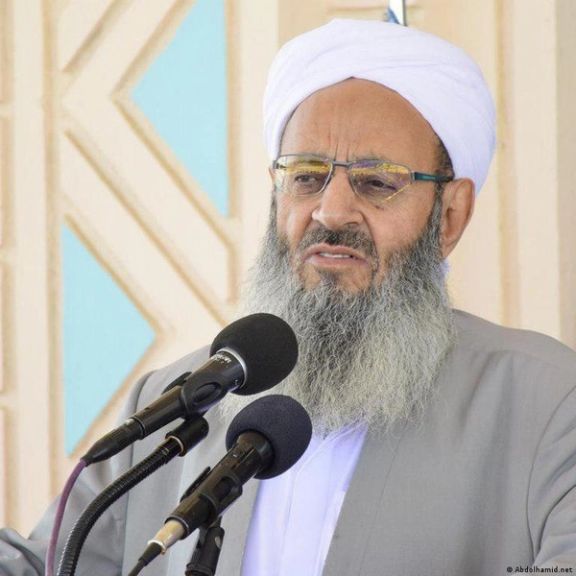
Mowlavi Abdolhamid, the top religious leader of Iran's largely Sunni Baluch population

The office of Iran's leading Sunni cleric, Mowlavi Abdolhamid, denied reports that he had endorsed any candidates in the upcoming presidential election.

While Abdolhamid had previously supported late President Ebrahim Raisi and reformist-backed candidates, he recently criticized both 'reformist' and conservative factions for their ineffective governance. “Despite their promises, the previous administrations failed to deliver. Reformists also failed to bring about a meritocracy system,” he stated. “We talked to the fundamentalists [conservatives] about national and regional problems, but they didn't show any real commitment to solving them.”

Abdolhamid emphasized the limited authority of past presidents, suggesting that "affairs are overseen from elsewhere," likely alluding to Supreme Leader Khamenei's control over decisions. He also raised concerns about the state's transparency and accountability.

Historically, any candidate with Abdolhamid's support won the election in the mostly Sunni populated Sistan-Baluchistan and Kordestan provinces. His popularity stems from his willingness to challenge Supreme Leader Ali Khamenei's authority. Abdolhamid has spoken out against discrimination faced by women, ethnic and religious groups, and minorities since the establishment of the Islamic Republic in 1979.

Previously, Abdolhamid supported Reformist President Mohammad Khatami (1997-2005) and moderate conservative Hassan Rouhani (2013-2021). He encouraged Iran's Sunni population to back ultraconservative Ebrahim Raisi in the 2021 presidential election but later criticized Raisi for failing to fulfill promises to the Sunni community. Following the killing of over 100 Sunnis in Zahedan during the 2022 protests, some criticized Abdolhamid for having supported Raisi.


Most Viewed

Iran International says it won’t be silenced after London arson attack
1

Iran International says it won’t be silenced after London arson attack

2
VOICES FROM IRAN

Hope and anger in Iran as fragile ceasefire persists

3

Iran halts petrochemical exports to supply domestic market

4
INSIGHT

How Tehran bends its own red lines to boost state rallies

5

US arrests Iranian national over alleged Basij-linked visa fraud

Banner
Banner

Spotlight

  • Hardliners push Hormuz ‘red line’ as US blockade tests Iran’s leverage
    INSIGHT

    Hardliners push Hormuz ‘red line’ as US blockade tests Iran’s leverage

  • Ideology may be fading in Iran, but not in Kashmir's ‘Mini Iran'
    INSIGHT

    Ideology may be fading in Iran, but not in Kashmir's ‘Mini Iran'

  • War damage amounts to $3,000 per Iranian, with blockade set to add to losses
    INSIGHT

    War damage amounts to $3,000 per Iranian, with blockade set to add to losses

  • Why the $100 billion Hormuz toll revenue is a myth
    ANALYSIS

    Why the $100 billion Hormuz toll revenue is a myth

  • US blockade targets Iran oil boom amid regional disruption
    ANALYSIS

    US blockade targets Iran oil boom amid regional disruption

  • Iran's digital economy battered by prolonged blackout
    INSIGHT

    Iran's digital economy battered by prolonged blackout

•
•
•

More Stories

Supreme Court Overturns Death Sentence of Toomaj Salehi

Jun 22, 2024, 11:44 GMT+1

Iran’s Supreme Court has overturned the death sentence of jailed Iranian rapper Toomaj Salehi that had shocked millions of Iranians and human rights defenders, as well as politicians in the West.

“The Supreme Court avoided an irreparable judicial error. The death sentence of Toomaj Salehi was overturned and based on the appeal decision of the 39th branch of the Supreme Court, the case will be referred to the parallel branch for consideration,” Salehi’s lawyer, Amir Raisian wrote on X.

Salehi was sentenced to death by a revolutionary court in Esfahan in April this year on charges of "spreading corruption on Earth."

Reisian, in an interview with Shargh, stated that the Supreme Court overturned the verdict arguing that the sentence of 6 years and 3 months was issued during the court proceedings for Salehi, so any sentence harsher in the subsequent stages of the trial is inconsistent with the law.

"The Supreme Court suggested that even the previous sentence" had been issued "without adhering to laws," Reisian said referring to the initial jail term issued before the death sentence.

Mostafa Nili, another lawyer for Salehi, in a separate interview mentioned that the Supreme Court also pointed out that two criminal charges have been considered for a single act.

For instance, Salehi has been convicted for spreading lies online and offline and that’s against the penal law, Nili said.

Salehi, the 2024 Václav Havel International Award laureate, has faced a tumultuous legal battle in Iran since his arrest multiple times by security forces, notably in October 2022 for supporting nationwide protests sparked by the death of Mahsa Amini in the custody of the morality police.

Initially sentenced to 6 years and three months in July 2023, Salehi was granted bail on November 18, 2023. However, less than two weeks later, the 32-year-old dissident rapper was re-arrested on new charges of "publishing falsehoods" after releasing a video detailing his torture experiences in custody, as reported by Raisian.

Voting Legitimizes the Islamic Republic, Prominent Scholar Warns

Jun 22, 2024, 10:59 GMT+1

Iranian female Islamic scholar Sedigheh Vasmaghi has contended that participating in the upcoming snap presidential elections will bolster the Islamic Republic's authority.

“When voter turnout is low, the ruling factions lose confidence, but high turnout empowers and validates them,” the academic wrote on her Instagram account on Friday.

“I view the people's vote as a valuable social and national asset that should not be squandered or benefit those responsible for current issues,” she added.

Previously, she cautioned "reformist" politicians against becoming ensnared in an unchangeable political system and "falling into the trap of tyranny."

Vasmaghi argued that currently, the Islamic Republic "is unable to confront the powerful and pervasive wave of change that has infiltrated its own ranks."

"In this context, to resist this tide, the ruling establishment has no alternative but to collaborate with a spectrum of reformists—a spectrum that is not threatening but rather enhances its authority."

Vasmaghi was detained in March for denouncing Supreme Leader Ali Khamenei as a dictator and criticizing compulsory hijab laws. Her health deteriorated during imprisonment, leading to her eventual release.

During her incarceration, Vasmaghi wrote to the United Nations Fact-Finding Mission and international human rights organizations, detailing the mistreatment she had to face and highlighting Iran's systemic oppression, especially towards women.

Iranian Candidate's Use of Protest Song in Campaign Sparks Backlash

Jun 22, 2024, 10:30 GMT+1
•
Niloufar Goudarzi

'Reformist' presidential candidate Masoud Pezeshkian's use of an iconic song from Iran's nationwide protests in his presidential campaign has sparked backlash on social media.

Critics assert that while Pezeshkian slammed the protests, dubbed Woman, Life, Freedom, he has appropriated the movement's song, “Baraye,” for his own political gain.

The demonstrations, lasting for months, began in the wake of the death of 22-year-old Mahsa Amini while in police custody, resulting in over 550 deaths.

In 2022, Pezeshkian condemned the demonstrations as orchestrated acts of hostility, blaming America and Europe for igniting Iran's worst uprising since the founding of the Islamic Republic.

Singer-songwriter Shervin Hajipour, honored with the Grammy's Best Song for Social Change in 2023 for "Baraye," was sentenced to more than three years in prison for incitement and provocation to disturb national security through his music.

He is one of dozens of artists imprisoned or levied with the likes of work bans, bank account freezes and travel bans for supporting the protests.

“Dear Mr. Pezeshkian, using Shervin's song this way may cost you votes because you were indifferent to the Woman Life Freedom movement,” a user wrote on X.

“Mr. Pezeshkian, please don’t use “Baraye” for the clerical establishment. It belongs to the people, not them,” another user wrote on X.

Critics on social media also highlighted Pezeshkian's silence on Hajipour's sentence.

US officials, including First Lady Jill Biden, praised the song as a powerful advocate for freedom and women's rights, underscoring its potential to inspire societal change.

State Department spokesman Matthew Miller condemned Hajipour's sentence as indicative of Iran's broader crackdown on dissenting voices.

When released, the song "Baraye" gained immense popularity. Within two days, it swiftly amassed over 40 million views on Shervin’s Instagram.

The Persian word “Baraye”٬ meaning “for …” or “for the sake of” punctuates each line of the song, crafted from a mosaic of Iranian tweets lamenting societal challenges: "For dancing in the streets; for fear of kissing; for the students and their future," and "for women, life, freedom."

While Pezeshkian is the only reform candidate among the six final candidates in the upcoming snap elections on June 28, he has grown increasingly more conservative in a bid to win the coveted presidential seat.

Nobel Laureate Condemns Iran’s Presidential Elections from Prison

Jun 22, 2024, 10:24 GMT+1

Iranian Nobel Peace Prize laureate Narges Mohammadi denounced the upcoming June 28 snap presidential election in Iran, calling it a facade orchestrated by an oppressive regime.

In a message from Evin Prison in Tehran on Saturday, Mohammadi said:

“I will not participate in the illegal elections of the oppressive and illegitimate government.”

Mohammadi questioned the integrity of the elections, highlighting the contradiction in the government's actions.

“How can you, while holding a sword, gallows, weapons, and prisons against the people with one hand, place a ballot box in front of the same people with the other hand, and deceitfully and falsely call them to the polls?”

Mohammadi further criticized the true intent behind the elections:

“The only purpose of holding elections for a regime that believes in repression, terror, and violence as the sole means to maintain power is not to uphold democracy and the rights of the people but to consolidate power and tyranny. Such elections will not bring legitimacy to the Islamic Republic.”

Six hand-picked candidates approved by Iran’s Guardian Council have been allowed to run in the presidential elections amid strict media control, while Iranian media and government officials admit a low level of voter interest.

Zarif’s Visit to Graves of Flight PS752 Victims Outrages Families

Jun 22, 2024, 06:42 GMT+1
•
Azadeh Akbari

The families of Flight PS752 victims, downed by IRGC missiles in 2020, say they are outraged by the recent visit of Iran's former Foreign Minister Javad Zarif to the graves of victims in Esfahan.

“The presence of Javad Zarif at the graves of our loved ones is outrageous,” the families’ association said in a statement.

“Javad Zarif is one of the individuals involved in covering up the crime of January 8, 2020, and the visits of any of the perpetrators and instigators of the crime to the graves of our loved ones once again demonstrate that the impudence of the officials of the Islamic Republic knows no bounds,” the statement added.

The Ukrainian Airline flight took off from Tehran in the early hours of that faithful day and minutes later two anti-air missiles fired by the IRGC downed the plane. For three days the authorities tried to cover up the incident, claiming a mechanical problem with the aircraft, until videos emerged showing the moment of impact. Zarif was foreign minister, and was heard saying that if the military had told him the truth earlier, he could have helped explain away the the incident.

It also said that Zarif and other authorities responsible for the downing of flight PS752, from IRGC Aerospace Chief Amir-Ali Hajizadeh to IRGC Chief Hossein Salami, and from the operator to Ali Khamenei, must be tried in a fair court.

”That day will come,” the statement said. “We neither forget nor forgive the perpetrators and instigators of this crime.”

Javad Soleimani, a member of PS752 Association’s board, earlier referred to Zarif and presidential candidate Masoud Pezeshkian who visited the graves together as "puppets" participating in Iran's "election circus."

Pezeshkian is backed by groups within regime politicians who are known as 'reformists' and he is running as a 'moderate.' Zarif, coming out of political retirement after three years, has joined the candidate, urging a reluctant electorate to vote for him. The visit to the resting place of the crash victims is seen as a campaign stunt by Pezeshkian, but Zarif's presence has angered many.

The Association’s statement drew attention to a controversial audio file leaked in 2021 in which Zarif was heard suggesting that the PS752 downing was likely unintentional.

"We will not forget the audio file of Zarif saying it was unlikely that the downing of the Ukrainian plane was intentional but if it was, they could tell us so we can ‘remedy’ it," Soleimani stated on X on Friday.

In the leaked audio file, Zarif was also captured stating that the truth surrounding the downing of PS752 would never come to light. Iranian officials attributed the downing of PS752 to "human error".

The flight PS752, which was shot down by the Islamic Revolutionary Guard Corps (IRGC) in January 2020, claimed the lives of 176 passengers and crew, including Soleimani's wife, Elnaz Nabiyi.