• العربية
  • فارسی
Brand
  • Iran Insight
  • Politics
  • Economy
  • Analysis
  • Special Report
  • Opinion
  • Podcast
  • Iran Insight
  • Politics
  • Economy
  • Analysis
  • Special Report
  • Opinion
  • Podcast
  • Theme
  • Language
    • العربية
    • فارسی
  • Iran Insight
  • Politics
  • Economy
  • Analysis
  • Special Report
  • Opinion
  • Podcast
All rights reserved for Volant Media UK Limited
volant media logo

Canada Court Says Airline Failed To Cancel Iran Flight Downed By IRGC

Jun 11, 2024, 11:07 GMT+1

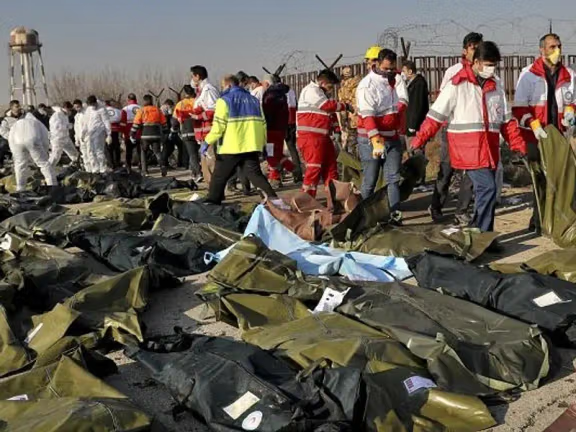
A court in Ontario has found that Ukraine International Airlines failed in its duty to cancel flight PS752 in 2020 that took off from Tehran amid military activity and was downed by the IRGC killing 176.

This judgment does not absolve the IRGC from responsibility in the downing of the aircraft. The Ontario Superior Court of Justice earlier labeled the missile strike by the IRGC as "terrorist activity" and dismissed claims by Iran that the downing was a mere "human error."

The judgement on Monday found, that despite the IRGC's deliberate firing of two missiles at the airliner, the company could not prove that it acted according to standards to cancel the flight amid potential military activities in the early hours of January 8, 2020.

“I declare that the defendant has failed to prove, on a balance of probabilities ... that the plaintiffs’ damage was not due to the negligence or other wrongful act or omission of the carrier or its servants or agents; or that such damage was solely due to the negligence or other wrongful act or omission of a third party,” said Justice Jasmine Akbarali on Monday.

Legal expert Paul Miller commented on the verdict, stating, "This verdict sends a strong message to international airlines that passenger safety must always be their top priority. Airlines must take proper measures to avoid operating in conflict zones.”

The judgment now means that under the Montreal Convention, UIA cannot limit compensation to $180,000 USD per passenger but must pay full compensatory damages for the fatalities, a small victory for the families of victims who are still seeking justice for Iran's act of shooting down the plane. 

Iran failed to close its airspace during the hours when it launched the attack and was expecting a US retaliation. Later, when it was proven the airliner was downed by two IRGC missiles, Iranian officials argued that it was human error due to the tense situation prevailing in the aftermath of the attack on US bases.

The incident claimed the lives of 176 people, including 63 Canadians, 10 Swedes, and 82 Iranians. Flight PS752 was hit by two IRGC air-defense missiles shortly after departing from Tehran's Imam Khomeini International Airport.

When it was proven the airliner was downed by two IRGC missiles, Iranian officials argued that it was human error. They have also prevented an independent investigation of the incident and disclosing full details. For three days after the incident, they hid the fact that the plane was shot down, insisting that the crash was an accident.

Most Viewed

US terminates green cards of 3 Iranians tied to Islamic Republic
1

US terminates green cards of 3 Iranians tied to Islamic Republic

2
PODCAST

Worst outcome is Islamic Republic’s survival, ex-CIA official says

3
ANALYSIS

Iran brings unusually broad team to US talks to blunt future blame

4
INSIGHT

Tehran sends tough message but keeps diplomacy door open

5

Zoroastrian religious figure arrested in Iran

Banner
Banner

Spotlight

  • Tehran sends tough message but keeps diplomacy door open
    INSIGHT

    Tehran sends tough message but keeps diplomacy door open

  • Worst outcome is Islamic Republic’s survival, ex-CIA official says
    PODCAST

    Worst outcome is Islamic Republic’s survival, ex-CIA official says

  • Why the Iran-US truce is more likely to buy time than peace
    ANALYSIS

    Why the Iran-US truce is more likely to buy time than peace

  • Engaged but uncommitted: China watches Iran and US fight and talk
    ANALYSIS

    Engaged but uncommitted: China watches Iran and US fight and talk

  • A truce for the world, a reckoning for Iran’s economy
    ANALYSIS

    A truce for the world, a reckoning for Iran’s economy

  • Why the world failed to bypass the Strait of Hormuz
    ANALYSIS

    Why the world failed to bypass the Strait of Hormuz

•
•
•

More Stories

Iranian Dissident Alleges Sexual Assault Threat by Security Forces

Jun 11, 2024, 10:30 GMT+1

Former political prisoner Hossein Ronaghi has alleged that security forces threatened him with sexual assault and confiscated his belongings while he was traveling from Tabriz to Tehran on Sunday.

In a social media post on Monday, the activist described the incident: “What stood out for me was the public threat of rape by a young man in plain clothes at the Tabriz airport, along with the deputy prosecutor of Tabriz breaking the law and stealing my belongings!”
As he described on X, the national emblems of the Lion, Sun, and "Woman, Life, Freedom" movement caught the attention of agents, who ridiculed him. Woman, Life, Freedom became the slogan for the nationwide protest in Iran in 2022 following the death of Mahsa Amini in police custody. Over 550 protesters were killed during the uprising.

Ronaghi had to flee his home in September 2022 as security agents raided his home while he was speaking with Iran International about unfolding protests.


The blogger was waiting to board the flight in the transit lounge when officers of the Islamic Revolutionary Guard Corps (IRGC) approached him and told him they need to ask questions and inspect his bag one more time. He was then interrogated, and his belongings were searched.

The agents told him he could not leave unless he surrendered all his belongings, claiming that the deputy prosecutor of Tabriz had ordered the confiscation of his mobile phone, laptop, electronic devices, and identity documents.

Describing the conversation he had with one of the agents, Ronaghi wrote: “Suddenly, in a harsh tone, he threatened to rape me, saying: ‘It's a pity that Islam has tied my hands. Otherwise, I would have shown you what it means to suffer (as a result of rape)!

Ronaghi wrote he replied to the plainclothesman: Do you think these threats scare us? Or does it compel us to be silent? No one is afraid of you anymore!" Ronaghi wrote on X.

Ronaghi's brief detention at the airport and confiscation of his belongings could be part of regime actions to intimidate dissidents during the tightly controlled presidential election on June 28. He is a well-know dissident and has published opinion articles in Western media.

In the past decade, the dissident activist has been arrested several times and has staged hunger strikes in prison. He was first arrested, along with his brother Hassan, in the aftermath of the disputed presidential elections in 2009 for assisting journalists and political activists to circumvent internet censorship. In addition, he was charged with insulting the Supreme Leader Ali Khamenei in his blog posts.

His most recent arrest was in September 2022 during the Woman, Life Freedom protests. He was detained along with his lawyers in front of the Evin Prison prosecutor's office and subsequently tortured. In protest, he went on a hunger strike. Iranian authorities later released Ronaghi on bail.

According to human rights sources, previous rounds of torture had resulted in him losing one kidney, with his remaining kidney functioning at only 60 percent.

Iran Imprisons Cartoonist for Six Years

Jun 11, 2024, 09:22 GMT+1

The Revolutionary Court of Tehran has handed down a six-year prison sentence to Atena Farghadani, a cartoonist targeted for her critique of the government.

According to her attorney, Mohammad Moqimi, Farghadani has been behind bars since her arrest on April 13, charged with “insulting sacred values and propagating against the ruling system". Farghadani received five years for the former and an additional year for the latter. Moqimi blasted the proceedings as a "sham trial" in a post on the X, denouncing the judiciary's manipulation of charges to secure the harshest possible sentence.

Farghadani came to a head when she was seized by security forces while attempting to display her artwork on a street wall outside Supreme Leader Ali Khamenei’s compound in response to the suppression of her art exhibition and the continuous harassment by security personnel. 

Post-arrest, she was subjected to torture in a Revolutionary Guard-operated safe house, before being transferred to Evin prison.

Her imprisonment has drawn criticism from global human rights entities, including PEN America, Cartooning for Peace, and the Cartoonists Rights Network International, which have collectively decried her arrest and the punitive actions against her, urging for her immediate release.

The crackdown on artists has worsened since the 2022 uprising with some even receiving the death penalty, as seen in the recent case of Toomaj Salehi, a dissident rapper who is now on death row.

'Life Is Living Hell', Says Israeli Citizen on Clashes with Hezbollah

Jun 11, 2024, 07:15 GMT+1
•
Negar Mojtahedi

Northern Israeli residents who face daily attacks from Iran-backed Hezbollah say their lives have turned into "hell", and view the Islamic Republic of Iran as responsible.

Hezbollah launched anti-aircraft missiles at Israeli fighter jets over southern Lebanon on Sunday, according to the Israel Defense Forces (IDF), as cross-border skirmishes between Israel and the Iran-backed terror organization intensify.

Incoming rocket alerts were also activated in the northern coastal region of Acre overnight Monday, the IDF said in a statement.

The drones and anti-tank missiles launched caused fires and damaged buildings in northern Israel. This came just a week after Hezbollah rockets sparked days of wildfires in northern Israel, with a forest reserve destroyed and at least 11 people hospitalized for smoke inhalation.

Since October 7, clashes between Israel and Lebanon have escalated, with 150,000 people on both sides of the boundary forced to flee their homes. Recent attacks have increased the fears of full-scale war.

For Northerners in Israel, everyday life is a battle, Israeli resident Ofri Eliyahu Rimoni told Iran International. "Life is a living hell' for people of the North," she told Iran International.

"Alarms four or five times a day, telling us to go to shelters to stay there. A lot of people was displaced from their homes and the people who didn't get displaced from their homes, they are right now living in a war zone. Literally a war zone," she said.

She said agriculture is the main industry in the region and the wildfires set off by Hezbollah attacks are devastating the local economy as people risk their lives just to work in the fields.

"Your whole life burning down. It's burning my heart," said Rimoni.

Israeli Prime Minister Benjamin Netanyahu threatened further military action after the onslaught of Hezbollah attacks in the North.

While touring the damage from the fires in the northern city of Kiryat Shmona last week, Netanyahu said that Israel was preparing for “very intense action in the north.”

“One way or another, we will restore security to the north,” Netanyahu said.

60,000 people, who previously called the North their home, are living in hotel rooms scattered across Israel.

On June 5, at least 11 people from a Druze Arab village of Hurfeish in northern Israel were injured after Hezbollah launched an armed drone attack. One person was reportedly in critical condition after the exploding drones crashed into a soccer field. 39-year-old First Sergeant (res.) Refael Kauders was killed.

On Telegram, Hezbollah took credit for the attack, claiming the attack was in response to an Israeli strike on June 4 that killed a Hezbollah operative in the southern Lebanese town of Naqoura.

Mufid Mari, a former Knesset member and retired IDF Colonel is from the Druze village of Hurfeish that was hit. He said life is not normal, with tourism at a standstill in the north and the Hezbollah attacks impacting factories and day-to-day life.

Mari said Druze villages are especially vulnerable to Hezbollah attacks because 40 percent of their homes are old and are not equipped with safe houses to protect them against rockets. When the sirens sound, the goal is to move as quickly as possible, in a matter of seconds, to the safe room.

"All of us in the Middle East, we want and need to be living in peace," said Mari.

Mari said the daily attacks are intolerable and he believes they need to get ready for a large-scale war with the Iran-backed proxy.

Israeli security expert Sarit Zehavi said Northerners in Israel are expecting a Hamas-style attack in the region. Zehavi said more than a decade ago, Hezbollah published its offensive plan for an attack on Israel - and she described its similarity to what Hamas did to southern Israel as “astonishing.”

The anticipated attack hasn't happened yet, she believes, because tens of thousands of residents have already evacuated. She said most of the attacks are in evacuated areas, but in the recent weeks there were more attacks on areas which are further from the border with Lebanon.

"These are exactly the areas that the UAVs and the anti-tank in the rockets aim to and this is every day," said Zehavi.

Zehavi, who served 15 years as an intelligence officer in the IDF said "the evacuated towns have no prospect when they will be able to come home. They just don't know how this is going to play out. And it's so sad to see the beautiful valley empty like this."

Zehavi said all roads lead to Iran.

The founder of the Alma Research Center which monitors and disseminates information on the threats faced in the North, referred to Iran as the 'engineer' and the 'architect' behind everything happening.

"This is all part of the same campaign under the title 'unification of fronts.' The idea of unification of fronts is to create a multi-front campaign against the State of Israel by these proxies."

It is widely believed that Iran supports Hamas with $1 billion a year. The Islamic Republic also supports Palestinian Islamic Jihad with tens of millions and is providing Hezbollah with 70 per cent of its budget - and its ideology.

Hezbollah opened a battle front with Israel on Oct. 8, a day after the deadly Hamas attacks in Israel.

While the US and France have been trying to find a diplomatic solution to the conflict, Northerners in Israel say they just want to have their lives back.
Iran Escalates Crackdown on Cafes Serving Alcohol Secretly

Jun 11, 2024, 02:30 GMT+1
•
Azadeh Akbari

Iranian law enforcement agencies have recently widened their crackdown on cafes secretly serving alcohol to customers, with two cafes in Tehran province sealed by authorities in the last week.

State-affiliated media quoted Amir Ahmadi, the Public Prosecutor of Baharestan County, in Tehran province, announcing that two cafes were sealed after being identified for serving alcoholic beverages.

Selling, possession and drinking alcohol by Muslims was prohibited in Iran after the establishment of the Islamic Republic in 1979. During the monarchy alcoholic beverages were unrestricted, subject to certain regulations.

IRGC-affiliated Tasnim News Agency on Sunday quoted Ahmadi as saying, "A cafe in the city of Salehieh that served alcoholic beverages at the premises was sealed. The cafe owner and two of the customers of the cafe were arrested."

Ahmadi further stated that arrests were made in addition to the cafe being sealed.

“The operator of the cafe and two of the customers were arrested,” he added.

He also warned that all cafes in Baharestan County are being closely "monitored" and "must comply with Sharia law."

"We will not allow alcohol to be served in public places and cafes in the city under any circumstances," Ahmadi stated. "If we find any violations, decisive action will be taken against the operators, as demonstrated by the recent closures of cafes for serving alcohol."

The increased crackdown on alcohol consumption coincides with government efforts to enforce hijab rules

Additionally, on May 15, Asghar Jahangir, Iran’s judiciary spokesperson announced the arrest of a garden owner accused of producing homemade alcohol that poisoned some people. The garden was subsequently sealed, according to Entekhab News.

He added that 24 people were present at this gathering of which 6 were poisoned and 1 died as a result of consuming counterfeit alcohol.

Moreover, last year in July, Mohammad Yousefvand the Public and Revolutionary Prosecutor of Robat Karim County, Tehran Province, announced that five cafes had been sealed and four individuals were arrested. Yousefvand further stated that 6 individuals were killed as a result of consuming bootleg alcohol, and 22 people were poisoned in Robat Karim.

Individuals who breach the ban on alcohol are punished with lashings and monetary penalties. For those who distribute alcohol, the penalties are even higher with the possibility of capital punishment. In September last year, four men were sentenced to death for their involvement in counterfeit alcohol distribution which allegedly led to the death of 17 individuals.

Despite the ban and the recent heightened crackdown by authorities on cafes, shops, parties, and gatherings where alcohol is served or sold, Iranians continue to consume alcohol.

A survey by Iran Open Data in 2021 found that half of all adults in Iran regularly drink alcohol with homemade alcohol being the preferred choice.

Furthermore, a survey by World Health Organization in 2018, placed Iran in the 9th ranked among 189 countries for alcohol consumption per capita.

With bootleg alcohol consumption on the rise in Iran, some critics believe that hardliners are involved in widespread alcohol poisoning as they believe those who consume alcohol must be punished.

Nevertheless, with alcohol consumption unregulated and prohibited, Iranians lack safety measures for responsible drinking, leaving them vulnerable to the dangers of counterfeit alcohol which include poisoning, blindness, and death.

Two Candidates Say Nothing About Foreign Policy on Iran TV

Jun 10, 2024, 21:04 GMT+1
•
Maryam Sinaiee

Iran’s state TV began its programs introducing the six handpicked presidential candidates on Monday, airing recorded interviews with each candidate before four-hour TV debates take place starting next week.

The interviews with Masoud Pezeshkian and Parliament Speaker Mohammad-Bagher Ghalibaf took place on Monday and were focused on the economy and other issues without any reference to foreign policy, the nuclear issue, or hijab.

In his first interview with the news channel Monday evening, Pezeshkian, the only approved ‘reform’ candidate referred to the “divide between the people and the government” as a major issue.

Pezeshkian stressed that his government would not introduce any new economic strategies and policies. Instead, he said, it will try to efficiently implement the existing development plan by reforming the administrative system, making it transparent and accountable.

Pezeshkian criticized the lack of justice in distribution of wealth and resources among the country’s provinces and stressed the importance of improving the lives of civil servants, relying on experts and the elite personnel, improving and stabilizing the environment for domestic and international investment for a desirable level of economic growth.

However, the issue in Iran is not only fair distribution but lack of resources to distribute. The country’s bombastic foreign policy and its expanding nuclear program have impeded oil exports, foreign trade, technology and investments.

Pezeshkian, 69, is running against five hardliners including “neo-conservative” Parliament Speaker Mohammad-Bagher Ghalibaf and former nuclear negotiator Saeed Jalili.

The outspoken cardiac surgeon, served as health minister under reformist Mohammad Khatami and has been elected five times as representative of Tabriz, capital of the East Azarbaijan Province since 2007. He was deputy speaker from 2016 to 2020.

Spokesman of the Reforms Front, Javad Emam, in a statement Sunday expressed regret over the disqualification of the Front’s two other candidates, Abbas Akhundi and former Vice-President Es’haq Jahangiri, as well as candidates of other political groups and confirmed that the Front would be supporting Pezeshkian as its candidate.

The Reforms Front had insisted it would not participate in the elections if none of its three proposed candidates were allowed to run. The Front’s leader, former President Mohammad Khatami, abstained from voting in the parliamentary elections in March to protest the extensive disqualification of ‘reformist’ candidates by the un-elected watchdog, the Guardian Council.

In a short statement Monday, Jahangiri who also registered to run but was barred by the Guardian Council announced his full support for Pezeshkian as the Reforms Front’s candidate.

In a tweet Monday, however, former Vice-President Mohammad-Ali Abtahi warned about too much optimism over Pezeshkian’s chances of being elected based on the increasing attention he is gaining on social media. “Social media only reflects [the views] of a small part of the society. Candidates and their supporters shouldn’t be misled by the social media,” he tweeted.

Journalist and political commentator Ahmad Zeydabadi opined in an interview that for Pezeshkian to succeed, he must become a symbol of change for the younger generation like the leader of the Green Movement Mir-Hossein Mousavi in the 2009 elections.“Two things matter to those who want to vote: what direction are [the candidate’s] plans and how feasible their execution is given the existing structures,” he wrote.

“Mr. Pezshkian has high influence among ethnic groups,” Zeydabadi said, adding that not only the Turki-speaking population but also the Kurds and other ethnic minorities may go to the ballots to vote for him. According to Zeydabadi Pezeshkian’s chances of being elected is good but “what happens after he is elected” that worries him.

Pezeshkian is the front-runner in an online poll by Tabnak, a conservative news website close to the secretary of the Expediency Council, Mohsen Rezaei, with 67 percent of the 16,500 votes Monday. In the same poll, Ghalibaf and Jalili both have less than 13 percent of the votes.