• العربية
  • فارسی
Brand
  • Iran Insight
  • Politics
  • Economy
  • Analysis
  • Special Report
  • Opinion
  • Podcast
  • Iran Insight
  • Politics
  • Economy
  • Analysis
  • Special Report
  • Opinion
  • Podcast
  • Theme
  • Language
    • العربية
    • فارسی
  • Iran Insight
  • Politics
  • Economy
  • Analysis
  • Special Report
  • Opinion
  • Podcast
All rights reserved for Volant Media UK Limited
volant media logo

‘Iranians Ready To Sacrifice for Revolution,’ Pahlavi Says in Interview
May 28, 2024, 11:22 GMT+1Updated: 16:43 GMT+0
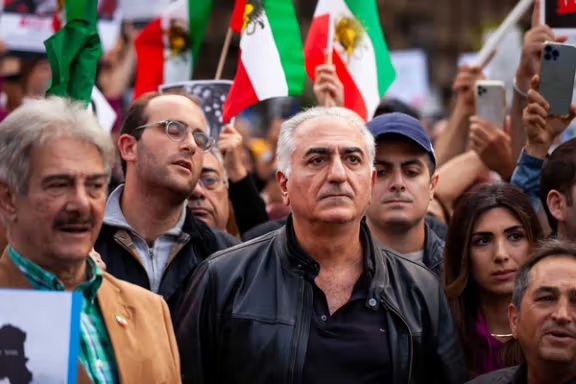
Iran’s exiled prince Reza Pahlavi, who has become a leading opposition figure since the start of Women, Life, Liberty movement, during a rally against the Islamic Republic in Washington in 2022

Iran’s exiled Prince Reza Pahlavi has unequivocally declared his desire for regime change in an interview with Germany’s Spiegel magazine.

Pahlavi says the Iranian people are willing to make sacrifices for a new revolution to overthrow the Islamic Republic “because they know that their country is doomed” otherwise.

“The question is not whether the regime will disappear, but when, and whether we have given Iranian society the maximum support,” Pahlavi insisted.

The latest interview is part of Pahlavi’s recent media tour, which seemingly began amid escalating tensions between Iran and Israel.

Describing the 2022 nationwide protests as transformative, Pahlavi said, “The last uprising was already a revolution” and an “authentic reaction against the oppression.”

In its crackdown on these protests, Iranian security forces killed at least 550 protestors, including children, and imprisoned over 20,000 people.

Pahlavi emphasized that the Iranian state is “weaker than ever,” with Supreme Leader Ali Khamenei, who represents the system, rejected by at least 80% of Iranian society.

In the extensive interview with foreign correspondent Susanne Koelbl, Pahlavi was also asked why the various factions of the exiled Iranian opposition have failed to agree on a common approach and with whom he cooperates.

Pahlavi, seemingly avoiding the second part of the question, stated that when he “appears with representatives of the opposition, as recently at Georgetown University in Washington,” he views it as “symbolic cooperation.” He emphasized that the “great unity in Iran and a common vision” are “more important” to him.

Earlier this month, Pahlavi had noted that extreme factions of the right and the left within the opposition to the regime are preventing unity.

Pahlavi reiterated his call for Western governments to maximize support for dissidents and activists in Iran while increasing international pressure on the regime through sanctions. He also reaffirmed his support for listing the IRGC as a terrorist entity.

Discussing the aftermath of a potential revolution in Iran, he advocated for a general amnesty for a peaceful transition, ensuring accountability for certain individuals.

When asked whether he wanted to offer “opportunities” to potential defectors, Pahlavi emphasized his goal to “lose as few lives as possible in the process.” To achieve this, he argued that the resistance of those holding weapons must be minimized.

“If the rulers try to commit a genocide at the last minute, the Iranian security forces must become a shield for the population,” he said.

Pahlavi Distances Himself From Father’s Legacy

Pahlavi noted that there are clear signs indicating that many Iranians have revised their previous stance on the monarchy's legacy and that younger generations desire change, despite the decades of Islamic indoctrination they have faced since 1979.

When the interviewer confronted Pahlavi about his views on the violence perpetrated by Savak, the secret police and intelligence service of Iran during the reign of his father, Mohammad Reza Shah Pahlavi, Pahlavi acknowledged that while there is legitimate criticism of Savak, there is also a “disproportionate exaggeration of facts, especially from radical Islamists and Marxists.”

“They had an interest in discrediting the government, which was largely pro-Western and did not align with their ideologies. Historians should work this out,” he said.

When the interviewer insisted that much is already known about Savak's actions, Pahlavi distanced himself from his father's legacy, emphasizing his own plans and vision, and asserting that he should be judged based on his own proposals and actions.

“I am not my father. I have my own plans, my own vision, and I should be judged by what I propose,” Pahlavi said.

Pahlavi had previously supported certain policies of his father, highlighting that among those detained by Savak was Iran’s current Supreme Leader, Ali Khamenei.


Most Viewed

Iran negotiators ordered to return after internal rift over Islamabad talks
1
EXCLUSIVE

Iran negotiators ordered to return after internal rift over Islamabad talks

2
ANALYSIS

US blockade enters murky phase as tankers spoof signals and buyers hesitate

3

US tightens financial squeeze on Iran, warns banks over oil money flows

4
INSIGHT

Ideology may be fading in Iran, but not in Kashmir's ‘Mini Iran'

5
INSIGHT

Hardliners push Hormuz ‘red line’ as US blockade tests Iran’s leverage

Banner
Banner

Spotlight

  • Hardliners push Hormuz ‘red line’ as US blockade tests Iran’s leverage
    INSIGHT

    Hardliners push Hormuz ‘red line’ as US blockade tests Iran’s leverage

  • Ideology may be fading in Iran, but not in Kashmir's ‘Mini Iran'
    INSIGHT

    Ideology may be fading in Iran, but not in Kashmir's ‘Mini Iran'

  • War damage amounts to $3,000 per Iranian, with blockade set to add to losses
    INSIGHT

    War damage amounts to $3,000 per Iranian, with blockade set to add to losses

  • Why the $100 billion Hormuz toll revenue is a myth
    ANALYSIS

    Why the $100 billion Hormuz toll revenue is a myth

  • US blockade targets Iran oil boom amid regional disruption
    ANALYSIS

    US blockade targets Iran oil boom amid regional disruption

  • Iran's digital economy battered by prolonged blackout
    INSIGHT

    Iran's digital economy battered by prolonged blackout

•
•
•

More Stories

Activist Masih Alinejad Slams UN Memorial for Ebrahim Raisi

May 28, 2024, 10:14 GMT+1

Masih Alinejad, an Iranian journalist and women's rights activist, has slammed the UN for holding a memorial service for the late Iranian President Ebrahim Raisi at its headquarters in New York later this week.

Alinejad, known for her vocal opposition to the Iranian government, addressed an open letter to UN Secretary-General António Guterres expressing her strong disapproval of the event. "Honoring a leader implicated in severe human rights violations sends a deeply troubling message to the victims of his regime’s brutality," Alinejad wrote on X.

The activist who has been subject to multiple assassination attempts from Iran-backed agents for her bold dissent, highlighted the late president's policies of violence and suppression.

"Raisi's tenure is marked by the violent suppression of women and peaceful protesters,” she said, over 500 protesters killed in the wake of the 2022 uprising. “His directive to crack down on women defying the mandatory hijab law has led to widespread violence and deaths, including the tragic case of Mahsa Amini," Alinejad stated.

Iranian Nobel Peace Prize laureate Narges Mohammadi, currently detained in Evin Prison, labeled the memorial "a celebration of the gallows," referencing a record year of executions in Iran. 

Shirin Ebadi, another Iranian Nobel laureate, joined the chorus of voices asking the UN to cancel the even, calling it a mockery of the UN's foundational principles.

The United Nations has already observed a minute of silence for Raisi and flew its flag at half-mast last Monday.

However, the UN struggles to deal with the regime. While the UN has claimed 834 people were executed in Iran in 2023 alone, in November, Iran was invited to chair a UN human rights forum while the UN’s own investigation was looking into the country’s gross human rights violations.

Nikki Haley Blames Iran, Russia, China for Hamas Attack

May 28, 2024, 09:08 GMT+1

The former US Ambassador to the United Nations has blamed Iran, Russia and China for their alleged roles in orchestrating the October 7 Hamas attack on Israel.

During a visit to Israeli communities devastated by the attack at the remnants of the destroyed Sderot police station, Nikki Haley cautioned that similar attacks could potentially occur on American soil if vigilance wanes. "If we are arrogant enough,” such an attack “could absolutely happen in America too," she stated.

Haley blamed the coordination of the October 7 attack on Iran, claiming it was assisted by Russian intelligence and financed by Chinese funds. Hamas’s attack on October 7 “was orchestrated by Iran. It was helped with Russian intelligence. And it was fueled by money from China. Don’t deny that,” Haley asserted. 

She further accused China of long-standing financial support to Iran, which in turn facilitated the training and operational planning carried out by Hamas in the attack which saw over 1,200 mostly civilians murdered and over 250 taken hostage.

In a telling revelation last month, an ultra-conservative Iranian political faction admitted that the late Mohammad Reza Zahedi, commander of Iran's Revolutionary Guard Corps (IRGC), killed in an alleged Israeli airstrike in Syria, played a significant role in the planning and execution of the October 7 attacks.

Zahedi, together with his deputy and five other IRGC members, was killed in the airstrike targeting Iran’s consulate in Damascus on April 1. Israel has not confirmed the attack which led to an unprecedented direct attack from Iran in an aerial assault two weeks later.

Iran Boasts About Missile Attacks on Neighbors and Israel

May 28, 2024, 08:59 GMT+1

Iran's acting president Mohammad Mokhber claimed on Monday that Iran is now much stronger than a few years ago, asserting it could 'hit' neighboring countries and Israel with little to no repercussions.

Mokhber was referring to missile attacks by Revolutionary Guards (IRGC) against targets in Pakistan, Iraqi Kurdistan, and Israel, all of which have taken place in the context of an ongoing conflict after 7 October.

"There was a time when [the IRGC] would test a missile, and all [Iran’s] markets would be unsettled. Government officials would scream, saying, ‘what will happen to our country after what you did’. [But] today, three countries have been hit. We hit Israel. [Yet] people wake up in the morning… and the currency rate is the same. Inflation is the same," Mokhber said.

The interim president was speaking at the opening ceremony of Iran’s new parliament, defending the government of former president Ebrahim Raisi, who died in a helicopter crash in northwestern Iran last week. Mokhber seemed to be undisturbed by the presence of foreign dignitaries, including those whose countries were targeted by the IRGC missiles.

His remarks raised a few eyebrows, not least because Pakistan and Iraq whose targeting Mokhber seemed to be celebrating, declared national mourning following the death of Ebrahim Raisi and sent high-ranking delegations to his funeral.

As undiplomatic as Mokhber’s words may be, it betrays an element of truth that has been brought up by many politicians in the US and elsewhere: that the Islamic Republic of Iran has gained in confidence and aggression in the past few years, especially since Joe Biden entered the White House.

Biden critics say his ‘leniency’ has emboldened Iran and the IRGC. On Monday, Wall Street Journal reported that the Biden administration is advising European countries to "back off plans to rebuke Iran" for advances in its nuclear program, hoping to prevent escalation ahead of the 2024 US elections in November.

Even more controversial than his assertion about Iran becoming immune to repercussions, was Mokhlber’s claim that economy had come out unscathed from Tehran’s aggressive actions –on the day that brokers in two major stock exchanges in Iran halted trading to protest the downturn in Iran’s stock market.

Many users on social media were quick to point out that Iran’s currency hit an all-time low against the US dollar following the IRGC’s drone and missile attack on Israel on April 13. Others mocked Mokhber's words, stating that Iran’s economy was in ruins, and that millions of Iranians were struggling to make ends meet while the nation’s wealth was being spent on the regime’s costly adventures in the region and beyond.

It’s unclear if Mokhber will stand in the upcoming elections to replace Raisi. He is well positioned as vice-president and enjoys the trust of Supreme Leader Ali Khamenei. However, other hardline figures are also contenders, such as Saeed Jalili, a former nuclear negotiator known for his tough stance, and Parviz Fattah, a former IRGC member currently heading the influential parastatal foundation for the Execution of Imam Khomeini’s Orders, a key player in Iran’s economy.

Iran's Ghalibaf Re-elected Parliament Speaker Despite Challenge

May 28, 2024, 07:36 GMT+1

Veteran politician and former IRGC general Mohammad Bagher Ghalibaf was re-elected as Speaker of Iran’s new parliament on Tuesday, after the March 1 low-turnout election.

Ghalibaf faced attacks by hardliners in the past few weeks, who were expected to challenge his bid for re-election as Speaker. However, with 198 votes out of 290 parliamentary seats, he secured a second term.

The election came less than 10 days after President Ebrahim Raisi was killed in a helicopter crash, which rattled the upper echelons of the clerical government in Iran. Supreme Leader Ali Khamenei in speeches following Raisi’s death had called for solidarity among regime loyalists.

Ghalibaf’s only serious challenger, Mojtaba Zolnur, a hardline cleric received 60 votes. Observers had predicted that Khamenei would back Ghalibaf’s re-election as Speaker, since he is a reliable loyalist and independent of the ultra-conservative Paydari (Steadfastness) Front.

Ghalibaf's name is also being mentioned as a possible candidate for the snap presidential election scheduled for June 28 to choose a successor to Raisi. He has run for the presidency in the past although he has not announced his intentions for this round.

Hardliners have dominated the Islamic Republic’s parliament since 2020, when the Guardian Council, controlled by Khamenei, barred hundreds of other regime insiders from running in the previous elections. The March 1 vote witnessed the repeat of the 2020 mas disqualifications, leaving mostly hardline loyalists to compete over the parliamentary seats.

Iran Snap Elections: A Race Between Hardliners

May 28, 2024, 01:22 GMT+1
•
Negar Mojtahedi

Hardliners, hardliners and more hardliners are going to be the likely choices Iranians will have to choose from when it comes to next month’s snap election after the death of their president in a helicopter crash.

“It's just a contest between different hardliners, and they're all devoted to [Supreme Leader Ali] Khamanei,” said Arash Azizi, Iran analyst and author of ‘What Iranians Want: Woman, Life, Freedom.

Azizi said an important question is which hardliners will run and which organizations will support it, and if centrists and so-called reformists are allowed to run, who will it be and how will everyday Iranians react given epic low voter turnouts in the last few years?

In March, less than 10% of Iranians voted in parliamentary by-elections. Many observers believe real turnout in the last two previous elections has been around 20-30 per cent.

As the registration for Iran’s presidential elections draws near on May 30 and closes on June 3, Azizi ’s list of potential candidates are as follows:

Saeed Jalili is an Iranian conservative politician.
100%
Saeed Jalili is an Iranian conservative politician.

Saeed Jalili: He’s an ultra-hardliner who confirmed his candidacy this weekend. According to Azizi, he is unpopular and "very widely hated.” Azizi described his main path to be ordering the Islamic Revolutionary Guard Corps (IRGC) to beat up women on the streets of Iran. Jalili was the secretary of the National Security Council between 2005 to 2013 and was the chief nuclear negotiator. Azizi said “he was an absolute disaster in that position.” With a PhD on diplomacy of the Prophet Mohammad, Azizi said Jalili was not the ‘career diplomat’ type to get the job done.

Parviz Fattah is an Iranian conservative politician and former member of the Revolutionary Guard. He has been head of the Execution of Imam Khomeini's Order since 2023.
100%
Parviz Fattah is an Iranian conservative politician and former member of the Revolutionary Guard. He has been head of the Execution of Imam Khomeini's Order since 2023.

Parviz Fattah: Azizi said he was the head of the Execution of Imam Khomeini’s Orders Headquarters. “They're called parastatal foundations. It is an organization, whose head is appointed by Khamenei. And they were built by expropriating the wealth of, you know, Iranians before 1979. And they use that to do all sorts of things,” said Azizi. He said Fattah’s base is with the IRGC and military caste.

Saeed Mohammad is an Iranian politican and second brigadier general in the IRGC.
100%
Saeed Mohammad is an Iranian politican and second brigadier general in the IRGC.

Saeed Mohammad: Azizi described him as being similar to Fattah and came from a background in the IRGC. He’s much younger than other potential candidates being in his 50s and he tried to run in 2021 but was barred from the Guardian Council.

Ali Larijani is the former Speaker of the Parliament of Iran.
100%
Ali Larijani is the former Speaker of the Parliament of Iran.

Ali Larijani: Azizi calls him a “Centrist conservative” only because he supported so-called centrist former President Hassan Rouhani in the past election. He’s the former speaker of the parliament and hails from the religious center of Qom. “He is also currently from the foundation of the regime. His brother was the head of the Expediency Council. Sadeq Larijani, who was the former head of the judiciary, a potential kind of a Supreme Leader even at some point, one of his other brothers, was a key sort of people person in the Iranian Foreign ministry for many years, the key clerical family that had been sidelined by the regime in recent years,” added Azizi.

Mohammad Bagher Ghalibaf is the current Speaker of Iran's Parliament.
100%
Mohammad Bagher Ghalibaf is the current Speaker of Iran's Parliament.

Mohammad Bagher Ghalibaf, is the current Parliament Speaker. Azizi said Ghalibaf is “also a conservative hardliner in some way, but known to be much more technocratic than ideological.” According to Azizi’s sources there was a meeting between Iran’s Supreme Leader and Ghalibaf that did not go well. He said he has a lot of political ambition with a deep IRGC past.

Freelance journalist and former senior analyst with the US government Behrouz Turani believes the conservative camp is going to win the election with the full support of the Interior Ministry, the Guardian Council and the Supreme leader.

“Iranians have not been going to the polls to vote, at least since 2021, because they don't have anyone to vote for. That is, the main problem about the Iranian election. It's not representative. It's not fair. It's not free. It generally depends on what the political system and what the Supreme Leader want from the election,” said Turani.

He said that no one in Iran can directly elect their president, instead “the biases and preferences for the Guardian Council, which is, supervised by, Supreme Leader Ali Khamenei,” decide how things will go.

The elections are happening during an economic crisis as Turani put it, “the biggest crisis in the lifetime of the Islamic Republic in the past 45 years.”

“This election is tremendously important for the government, but the nation has shown during the past maybe eight years even that they have no interest whatsoever in any kind of elections because they, are led by the government itself to believe that, no president, no parliament in Iran is going to serve their interest,” Turani told Iran International.

He said if Larijani is allowed to run for president there may be some sort of chance for the US and Iran to resume ties and that would help with what Turani described as a ‘catastrophic’ economic situation in the country.

Turani pointed out the timing of Iran’s elections are critical with the US elections only a few months away. Azizi said even political commentators in Iran have said whoever takes charge needs to be able to come up against Donald Trump if he is elected president.

"Tehran is definitely thinking about Trump," said Azizi.