• العربية
  • فارسی
Brand
  • Iran Insight
  • Politics
  • Economy
  • Analysis
  • Special Report
  • Opinion
  • Podcast
  • Iran Insight
  • Politics
  • Economy
  • Analysis
  • Special Report
  • Opinion
  • Podcast
  • Theme
  • Language
    • العربية
    • فارسی
  • Iran Insight
  • Politics
  • Economy
  • Analysis
  • Special Report
  • Opinion
  • Podcast
All rights reserved for Volant Media UK Limited
volant media logo

US-Saudi Efforts Continue for Security and Nuclear Deal

Mardo Soghom
Mardo Soghom

Iran International

May 19, 2024, 08:16 GMT+1Updated: 16:47 GMT+0
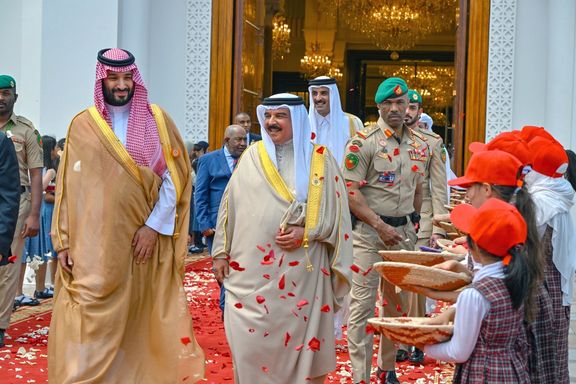
 Bahrain's King Sheikh Hamad bin Isa al-Khalifa and Saudi Crown Prince Mohammed bin Salman attending the 33rd Arab Summit, Bahrain, May 16, 2024.
Bahrain's King Sheikh Hamad bin Isa al-Khalifa and Saudi Crown Prince Mohammed bin Salman attending the 33rd Arab Summit, Bahrain, May 16, 2024.

US National Security Adviser Jake Sullivan and Saudi Crown Prince Mohammed bin Salman met in Dhahran to discuss a range of issues, including normalization of ties with Israel.

This comes just days after two State Department officials met Iranian negotiators in Oman to discuss ways to prevent a further escalation of tensions and potential hostilities in the region.

A Saudi statement on Sunday also said, "the semi-final version of the draft strategic agreements between the two countries, which are almost being finalised,” were discussed.

The Biden administration is offering a strategic deal to the Saudis who have reasons to be wary of Washington’s perceived soft stance toward Tehran in the past three years. In addition to security guarantees, part of the deal appears to be an agreement to assist a Saudi civilian nuclear program, as Iran has reached the weapons threshold under President Joe Biden’s watch.

The de facto Saudi leader and President Joe Biden's top security aide also discussed the need to find a "credible track for bringing about the two-state solution" for Israel and the Palestinians, stop the war against Hamas militants in Gaza and facilitate the entry of humanitarian aid, the statement said.

Iran has repeatedly warned regional Arab countries against normalizing ties with Saudi Arabia. Last year, shortly before the Hamas attack on Israel, Iran’s Supreme Leader Ali Khamenei said on October 3,"The position of the Islamic Republic is that countries that make the gamble of normalization with Israel will lose. They are betting on a losing horse.” The comment came at a time when a final decision was made by Tehran’s Palestinian ally, Hamas, to launch the unprecedented attack that killed more than one thousand Israeli civilians. It is unlikely that Mr. Khamenei was not aware of the imminent attack.

Iran’s representative to the United Nations in New York confirmed the talks with US representatives, saying that “this was not the first or the last” round of talks. Observers believe that Biden has tried hard to prevent a region-wide escalation of the Israeli-Hamas conflict in an election year. Iran in the meantime has reiterated its support for Hamas and other armed militant groups in the region receiving financial and military support from Tehran.

US assistance to the Saudi nuclear program poses the question if Riyadh is willing to live with an Iran on the threshold of obtaining nuclear weapons, without pursuing a similar course to establish deterrence. In the past, Riyadh has not only reiterated its right to have full control over the nuclear cycle, but has threatened to develop atomic weapons if its security needs so dictate.

The Saudi crown prince has long said that if Iran developed a nuclear weapon, Saudi Arabia would follow suit, a stance that has fueled deep concern among arms control advocates and some U.S. lawmakers over a possible US-Saudi civil nuclear deal.

This leaves the possibility that a purely civilian Saudi nuclear program would be linked to US security guarantees, which in turn would mean some sort of détente or deterrence with Iran. Recently, Iranian officials have been threatening “a change in nuclear doctrine” if Israel threatens the country’s nuclear installations or the Islamic Republic regime itself. Currently, Tehran has accumulated sufficient fissile material for at least three nuclear warheads, and for the time being it seems interested to use the option as a leverage with Israel and the United States.

Most Viewed

Ghalibaf defends Iran-US talks amid hardline backlash
1
INSIGHT

Ghalibaf defends Iran-US talks amid hardline backlash

2
ANALYSIS

From instability to influence: Pakistan’s pivotal role in US-Iran diplomacy

3
ANALYSIS

100 days on: why Iran’s January protests spread across social classes

4

War-hit homeowners feel abandoned as Iran’s reconstruction aid fades

5

Iran says no decision yet on talks as Pakistan prepares to host US team

Banner
Banner

Spotlight

  • Iran diplomacy wobbles as factions compete to avoid looking soft on US
    INSIGHT

    Iran diplomacy wobbles as factions compete to avoid looking soft on US

  • The politics of pink: how Iran uses cuteness to rebrand violence
    ANALYSIS

    The politics of pink: how Iran uses cuteness to rebrand violence

  • Bread shortages, soaring prices strain households in Iran, residents say
    VOICES FROM IRAN

    Bread shortages, soaring prices strain households in Iran, residents say

  • 100 days on: the anatomy of Iran’s January crackdown
    INSIGHT

    100 days on: the anatomy of Iran’s January crackdown

  • Ghalibaf defends Iran-US talks amid hardline backlash
    INSIGHT

    Ghalibaf defends Iran-US talks amid hardline backlash

  • From instability to influence: Pakistan’s pivotal role in US-Iran diplomacy
    ANALYSIS

    From instability to influence: Pakistan’s pivotal role in US-Iran diplomacy

•
•
•

More Stories

US Campus Protests and the Iranian Experience

May 19, 2024, 05:16 GMT+1
•
Lawdan Bazargan

In recent events at Princeton University, a stark contrast emerged between the peaceful protest by a group of Iranians—who have personally suffered under the brutality of the Islamic ruling system—and a sit-in by some US students.

Just like other students on US campuses, these students displayed flags of Hamas and Hezbollah and labeled these entities as "resistance groups." This troubling endorsement starkly clashes with the profound grievances of those who have experienced the true nature of such groups first-hand.

The Iranian protest at Princeton was not just a demonstration against Seyed Hossein Mousavian, a former Iranian ambassador to Germany and a figure deeply intertwined with Tehran’s oppressive apparatus. It was a plea for recognition of the agonies inflicted by the Islamic Republic, which has left deep scars on the Iranian people through relentless suppression of dissent and promotion of terrorism.

Mousavian’s tenure in the 1990s coincided with some of the darkest days of repression and external terrorist activities orchestrated by Tehran, including the systematic assassinations of 24 Iranian intellectuals and activists across Europe. His current academic position at Princeton starkly contrasts with his past, serving as a painful reminder to the victims' families of the injustice that continues to elude the international community’s full recognition and response.

Simultaneously, a group of US students conducted a "solidarity sit-in," with Hamas mirroring similar demonstrations across numerous college campuses. This perspective reveals a concerning disconnect from the historical and ongoing realities these organizations represent.

Historical Context and the Impact of Designating Terrorists as 'Resistance'

Hamas and Hezbollah are officially designated as terrorist organizations by the United States and several other countries. This designation is based on a history of violent actions that include suicide bombings, rocket attacks, and other forms of terrorism aimed at civilian populations. Their activities have contributed to the destabilization of regions and inflicted severe suffering upon countless innocents.

Moreover, Hezbollah’s involvement in the 1983 Beirut barracks bombing, which killed hundreds of US and French military personnel, is a grim exemplar of the group’s long-standing hostility towards Western nations and their regional allies. This act of terrorism, along with numerous others, underscores the inherent danger in romanticizing groups that actively undermine peace and security.

The Plight of Women and LGBTQ+ Under Islamist Regimes

The endorsement of Islamist groups by some Western students overlooks the severe implications these regimes have for human rights, particularly concerning women and the LGBTQ+ community. Wherever these Islamist groups have gained power, the result has been chaos, the erosion of civil liberties, and the imposition of draconian laws that strip away the rights and freedoms of women and LGBTQ+ individuals. The Iranian "Woman Life Freedom Movement" exemplifies the courageous struggle of Iranian women against a brutal regime that systematically oppresses them. This movement highlights the stark contrast between the aspirations of these brave women and the harsh realities imposed by theocratic governance. Furthermore, in groups like Hamas and Hezbollah, there is a conspicuous absence of women or LGBTQ individuals in any positions of leadership, reflecting a broader ideology that views women as lesser beings and severely restricts the rights and freedoms of the LGBTQ+ community. This fundamental disrespect for equality and human dignity underlines the dangers of supporting such groups under the guise of political resistance.

Complicity in Academia: The Role of Educators in Shaping Perceptions

Compounding the issue is the stance of some academics within Western universities, whose endorsement or passive acceptance of extremist ideologies under the guise of intellectual debate contributes significantly to the normalization of groups like Hamas and Hezbollah. Professors and educators entrusted with shaping young minds play a pivotal role in either challenging or perpetuating dangerous misconceptions about what constitutes legitimate resistance versus terrorism.

In several academic circles, a troubling trend exists where the lines between critical discussion and outright support for militant actions blur. By framing these groups as legitimate resistance movements and focusing predominantly on their opposition to Western policies without equally scrutinizing their methods of violence and governance, these educators foster a one-sided narrative that ignores the broader, often devastating implications of these groups’ actions on civilians.

This academic endorsement can give unwarranted legitimacy to extremist views, making it crucial for educational institutions to maintain a balanced perspective that rigorously examines all aspects of such groups. Universities must encourage critical thinking and promote a comprehensive understanding of geopolitical issues, one that respects human rights and rejects any form of violence targeting innocents under the guise of political struggle.

Educational leaders and faculty members are responsible for guiding their students toward informed, ethical viewpoints on international politics, emphasizing the importance of peace, security, and respect for all human lives. By doing so, they can help prevent the spread of misinformation and the glorification of violence, ensuring that the next generation of leaders and thinkers advocates for genuine justice and peace, not masked by the banners of terror.

As the world continues to grapple with the complexities of international relations, terrorism, and the struggle for human rights, the need for clear-eyed scrutiny of all entities that purport to fight for justice but employ terror and suppression cannot be overstated. The future of global security and the preservation of fundamental human rights depend on our ability to discern true resistance from oppressive terror.

Opinions expressed by the author are not necessarily the views of Iran International.

Lufthansa Extends Suspension of Flights to Tehran

May 18, 2024, 11:20 GMT+1
•
Iran International Newsroom

German flagship airline Lufthansa has declared a continued suspension of its flights to and from Tehran until June 16, responding to ongoing instability in the Middle East.

The company, on Saturday, also confirmed that it would avoid Iranian airspace during the period.

The initial suspension followed heightened tensions after an Israeli attack on Iran on April 19, leading several other airlines to reroute their flights to avoid the area.

The move by Lufthansa and its subsidiary, Austrian Airlines—both notable for being among the few Western carriers operating flights to Tehran—follows aerial hostilities.

On April 13, Iran executed its first direct assault on Israeli territory, launching over 350 drones, missiles, and ballistic missiles, most of which were intercepted by Israeli defenses and a US-led coalition.

The airspace over Iran, critical for numerous major carriers including Emirates and Qatar Airways for flights to Europe and North America, remains a geopolitical flashpoint.

Panama-flagged Oil Tanker Hit Near Yemen - Report

May 18, 2024, 09:59 GMT+1
•
Iran International Newsroom

British security firm Ambrey said on Saturday it had received information that a Panama-flagged crude oil tanker had been attacked approximately 10 nautical miles southwest of Yemen's Mokha.

Ambrey said a radio communication indicated the vessel was hit by a missile and that there was a fire onboard. It did not provide details of the communication.

Ambrey later added that the tanker had received assistance and one of its steering units was reportedly functional. It did not indicate who provided the assistance.

Yemen's Houthi militia, which controls the most populous parts of Yemen and is aligned with Iran, has staged attacks on ships in the waters off the country for months in solidarity with Hamas fighting Israel in Gaza. The attacks began after Iran’s Supreme Leader Ali Khamenei called on Muslims in early November to boycott Israeli trade.

Vessels in the vicinity were advised to exercise caution and report any suspicious activity, Ambrey added in an advisory note.

Earlier on Saturday, the United Kingdom Maritime Trade Operations (UKMTO) agency said a vessel in the Red Sea was struck by an unknown object and sustained slight damage.

"The vessel and crew are safe and continuing to its next port of call," UKMTO said in an advisory note, adding the incident occurred 76 nautical miles northwest of Yemen's Hodeidah.

Months of Houthi attacks in the Red Sea have disrupted global shipping, forcing firms to re-route to longer and more expensive journeys around Southern Africa, and stoking fears that the Israel-Hamas war could spread to destabilize the wider Middle East.

The United States and Britain have carried out strikes against Houthi targets in response to the attacks on shipping.

Report Says US Officials Met with Iranians in Oman

May 18, 2024, 08:58 GMT+1
•
Iran International Newsroom

Biden administration officials held indirect talks with representatives of the Iranian government in Oman this week, to discuss regional issues, Axios reported on Friday.

According to the report, talks focused on how to reduce the likelihood of more military clashes in the region. Since the Hamas attack on Israel in October, Iranian backed proxies have launched nearly 200 attacks against US forces in the region.

Israel in turn has attacked a multitude of Iranian targets, including a strike on its diplomatic compound in Damascus on April 1. In that attack two Revolutionary Guard generals and five other officers were killed. Iran retaliated on April 13 by launching more than 300 drones and missiles at Israel, most of which were intercepted by Israeli air defense and allies air forces.

Two sources told Axios that President Joe Biden’s top Middle East adviser, Brett McGurk, and Abram Paley the acting US envoy for Iran arrived in Oman on Tuesday and held talks with unidentified Iranian envoys. In addition to discussing regional tensions, the two sides also discussed Iran’s escalating nuclear program, according to the report. In recent weeks Iranian officials have threatened to opt for producing atomic weapons.

They had held similar talks with Iranian officials in January. At the time, tensions were rising between Israel and Iran and Tehran-backed Yemeni Houthi forces were attacking international commercial shipping in the Red Sea.

US Codifies Sanctions Exemption to Help Iranians Access Internet

May 18, 2024, 07:50 GMT+1

The Biden administration has amended federal regulations to exempt internet communications services from Iran sanctions, allowing Iranians to access certain American software, hardware and services.

The existing ‘sanctions waiver’ was granted by the US Treasury in September 2022, as thousands across Iran took to the streets following the death in custody of the 22-year old Mahsa Amini, who had been detained for improper hijab.

On Friday, that waiver was codified and entered federal regulations, according to a notice published on the Federal Register. The new rule incorporates “a general license relating to the export, reexport, and provision of certain services, software, and hardware incident to communications over the internet,” the official summary of the document reads.

This would be good news for many Iranians, activists, in particular, who for many years have been stuck between a rock and a hard place –with US sanctions often aggravating the agony of internet users struggling to find a way around the regime’s censorship.

“This should give compliance teams at big tech companies more assurances to finally open up services such as Google Cloud Platform for hosting circumvention tools for Iran,” Mahsa Alimardani, an Internet researcher at Oxford University, posted on X.

Tech giants such as Google and Amazon are known to have been restricting the use of their cloud services and platforms for hosting tools that could help users in Iran to circumvent the government's draconian Internet censorship.

Advocates of free Internet, as well as technologists who want to provide circumvention tools to Iranian users, have criticized ‘blind’ US sanctions that they say harm ordinary people more than they deny technology to the sanctioned government. They now hope that the ‘waiver’ being codified into federal regulations would pave the way for the tech companies to provide services to Iranians that they until now refused.

“This codification is a reminder to technology companies that they bear the responsibility to ensure their platforms remain accessible to Iranian civil society in the face of the Islamic Republic’s digital repression,” freedom of expression campaigners Article 19 said in a statement published on their website.

US administrations –at least since the 2009 protests in Iran– have consistently underlined the importance of keeping ordinary Iranians ‘connected’ to the outside world. In recent years, the US Treasury has issued several licenses to exempt certain internet communications services from its Iran sanctions.

It remains to be seen whether the latest move –and the codification of the exemptions– is enough to convince tech companies to offer their service to Iranians inside Iran.

In 2022, amid the most widespread protests in the 45-year history of the Islamic Republic, Tesla CEO, Elon Musk, was asked if he’d make Starlink internet services available to the people of Iran. In response, he said his company would apply for an exemption from the US treasury –which in turn exempted some satellite internet equipment from sanctions.

In December 2022, the Wall Street Journal reported that Starlink equipment was being smuggled into Iran. Roughly the same time, Google announced that it was working to create secure internet access for Iranians inside of Iran.