• العربية
  • فارسی
Brand
  • Iran Insight
  • Politics
  • Economy
  • Analysis
  • Special Report
  • Opinion
  • Podcast
  • Iran Insight
  • Politics
  • Economy
  • Analysis
  • Special Report
  • Opinion
  • Podcast
  • Theme
  • Language
    • العربية
    • فارسی
  • Iran Insight
  • Politics
  • Economy
  • Analysis
  • Special Report
  • Opinion
  • Podcast
All rights reserved for Volant Media UK Limited
volant media logo

Israel And Iran Both Downplay Friday Attack
Apr 19, 2024, 11:51 GMT+1Updated: 09:48 GMT+1
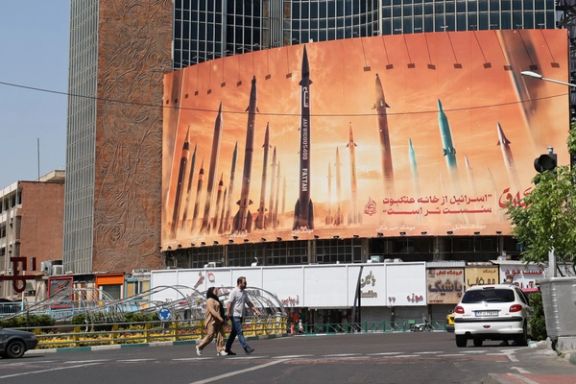
An anti-Israel billboard with a picture of Iranian missiles is seen on a street in Tehran, Iran April 19, 2024.

Israeli media cited foreign reports of an strike on Iran on Friday in the absence of official public comment, while Iranian officials and media played down the attack.

The Islamic Republic military officials spoke about small drones being involved, that they claimed were launched from within Iran, not even mentioning the "Zionist entity", Iran's term for Israel.

The strike in the central city of Esfahan (Isfahan) appears to have caused no significant damage and the muted way the story was told in both nations pointed to a determination, at least for now, not to further escalate their conflict.

In an interview with state TV, a person introduced as a resident of Esfahan described the explosions in the early hours of the morning as "nothing more than firecrackers".

The Israeli military and foreign ministries declined comment and there were no immediate public statements from senior politicians apart from hardline security minister, Itamar Ben Gvir, who sent out the one-word message "Feeble!" on social media platform X.

In fact, some commentators believe Israel will not launch a large-scale attack against Iran, trying to avoid escalation. It can continue its undeclared piecemeal sabotage and other attacks, a method many believe has been used frequently since mid-2020.

Israel has a long tradition of maintaining ambiguity over issues like nuclear weapons and intelligence operations and the silence appeared to be part of its messaging.

Israeli media cited reports from the New York Times and the Washington Post, which quoted unnamed Israeli officials as confirming Israel was behind the attack, but did not report official confirmation of their own.

Writing for Israel's biggest newspaper Yedioth Ahronoth, before the attack took place, a columnist said an official had said Israel planned a "pinpoint operation".

He quoted a Bible story in which the future King David crept up on a sleeping enemy and cut a piece of cloth from his clothing as proof that he could have struck a deadly blow but chose not to.

"I think it is ultimately a cautionary message that Israel can respond and can get through to Iran if it wants, but it does not want to widen the scope of this conflict right now," said Hasan Alhasan, a senior Fellow for Middle East Policy at the International Institute for Strategic Studies.

Iran's thoughts were spelt out most clearly by a senior Iranian official who told Reuters that Tehran did not plan a response now.

Iranian media appeared to play down the significance of the strike. In official statements, there was almost no mention that Israel - or as it usually says the "Zionist entity" - was behind it. State television carried analysts and other pundits who all appeared to be dismissive about the scale.

"There has been a remarkable fabrication to exaggerate the extent of the incident" the semi-official ISNA news agency said.

The apparent attack was the latest in a round of actions set off by the killing of seven Iranian officers in a strike on an embassy compound in Damascus that has drawn fears of a wider regional conflict spilling over from the war in Gaza.

Although Israel has never acknowledged that it was behind the strike on April 1, Iran launched a wave of hundreds of drones and missiles in response that was successfully warded off by the air defenses of Israel and its allies.

Iran's reaction also appeared to signal that it did not want the exchange to go further.

"That seems to indicate that Iran is seeking to step down off the ledge, minimize the impact of the attack, and perhaps walk back down the escalation ladder from here," said Jonathan Lord, head of the Middle East security program at the Center for a New American Security, a US think tank.

Iranian President Ebrahim Raisi chose not to cut short his trip to the central province of Semnan, indicating that the country was not on high alert. In Israel, the Homefront Command issued no new instructions to the population.

Opinion polls in Israel have appeared to show no overwhelming desire for retaliation, with one poll on Thursday showing 48% in favor of responding even if it meant expanding the conflict with 52% preferring not responding.

"We're good, you can look around, we're happy here, not from the attack but I think the situation in the Middle East is complicated, but Israel will always win and everybody has to know that," said Pavlo Tzuk, a resident of central Israel.

"So, enjoy your day and hope people in Iran will understand we are not seeking for war, but we are seeking for peace, and we want to be here safe, so, understand that," he said.

(With reporting by Reuters)

Most Viewed

Iran International says it won’t be silenced after London arson attack
1

Iran International says it won’t be silenced after London arson attack

2
VOICES FROM IRAN

Hope and anger in Iran as fragile ceasefire persists

3

Iran halts petrochemical exports to supply domestic market

4
INSIGHT

How Tehran bends its own red lines to boost state rallies

5

US arrests Iranian national over alleged Basij-linked visa fraud

Banner
Banner

Spotlight

  • Hardliners push Hormuz ‘red line’ as US blockade tests Iran’s leverage
    INSIGHT

    Hardliners push Hormuz ‘red line’ as US blockade tests Iran’s leverage

  • Ideology may be fading in Iran, but not in Kashmir's ‘Mini Iran'
    INSIGHT

    Ideology may be fading in Iran, but not in Kashmir's ‘Mini Iran'

  • War damage amounts to $3,000 per Iranian, with blockade set to add to losses
    INSIGHT

    War damage amounts to $3,000 per Iranian, with blockade set to add to losses

  • Why the $100 billion Hormuz toll revenue is a myth
    ANALYSIS

    Why the $100 billion Hormuz toll revenue is a myth

  • US blockade targets Iran oil boom amid regional disruption
    ANALYSIS

    US blockade targets Iran oil boom amid regional disruption

  • Iran's digital economy battered by prolonged blackout
    INSIGHT

    Iran's digital economy battered by prolonged blackout

•
•
•

More Stories

Slain Teen’s Sister Moved to Shahr-e Rey for Hijab Defiance

Apr 19, 2024, 10:56 GMT+1
•
Iran International Newsroom

Aida Shakarami, the older sister of the slain teen protester Nika Shakarmi, has been transferred to Shahr-e Rey women's prison after her arrest by security forces for refusing to wear the hijab.

"Aida was transferred from the morality police detention center to Evin prison on Thursday morning, and from Evin to Shahr-e Rey women's prison," Nasrin Shakarami, Aida's mother, wrote on her personal Instagram account on Friday.

Over the weekend, Nasrin Shakarami revealed on social media that Aida had been detained for failing to wear the mandatory hijab.

Earlier this week, Iran's police initiated a renewed crackdown on unveiled women, using violence against detainees and those trying to intervene to prevent arrests.

Aida’s sister, 16-year-old Nika Shakarami, was abducted by security forces off Tehran’s Keshavarz Boulevard, while she was protesting against the regime amid the nationwide 2022 Women, Life, Freedom protests.

Nika’s body, reportedly subjected to torture, abuse, and beatings by security forces, was handed over to her family over a week after her disappearance.

Fearful of her gravesite becoming a location of protests, government agents secretly seized her body from her hometown of Khorramabad in Lorestan and buried her in one of the province’s villages instead.

At least 500 civilians, including children and teenagers, were killed when regime forces cracked down on the months-long protests following the killing of Mahsa Jina Amini by the so-called "morality police" in Tehran.

Iranian Official Warns Israel Over 'Dangerous Mistake' After Airstrike

Apr 19, 2024, 09:53 GMT+1

Following Israel’s airstrike on Iran, Iranian Parliamentarian Mahmoud Abbaszadeh Meshkini is warning the country for having made “a very dangerous and strategic mistake by playing with the lion's tail".

In remarks to the semi-official ILNA news outlet, Meshkini, a member of the National Security and Foreign Policy Commission, emphasized that Iran is equipped with "the most advanced military equipment and precision missiles."

Early Friday morning, explosions were reported near the airport and an army base in Isfahan province, located in the central part of the country. The attack prompted Iran's air defense systems to be activated at several sites, according to state media.

While US officials have confirmed the attack, Israel has not yet acknowledged any involvement in the airstrike.

Iranian state media, controlled by the regime, is downplaying the strike. An official stated that the country’s air defenses intercepted three drones and denied any impacts from missiles.

Iranian media also reported that their nuclear sites remained secure and showed calm scenes in areas where explosions were reportedly heard.

This latest military action follows Iran attacks on Israel, where it launched hundreds of drone and missile strikes over the weekend. Tehran says it was retaliating for a widely believed Israeli attack on Iran’s purported consulate in Syria, which killed several high-ranking Islamic Revolutionary Guard (IRGC) officials.

Before the Friday attack on Iran, Esmail Kowsari, another parliamentarian on the national security commission, spoke about potential actions against Israeli nuclear facilities.

"If necessary, it will definitely be done," Kowsari told Jamaran news.

He emphasized that Iran does not seek conflict with any regional country, but that it will be considered if they act “maliciously”.

Assailants Of Iran International Presenter Were Eastern European Mercs - Report

Apr 18, 2024, 22:24 GMT+1

British investigators believe that the three suspects sought in connection with the stabbing of Iran International's presenter are from Eastern Europe.

According to an exclusive report by the Guardian on Thursday, the investigators are looking into whether one of the suspects has connections to Albania.

The investigators interviewed by The Guardian believe that the assailants were recruited and flown to the UK specifically to execute the assault.

Iran International presenter Pouria Zeraati was stabbed outside his home in Wimbledon, in south London, late in March and sustained leg injuries.

Shortly after the attack, London Metropolitan Police announced that considering previous threats against journalists in Persian-language media outlets, the incident is being handled by specialized officers from the Met's counter-terrorism division. Earlier in the month, London Metropolitan police said the three suspects fled the UK after the attack, triggering an international manhunt.

Guardian further reported that Western sources believe that those likely responsible for the attack, presumed to be acting in the interests of the Iranian regime, utilized connections and insights into criminal networks to recruit the assailants.

Senior British counter-terrorism officials, as per The Guardian's report, believe that employing "criminal proxies provides Tehran with plausible deniability" as those recruited are unlikely to be on terror watchlists which would prevent them from entering the UK.

Last year, federal indictments revealed that three individuals linked to an Eastern European mafia group were charged by the United States for plotting to assassinate Iranian-American journalist and activist Masih Alinejad at the request of the Iranian regime.

The US Justice Department announced that the Eastern European mafia group charged "has ties to Iran and is violent, engaging in murders, kidnappings, assaults, and extortions".


IRGC Commander Threatens Nuclear Policy Change Amid Israel Crisis

Apr 18, 2024, 20:46 GMT+1
•
Iran International Newsroom

A senior IRGC commander warned Thursday that Tehran could change its nuclear policies if Israel continues to threaten to attack Iran’s nuclear sites, tacitly suggesting no cooperation with world bodies and building a nuclear bomb.

“If the fake Zionist regime wants to use the threat of attacking nuclear sites to put pressure on Iran, it is possible and conceivable for the Islamic Republic to revise its nuclear doctrine and policies, and deviate from its past declared considerations,” said Ahmad Haghtalab, who is in charge of the security of Iran’s nuclear sites.

His remarks came a day after Zohar Palti, the former intelligence director at the Israeli spy agency Mossad, announced that Israel has many options on the table to retaliate Tehran’s recent missile and drone attacks and could even choose to strike Iran’s nuclear facilities.

According to Haghtalab, Israel’s threats to target Iran’s nuclear facilities “are not from today or yesterday” and Israel has already been involved in “sabotage and terrorist acts” to stop Iran’s nuclear program over the past years.

A view of the Natanz uranium enrichment facility 250 km (155 miles) south of the Iranian capital Tehran, March 30, 2005.
100%
A view of the Natanz uranium enrichment facility 250 km (155 miles) south of the Iranian capital Tehran, March 30, 2005.

One of the most significant attacks on Iran’s nuclear program occurred in 2010 when the Stuxnet computer virus disrupted the control systems of the country’s most sensitive and tightly watched nuclear facility in Natanz.

The Dutch daily Volkskrant reported in January that the malware, widely believed to be an American-Israeli creation, was delivered by a Dutch engineer working at the enrichment plant.

In 2020 and 2021, two internal explosions hit Iran's highly protected Natanz uranium enrichment facility, inflicting considerable damage. The attacks were attributed to Israel, although Iran's chief adversary never took responsibility. In November 2020, Mohsen Fakhrizadeh, known as the father of Iran's nuclear program was assassinated in broad daylight near Tehran.

Further in his remarks, IRGC Commander Haghtalab threatened that the Iranian government can target Israel’s nuclear sites if the Jewish state decides to respond to Iran’s recent offensive on the Israeli territory: “The nuclear sites of the Zionist enemy have been identified and we have the information we need on all targets. In case of their so-called retaliation, our hands are on the trigger to fire powerful missiles to destroy specified targets.”

IRGC commander Ahmad Haghtalab (undated)
100%
IRGC commander Ahmad Haghtalab

On Saturday night, Iran launched its first ever direct offensive against Israeli territory with more than 350 drones and cruise and ballistic missiles. The Israeli army announced that 99% of the projectiles were intercepted and downed.

According to IAEA Director General Rafael Grossi, Iran shut down its nuclear facilities last Sunday over “security considerations.” He confirmed that the facilities had reopened within 24 hours, but with no IAEA supervision, as the agency decided to temporarily keep its inspectors away until the situation is “completely calm.”

When asked about the possibility of Israel hitting Iran’s nuclear sites, Grossi said, “We are always concerned about this possibility.” The UN nuclear chief also reiterated the IAEA’s concerns about Iran’s nuclear program.

Iranian officials have always maintained that Tehran’s nuclear program is purely for peaceful purposes. But nuclear experts are almost unanimous in their assessment that enrichment to the levels and in the amounts that Iran has been doing since 2021 cannot be justified in the absence of a weapons program.

In February, Ali-Akbar Salehi, the former head of Iran's nuclear agency, implied that the country has everything it needs for an A-bomb: "We have [crossed] all the thresholds of nuclear science and technology. Here's an example: Imagine what a car needs; it needs a chassis, an engine, a steering wheel, a gearbox. You're asking if we've made the gearbox, I say yes. Have we made the engine? Yes, but each one serves its own purpose."

On Wednesday, an advisor to Iranian Parliament Speaker Mohammad-Bagher Ghalibaf hinted at Tehran’s military use of its nuclear program. “Iran has a nuclear program in addition to its missile program,” wrote Mehdi Mohammadi on X in what can be construed as a shrouded threat against Israel and its allies.

Meanwhile, Mohammad Marandi, a political analyst close to Iran’s hardliners, claimed that Iran has not yet used “its most advanced weapons” against Israel. When asked if Iran might use nuclear weapons, he said, “Iran is not like the United States which has and uses and has already used nuclear weapons.”

In November, an IAEA confidential report indicated that Iran has enough uranium enriched to up to 60% for three atomic bombs.

At UN Security Council, Iran Reiterates Warning Against Possible Israeli Response

Apr 18, 2024, 20:33 GMT+1

Iran told the United Nations Security Council on Thursday that Israel "must be compelled to stop any further military adventurism against our interests" as the UN secretary-general warned that the Middle East was in a "moment of maximum peril."

Israel has said it will retaliate against Iran's April 13 missile and drone attack, which Tehran says was carried out in response to an Israeli strike on its consulate in Damascus earlier this month.

"In case of any use of force by the Israeli regime and violating our sovereignty, the Islamic Republic of Iran will not hesitate a bit to assert its inherent rights to give a decisive and proper response to it to make the regime regret its actions," said Iran's Foreign Minister Hossein Amir-Abdollahian.

His remarks came after an Iranian Revolutionary Guards commander said earlier on Thursday that Iran could review its "nuclear doctrine" following Israeli threats.

At a UN Security Council meeting on the Middle East, Secretary-General Antonio Guterres urged maximum restraint.

"It is high time to end the bloody cycle of retaliation. It is high time to stop," Guterres said. "The international community must work together to prevent any actions that could push the entire Middle East over the edge, with a devastating impact on civilians."

Speaking earlier on Thursday in the Security Council, Israel's UN Ambassador Gilad Erdan criticized Amir-Abdollahian's presence at the world body.

"He is here to make a mockery of you. He is here to show you all – in your suits and with your diplomatic niceties – that his country can launch an attack on another member state on Saturday, and then he can come here on Thursday to lecture you all on human rights and international law," Erdan said.

(Report by Reuters)






