• العربية
  • فارسی
Brand
  • Iran Insight
  • Politics
  • Economy
  • Analysis
  • Special Report
  • Opinion
  • Podcast
  • Iran Insight
  • Politics
  • Economy
  • Analysis
  • Special Report
  • Opinion
  • Podcast
  • Theme
  • Language
    • العربية
    • فارسی
  • Iran Insight
  • Politics
  • Economy
  • Analysis
  • Special Report
  • Opinion
  • Podcast
All rights reserved for Volant Media UK Limited
volant media logo

EU Members Plan More Sanctions Against Iran
Apr 17, 2024, 21:36 GMT+1Updated: 17:07 GMT+0
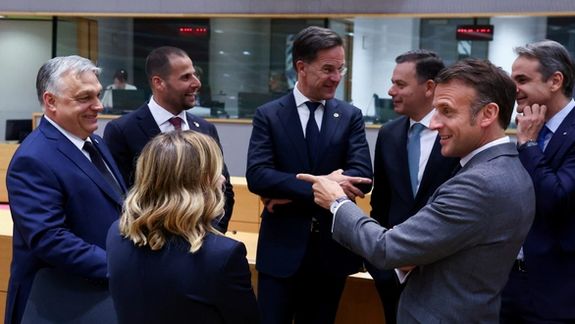
Heads of several EU states during an informal European Union leaders' summit in Brussels, Belgium April 17, 2024

European Union leaders decided on Wednesday to step up sanctions against Iran after Tehran's recent attack on Israel left world powers scrambling to prevent a wider conflict in the Middle East.

The two-day summit in Brussels is the first meeting of the EU's 27 national leaders since Saturday's attack, more than six months into the war between Israel and the Iran-backed Palestinian militant group Hamas.

Israel has signaled that it will retaliate but has not said how. The EU has urged Israel to exercise restraint while expressing readiness to tighten sanctions on Tehran.

"We have to adjust, to expand them (the sanctions) on Iran," French President Emmanuel Macron said in Brussels ahead of the summit.

"We are in favor of sanctions that can also target all those who help manufacture drones and missiles that were used in the attacks last Saturday and Sunday."

In the coming days, the US will also impose sanctions on Iran's missile and drone programs, as well as on entities that support the Islamic Revolutionary Guard Corps (IRGC), and the Defense Ministry, according to Jake Sullivan, the National Security Adviser at the White House.

German Chancellor Olaf Scholz said it was important that Israel "does not respond with a massive attack of its own".

The leaders will condemn the Iranian attack, reaffirm their commitment to Israel's security and call on all sides to prevent more tensions, including in Lebanon, according to a draft statement seen by Reuters.

"The EU is ready to take further restrictive measures against Iran, notably in relation to unmanned aerial vehicles (UAVs) and missiles," said the statement.

Italy spoke separately ahead of G7 talks in favor of sanctions against those who supplied arms for the attack against Israel, as well as those behind attacks on ships in the Red Sea.

Iran launched the attack on Saturday in response to an April 1 strike on a building adjacent to its embassy in Damascus which it blamed on Israel. Two IRGC generals and five senior officers meeting in the building were killed. Tel Aviv launched its military offensive in Gaza after Hamas' deadly attack on Israel on October 7.

EU Divisions

The war in Gaza has exposed differences between EU countries, with some siding more with Israel and others more strongly criticizing its conduct while highlighting the dire humanitarian situation in the Palestinian enclave.

Several EU states have proposed expanding a sanctions scheme that seeks to curb the supply of Iranian drones to Russia for Moscow's war in Ukraine to include the provision of missiles and cover deliveries to Iranian proxies in the Middle East.

Belgian Prime Minister Alexander De Croo backed introducing sanctions against Iran's Revolutionary Guard Corps but Scholz said that required further legal checks.

On Tuesday, EU's top diplomat said the bloc's rules meant that could only happen if a national authority in the EU found that the group had been involved in terrorist activity.

Based on political decisions at the summit, EU foreign ministers are due to continue the sanctions work next Monday.

The United States and other Western governments hope new sanctions against Iran will help persuade Israel to limit its retaliation. Analysts say, however, Iran is unlikely to face severe punishment because of worries about boosting oil prices in a US election year.

With reporting by Reuters

Most Viewed

Ghalibaf defends Iran-US talks amid hardline backlash
1
INSIGHT

Ghalibaf defends Iran-US talks amid hardline backlash

2
INSIGHT

Iran diplomacy wobbles as factions compete to avoid looking soft on US

3
VOICES FROM IRAN

Bread shortages, soaring prices strain households in Iran, residents say

4
ANALYSIS

The politics of pink: how Iran uses cuteness to rebrand violence

5

Scam messages seek crypto for ships’ safe passage through Hormuz, firm warns

Banner
Banner

Spotlight

  • Opposition to US talks grows in Tehran as ceasefire deadline nears
    INSIGHT

    Opposition to US talks grows in Tehran as ceasefire deadline nears

  • Tehran moderates see ‘no deal–no war’ limbo as worst outcome
    INSIGHT

    Tehran moderates see ‘no deal–no war’ limbo as worst outcome

  • The future has been switched off here
    TEHRAN INSIDER

    The future has been switched off here

  • Lights out, then gunfire: Witnesses recount Mashhad protest crackdown
    VOICES FROM IRAN

    Lights out, then gunfire: Witnesses recount Mashhad protest crackdown

  • Family told missing teen was alive, then received his body 60 days later
    EXCLUSIVE

    Family told missing teen was alive, then received his body 60 days later

  • Is Iran entering its Gorbachev moment?
    INSIGHT

    Is Iran entering its Gorbachev moment?

•
•
•

More Stories

Iran Prepares For Possible Israeli Retaliation

Apr 17, 2024, 18:55 GMT+1

After Iran's missile and drone attack aimed at Israel over the weekend, the country is bracing for possible retaliatory attacks either on its territories or proxies.

This comes after the Iranian government had made preparations to safeguard their assets, which included activating the air force for possible strikes, and deployment of navy escorts for commercial Iranian ships in the Red Sea.

In addition, the Wall Street Journal reports that they are in the process of evacuation at Iranian bases within Syria, especially where the Islamic Revolutionary Guard Corps (IRGC) predominantly resides.

After launching more than 350 drones and missiles, officials in Israel warned of a counter strike without specifying what kind of response is to be expected.

The US, along with European nations, has urged Israel to refrain from retaliation that could escalate tensions further.

German Foreign Minister Annalena Baerbock and Britain’s former Prime Minister David Cameron had separate meetings Wednesday with Israeli Prime Minister Benjamin Netanyahu, in which they echoed a message of de-escalation.

The Biden administration also plans to shore up the diplomatic effort with new economic sanctions on the IRGC and its economic links to Iran's missile and drone programs.

On the military front, it is reported that Iran ordered emergency protocols, especially in Syria, where the IRGC and Hezbollah have adjusted their presence and heightened security measures in anticipation of potential Israeli strikes.

Tehran also indicated that it would respond to any Israeli attack. “The smallest action against Iran’s interests will definitely be met with a severe, extensive and painful response against all its perpetrators,” Iranian President Ebrahim Raisi said.


Iran's Raisi Threatens Israel With 'Massive And Harsh' Response

Apr 17, 2024, 15:17 GMT+1

Iranian President Ebrahim Raisi warned on Wednesday that any "tiniest invasion" by Israel would face "massive and harsh" response from Iran as the two archenemies sit on the verge of war.

His threats came during an annual army parade which had been moved from its usual venue, a highway in southern Tehran, to a barracks north of the capital. Iranian officials gave no reasons for the venue change, and unlike in past years, the event was not live on state television. 

Speaking about the weekend air attack in which 350 plus drones and missiles were fired towards Israel a "limited action" and warned that in case of a more expansive assault "nothing will be left from the Zionist regime."

With the help from allies including the United States, the United Kingdom and Jordan, most of the deadly bombardment was intercepted.

The Saturday aerial assault was, Iran claims, in retaliation to an Israeli airstrike on April 1 that targeted the consulate of Iran in Syria, killing several of its staff from the Revolutionary Guards, including two generals.

Israel has not detailed its response to the Iranian attack immediately but has vowed action will be taken. Its allies called for restraint from all sides to avoid further escalation.


US Lawmakers Support Potential Israeli Retaliation Against Iran

Apr 17, 2024, 15:15 GMT+1

Several Republican and Democratic lawmakers have endorsed a potential Israeli retaliatory attack against Iran, branding the Biden administration too soft on its archenemy.

The congressmen told Iran International that they viewed Iran's attack over the weekend as a failure but believed Israel's response was "necessary".

“If they [Iran] intended to create a lot of chaos and cause damage in Israel they weren't successful,” but the Iranian regime “crossed the red line,” Republican Representative Lance Gooden (R-TX) told Iran International.

Representative Steve Cohen (D-TN) believed the escalation did not start with Israel killing IRGC commanders in Iran’s consulate in Syria earlier this month, which Tehran claims was the trigger for the aerial bombardment this weekend, as the regime was involved in Hamas’ October 7th attack against Israel.

“This has been going on for a while as Iran trained some of the leaders of October 7 in the country,” he explained. Iran-backed Hamas invaded Israel on October 7, killing 1,200 mostly civilians and taking over 250 more hostage.

Earlier this month, an alleged Israeli air strike hit the Iranian consulate in Damascus, killing a senior Quds Force commander and several other IRGC personnel. Tehran claims the weekend's bombardment of over 350 missiles and drones was an act of self defence in response to the strike.

Democrat Cohen said the operation was done with the intent to “kill people”. He added, “Israel will respond. And I support Israel.” The majority of the projectiles were intercepted on Saturday night by Israel and its allies including the UK, US, Jordan and France in one of the most complex aerial missions in modern warfare.

Biden has stated the US will not take part in any Israeli attack against Iran, though says it will support the Jewish state in the face of attack. Since the Biden presidency began, Tehran has become ever more emboldened, including accelerating its nuclear program. 

The Republican Party has long criticized the policies enacted by the Biden Administration regarding Iran. Biden has come under fire for releasing $6 billion of Iranian oil revenues in September as part of a prisoner exchange agreement and also for granting Iraq a new four-month waiver that enabled the release of billions of dollars to Iran after the October 7 terrorist attacks.

Despite the humanitarian guise, Republicans and Democrats challenged these decisions, arguing that money's fungibility would enable the Tehran regime to divert these funds towards arming its proxies.

Republican Representative Don Bacon (R-NE) stated that “there's a greater risk by being weak in our response to Iran,” as it would lead to a more aggressive response on the part of the regime.

"The Islamic Republic wants to be a caliphate. They want to control the Mideast, have a Shia empire there," he said, adding that "Iran wants to be the regional superpower, and that would be bad for America and bad for our allies."

Republican congressman Randy Weber (R-TX) told Iran International that times must change and a new approach taken with Iran which has been emboldened under Biden. “He's [Biden] giving Iran billions of dollars when we should have had sanctions. They should have been tight. The sanctions should not have been lessened,” he said.

While the White House announced on Tuesday that fresh sanctions would be imposed on Iran, analysts believe that the US will not initiate drastic sanctions on Iran because it is worried about increasing oil prices and angering its top customer, China.

Former president Donald Trump, who Biden is running against in the upcoming presidential elections, has already blamed the ageing president for the Iranian attack on Israel. “It [the aerial bombardment] would not have happened if we were in office,” Trump said in the wake of the bombardment on Sunday.

Under Trump, policies to Iran took a much tougher stance. He pulled out of the JCPOA nuclear agreement and in 2020, the commander of Iran's Quds Force, Qassem Soleimani, was assassinated in an airstrike in Iraq.

Iran's Air Force Commander Threatens Israel With 50-Year Old Jets

Apr 17, 2024, 13:26 GMT+1

Hamid Vahedi, the commander of Iran’s Army Air Force, says forces are ready to execute orders, using the Soviet-era Sukhoi Su-24 bombers against Israel.

"We are ready to strike our targets with Sukhoi 24," Vahedi declared, the Sukhoi Su-24 first entering service in 1974. It remains a component of Iran's limited fleet of strike aircraft, which includes several aging models from both the US and Russia.

Vahedi's comments follow Iran's air strike against Israel over the weekend when over 350 missiles and drones were fired towards Israel, most of which were intercepted by Israel and its allies.

Tehran says its attack was in response to an earlier incident on April 1, where Iran’s consulate in Syria was attacked by an alleged Israeli air strike, killing a senior Quds Force commander and several IRGC personnel.

Despite the tone of Vahedi’s warnings, his remarks have sparked a flurry of jokes, with many commenting on the antiquated nature of the Su-24 bombers still in service.

Currently, the Islamic Republic of Iran Air Force operates around 30 Su-24MKs, a fleet acquired from Iraq during the 1991 Gulf War and potentially other post-Soviet states.


UN Chief Urges 'Maximum Restraint' By Iran

Apr 17, 2024, 11:34 GMT+1

United Nations Secretary-General Antonio Guterres urged the urgent de-escalation in the Middle East in a call with the Iranian foreign minister on Tuesday, urging "maximum restraint".

It comes on the back of Iran's aerial bombardment of Israel over the weekend in which over 350 drones and missiles were launched towards the Jewish state. 

"The secretary general's position is one he stated very clearly on Sunday in his call for maximum restraint," said Stephane Dujarric, spokesperson for the Secretary-General, during a press briefing. "We do not want to see another cycle of eye for an eye, which is not a policy that will lead to peace."

The aerial assault followed an alleged Israeli air strike on the Iranian consulate earlier this month in which a senior Quds Force commanders was killed along with several IRGC personnel.

Dujarric added that on Monday, Guterres also was in touch with Israeli President Isaac Herzog and other Israeli officials. The Secretary-General has called for de-escalating tension and reorienting efforts on the peace front in the region.

The Israeli military said 99 percent of the aerial threats were intercepted by an operation with a US-led coalition of partners.

Israel has also expressed its intention to retaliate against the assault, which its military chief was too severe to leave unanswered. "Iran will face the consequences for its actions", said Hertzl Halevi, chief of the general staff, earlier this week. 

The UN's calls also come amid criticism that the body has allowed Iran to chair its disarmament conference, while Iran not only bombards Israel and funds terror proxies across the Middle East and beyond, but also supplies drones to Russia in its offensive against Ukraine.






