• العربية
  • فارسی
Brand
  • Iran Insight
  • Politics
  • Economy
  • Analysis
  • Special Report
  • Opinion
  • Podcast
  • Iran Insight
  • Politics
  • Economy
  • Analysis
  • Special Report
  • Opinion
  • Podcast
  • Theme
  • Language
    • العربية
    • فارسی
  • Iran Insight
  • Politics
  • Economy
  • Analysis
  • Special Report
  • Opinion
  • Podcast
All rights reserved for Volant Media UK Limited
volant media logo

Iran Summons European Envoys Over Response To Strikes On Israel
Apr 14, 2024, 18:29 GMT+1Updated: 20:13 GMT+1
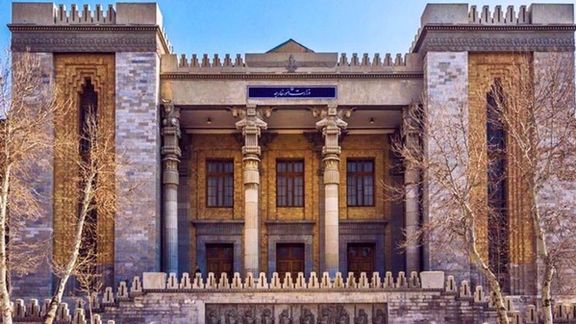
A view of Iran’s Foreign Ministry building in the capital, Tehran

The Iranian foreign ministry summoned the ambassadors of Britain, France, and Germany over their condemnation of the regime's drone and missile strikes on Israel.

The ministry's director for western Europe, Majid Nili Ahmadabadi, accused the three European states of showing "double standards", referring to their rejection of a Russian draft at the UN Security Council to condemn Israel over its alleged airstrike on an Iranian consulate in Syria earlier this month.

"Iran's military action against the Zionist regime's [Israeli] bases is well within the framework of the right to legitimate defense stipulated in Article 51 of the United Nations Charter and it is in response to a series of crimes, including the recent attack on the embassy compound in Syria," the official told the Iranian Labor News Agency. The strike in Damascus killed two commanders and several other IRGC personnel.

The German Foreign Minister Annalena Baerbock responded quickly after the attacks were launched from Iran on Saturday night, the country's first direct strike towards Israel, claiming that the Iranian bombardment of over 350 projectiles towards the Jewish state had brought the Middle East "to the edge of a precipice". She said Tehran had "plunged an entire region into chaos".

French President Emmanuel Macron was also quick to condemn Iran’s drone and missile attack on Israel. “I condemn in the strongest terms the unprecedented attack launched by Iran,” he wrote on X. “I express my solidarity with the Israeli people and France's commitment to the security of Israel, our partners, and regional stability,” he added.

According to the Israeli military spokesman, France was also involved in the coalition helping thwart the Iranian onslaught. Daniel Hagari said France "has very good technology and jets and radars, and they were contributing in patrolling in airspace".

In the UK, Prime Minister Rishi Sunak revealed that British fighter jets had shot down Iranian drones. "I can confirm our planes did shoot down a number of Iranian attack drones," he said, underscoring that Britain had taken an active role in helping Israel and other allies push back the strikes.


Most Viewed

State media slam Araghchi's Hormuz tweet, say it let Trump claim victory
1

State media slam Araghchi's Hormuz tweet, say it let Trump claim victory

2
OPINION

The Hormuz get out of jail card turned to a grave

3

Iran International says it won’t be silenced after London arson attack

4
INSIGHT

How Tehran bends its own red lines to boost state rallies

5

Iran halts petrochemical exports to supply domestic market

Banner
Banner

Spotlight

  • Too early to tell who is winning Iran war, experts say
    PODCAST

    Too early to tell who is winning Iran war, experts say

  • How Tehran bends its own red lines to boost state rallies
    INSIGHT

    How Tehran bends its own red lines to boost state rallies

  • Iran blackout cripples freelancer, small business incomes
    VOICES FROM IRAN

    Iran blackout cripples freelancer, small business incomes

  • Ideology may be fading in Iran, but not in Kashmir's ‘Mini Iran'
    INSIGHT

    Ideology may be fading in Iran, but not in Kashmir's ‘Mini Iran'

  • US blockade enters murky phase as tankers spoof signals and buyers hesitate
    ANALYSIS

    US blockade enters murky phase as tankers spoof signals and buyers hesitate

  • Why the $100 billion Hormuz toll revenue is a myth
    ANALYSIS

    Why the $100 billion Hormuz toll revenue is a myth

•
•
•

More Stories

Iranians Express Diverse Reactions To IRGC's Attack On Israel

Apr 14, 2024, 18:02 GMT+1
•
Majid Mohammadi

Reactions from authorized media commentators in Iran on Sunday to the attack on Israel were notably scarce, as they carefully avoided crossing any government red lines.

Typically, political pundits appearing in Iran’s government-controlled media speak before Ali Khamenei or the IRGC take a clear position on sensitive issues or make a decision. But when the decisions are made and actions are taken, they usually thread very carefully.

Military operations are one such area where dissenting opinions are rarely expressed. Consequently, after the IRGC's attack on Israel, voices of opposition were notably absent, with only statements from the IRGC and select reports from international media being disseminated. In such circumstances, pundits are constrained to voice agreement.

Insiders’ reaction

After 12 days of the regime's inaction following Israel’s attack on Quds Force members in Damascus, the predominant theme across all of the regime's propaganda outlets immediately after the drone and missile attacks was self-congratulation: “The regime is punishing the aggressor”, “the necessary warnings have been given to the United States”, and “the punishment is due”. These mirror Khamenei words and position taken by the IRG.

Apparently, to keep everyone in line, the hardliner Kayhan Daily, controlled by the Supreme Leader’s office labeled anyone who dared to speak about regional peace and stability, “a traitor.”

A gathering in Tehran in support of IRGC attack on Israel, April 13, 2024
100%
A gathering in Tehran in support of IRGC attack on Israel, April 13, 2024

To show the power of the IRGC, headlines such as "Israel was put on full alert", "Zero hour of punishment", "Zionists' fear of Iran's response", "Israelis are confused and dumbfounded, they have no confidence to fight", "Iranian drones do not give a chance to escape," in Government and quasi-government newspapers and websites were published. These headlines were responding to general public ridicule and lack of trust in any official claims.

Regime-organized rallies were launched, soon after the attack commenced, in cities such as Tehran, Qom, and Gorgan to show public support for the IRGC and Khamenei, but the number of participants was in the range of tens to hundreds of people. In these gatherings, small crowds chanted slogans likening the war against Israel to the historical conflict between the Prophet of Islam and the First Imam of Shias against the Jews during the early days of Islam.

People’s reactions

The initial response of ordinary people in the streets and bazaars of major cities was to queue up at gas stations to refuel their cars. The primary and immediate concern was the potential disruption in daily life due to subsequent shortages. Similar lines were witnessed during the Iran-Iraq war following air strikes.

In the responses seen on social media, three significant trends emerged: expressions of support for Israel, public skepticism towards official news, and ridicule directed at IRGC weapons used in the attack. One user, writing in Farsi, stated, "My country is fighting with another country, and I want that country to win." Iranians on social platforms also utilized hashtags like "Beat them, Israel!" and "Thank you, Israel."

In reaction to the criticism following the attack on Israel, the Revolutionary Guards Intelligence Organization issued a notice urging citizens to report any online support for Israel, treating it as a "criminal" offense. The amount of pro-Israel sentiment exceeded expectations for the IRGC intelligence unit.

Comments online referred to the Islamic Republic's operation as "Fake Al-Assad," a mocking reference to the previously announced retaliation for the killing of Qassem Soleimani, when Iran launched ballistic missiles at the Ain al-Asad military base in Iraq hosting US troops in 2020.

Videos circulated online showed individuals examining crashed drones in various regions of Iran, ridiculing the regime's military institutions and weaponry.

Iranian Newspaper, Journalist Face Charges Of Undermining National Security

Apr 14, 2024, 17:49 GMT+1

Legal proceedings have been taken against the Jahan Sanat newspaper and a journalist accusing them of “compromising national security" for coverage of Saturday's operation against Israel.

The Tehran Prosecutor's Office has raised the charges which include disrupting "the psychological security of society and destabilizing the country's economic atmosphere," particularly in response to a headline in Jahan Sanat, "Hard Revenge or Big Concession," which was published after the attacks.

On Saturday night, Iran launched over 350 drones and missiles towards Israel, a retaliation for the April 1 airstrike on the Iranian consulate compound in Damascus, for which Iran blames Israel. The attack killed multiple Islamic Revolutionary Guard Corps (IRGC) members including two top commanders.

Iran's proxies in Iraq and Yemen also joined the onslaught. The regime has deemed the operation a huge "success" in spite of 99 percent of the projectiles having been intercepted by Israel and its allies, the US, UK, Jordan and France.

While many in Iran celebrated the failure, condemning the attack, the Intelligence Organization of the IRGC has called on the Iranian public to spy on their fellow countrymen and report any pro-Israel activities online by Iranian citizens.

The economic impact of the Sunday morning attack saw increases in gold and foreign currency prices in Iran, with the US dollar rate reaching 700,000 rials.

Since the 2022 Women, Life, Freedom Uprising, over 70 journalists have been arrested in Iran with press freedom among the lowest in the world.


Iran's Parliament Speaker Warns Of ‘Harsher Responses’ Against Israel

Apr 14, 2024, 14:51 GMT+1

Iranian Parliament Speaker Mohammad Bagher Ghalibaf has warned Israel of “harsher responses” if there is counteraction to Sunday's aerial bombardment.

During his Sunday speech Ghalibaf claimed Iran's military aerial bombardment launched Saturday night was a “legitimate response to aggressions against its diplomatic facilities, aligning with United Nations guidelines," referring to the alleged Israeli airstrike on the Iranian consulate in Damascus earlier this month which killed two senior Quds Force commanders and other IRGC personnel.

His statement was followed by the parliament members' reactions, who chanted "Death to Israel!" following the attack on Israeli soil.

Meanwhile Supreme Leader Ali Khamenei’s account on X published a post claiming that Israel had been punished, failing to acknowledge the fact that of the roughly 350 projectiles sent to Israel from Iran, the first such attack of its kind, 99 percent were intercepted by Israel, the US, UK, Jordan and France.

Iran's Army Commander-in-Chief Abdolrahim Mousavi also threatened that “if Israel persists in its actions, this time it will face a harsher and heavier punishment." He threatened the United States that if its bases are used to respond to an attack, "they will be considered operational targets and will be targeted."

Iran's mission to the UN shared a message claiming that it considered the operation "deemed concluded". "However, should the Israeli regime make another mistake, Iran’s response will be considerably more severe," it warned. "It is a conflict between Iran and the rogue Israeli regime, from which the US MUST STAY AWAY!"

Praising the Israeli defensive operation, Israel's defense minister, Yoav Gallant, said, "The IDF operated in an extraordinary manner overnight, and will continue to be prepared for every scenario. The campaign is not over yet and we are alert and strong."


Panic At Tehran Stock Exchange As Investors Rush To Sell

Apr 14, 2024, 14:38 GMT+1

The Tehran bourse has taken emergency measures to limit transactions after market turmoil followed an overnight aerial bombardment by Iran on Israel.

Stock exchange officials decided in an emergency meeting to lower the daily price fluctuation range to one percent for the next three consecutive days in a bid to cool off the market that was witnessing queues of investors trying to sell off their holdings.

The decision came after a sharp fall on the stock exchange which saw the overall index lose more than 11,000 points at the closing of Sunday's trading. The steep decline marked one of the biggest recent history drops, reflecting anxieties over escalating regional tensions fueled by Tehran.

The economic repercussions of the conflict are profound, as Iran's national currency also hit a record low. In the early hours after the attack on Sunday morning, the US dollar rose to pass 710,000 rials but later decreased slightly to reach 674,000 rials, an almost 30 percent depreciation since early January. Other major currencies have also seen historic increases, with the Euro exchanged at 719,200 rials and the British pound trading at 839,600 rials.

A declining currency value could bring more economic hardships for Iranians in the midst of an economic crisis. Now, with the annual inflation rate near 50 percent, savers are converting their money into hard currencies or gold to gain stability at a time when the economic landscape is changing rapidly.


Iran’s Government Again Resorts To Harsh Hijab Enforcement

Apr 14, 2024, 13:06 GMT+1
•
Maryam Sinaiee

On Saturday, Iran's police initiated a plan to compel unveiled women to adhere to the veil, resorting to violence against detainees and individuals from the public who attempted to intervene to prevent women's arrests.

Supreme Leader Ali Khamenei has twice in the past ten days underlined that ignoring hijab is a redline that should not be crossed and urged the authorities to enforce related laws.

The police have introduced their hijab enforcement initiative, named the Nour (Light) Plan, aiming to enforce hijab laws nationwide in response to what they claim is a "national and public demand." Businesses face closure if they fail to ensure compliance with these regulations among their customers.

Reports from citizens and images circulated on social media suggest that "hijab patrol" vehicles and agents, previously withdrawn from the streets following the death of Mahsa (Jina) Amini while in the custody of the morality police in September 2022, have now resumed operations at full capacity. Amini's death, at the age of 22, sparked extensive protests that persisted for several months.

Since then, there has been a significant increase in the number of unveiled women, even in many traditionally conservative towns and cities.

Hijab police vans and agents on motorbikes at a Tehran square (April 2024)
100%
Hijab police vans and agents on motorbikes at a Tehran square

Social media users have reported several cases of violent arrests including the detention of a teenage girl in Tehran by several male and female officers.

“She had clutched the street railings and was crying. A female officer punched her hand, and the male officer forcefully released her fingers. They dragged her to the [police] van. It was as if they had arrested ISIS [members], the scoundrels!” a citizen report on X Saturday said.

According to the author of the tweet, more than a dozen people who were also present at the scene pleaded with the police to let the girl go, a member of the public even offered the girl a headscarf to wear to convince the police not to arrest her, but the police threatened to use tear gas and arrest them if they persisted. “Eventually the pleadings turned into shouting and swearing.”

Another citizen report on X said the police kicked those who opposed the arrest of a young student on the metro.

Uniformed male officers and black-veiled female hijab enforcers patrolling a busy street in Tehran Saturday

Iranian media also reported the arrest, and eventual release, of the wife and daughter of legendary former goalkeeper of Iran's national soccer team, Ahmadreza Abedzadeh, for appearing unveiled in public in Tehran.

IRGC-linked Fars news agency claimed that the mother and daughter were detained for “causing tension and conflict” with hijab enforces and released later.

Some social media users on Saturday said sarcastically that the regime is taking revenge on Iranian women because it does not have the courage to exact its promised “hard revenge” against Israel.

“Hijab enforcers have poured into the streets and the subway, warning women, and trying to humiliate people on the metro and streets as if their enemy is us women. They are desperate and want to exact the hard revenge on us instead of Israel,” Samaneh Sami, a social scientist and journalist tweeted.

Others say the reason for taking action against women at this particular time is to divert attention from such controversial issues as the possibility of a strike against Israel for attacking the Iranian embassy in Damascus on April 1, the massive depreciation of the national currency and other economic problems, the recent land grab scandal of one of Tehran’s Friday imam, and Theran mayor’s plans to build mosques in parks.