• العربية
  • فارسی
Brand
  • Iran Insight
  • Politics
  • Economy
  • Analysis
  • Special Report
  • Opinion
  • Podcast
  • Iran Insight
  • Politics
  • Economy
  • Analysis
  • Special Report
  • Opinion
  • Podcast
  • Theme
  • Language
    • العربية
    • فارسی
  • Iran Insight
  • Politics
  • Economy
  • Analysis
  • Special Report
  • Opinion
  • Podcast
All rights reserved for Volant Media UK Limited
volant media logo

Iran’s Sunni Leader Urges Dialogue Between Government, Dissenters

Iran International Newsroom
Apr 13, 2024, 13:14 GMT+1Updated: 17:20 GMT+0
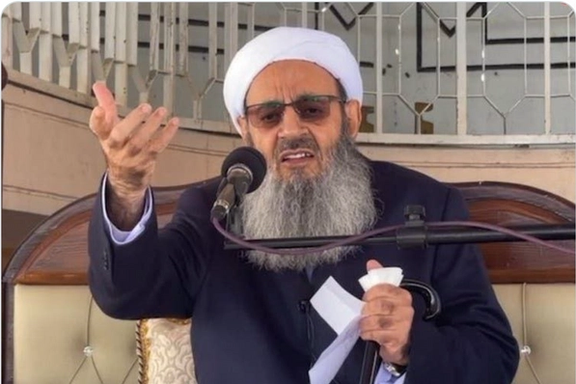
Iran's outspoken Sunni religious leader Mowlana Abdolhamid

Iran’s top Sunni cleric Mowlavi Abdolhamid has once again urged the government to hold “constructive” talks with protesters as widespread dissatisfaction has largely delegitimized the Islamic Republic over the past years.

“We believe in dialogue, but not the kind of dialogue that results in no action. We believe in a constructive dialogue that results in accepting the truth,” said the top religious leader of Iran’s largely Sunni Baluch (Baloch) population in his Friday prayer sermons in the Makki Jameh Mosque of Zahedan, the provincial capital of Sistan-Baluchestan.

The situation has recently become more tense in the province as the insurgent Sunni Baluch group known as Jaish al-Adl (Army of Justice) has intensified its operations against Iranian security forces in southeastern Iran. The group advocates for enhanced rights and improved living conditions for the Baluch ethnic minority.

On Tuesday, six law enforcement officers were killed by Jaish al-Adl militants during an ambush on police vehicles along the Sib and Suran county route. The group also launched simultaneous attacks recently against military posts in Chabahar and Rask last week, killing 16 police forces; the clashes also claimed the lives of 18 Jaish al-Adl militants.

On April 5, Abdolhamid urged the government and the militant group to avoid further “gunfights and bloodshed,” stressing that the two sides should “sit together and talk through their problems.

His call for negotiations between Tehran and Jaish al-Adl immensely angered the Iranian government, which has designated the group as “terrorist.” IRGC-affiliated Fars and Tasnim news agencies harshly criticized the Sunni cleric, with Fars saying he “knowingly or unknowingly” serves the interests of “Western political and security apparatus.”

In another response, Mojtaba Azizi, the government-backed Shiite imam of Friday prayers in Zabol, another town in Sistan-Baluchestan, accused Abdolhamid, without naming him, of backing Jaish al-Adl militants. The authorities must deal decisively with the militants, including “the Israeli and evil movement in the Makki Mosque,” stated Azizi in what was seen as a direct attack at Abdolhamid.

In response to the government-orchestrated attacks, Abdolhamid blamed the regime for fanning the flames of discontent and violence in the country by refusing to listen to the demands of the protesters.

“You don’t negotiate with armed people, but have you negotiated with unarmed peaceful protesters? Have you talked to political prisoners about their demands?” asked the Sunni cleric, further saying that the regime authorities should have heard and fulfilled the demands of the Iranian nation which has been protesting over the past two years.

Expressing his opposition to “any kind of violence from anyone and any party,” Abdolhamid firmly stressed that he encourages and supports “civil efforts” to change the status quo.

In his sermon, the cleric also referred to the government’s harsh measures to enforce compulsory hijab laws in Iran. “Violence begets violence … If you want to enforce religious precepts in society, do not resort to violence. It will not work.”

The Iranian police has announced that it will adopt stricter measures to impose compulsory hijab as of Saturday and will deal with those who “violate” the laws.

Abdolhamid has turned into an outspoken and staunch critic of Iran's rulers following its harsh crackdown on the 2022 nationwide uprising triggered by the death in morality-police custody of Mahsa Amini. On September 30, 2022, security forces killed more than 90 protesters near Abdolhamid's mosque in Zahedan.

One of the latest victims of the Iranian regime’s repressive hijab policy was Armita Geravand, a sixteen-year-old girl. She died on October 28, 2023 after about a month in coma for brain damage she suffered during a violent encounter with hijab enforcers deployed at Tehran’s subway stations.

Follow developments on Iran International's Live coverage of ongoing tensions between Iran and Israel.
Most Viewed

100 days after carnage: Iran economy reels from war, inflation, unemployment
1
INSIGHT

100 days after carnage: Iran economy reels from war, inflation, unemployment

2
INSIGHT

Ghalibaf defends Iran-US talks amid hardline backlash

3
INSIGHT

A nation in limbo: 100 days after the massacre, has the world moved on?

4
ANALYSIS

From instability to influence: Pakistan’s pivotal role in US-Iran diplomacy

5
ANALYSIS

100 days on: why Iran’s January protests spread across social classes

Banner
Banner

Spotlight

  • War-hit homeowners feel abandoned as Iran’s reconstruction aid fades

    War-hit homeowners feel abandoned as Iran’s reconstruction aid fades

  • 100 days on: the anatomy of Iran’s January crackdown
    INSIGHT

    100 days on: the anatomy of Iran’s January crackdown

  • Ghalibaf defends Iran-US talks amid hardline backlash
    INSIGHT

    Ghalibaf defends Iran-US talks amid hardline backlash

  • 100 days on: why Iran’s January protests spread across social classes
    ANALYSIS

    100 days on: why Iran’s January protests spread across social classes

  • From instability to influence: Pakistan’s pivotal role in US-Iran diplomacy
    ANALYSIS

    From instability to influence: Pakistan’s pivotal role in US-Iran diplomacy

  • A nation in limbo: 100 days after the massacre, has the world moved on?
    INSIGHT

    A nation in limbo: 100 days after the massacre, has the world moved on?

•
•
•

More Stories

Khamenei’s Military Advisor Boasts Of Fear Among Israelis

Apr 13, 2024, 12:15 GMT+1
•
Iran International Newsroom

Israelis are in complete terror, awaiting Iran’s retaliatory attack, IRGC General Yahya Rahim-Safavi, chief military advisor to Iran’s Supreme Leader Ali Khamenei said late on Friday.

Rahim-Safavi who was speaking at a memorial service for IRGC officers killed in an Israeli air strike in Damascus on April 1, claimed that Israel has refrained from attacking Rafah area in Gaza, because it awaits an attack from Iran.

"The victory of the resistance front and the Palestinian nation under the leadership of Iran is certain, and the new Middle East will be formed with Iran and the resistance front as the center, contrary to the plans and wishes of America and Israel,"he added.

Israel has not claimed responsibility for the strike on Damascus on April 1 that killed seven IRGC officers including two top generals, but Iran’s Supreme Leader vowed to punish Israel for the attack.

In response, Israel’s Chief of the General Staff of the Israel Defense Forces, Herzi Halevi, said, "We know how to act forcefully against Iran in both near and distant places. We are operating in cooperation with the USA and strategic partners in the region," Reuters reported.

Although US officials warned of an attack on Israel by Iran on Friday, Iran's response so far has been limited to psychological warfare tactics to keep Israeli's on edge.

Follow developments on Iran International's Live coverage of ongoing tensions between Iran and Israel.

UK Prepares Evacuation As Tensions Rise In Middle East

Apr 13, 2024, 11:12 GMT+1
•
Iran International Newsroom

The UK Royal Marines are prepared to oversee a major evacuation of British nationals from the Middle East if Iran decides to launch a missile strike on Israel.

According to a report from the Daily Mail, commandos have been doing reconnaissance along the Lebanese coast in preparation for a possible maritime rescue operation.

Defense Secretary Grant Shapps told the Mail that the UK “stands ready” to help any Britons who find themselves stuck in the area. The Foreign Office has recommended that all UK citizens leave Lebanon as a precaution.

US President Joe Biden on Friday issued a warning about a significant risk of attack "sooner than later."

Meanwhile, there are reports suggesting that Iran has advised against US intervention in the region. The evacuation plan, known as Operation Meteoric, will be led by the UK's 'Green Berets' with assistance from the Royal Navy and Royal Air Force.

A team of Marines from 30 Commando has been sent to the area for Operation Meteoric, drawing parallels to the historic Operation Dynamo from 1940, which evacuated Allied soldiers from Dunkirk.

Tensions escalated following an attack on Iran's consulate in Damascus on April 1, reportedly carried out by Israel. Iran has repeatedly threatened retaliation either directly from its territory or deploying its proxy forces in the region.

Recent reports indicate that Iran may use drones, cruise missiles, and ballistic missiles, posing a threat to civilian air travel.

In a worst-case scenario, civilians stranded on beaches could be rescued by the UK’s Royal Fleet Auxiliary ships in the eastern Mediterranean, supported by RAF Typhoon jets stationed in Cyprus.

Shapps assured that the UK is prepared to help its citizens in the midst of rising tensions, even though details of the plans are classified for safety.

Follow developments on Iran International's Live coverage of ongoing tensions between Iran and Israel.

Blinken Discusses Iran’s Threats With Jordan, Egypt FMs

Apr 13, 2024, 10:50 GMT+1
•
Iran International Newsroom

In calls with Egyptian and Jordanian foreign ministers on Friday, US Secretary of State Antony Blinken discussed the recent escalation in the Middle East amid Iran’s ongoing threats against Israel.

According to the State Department, Blinken told Egyptian Foreign Minister Sameh Shoukry that “an escalation by Iran would not benefit anyone in the region.”

The two sides also addressed the conflict in Gaza and discussed ways to increase the flow of humanitarian aid into the war-torn enclave and to achieve an immediate ceasefire conducive to the release of all Hamas’s hostages.

Earlier on Friday, Blinken also spoke with Jordanian Minister of Foreign Affairs and Expatriates Ayman Safadi, stressing “the urgent need to avoid further escalation in the region by Iran,” the State Department said.

Ceasefire negotiations between Hamas and Israel was another pivotal issue addressed in the phone call. In the case of finalization, an at least six-week truce is to be declared in the region which would see the release of Israelis held captive by the Palestinian militants in the Gaza Strip.

Over the past days, there have been widespread and intensive international consultations to prevent the intensification of tensions in the Middle East. Since Israel’s deadly April 1 attack on the Iranian consulate in Damascus, Iranian regime officials have time and again vowed reprisals.

On Wednesday, the foreign ministers of Saudi Arabia, Qatar, Iraq and UAE contacted their Iranian counterpart Hossein Amir-Abdollahian, at the request of the US, in an attempt to persuade Tehran to avoid a direct confrontation with Israel.

Germany's Lufthansa and its subsidiary Austrian Airlines have suspended their flights to Tehran after reports confirmed that Iran’s attack on Israel seems imminent.

Follow developments on Iran International's Live coverage of ongoing tensions between Iran and Israel.

Iran May Attack Israel From Inside Its Territories – CNN

Apr 13, 2024, 08:26 GMT+1
•
Iran International Newsroom

The US believes Iran may attack Israel from inside its territory as Tehran officials constantly vow revenge for the deaths of top IRGC generals in an Israeli strike in Damascus, CNN reported.

“The US had observed Iran moving military assets around internally, including drones and cruise missiles, signaling that it was preparing to attack Israeli targets from inside its own territory,” the report quoted two informed sources as saying.

According to one CNN source, Iran has recently been tracked to have readied around 100 cruise missiles. “It was not clear whether Iran was preparing to strike from its soil as part of an initial attack, or if it was posturing to try to deter Israel or the United States from conducting a possible counter strike on its territory,” the report added.

Washington also believes that Tehran might involve its regional proxies in its retaliatory attack and that the potential targets can be both on the Israeli soil and abroad, the CNN said.

Earlier on Friday, the White House confirmed that Iran’s threats against Israel are “real,” “viable” and “credible.”

Meanwhile, US President Joe Biden told reporters that Iran’s reprisals would occur “sooner than later,” but the regime “will not succeed” as Washington is committed to Israel’s security and will help it defend itself against threats.

On April 1, Israel launched a precision missile strike on Iran's consulate building in Damascus, killing 7 IRGC forces, including Mohammad Reza Zahedi, the highest-ranking commander of the Iranian Revolutionary Guards Quds Force (IRGC-QF) in Lebanon and Syria. Since then, Supreme Leader Ali Khamenei and other senior Iranian officials have vowed revenge against Israel.

Despite Warnings Of Imminent Attack, Iran Keeps Suspense

Apr 13, 2024, 08:04 GMT+1
•
Iran International Newsroom

President Joe Biden all but confirmed Friday night that his “Don’t” message to the Iran's government would not stop its looming retaliatory attack against Israel.

“Sooner rather than later,” he said, when reporters asked him about the timing of Iran’s seemingly imminent attack, reiterating that the US is “devoted to the defense of Israel” and would not allow Iran “to succeed.”

Many Iranian officials have been walking the line drawn by their Supreme Leader Ali Khamenei during his speech on Wednesday, that Israel has to be “punished” for bombing Iran’s consulate in Damascus, and killing two senior Revolutionary Guards (IRGC) commanders.

On Friday, IRGC’s deputy commander of operations General Abbas Nilforushan posted an image resembling a missile with the quote by Khamenei written on it: “The Zionist regime made a mistake by attacking the Iranian consulate. It should be punished and it will be.”

For a moment Friday night, it seemed like the ‘punishment’ had started, with Hezbollah firing 40 rackets towards Israel. It had no follow up, however. The Israeli army announced that it had shot down most rockets and that those slipping through had hit open spaces.

After three days of speculation, laden with media reports quoting anonymous American sources, some began questioning the veracity of the underlying intelligence, suggesting that the regime in Iran could be playing a mind game, sowing confusion, and shaking Israel without so much as raising a finger. 

But most governments seem to continue to take the threat seriously, advising their citizens to avoid traveling to –or even leave– Iran and Israel. European airlines Lufthansa, Austrian, and Air France, have suspended their flights to and from Tehran. Australian airline Qantas has paused its non-stop flights from Perth to London because the 17.5 hour flight is possible only by using Iranian airspace.

Airlines are perhaps more concerned because the memory of Iran’s last “hard revenge” is still fresh –when on January 8, 2020, following the assassination of Iran’s preeminent military man, Qassem Soleimani, the IRGC shut down the Ukrainian passenger flight PS752, killing all 176 on board. First Iran denied it had targeted the plane with two anti-air missiles, but then grudgingly admitted its role but claiming it was a missile operator error.

Many in Iran fear that they would end up paying the price, however the current crisis unfolds. A ‘significant’ attack on Israeli interests, as predicted by US intelligence, could beget severe retaliation from a beleaguered Netanyahu looking to reassert his authority. And a decision to not retaliate against Israel, many Iranians fear, could mean their government channeling its rage and anxiety inwards, taking it on the people instead of foreign militaries.

“Ali Khamenei is trying to start a war to save his failing regime,” Iranian Prince Reza Pahlavi posted on X. “But this is not a war that our nation wants. Iranians have made it clear: the criminal mafia occupying Iran does not represent our nation, our values, or our aspirations.”

In reality, the wishes or aspirations of ordinary Iranians has very little bearing on the looming crisis. The likeliest scenario, still, is Iran attacking Israeli interests through allied armed groups in the region.

CNN reported late Friday that US intelligence has observed some movement of Iranian military assets, including cruise missiles and one-way drones around the country. This may hint at direct strikes against Israel from Iranian territory, which contradicts other intelligence suggesting any potential operation would be launched by Iran’s proxies.

According to the report, US officials are unsure if these movements are offensive preparations or defensive measures in anticipation of a joint Israeli-American retaliatory strike.

Follow developments on Iran International's Live coverage of ongoing tensions between Iran and Israel.




