• العربية
  • فارسی
Brand
  • Iran Insight
  • Politics
  • Economy
  • Analysis
  • Special Report
  • Opinion
  • Podcast
  • Iran Insight
  • Politics
  • Economy
  • Analysis
  • Special Report
  • Opinion
  • Podcast
  • Theme
  • Language
    • العربية
    • فارسی
  • Iran Insight
  • Politics
  • Economy
  • Analysis
  • Special Report
  • Opinion
  • Podcast
All rights reserved for Volant Media UK Limited
volant media logo

US Transfers Iran’s Seized Arms, Ammunition To Ukraine
Apr 9, 2024, 15:20 GMT+1Updated: 21:44 GMT+1
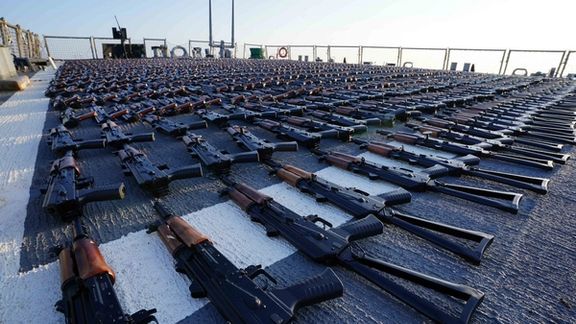
A photo of AK-47s seized while being transferred from the IRGC to the Houthis in Yemen

Washington has supplied Ukraine with Iranian small arms and ammunition seized while en route to the Iran-backed Houthis in Yemen. 

According to a statement from the US Central Command (CENTCOM) on social media, "The US government transferred over 5,000 AK-47s, machine guns, sniper rifles, RPG-7s, and over 500,000 rounds of 7.62mm ammunition to the Ukrainian armed forces" on April 4. “These weapons will help Ukraine defend against Russia’s invasion.”

The arms and ammunition were confiscated from four "stateless vessels" between May 2021 and February 2023 while in transit from Iran's Revolutionary Guards to Yemen's Houthi rebels, CENTCOM revealed.

The US government obtained ownership of the munitions on December 1, 2023, through the Department of Justice’s civil forfeiture claims against Iran’s IRGC.

CENTCOM said it remains committed to collaborating with allies and partners to stem the flow of Iranian weapons in the region through lawful measures, including in violation of UN and US sanctions, and interdictions.

Since January, the US has intercepted multiple shipments of advanced weaponry destined for the Houthis in Yemen. These weapons violate international law and have been used to threaten international commerce.

On January 11, CENTCOM forces intercepted a dhow during a routine flag check. The vessel was transporting advanced weaponry from Iran to Houthi rebels in Yemen “to resupply Houthi forces in Yemen as part of the Houthis’ ongoing campaign of attacks against international merchant shipping.”

“Seized items include propulsion, guidance, and warheads for Houthi medium range ballistic missiles (MRBMs) and anti-ship cruise missiles (ASCMs), as well as air defense associated components. Initial analysis indicates these same weapons have been employed by the Houthis to threaten and attack innocent mariners on international merchant ships transiting in the Red Sea,” CENTCOM said.

In late January, a US Coast Guard vessel operating in the Arabian Sea seized another shipment of advanced weaponry originating in Iran and destined for Houthi-controlled areas of Yemen.

The Coast Guard team found over 200 packages containing components for medium-range ballistic missiles, explosives, drones, military communications equipment, and anti-tank missile launchers.

“This is yet another example of Iran’s malign activity in the region,” said Gen. Michael Erik Kurilla, CENTCOM commander. “Their continued supply of advanced conventional weapons to the Houthis is in direct violation of international law and continues to undermine the safety of international shipping and the free flow of commerce.”

The Houthi rebels, who have been targeting vessels in the Red Sea and Gulf of Aden since November 2023, claim solidarity with Palestinians in Gaza. The maritime blockade aims to force a ceasefire on Israel but has expanded from targeting Israeli vessels to a global assault. The attacks began after Iran's Supreme Leader Ali Khamenei called on Muslims in early November to blockade Israel.

The recent transfer to Ukraine mirrors a similar one conducted by Washington in early October when 1.1 million rounds of 7.62mm ammunition seized from Iranian forces en route to Yemen were given to Ukraine to address dire shortages in its defensive against Russia.

However, the delivery of artillery and air defense munitions to Ukraine has been hindered by Republican lawmakers who have delayed a $60 billion support package in the US Congress since last year. Consequently, Ukrainian troops have been forced to ration ammunition, uncertain of when further deliveries will occur.

Despite the obstacles, the United States announced a $300 million assistance package for Kyiv on March 12, encompassing anti-aircraft and anti-tank weapons, as well as artillery shells. This funding, sourced from reallocated savings from Pentagon expenditures, aims to sustain aid to Ukraine amidst the congressional deadlock.


Most Viewed

100 days after carnage: Iran economy reels from war, inflation, unemployment
1
INSIGHT

100 days after carnage: Iran economy reels from war, inflation, unemployment

2
INSIGHT

Ghalibaf defends Iran-US talks amid hardline backlash

3
INSIGHT

A nation in limbo: 100 days after the massacre, has the world moved on?

4
ANALYSIS

From instability to influence: Pakistan’s pivotal role in US-Iran diplomacy

5
ANALYSIS

100 days on: why Iran’s January protests spread across social classes

Banner
Banner

Spotlight

  • War-hit homeowners feel abandoned as Iran’s reconstruction aid fades

    War-hit homeowners feel abandoned as Iran’s reconstruction aid fades

  • 100 days on: the anatomy of Iran’s January crackdown
    INSIGHT

    100 days on: the anatomy of Iran’s January crackdown

  • Ghalibaf defends Iran-US talks amid hardline backlash
    INSIGHT

    Ghalibaf defends Iran-US talks amid hardline backlash

  • 100 days on: why Iran’s January protests spread across social classes
    ANALYSIS

    100 days on: why Iran’s January protests spread across social classes

  • From instability to influence: Pakistan’s pivotal role in US-Iran diplomacy
    ANALYSIS

    From instability to influence: Pakistan’s pivotal role in US-Iran diplomacy

  • A nation in limbo: 100 days after the massacre, has the world moved on?
    INSIGHT

    A nation in limbo: 100 days after the massacre, has the world moved on?

•
•
•

More Stories

Israel Launches ‘C-Dome’ Seaborne Defense System For First Time

Apr 9, 2024, 14:39 GMT+1

Israel for the first time used a seaborne missile defence system to shoot down a drone approaching from the Red Sea that had set off sirens in the port city of Eilat, the military said on Tuesday.

Eilat has been a frequent target for launches by Iran-backed Houthis in Yemen as a show of support for Hamas, the Palestinian group that rules Gaza and is also backed by Iran.

Israel positioned missile boats in the Red Sea after the start of the war in Gaza, the military said. One of those missile boats shot down the drone with the new system called the C-Dome.

"Overnight, for the first time ever, an IDF Sa'ar 6-class corvette missile ship successfully intercepted a UAV (unmanned aerial vehicle) that had approached from the east and had crossed into the area of the Gulf of Eilat," the military said.

The C-Dome is the naval version of the Iron Dome, Israel’s rocket-defense system that has intercepted thousands of rockets fired from Gaza. The Iron Dome, which has been active since 2011 with an impressive success rate of approximately 90 percent, works by using radars to detect short-range rockets before destroying them with its own missiles.

The C-Dome was first unveiled in 2014 and was declared operational in November 2022. It works similarly to the Iron Dome, using some of the same technology, except that it is mounted on ships.

It bookends Israel's multi-tier air defence array opposite Arrow-3, which is designed to intercept ballistic missiles outside the earth’s atmosphere.

Iranian Nurse Commits Suicide In Rising Trend Among Medics

Apr 9, 2024, 14:22 GMT+1

A young nurse has committed suicide after being made redundant from Kermanshah's Imam Khomeini Hospital amid a national health crisis in Iran with increasing numbers of suicides facing the profession.

The death of the man identified only as Sasan, 32, was confirmed by Mohammad Sharifi Moghadam, the Secretary-General of the Nursing Association. Sasan worked in the hospital's poisoning department which specializes in suicide attempts.

Since the pandemic, the health crisis has faced huge challenges with many in the medical profession leaving Iran to find work abroad. Experts have dubbed it an exodus which has left the profession with dire shortages.

Sharifi Moghadam criticized the negligence towards the demands of the nursing profession following the conclusion of the coronavirus pandemic, noting that many contract nurses were laid off during the period with no care taken to support them.

He said that during the pandemic, almost one third of nurses reported suicidal thoughts, a trend which continued amidst the country's ongoing economic crisis and social oppression.

Blaming the government for poor working conditions such as overwhelming workloads, poor pay and a lack of career opportunities, he said, "The field is stressful for nurses, and all officials share responsibility for creating such an atmosphere."

The alarming trend of suicides among medical students, nurses and doctors has garnered increasing attention, as evidenced by numerous reports in recent years. A study carried out by a psychiatric association last year revealed a substantial increase in suicide rates within the medical community, ranging from 3.1 to 5 times higher compared to previous periods. 

However, these will only be the reported cases, many not being attributed to suicide as it is forbidden in Islam. In February, the president of the Iranian Psychiatric Scientific Association disclosed that 16 medical residents had ended their lives within the past year alone.

Last May, MP Hossein Ali Shahriari, chairman of the Iranian parliament's Health and Treatment Committee, said around 10,000 healthcare practitioners have left Iran over the past two years to work in the Arab world seeking better opportunities. 


Iranian Ministry Of Interior To Expel Illegal Afghans

Apr 9, 2024, 12:57 GMT+1

Iran’s ministry of interior has issued a directive for all illegal Afghan immigrants to leave or face deportation.

The statement, released on Monday emphasized that “unauthorized individuals, particularly foreign nationals, will be repatriated.”

Amid an economic crisis, the ministry stated that there is no possibility of accepting further Afghan immigrants into the country as Iran faces growing discontent about rising numbers of both legal and illegal Afghans in the country.

The ministry's public relations department appended the statement with a note, attributing its issuance to certain websites' attempts to stir anti-Afghan sentiments, although no further explanation was provided.

The announcement follows recent remarks made by Ehsan Heidari, the acting head of the Department of Foreign Nationals and Immigrants Affairs of Tehran Province in which he warned of crackdowns on illegal immigrants. .

On March 21, the IRGC-affiliated Tasnim News Agency reported the initiation of a police plan aimed at gathering and repatriating unauthorized immigrants from recreational areas in Tehran Province.

Reports of detention and expulsion of foreign nationals from Iran have become increasingly common in recent months. While the reports do not specify the nationality of those affected, it is widely understood that a significant portion of them are Afghan citizens.

The influx of Afghan migrants into Iran has sparked debate among citizens and officials alike, with differing opinions on whether their presence poses a threat or an opportunity for the regime. Estimates of the size of the Afghan diaspora population in Iran vary, with precise figures difficult to ascertain due to Afghans' reluctance to participate in official counts and registrations.

Approximately 780,000 Afghans residing in Iran possess official refugee status, leaving the majority without documentation. Over recent years, Afghan refugees have been crossing the border in significant numbers fleeing the Taliban regime, with estimates now suggesting their total population in Iran ranges between 6 to 7 million, as indicated by an expert from the Iranian Parliament's Research Center.

Speculation Mounts On Iran Leader's Health

Apr 9, 2024, 11:36 GMT+1

Statements from the head of Iran's Supreme Leader's medical team celebrating his good health have sparked speculation as to the true state of the aging dictator’s health.

Alireza Marandi highlighted Ali Khamenei's active schedule in spite of his being 84, attributing it to “divine grace”.

Marandi said, "God has been very gracious to the Islamic Republic and all of us, keeping him healthy and well."

The decision to air such statements on a TV talk show has raised questions about the motive behind the sudden public discourse.

Speculation about Khamenei's health has been ongoing, sparking questions about potential successors. While discussions about succession remain taboo in Iranian political discourse, several names have been floated, with Khamenei's son, Mojtaba, emerging as a prominent figure believed to be groomed for the role.

However, experts caution that such an appointment could trigger instability within the regime, given competing power dynamics.

Reports of Khamenei's health issues have surfaced in the past. In 2022, the New York Times reported on his emergency surgery for bowel obstruction amid rumors of his deteriorating health.

Khamenei's subsequent public appearances were seen as attempts to dispel rumors of his death and reaffirm his leadership.

Khamenei has been Iran's supreme leader since 1989 and has been battling ill health for almost a decade. In 2014, he underwent a successful prostate cancer operation which also triggered fears for what would come next.

Iran’s Science Ministry To Close 10 Institutions Involved In Plagiarism

Apr 9, 2024, 10:12 GMT+1

The legal deputy of the ministry of science in Iran announced that 10 institutions involved in the sale of theses and counterfeit documents will be closed down in the coming days.

Reza Saberi said, "Currently, we have identified 10 entities engaged in buying and selling theses … most of them operate through illegal online platforms."

The proliferation of online platforms offering fraudulent academic services has posed a challenge to academic integrity in Iran. These platforms target people seeking shortcuts to academic credentials, exploiting loopholes in the system.

In recent years, degree seeking among students in Iran has escalated, reflecting a concerning trend that highlights broader systemic issues within the country's educational landscape.

While education is highly valued in Iranian society, the pursuit of degrees has increasingly become intertwined with socioeconomic pressures and political realities, leading to a culture of degree seeking that often prioritizes credentials over genuine learning.

One of the primary drivers behind the surge in degree seeking is the competition for limited opportunities in higher education and the job market.

With a large youth population and limited employment prospects, obtaining a degree is often viewed as essential for securing stable employment and socioeconomic advancement.

Moreover, the politicization of education has further complicated the landscape. Government policies, ideological biases, and censorship have shaped educational curricula and restricted academic freedoms, undermining the quality and relevance of education. This has fueled disillusionment among students and exacerbated the pressure to seek degrees as a means of navigating an uncertain future.