• العربية
  • فارسی
Brand
  • Iran Insight
  • Politics
  • Economy
  • Analysis
  • Special Report
  • Opinion
  • Podcast
  • Iran Insight
  • Politics
  • Economy
  • Analysis
  • Special Report
  • Opinion
  • Podcast
  • Theme
  • Language
    • العربية
    • فارسی
  • Iran Insight
  • Politics
  • Economy
  • Analysis
  • Special Report
  • Opinion
  • Podcast
All rights reserved for Volant Media UK Limited
volant media logo

Israeli Embassies Are No Longer Safe - Khamenei’s Top Military Aide
Apr 7, 2024, 11:42 GMT+1
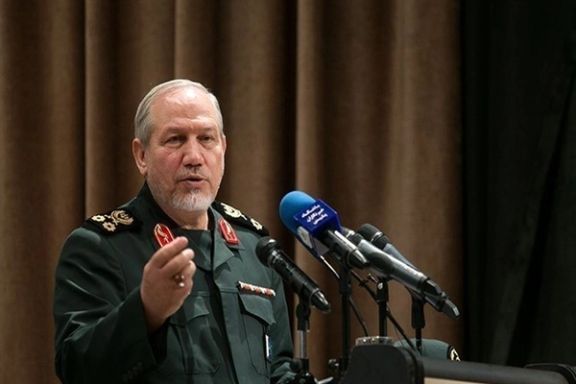
General Yahya Rahim Safavi, the top military advisor of Iran Supreme Leader

General Yahya Rahim Safavi, the top military advisor of Iran Supreme Leader, has reiterated threats against Israeli embassies worldwide, saying none of them are safe anymore.

According to Tasnim news agency, affiliated with the Revolutionary Guards, Safavi said, “The shadow of fear and terror looms over the occupied lands, and the Zionists see the specter of death in their dreams every night.”

He made the remarks as debate continues in Tehran about how to retaliate Israel’s April 1 air strike that killed seven IRGC officers in the Iranian embassy in Damascus.

The leadership of the Islamic Republic, and particularly Supreme Leader Ali Khamenei face a challenging political dilemma -- launch a forceful retaliatory attack and risk a wider war, possibly involving the United States, or exercise restraint and look for less dramatic alternatives. However, Tehran’s proxies around the region, its domestic supporters, and even ordinary Iranians opposed to the government might see any hesitation as a sign of weakness.

Safavi pointed out that 28 Israeli embassies and consulates have been temporarily closed because of threats on behalf of Iran and its proxies. The closures “happened out of fear, and it means that confronting this brutal regime is a legal and legitimate right.”

While the IRGC and its media outlets clamor for war and a swift response, Tehran's commentators advocate for a measured approach, warning that the strike might be a trap to drag Iran into a direct conflict.

Israeli attacks have killed 18 senior IRGC officers since December, a trend that has become difficult to explain away by the Islamic Republic.

Many regional countries would like to ,see Iran directly involved in a war with Israel because it will inflict great damage on the country, two Iranian commentators said Sunday. “The interests of all actors in the region today lie in dragging Iran into war," said Former chairman of Iranian parliament’s national security and foreign policy committee, Heshmatollah Falahatpisheh.

IRGC-affiliated Tasnim claims that the Israeli government is creating staged scenes near Tel Aviv's Ayalon Highway, a major thoroughfare. These fabricated scenarios aim to portray a failed strike on Israel's military and security facilities, shifting the narrative to a civilian catastrophe. The intent is likely to demonize Iran by claiming their missiles or drones targeted residential areas, causing casualties. “This is being done in order to claim that Iranian missiles or drones have targeted residential areas in the city and caused casualties," Tasnim said.

Earlier in the day, Israel's defense minister said the country was ready to handle any scenario that may develop with its foe Iran as it stayed on alert for the possible retaliatory attack. Yoav Gallant's office made the statement after he held an "operational situation assessment" with senior military officers. "Upon completing the assessment, Minister Gallant emphasized that the defense establishment has completed preparations for responses in the event of any scenario that may develop vis-à-vis Iran," his office said.


Most Viewed

Iran negotiators ordered to return after internal rift over Islamabad talks
1
EXCLUSIVE

Iran negotiators ordered to return after internal rift over Islamabad talks

2
ANALYSIS

US blockade enters murky phase as tankers spoof signals and buyers hesitate

3

US tightens financial squeeze on Iran, warns banks over oil money flows

4
INSIGHT

Ideology may be fading in Iran, but not in Kashmir's ‘Mini Iran'

5
INSIGHT

Hardliners push Hormuz ‘red line’ as US blockade tests Iran’s leverage

Banner
Banner

Spotlight

  • Hardliners push Hormuz ‘red line’ as US blockade tests Iran’s leverage
    INSIGHT

    Hardliners push Hormuz ‘red line’ as US blockade tests Iran’s leverage

  • Ideology may be fading in Iran, but not in Kashmir's ‘Mini Iran'
    INSIGHT

    Ideology may be fading in Iran, but not in Kashmir's ‘Mini Iran'

  • War damage amounts to $3,000 per Iranian, with blockade set to add to losses
    INSIGHT

    War damage amounts to $3,000 per Iranian, with blockade set to add to losses

  • Why the $100 billion Hormuz toll revenue is a myth
    ANALYSIS

    Why the $100 billion Hormuz toll revenue is a myth

  • US blockade targets Iran oil boom amid regional disruption
    ANALYSIS

    US blockade targets Iran oil boom amid regional disruption

  • Iran's digital economy battered by prolonged blackout
    INSIGHT

    Iran's digital economy battered by prolonged blackout

•
•
•

More Stories

Israel Prepared To Handle Any Scenario With Iran, Defense Chief Says

Apr 7, 2024, 10:52 GMT+1

Israel's defense minister said on Sunday the country was ready to handle any scenario that may develop with its foe Iran as it stayed on alert for a possible retaliatory attack to the killing of Iranian generals on April 1.

Defense Minister Yoav Gallant's office made the statement after he held an "operational situation assessment" with senior military officers.

"Upon completing the assessment, Minister Gallant emphasized that the defense establishment has completed preparations for responses in the event of any scenario that may develop vis-à-vis Iran," his office said.

An Israeli precision strike on the Iranian embassy compound on April 1, killed two top IRGC Quds Force generals and seven other officers, rattling the Iranian government that has vowed to punish Israel.

Meanwhile, Israel launched air strikes on eastern Lebanon early on Sunday, hitting what it said were Hezbollah infrastructure sites after the armed group downed an Israeli drone over the country as both sides continue to trade fire amid escalating regional tensions.

The Israeli army said in a statement that fighter jets struck a military complex and three other infrastructure sites belonging to Hezbollah in the eastern city of Baalbek.

It said the latest attack was in response to Iran-backed Hezbollah's downing of an unmanned aerial vehicle in Lebanese airspace, which the group identified as the Israeli-made Hermes 900 drone.

Hezbollah has been trading fire with Israel across Lebanon's southern border since October 8, a day after the Palestinian group Hamas launched an attack on Israel that sparked Israel's war in Gaza and led to escalating regional tensions.

(Reporting by Reuters)

Iran's FM Embarks On Regional Tour After Consulate Attack

Apr 7, 2024, 10:13 GMT+1

Shoring up support for a possible retaliation to last week's Israeli attack on Iran's consulate in Syria, Foreign Minister Hossein Amir-Abdollahian has embarked on a regional tour.

Arriving in Oman on Sunday, his visit comes just days after the deadly strike which resulted in the deaths of seven Revolutionary Guards, including senior members.

"Leading a delegation of political and parliamentary representatives, discussions will encompass bilateral and regional matters, including Gaza," stated the Iranian foreign ministry, referring to the Gaza war sparked by Iran-backed Hamas's attack on Israel on October 7.

A US official has warned of increased vigilance and readiness for potential Iranian retaliation targeting Israeli or American assets in the region as fears grow for US personnel, and in Israel, veiled announcements of countering any threats at home and abroad have been vocal from both the military and political leadership.

Airstrikes took place in eastern Lebanon early Sunday, reportedly targeting infrastructure sites associated with Hezbollah which since October 7, when Iran-backed Hamas invaded Israel, has fired over 3,100 projectiles into Israeli territory. Sunday's action followed the downing of an Israeli drone by the militant group over Lebanese territory in what is the worst conflict between Israel and Hezbollah since the second Lebanon war.

Alongside the Gaza war, the Israeli army has confirmed that 30 commanders from Hezbollah have been eliminated since the war began as well as 330 terrorists from the largest of Iran's militia groups. Over 1,400 targets have been struck from the air in Lebanon alone and 3,300 or more ground targets struck.

Iran's political and military leadership have called for harsh responses to the humiliating attack last week, believed to have struck a key IRGC-Quds Force center, with Hezbollah leader Hassan Nazrullah this weekend warning retaliation is "inevitable".


Two Vessels Targeted Southwest Of Yemen's Aden - UK Security Firm

Apr 7, 2024, 09:43 GMT+1

British security firm Ambrey said it had received information indicating that a vessel was attacked on Sunday in the Gulf of Aden about 102 nautical miles southwest of Mukalla in Yemen.

"Vessels in the vicinity were advised to exercise caution and report any suspicious activity," the firm said. It did not say who was responsible for the attack or give further details.

Separately, a missile landed near a vessel in the Gulf of Aden on Sunday but there was no damage to the ship or injuries to crew in the incident, 59 nautical miles southwest of the Yemeni port of Aden, the United Kingdom Maritime Trade Operations (UKMTO) agency said.

"The Master of the vessel reports a missile impacted the water in close proximity to the vessel’s port quarter," UKMTO said in an advisory note. "No damage to the vessel reported and crew reported safe," it added.

It did not say who fired the missile or give further details.

Yemen's Iran-aligned Houthi militants have staged months of attacks on shipping in the Red Sea region in support of Palestinians in the Gaza war. They are armed and trained by Iran and began attacking vessels when in November Supreme Leader Ali Khamenei called on Arabs to blockade Israel.

Abdul Malik Al-Houthi, the leader of the pro-Iran rebels, said in a televised speech Friday tha 90 ships had been targeted in the Red Sea and drone attacks had increased and expanded to additional regions.

The attacks have disrupted global shipping through the Suez Canal, forcing firms to re-route to longer and more expensive journeys around southern Africa. The United States and Britain have launched strikes on Houthi targets in Yemen.

Iranian Political Prisoner Accused Of Supporting Israel

Apr 7, 2024, 09:23 GMT+1

Fatemeh Sepehri, an Iranian political prisoner, has been accused of supporting Israel due to condemning Iran-backed Hamas's atrocities of October 7 which since sparked a regional proxy war.

Her brother, Asghar Sepehri, announced on X that Fatemeh participated in a virtual court session from Vakilabad Prison in Mashhad on Saturday, during which the judge accused her of supporting Israel following her condemnation of the attacks which killed at least 1,200 mostly civilians, led to the mass rape and torture of civilians, and saw the kidnap of over 250 hostages to Gaza, dozens of whom have since been killed in captivity. 

Imprisoned since September 21, 2022 amid the Women, Life, Freedom protests, her family already fears for her health as she deteriorates in dire prison conditions amid heart disease. 

Sepehri faces severe charges, including "collaboration with hostile countries" resulting in a 10-year sentence, "conspiracy and collusion" leading to five years of imprisonment, "insulting the leadership" resulting in two years of imprisonment, and "propaganda against the system" leading to one year of imprisonment.

The Hamas invasion of Israel has since led to military attacks from Iran's proxies regionally. Over 3,100 projectiles have been fired to Israel from Hezbollah in Lebanon, over 35 from Syria, and on Israel's south coast, Yemen's Houthis have waged a maritime blockade, with missiles being fired not only into southern Israel but targeting global shipping, sparking a global crisis.

Iran's proxies in the Middle East have waged over 200 attacks on US infrastructure as punishment for supporting Israel's right to defend itself and a 20+ nation coalition led by the US has been formed to counter the Red Sea blockade.

The Gaza war has seen a significant shift in sentiment among Iranians regarding the Israeli-Palestinian conflict. Expressions of neutrality towards the Israeli-Palestinian conflict and even "Israelophilia" have been observed across Iranian society. The traditional government narrative supporting Hamas and opposing Israel has faced growing dissent, with slogans like "Neither Gaza, nor Lebanon, I will sacrifice my life for Iran" becoming popular among protesters, referring to the Iran-backed proxies currently waging war on the Jewish state.

At a cost of billions of dollars, Iran has long funded its proxies around the region with the goal of eliminating Israel, at the expense of the Iranian population who are witnessing the worst economic and social conditions since the founding of the Islamic Republic.

The regime's attempts to organize large-scale demonstrations in support of Hamas have largely failed, with only small gatherings occurring, primarily among attendees of Friday prayers in major cities, and incentivized by the likes of free food and drinks, easily luring a population in the midst of an economic disaster.


Debate Continues In Tehran About How To Respond To Israel

Apr 7, 2024, 09:13 GMT+1
•
Iran International Newsroom

Many regional countries would like to see Iran directly involved in a war with Israel, because it will inflict great damage on the country, two commentators told the media in Tehran.

Government controlled media in Tehran has been abuzz with bellicose statements by some officials and at the same time warnings of remaining cool-headed by many pundits, following Israel’s April 1 air strike that killed seven IRGC officers in the Iranian embassy in Damascus.

The leadership of the Islamic Republic, and particularly Supreme Leader Ali Khamenei face a challenging political dilemma - launch a forceful retaliatory attack and risk a wider war, possibly involving the United States, or exercise restraint and look for less dramatic alternatives. However, Tehran’s proxies around the region, its domestic supporters, and even ordinary Iranians opposed to the government, might see any hesitation as a sign of weakness.

Former chairman of Iranian parliament’s national security and foreign policy committee, Heshmatollah Falahatpisheh, stated on Sunday that, “The interests of all actors in the region today lie in dragging Iran into war. In the current situation, Iran is alone.” He went on to accuse Russia of pursuing the same goal. Falahatpisheh emphasized that war in the Middle East is in the interest of Moscow. While Russia has refused to deliver Sukhoi-35 warplanes to Iran and its air defenses have not confronted Israeli aircraft over Syria, its diplomats engage in provocative rants at the UN Security Council.

The former lawmaker cautioned against any escalation by Iran. “The country should not make a strategic mistake while in isolation. Therefore, while strengthening defensive capabilities, Iran should not fall into the trap and sedition created by [Benjamin] Netanyahu.”

Former lawmaker Heshmatollah Falahatpisheh (undated)
100%
Former lawmaker Heshmatollah Falahatpisheh

Rahman Ghahremanpour, another well-known commentator, also reiterated that Iran is alone in the region and Israel’s air strike in Damascus was a unique provocation to drag Tehran into a wider war. He also agreed with Falahatpisheh that other countries in the region would like to see Iran entangled in a war that will destroy its military power and weaken it. Although he did not name any country, but the reference could well be directed at Sunni Arab states in the region that have long been tormented by Iran’s expanding influence and armed proxies.

A relatively independent news website, Entekhab, argued that Tehran has four alternatives to choose from in deciding how to respond to Israel.

First, Iran, relying on its missile and drone capabilities, targets military or infrastructure objectives in Israel in retaliatory attacks. While punishing Israel, it will demonstrate its missile power and deterrent capability at the regional and international levels.

Second, in a tit-for-tat fashion Iran targets an Israeli diplomatic mission in one of the regional countries, thus demonstrating a proportional response.

Third, Iran, relying on the operational capabilities and drone power of its regional proxy groups, carries out targeted and impactful attacks on Israeli military bases and critical centers, in indirect retaliation.

Fourth, to avoid regional escalation, Iran refrains from any immediate response, instead adopting strategic patience, and engaging in a war of psychological attrition against Israel, while preserving its military power.

Entekhab concluded that considering many statements by officials and influential figures in the Iranian regime, it is safe to assume that Tehran has adopted that latter option.