• العربية
  • فارسی
Brand
  • Iran Insight
  • Politics
  • Economy
  • Analysis
  • Special Report
  • Opinion
  • Podcast
  • Iran Insight
  • Politics
  • Economy
  • Analysis
  • Special Report
  • Opinion
  • Podcast
  • Theme
  • Language
    • العربية
    • فارسی
  • Iran Insight
  • Politics
  • Economy
  • Analysis
  • Special Report
  • Opinion
  • Podcast
All rights reserved for Volant Media UK Limited
volant media logo

Amnesty Says 853 Executed In Iran In 2023, Highest Since 2015
Apr 4, 2024, 11:21 GMT+1

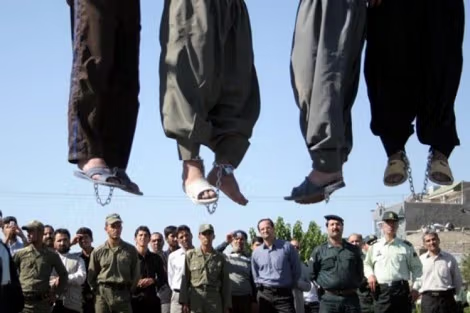
Rights group Amnesty International reported Thursday that 853 people were executed in Iran in 2023, a record number in the last eight years.

“Amid domestic calls for the abolition of the death penalty, including from death row prisoners, the Iranian authorities have doubled down and persisted with their state-sanctioned killing spree which has turned prisons into killing fields,” read the investigative titled “‘Don’t Let Them Kill Us’: Iran’s Relentless Execution Crisis Since The 2022 Uprising.”

 report

Amnesty International announced that execution is used as a tool of political repression by the Iranian government which may continue its juggernaut to execute thousands more in the coming years if there is no robust response from the international community.

According to the report, 481 executions, more than half of the total recorded in 2023, were for drug-related offences as the regime beefs up its lethal anti-narcotics policy which can impact poor and marginalized communities in Iran.

Since the 2022 nationwide uprising triggered by the death in morality-police custody of Mahsa Amini, the Iranian government has intensified the use of the death penalty to sow terror among the people and consolidate its grip on power, Amnesty International said.

The number of executions in Iran in 2023 is the highest recorded since 2015, representing a 48% increase from 2022 and a 172% increase from 2021. The trend has continued in 2024, with at least 95 executions recorded until March 20.

“The execution crisis in Iran both stems from and exacerbates a wider crisis of systemic impunity for the arbitrary deprivation of life. Security forces, prosecutors and judges collaborate in a relentless assault on the right to life,” the report said.

At least six of the executed in 2023 were protesters arrested during the “Woman, Life, Freedom” movement in 2022, and one other executed in connection to the nationwide uprising in November 2019. The Iranian government also executed at least two social media users on charges of “apostasy” and “insulting the Prophet of Islam” in their social media posts.

“Our shocking findings on the Iranian authorities’ ongoing assault on the right to life underscore the urgent need for the international community to press the Iranian authorities for an immediate moratorium on all executions,” said Diana Eltahawy, Deputy Regional Director for the Middle East and North Africa at Amnesty International, further calling for the renewal of the mandates of the UN Fact Finding Mission on Iran and the UN Special Rapporteur on Iran.

The United Nations Human Rights Council launched the Fact-Finding Mission (FFM) in November 2022 in the midst of the Woman, Life, Freedom movement. Following 18 months of investigations, the FFM released its first report on March 8, concluding that the Iranian government carried out widespread and sustained human rights violations, which broke international laws and disproportionately targeted women and girls as well as children and members of ethnic and religious minorities during 2022 protests.

The latest report even exceeds the numbers released in January by the UN which said at least 834 people had been executed in 2023.

“It is vital to signal to the Iranian authorities that their abysmal human rights record will remain under international scrutiny and to ensure that an international independent investigative and accountability mechanism remains in place to collect and analyze evidence of crimes under international law,” Eltahawy stressed.



Most Viewed

US terminates green cards of 3 Iranians tied to Islamic Republic
1

US terminates green cards of 3 Iranians tied to Islamic Republic

2
PODCAST

Worst outcome is Islamic Republic’s survival, ex-CIA official says

3
ANALYSIS

Iran brings unusually broad team to US talks to blunt future blame

4
INSIGHT

Tehran sends tough message but keeps diplomacy door open

5

Zoroastrian religious figure arrested in Iran

Banner
Banner

Spotlight

  • Tehran sends tough message but keeps diplomacy door open
    INSIGHT

    Tehran sends tough message but keeps diplomacy door open

  • Worst outcome is Islamic Republic’s survival, ex-CIA official says
    PODCAST

    Worst outcome is Islamic Republic’s survival, ex-CIA official says

  • Why the Iran-US truce is more likely to buy time than peace
    ANALYSIS

    Why the Iran-US truce is more likely to buy time than peace

  • Engaged but uncommitted: China watches Iran and US fight and talk
    ANALYSIS

    Engaged but uncommitted: China watches Iran and US fight and talk

  • A truce for the world, a reckoning for Iran’s economy
    ANALYSIS

    A truce for the world, a reckoning for Iran’s economy

  • Why the world failed to bypass the Strait of Hormuz
    ANALYSIS

    Why the world failed to bypass the Strait of Hormuz

•
•
•

More Stories

Iraqi Militant Group Urges Iran's Response To Israeli Attack

Apr 4, 2024, 10:05 GMT+1

In the aftermath of the recent attack on Iran's consulate in Damascus, the representative of the Kata'ib Sayyid al-Shuhada militia in Iraq has called for a “decisive” response from Iran.

Describing the Israeli strike as tantamount to "declaring war on Iran," Hassan al-Abadi emphasized Iran's right to retaliate against Israel.

The Kata’ib Sayyid al-Shuhada (KSS) militia, an Iranian-backed Iraqi Shiite group established in May 2013, operates both in Iraq and Syria. In Iraq, it is aligned with the Popular Mobilization Forces (PMF) and fights alongside the Iraqi government and other Shiite paramilitaries against threats such as the Islamic State. Meanwhile, in Syria, KSS is allied with the Assad regime, Iran’s Islamic Revolutionary Guard Corps (IRGC), Lebanese Hezbollah, and other pro-Assad, predominantly Shiite factions battling against jihadists and anti-government forces.

The airstrike, reportedly carried out by an Israeli F-35, targeted a building within the diplomatic compound on Monday. The attack resulted in the deaths of two senior IRGC generals and five other officers. The incident is widely regarded as the most significant setback to the clerical regime and its regional aspirations since the elimination of Qasem Soleimani, the commander of the IRGC's Quds Force, in a similar US strike in Baghdad in January 2020.

In response to the attack, Supreme Leader Ali Khamenei vowed revenge on Tuesday.

With expectations high for retaliation, the Iranian regime finds itself in a delicate position. While it must respond to maintain its credibility, any direct military action risks escalating tensions into open warfare with Israel—an outcome many in Tehran want to avoid.

Militant Attack On Government Forces Shakes Iran

Apr 4, 2024, 08:11 GMT+1

A Sunni militant group has attacked IRGC posts in southeast Iran, killing at least 11 security personnel, hours after the remains of seven officers killed in Syria were brought back to Iran.

Conflicting reports from sources on the two sides make it almost impossible to draw an accurate picture of what happened late on Wednesday local time, and the apparent continuation of clashes on Thursday. But It is clear that Iranian forces were caught off-guard and the ensuing exchange of fire lasted for several hours, likely in more than one location.

Jaish al-Adl, the militant group taking responsibility for the attacks, has a long history of targeting Iranian armed forces, especially the Revolutionary Guards (IRGC), in areas bordering Pakistan. It has been on the US foreign terrorist organization list since 2010, and has on occasion killed civilians in bombings. 

Thursday morning, Iranian official sources claimed that as many as 16 militants were killed. News websites affiliated with the Revolutionary Guard announced that government casualties has increased to 11 dead, including 7 IRGC personnel. Also, there were reports that clashes still continued in some locations at daybreak.

This recent attack holds more significance than previous ones for two main reasons: firstly, it occurred shortly after Israel's airstrike in Syria, which killed seven IRGC members, including two senior commanders; and secondly, Jaish al-Adl's previous major attack in January led to a political crisis between Iran and Pakistan. This crisis ensued after Iran targeted what it claimed were militant hideouts inside Pakistan, prompting Pakistan to retaliate by hitting what it alleged were separatist Baluch positions within Iran.

It’s unclear if the regime in Tehran would react in the same manner to the attacks Thursday. Only hours before the Jaish al-Adl ambush, Iran’s Supreme Leader Ali Khamenei threatened Israel with a ‘slap’ for its killing of IRGC commanders in Syria. A similar threat, whether or not it’s followed through, could further complicate the questions facing Khamenei and his soldiers.

The last thing the Islamic Republic needs at the moment is a spat with Pakistan –or worst case scenario, a new front in its ongoing proxy wars. But turning a blind eye to this attack may not be an option either, especially since Jaish al-Adl has killed Iranian military personnel and will almost certainly do so again whenever it can. Moreover, the attack came on the eve of the annual Quds Day, much touted by Tehran. This year, officials were emphasizing the importance of the occasion to support Palestinians across the world.

On Thursday, the Sunni militants claimed they had attacked and exchanged heavy fire with Iranian forces at six IRGC and police locations. They even posted a video on the group’s Telegram channel that they said showed their fighters inside an IRGC base capturing weapons and preparing to fight.

Sources in Iran –state and IRGC affiliated– denied this, claiming to have neutralized the "attempt by terrorists”, and downplaying the significance of the attack. They first announced 5 casualties on each side, but later changed it to 3 Iranians and 12 militants.

The ‘chain operations’ targeted police and IRGC posts in the southeast cities of Chabahar and Rask, according to Jaish al-Adl. Iran's Deputy Minister of Interior Majid Mirahmadi admitted that the militants had set up ambushes along nearby roads to prevent Iranian forces from chasing them.

Shortly after, he was quoted by IRGC-affiliated sources, claiming that the militants had failed to breach the IRGC base and that the hostage in a residential building had been freed. "The terrorists experienced a total defeat," he said, while some local sources claimed some fighting was still going on.

The government in Iran considers Jaish al-Adl a terrorist organization. Officials often allege that the group has ties with US, Saudi, and Israeli intelligence agencies, and is tasked by them to whip up instability and insecurity in southeast Iran.

Why Iran Refuses To Import Electric Cars

Apr 4, 2024, 04:16 GMT+1
•
Dalga Khatinoglu

Despite promises in recent years by the Iranian government to import environmentally friendly cars into the country, there has been minimal to no efforts made, as the domestic car industry is mostly owned by the state.

In the last two years, for instance, not a single electric vehicle (EV) has been imported into Iran. And, since 2021, only 15,000 low-consumption cars have been imported, instead of the promised 300,000. Even fuel-efficient new vehicles or hybrid models have not been imported.

In 2017, Iran instituted a ban on car imports, citing the imperative of conserving foreign exchange reserves. The ban was allegedly implemented as a measure to reduce spending on imported vehicles and safeguard the country's currency holdings.

Iran's domestic car manufacturers, owned by the government and its affiliates, meanwhile, produced approximately 1.2 million vehicles in 2023, all of which were gasoline powered.

Iran International's calculations suggest that the cost of charging an electric vehicle (EV) in Iran would amount to only one-fourth of the price of gasoline purchased at the government-set quota prices.

This is notable, as Iran has been grappling with a gasoline deficit since mid-2022, prompting the initiation of fuel imports – pushing the country's annual gasoline subsidies to over $10 billion.

And yet, despite the rapid growth of the global electric vehicle market, the Iranian government has shown no regard or desire to import electric vehicles.

Tesla Model X electric cars recharge their batteries in Berlin, Germany, November 13, 2019.
100%
Tesla Model X electric cars recharge their batteries in Berlin, Germany, November 13, 2019.

Global EV markets and energy costs

In 2023, the global electric vehicle market witnessed a staggering 37% surge, capturing nearly 15% of the total automotive market share worldwide.

By 2030, it is anticipated that two-thirds of new car sales in the market will be EVs.

Currently, there are about 27 million electric cars on the world's roads, and their electricity consumption is about 110 to 120 terawatt hours per year (TWh/yr).

Today, there are 16 million cars in Iran, mostly domestically produced, that consume 110 million liters of gasoline per day. These are based on older foreign models with inefficient engines and high pollution.

Thus, if Iran imports even one million electric cars, their electricity consumption will be about 4 TWh/yr, which is equivalent to approximately 1% of the country’s electricity generation.

Meanwhile, Iran is facing both a shortage of gasoline and severe air pollution.

A significant part of air pollution in the country is due to its domestically produced cars, consuming much higher fuel levels at 16 liters/100 km – almost two times more than global standards.

On the other hand, only less than a quarter of the domestically produced gasoline in Iran meets Euro 5 and Euro 6 standards.

Iranian cars also consume 20 million cubic meters of compressed natural gas (CNG) daily.

According to the International Energy Agency, Iran had about $50 billion hidden subsidies for oil products, $45 billion for natural gas, and $30 billion for electricity in 2022.

In a simple word, the difference between the domestic and foreign sales prices of Iran's oil products, gas and electricity was about $125 billion in 2022, which is equivalent to one third of the country's GDP.

Gasoline has a 25% share in the output of Iranian refineries. Then, Iran had about $12.5 billion hidden gasoline subsidies in 2022.

If Iran were to import 1 million cars – barring extra costs for infrastructure build-up – the hidden subsidy for their electricity demand will be only $300 million annually.

EV vs. Gasoline in Iran

On April 1, Mustafa Rajabi Mashhadi, the CEO of Iran’s state electricity company, announced that the energy ministry plans to build eight electric car charging stations in Tehran. But, the electricity price would be determined using higher commercial rates, at 5,470 rials (less than 1 cent) per kilowatt-hour.

As of now, there have been no reports published regarding the commencement of construction for these stations.

Furthermore, the rationale behind Iran's decision to calculate electricity prices for electric cars at commercial rates remains unclear, especially considering the substantial subsidy provided for gasoline.

Nonetheless, potential future electric car owners in Iran, could still expect to incur significantly lower energy costs compared to gasoline-powered vehicles.

At the current rate, an electric car consumes an average of 0.2 kilowatt-hours of electricity per kilometer – so, the cost of driving an electric car for 100 kilometers in Iran, would cost about 18 cents.

The cost of fuel for every 100 kilometers of driving with free gasoline is about 80 cents, and with quota gasoline, it is half of this figure.

Hence, using an electric car would be much more economical than a gasoline car, in Iran.

Government resistance due to state-owned monopoly

The true reason for the government's reluctance to import cars appears to stem from the fact that approximately 80% of domestic cars are manufactured by state-owned car companies.

As a result of the monopoly held by state-owned companies in the car market, Iranians are compelled to purchase low-quality, expensive vehicles with high gasoline consumption.

Saeed Tajik, CEO of Iran Quality and Standard Inspection Company, stated to the Economics Online website on April 1 that Iran's Ministry of Industry, Mines, and Trade has expressed interest in importing electric cars. However, the Ministry of Energy has raised concerns regarding this proposal due to the electricity deficit.

During the summer months, Iran faces a 14,000 MW electricity deficit, while there is no deficit during other seasons.

Furthermore, Iran boasted approximately 2.5 TWh of net electricity exports valued at around $300 million in 2023, an amount capable of meeting the energy requirements of 625,000 electric cars each year.

Iran's current electricity production stands at approximately 390 TWh, yet 13% of this (over 50 TWh) is lost due to the deterioration of the electricity transmission network. Tajik also emphasized that the reality is Iran lacks the necessary infrastructure for electric cars.

To justify the import ban on electric vehicles, he also cited the fact that the electricity produced in Iran is not environmentally friendly. Approximately 80% of Iran’s electricity generation is derived from thermal power plants, which burn large quantities of gas, mazut, and diesel.

According to official statistics from the Energy Ministry, over 94% of electricity generation in the country originated from thermal power plants in the last fiscal year, which ended on March 19. Despite government projections to add 2,500 MW of renewable energy capacity during the same period, only 75 MW of the planned capacity was realized, accounting for less than 3% of the intended target.

President Ebrahim Raisi’s government, meanwhile, claims to have projected the installation of 4,500 MW of new solar and wind farms in the current year.


Sunni Militants Attack Security Forces in Iran's Southeast

Apr 3, 2024, 23:51 GMT+1
•
Iran International Newsroom

The insurgent Sunni Baluch group Jaish al-Adl on Thursday launched simultaneous attacks against military posts in southeastern Iran, which left at least 11 security forces dead.

The simultaneous attacks claimed by Jaish al-Adl targeted law enforcement headquarters in Chabahar, belonging to Iran's Border Guards, and the Revolutionary Guard's base in Rask, both in the restive Sistan and Baluchestan province, Iran's Deputy Minister of Interior Majid Mirahmadi told the IRGC-affiliated Fars News early Thursday.

Iran’s official news agency IRNA initially said five members of security forces including an IRGC officer, a Basij paramilitary force, a conscript and two police forces were killed by the assailants. However, the numbers were revised upwards by noon on Friday to 11 security personnel killed, including seven Revolutionary Guards.

Five militants were also killed in clashes with security forces, IRNA reported.

Mirahmadi said militants had set up ambushes along the nearby roads to prevent security forces from chasing them.

In Rask, Mirahmadi said, the militants "failed to breach the Revolutionary Guards' base thanks to the resistance of our forces."

"One of the terrorists was killed, and the clashes continue, with terrorist forces also under siege," he said, calling the incident an "act of terrorism".

He said one militant was also killed in Chabahar and several others were wounded, but clashes were still under way early Thursday.

Jaish al-Adl has carried out dozens of large and small operations over the years against Iranian military forces, particularly the IRGC, including cross-border attacks and abduction of border guards and security personnel as well as bombings leading to the killing of civilians.

In January, Jaish al-Adl claimed responsibility for targeting an IRGC vehicle carrying officers near the city of Iranshahr in Iran's restive Sistan and Baluchestan Province.

Two days earlier the group had taken responsibility for an attack on an IRGC base in Saravan and claimed a sentry had been shot.

Iran’s IRGC, in turn, targeted Jaish al-Adl's positions in Pakistan's Balochistan province, while Pakistan retaliated by bombing hideouts of armed Baloch separatists in Iran's Sistan-Baluchestan province.

The strikes led to a rapid deterioration in diplomatic relations between Islamabad and Tehran, with both countries withdrawing ambassadors and severing official ties amid heightened rhetoric.

Jaish al-Adl has been designated as a terrorist organization by Iran, whose officials often refer to it as Jaish al-Zulm (Army of Injustice) and “Takfiri terrorists.” The United States put the group on its foreign terrorist organizations list in 2010.

Iranian officials often allege that the group has ties with US, Saudi, and Israeli intelligence agencies and is funded by them.

Jaish al-Adl was founded by Abdul Rahim Mollazehi, a Baluch militant, in 2012 by reorganizing Jundullah (Army of God), also known as the People’s Resistance of Iran.

Updated at 8:30 GMT, April 4

Ancient Jewish Mausoleum In Iran Attacked With Molotov Cocktails

Apr 3, 2024, 23:47 GMT+1

A newly released video depicts Molotov cocktails being thrown on the ancient mausoleum of Esther and Mordechai in Hamadan during the early hours of Tuesday, a key archaeological site in both Jewish and Christian history. 

The assailants used incendiary materials, causing a fire at the tomb complex, raising concerns about the safety of not only the historic sites but the country’s Jewish community, the largest in the Middle East outside Israel amidst the world’s worst antisemitism since the Holocaust. Around 10,000 Jews remain in Iran, one of the most ancient communities in Jewish heritage. They have long lived under the pressure of Iran’s shadow war with Israel, the world’s only Jewish state and archenemy of Iran.

The governor of Hamadan claimed that through surveillance footage, the perpetrators have been identified though it remains unclear who was behind the attack.

The tomb of Esther and Mordechai holds significant religious and cultural importance, being the burial place of the Jewish wife of King Xerxes and a key pilgrimage site for Jews and Christians both within Iran and around the world. It is registered as one of Iran's cultural heritage sites.

Social media has been abuzz with various interpretations of the attack. Many users speculate that the Iranian regime and its supporters may be behind the incident, viewing it as a form of retaliation for recent tensions with Israel including an alleged strike on the Iranian consulate in Syria.

Some have taken a sarcastic tone, mocking the incident as the "tough revenge" for the consulate attack. They have criticized the destruction of national heritage as a misguided attempt by the regime to express anger towards Israel.




