• العربية
  • فارسی
Brand
  • Iran Insight
  • Politics
  • Economy
  • Analysis
  • Special Report
  • Opinion
  • Podcast
  • Iran Insight
  • Politics
  • Economy
  • Analysis
  • Special Report
  • Opinion
  • Podcast
  • Theme
  • Language
    • العربية
    • فارسی
  • Iran Insight
  • Politics
  • Economy
  • Analysis
  • Special Report
  • Opinion
  • Podcast
All rights reserved for Volant Media UK Limited
volant media logo

US Officials Warn Of Heightened Terrorism Threat From Iran
Iran International Newsroom
Mar 21, 2024, 19:54 GMT+0Updated: 10:53 GMT+0
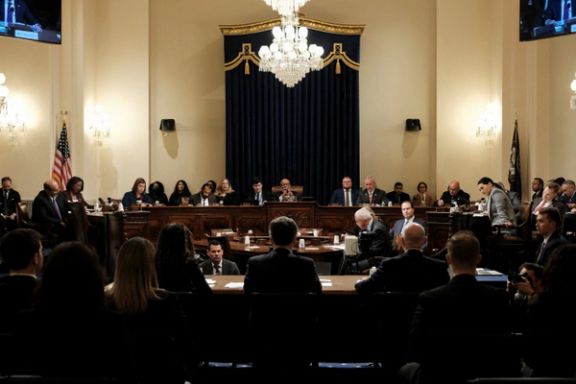
A general view of a House Homeland Security Committee hearing on "Worldwide Threats to the Homeland" on Capitol Hill in Washington, November 15, 2022.

The US Federal Bureau of Investigation (FBI) has informed a House panel that Iran is resolute in its intentions to carry out various attacks on US soil, including assassinations.

During a hearing at the US House of Representatives, the current status of Iran’s 'Axis of Resistance' and its implications for US homeland security and interests worldwide were examined, with a consensus that threats posed by Tehran and its proxies have escalated significantly.

Chairman of the Homeland Security Committee Mark Green (R-TN) commenced the hearing by outlining Iran’s threats, which encompassed "assassination plots on former Trump Administration officials, targeting and attacking US service members abroad, disrupting trade and commerce, and endangering Maritime Security in the Red Sea, along with attempting to coordinate external Terror operations in Europe and South America."

He elaborated that the hearing's focal point is on the threats posed by Iran's proxy networks, known as the ‘axis of resistance,' a collection of militia groups employed by Iran to bolster their power projection capabilities and provide plausible deniability for attacks conducted on behalf of the Iranian regime. Notably, these militias include Lebanon’s Hezbollah, Hamas, and Palestinian Islamic Jihad in Gaza, the Houthis of Yemen, and various Iraqi and Syrian militia groups.

Robert Wells, assistant director of the Counterterrorism Division at the Federal Bureau of Investigation (FBI), informed the committee that "The FBI believes Iran is capable of a variety of attack options against US targets, including cyber operations intended to sabotage public and private infrastructure, and targeted assassinations of individuals who are deemed to be a threat to the regime or its stability."

Several security officials provided testimonies during a hearing at the US House Committee on Homeland Security, March 20, 2024
100%
Several security officials provided testimonies during a hearing at the US House Committee on Homeland Security, March 20, 2024

According to Wells, the Tehran regime is resolute in executing attacks in the United States, whether to avenge the death of former IRGC-Quds commander Qasem Soleimani (such as the plan to murder former National Security Advisor John Bolton and Secretary of State Mike Pompeo in 2022), to silence dissidents (like the attempted murder of activist Masih Alinejad in 2023), or to eliminate the ambassador of an ally nation (as seen in the plot to murder the Saudi Ambassador to the US.

He also referred to Iran’s supplying weapons for the Houthis to disrupt global shipping, saying that in January 2024, US military intercepted Iranian-made weapon parts bound for Houthis, “who could have used the weapons to target US forces.”

James Dunlap, deputy undersecretary for analysis at the Department of Homeland Security’s Office of Intelligence and Analysis, highlighted the Iranian government’s cyber threats through a variety of tactics, techniques, and procedures -- “including social engineering, using easily accessible scanning and computer hacking tools, and exploiting publicly known software and hardware vulnerabilities” against the US government and the defense industry. “The Israel-Hamas conflict shows how Iran uses cyber operations to respond to geopolitical events while attempting to maintain plausible deniability.”

Elizabeth Richard, ambassador-at-large, and coordinator for counterterrorism at the US Department of State’s Bureau of Counterterrorism, pointed out, “Iran has been designated as a State Sponsor of Terrorism since 1984 and has long been directly involved in attack plotting against the US homeland and US personnel and activities, mainly but not exclusively via Iran’s Islamic Revolutionary Guard Corps’ (IRGC) Quds Force.”

“Hamas would not have been able to carry out its devastating October 7 terrorist attack without Iran’s long-time assistance, funding, and training,” she stated. “Our defense of the US homeland does not stop at our own physical border.”

Carrie Thompson, chief of intelligence at the Drug Enforcement Administration (DEA), addressed the threat from Iran and its proxies from an economic standpoint. She highlighted the “clear connection” between the drug trade and the financing of terrorist organizations and rogue state actors, including the Iranian regime. She said Hezbollah’s money laundering network collaborates with South American drug cartels to facilitate the smuggling of drugs into Europe and the Middle East. “The Assad regime in Syria has been associated with the production and trafficking of a synthetic drug called Captagon,” she added.

The hearing took place as Israel's war continues with Hamas, the epicenter of the current Middle East conflict ignited after the Islamist group invaded Israel and killed 1,200 mostly civilians and took 240 hostages. Iran’s ‘axis of resistance’ has increased attacks on US and Israeli targets to pressure Israel into a ceasefire.

Many American lawmakers have criticized the Biden administration for its Iran policy, which has not only failed to deter the attacks but also emboldened Tehran to boast about the victories of its ‘axis of resistance’ against the US.

According to David G. Perkins, a retired US Army general, deterrence means changing the minds and behaviors of Iran’s proxy forces, noting that the US should not try to deter the Houthis, but to deter Iran, which gives them “the head nod” for attacks.

Most Viewed

Iran International says it won’t be silenced after London arson attack
1

Iran International says it won’t be silenced after London arson attack

2
VOICES FROM IRAN

Hope and anger in Iran as fragile ceasefire persists

3

Iran halts petrochemical exports to supply domestic market

4
INSIGHT

How Tehran bends its own red lines to boost state rallies

5

US arrests Iranian national over alleged Basij-linked visa fraud

Banner
Banner

Spotlight

  • Hardliners push Hormuz ‘red line’ as US blockade tests Iran’s leverage
    INSIGHT

    Hardliners push Hormuz ‘red line’ as US blockade tests Iran’s leverage

  • Ideology may be fading in Iran, but not in Kashmir's ‘Mini Iran'
    INSIGHT

    Ideology may be fading in Iran, but not in Kashmir's ‘Mini Iran'

  • War damage amounts to $3,000 per Iranian, with blockade set to add to losses
    INSIGHT

    War damage amounts to $3,000 per Iranian, with blockade set to add to losses

  • Why the $100 billion Hormuz toll revenue is a myth
    ANALYSIS

    Why the $100 billion Hormuz toll revenue is a myth

  • US blockade targets Iran oil boom amid regional disruption
    ANALYSIS

    US blockade targets Iran oil boom amid regional disruption

  • Iran's digital economy battered by prolonged blackout
    INSIGHT

    Iran's digital economy battered by prolonged blackout

•
•
•

More Stories

Houthis Vow Not To Target Russian, Chinese Ships

Mar 21, 2024, 18:10 GMT+0

The Iran-backed Houthis have allegedly vowed not to attack vessels belonging to Russia and China in the Red Sea and Gulf of Eden after crisis talks in Oman amid the maritime blockade.

Bloomberg reported that Russian and Chinese diplomats met with Mohammed Abdul-Salam, a senior Houthi official and the group’s spokesperson.

It is believed that a deal has been made whereby Moscow and Beijing may provide the group with political support, which according to Bloomberg can include “blocking more resolutions” against the Yemeni terror group in the UN Security Council.

Leeway would be given to China and Russia as key allies of Tehran amidst global sanctions.

The Red Sea blockade has massively impacted global trade and logistics and Tehran will be keen to keep its two major allies onside while the blockade, initiated in November on the orders of the Supreme Leader, continues.

The talks follow recent naval drills between Iran, China and Russia as ties between the three pariah states deepen militarily and economically.

Yemen's Houthis launched their campaign to attack international vessels to initiate a blockade of Israel which has launched a relentless retaliatory attack on Gaza since Iran-backed Hamas militia invaded Israel on October 7, killing 1,200 mostly civilians and taking more than 250 more hostage. 

However, not only Israeli vessels have come under fire, with international shipping falling victim to the attacks. In March, a Houthi missile attack killed three seafarers on a Greek-owned, Barbados-flagged ship in the Red Sea, the first fatalities since the start of the blockade.

On Thursday, a gun-fight broke out when gunmen attacked a merchant vessel in the Red Sea. 

Progress in Riyadh-Washington Talks Over Israeli Normalization

Mar 21, 2024, 17:05 GMT+0

A senior US official said Washington and Riyadh have advanced in their negotiations towards a larger plan that would ultimately see the normalization of ties between Saudi Arabia and Israel.

Only a “handful of issues” have remained unresolved between Washington and Riyadh regarding the normalization plan, the official told the Associated Press.

The informed source, who has not been identified, is a senior member of the US State Department who accompanied Antony Blinken in his Wednesday visit to Saudi Arabia. In his sixth tour to the Middle East since Hamas’ deadly onslaught on October 7, Blinken met Saudi Crown Prince Mohammed Bin Salman and discussed the recognition of the Jewish state by Riyadh.

Blinken left Saudi Arabia for Egypt on Thursday and is scheduled to visit Israel on Friday.

The deal between Saudi Arabia and the US in this regard “is widely believed to include US defense guarantees and aid in building a civilian nuclear program in Saudi Arabia,” the Associated Press further reported.

Saudi Arabia has time and again stressed normalizing relations with Israel depends upon Tel Aviv’s recognition of a pathway towards the creation of an independent Palestinian state, a demand which has strongly been rejected by Israeli Prime Minister Benjamin Netanyahu.

The Iranian government has been a staunch critic of the normalization talks between Saudi Arabia and Israel as it would further isolate Tehran in the region. In October 2023, Iran’s Supreme Leader Ali Khamenei said: “The position of the Islamic Republic is that countries that make the gamble of normalization with Israel will lose. They are betting on a losing horse.”


Biden Administration Under Fire For Iran Messaging

Mar 21, 2024, 16:29 GMT+0
•
Iran International Newsroom

US Secretary Of State, Antony Blinken has come under fire for his mollycoddling of Iran, requesting they tell the Iran-backed Houthis "to stop" attacks on shipping in the Red Sea.

While the international community looks to the US to take stronger action against the Houthis, Blinken could only voice hopes that Iran would step in to stop the disruptions. “We would like to see Iran exert the influence that it has, because it’s the primary supplier to the Houthis of weapons, of information, of technology. We would like to see them tell the Houthis to stop.

The Red Sea blockade, initiated by the Yemen-based Houthi terror group after Iran’s Supreme Leader asked Muslims to stifle Israeli trade, has seen dozens of attacks carried out on global shipping, including US ships and causing major disruptions to global trade and logistics since November.

Implemented in a bid to force Israel into a ceasefire amid its war in Gaza against Iran-backed Hamas, US led attacks on Houthi infrastructure have as yet failed to deter the militia which are armed with some of the most lethal aerial assault weapons in the region, provided by Iran.

Long branded too soft on Iran’s nuclear activities, the allegations are now haunting the Biden administration as the blockade creates chaos on the vital trade route, with little being done by Washington.

“Meanwhile, we and other countries have no choice but to try to defend the shipping and, as necessary, degrade the assets – the military assets – that the Houthis are using to continue to attack shipping,” Blinken said this week.

He reiterated that the US is imposing sanctions on Iran and its terror entities but in spite of this, Tehran’s nuclear capabilities have only grown in the last year.

“I also don’t think it’s in Iran’s interest to continue to support these Houthi attacks, attacks that, again, are being condemned by countries around the world,” he said, in spite of the fact it was Iran who sparked the blockade, occurring alongside proxy actions from Lebanon, Iraq and Syria. “The extent to which Iran is seen as being responsible for that – I don’t think that’s good for Iran, so we hope that it will use the influence it has to put an end to this.”

State Department spokesman Matthew Miller reiterated talk of sanctions, failing to mention their lack of efficacy in stopping Tehran’s reign of terror. “Iran is always going to fund terrorism,” he said this week. “It’s always going to fund destabilizing activities … And with respect to those illegitimate activities by the Iranian Government, you have seen this administration respond to those. We have imposed sanctions on more than 500 Iranian entities since the outset of this administration. We have held Iran accountable for its support of terrorism and its funding of dangerous proxy groups around the region, and we’ll continue to do so.”

Jason Brodsky, policy director for think tank United Against A Nuclear Iran, slammed the remarks. “Why would Iran's regime have any incentive to ask the Houthis to stop when it hasn't been made to pay any direct cost at home for its support to the Houthis? I'd like to see the State Department understand who they are dealing with here. It's not clear to me they do,” he wrote on X.

In a huge miscalculation, President Joe Biden also enraged Iranians this week, mentioning the war in Gaza when sharing Norouz (Nowruz) messages for the Persian new year. Acknowledging the brave women of Iran, he went on to lament the suffering in Gaza, a cause totally disconnected from the plight facing the millions of Iranians on the poverty line and living under a brutal dictatorial regime.

“I don't know if the people of Iran care about the war in Gaza. As far as they're concerned, people of Iran are suffering because the regime invests in terrorism of Hamas instead of their own wellbeing,” Iranian-American Marjan Keypour said on X.

“Most Iranians blame the Islamic regime's policies toward Syria and "Palestinian" issues for their economic problems, not the US sanctions. It's time for the US officials to stop apologizing and hold tyrants and terrorists accountable for their actions,” she added.

Her sentiments were welcomed by other Iranians whose own plight is far closer to home than the suffering in Gaza amid a war sparked by Iranian regime-backed Hamas on October 7 when the militia invaded Israel killing 1,200 mostly civilians and taking more than 250 more hostage. “I don’t care about Gaza! Let us talk about the situation in Iran!”, responded Azadeh Nikzadeh, also an Iranian-American.

US-based PhD student, Sativa, reacted with fury to the Biden greeting mentioning Gaza, writing on X, “Dear @POTUS It is disrespectful to Iranians when you celebrate their NON-ISLAMIC new year, while paying lip service to their enemy, the Palestinians (who sided with Saddam and killed Iranians, and are now siding with the brutal mullah regime). Have you not seen how Iranians feel about Palestine? Or their flag?”

Canada Orders Deportation Of Former Iran Official

Mar 21, 2024, 14:59 GMT+0

Canada has expelled another former senior Iranian official as part of efforts to ban regime figures from seeking refuge there.

According to Global News on Wednesday, Canada’s Immigration and Refugee Board (IRB) ordered the deportation of Salman Samani, Iran's deputy minister of interior during Hassan Rouhani's term as president.

The tribunal’s verdict is issued in compliance with the Canadian sanctions imposed against Iranian officials following the 2022 nationwide protests triggered by the death in morality-police custody of Mahsa Amini.

Salmani is the second high-ranking Iranian official who has been ordered to leave Canada. In February, Majid Iranmanesh, a director general at Iran's Vice-Presidency for Science and Technology, was also forced to leave.

Before the verdict, Iranmanesh asked the court to allow him to leave the country voluntarily without a deportation order, which he said would interfere with his research in different countries.

Global News further reported that the IRB is considering the expulsion of a third senior member of the Iranian government.

“The IRB has refused to identify him, and has opted to hold his hearings behind closed doors, apparently because he is claiming to be a refugee,” Global News added.

The Immigration and Refugee Board is also set to decide the fates of another nine high-ranking Iranian officials following their participation in deportation hearings.

Many Iranian political activists and opposition figures contend that Tehran has been using Canada as a platform to further its malicious activities via the regime’s agents there.

In November, Pierre Poilievre, the leader of Canada’s opposition Conservative Party, confirmed reports of “well-placed regime thugs” in Canada who spend the money that “they stole from the Iranian people.”

He called for tightening immigration regulations to ensure that anyone “willingly associated” with the Iranian government should not be eligible for entry to Canada.


Borrell's Failing Diplomacy: EU's Troubled Relationship With Iran

Mar 21, 2024, 12:54 GMT+0
•
Iran International Newsroom

European Union Foreign Policy Chief Josep Borrell once again finds himself embroiled in a diplomatic battle over Iran sanctions, as revealed exclusively by the Wall Street Journal.

Amid escalating tensions in the Middle East, including Iran-backed Houthi attacks on cargo ships in the Red Sea and the ongoing conflict in Gaza, France and Germany last month advocated for targeted sanctions on Iranian entities supporting regional militias. However, Borrell was hesitant to support such measures.

Borrell’s refusal reflects his unwavering position on Iran, seemingly prioritizing diplomacy time and time again.

The recent revelation of internal discord within the EU perhaps also underscores criticism by many experts – and Members of the European Parliament – who allege that Europe’s Iran policy of the last decades has failed.

In the months leading up to widespread anti-regime protests in Iran, Borrell fervently advocated for salvaging the nuclear deal. He contended that the Joint Comprehensive Plan of Action (JCPOA) imposed stringent limits on Iran's nuclear pursuits, offering economic incentives in return for the lifting of sanctions imposed by the US, EU, and UN.

In August 2022, Borrell confidently announced the completion of a "final text" aimed at resurrecting the nuclear agreement, pending approval from Iran and the US. In defense of his stance, he warned of dire consequences should the deal be rejected, emphasizing the potential for a perilous nuclear crisis and heightened isolation for Iran and its populace. Borrell underscored the shared responsibility to reach a resolution, urging for the agreement's conclusion.

But, with Iran's persistent breaches of its obligations and its reluctance to fully adhere to the terms, diplomatic efforts to resurrect the deal, faced significant challenges. Borrell's offer to Iran failed to advance the talks and the JCPOA seemed dead in the water by mid-September.

The critique directed at Borrell's efforts to resurrect the nuclear deal surpasses mere apprehensions about curtailing Iran's nuclear aspirations; it delves into a deeper analysis of the broader strategic implications. The shortcomings of the original JCPOA and subsequent negotiations are starkly apparent, as they do not appear to address Iran's expanding destabilizing endeavors across the region.

This failure underscores a fundamental flaw in the diplomatic approach, highlighting the urgent need for a more comprehensive and analytically sound strategy to effectively mitigate Iran's multifaceted challenges.

Ultimately, the last-ditch efforts to salvage the nuclear deal were ostensibly halted, coinciding with the Iranian regime’s ruthless crackdown of nationwide protests in 2022/2023 and Tehran’s subsequent drone sales to Russia for its invasion of Ukraine.

As Borrell witnessed the stark reality of Iranians risking their lives in street protests – their chants were not against international sanctions but rather for the downfall of the regime.

This pivotal moment should have prompted the EU and the West to reassess their Iran policy. Yet, disappointingly, such strategic recalibration was noticeably absent from their response.

“The EU’s Iran policy of the last 44 years has failed - and it’s your job to think about new policies. Stop meeting regime representatives and start meeting the many different people that advocate for a free Iran,” MEP Hannah Neumann told Josep Borrell a year after nationwide protests first broke out.

While the EU rolled out rounds of sanctions against the regime in response to its brutality against protesters and its role in aiding Russia – it stopped short of listing the Islamic Revolutionary Guards (IRGC) as a terrorist entity.

Despite persistent demands from the Iranian diaspora, the European Parliament's decisive resolution urging the EU to act, and a bipartisan coalition of over 130 US Congress members advocating for the same, the EU remained steadfast in its refusal to designate the IRGC as a terrorist entity.

The EU policy chief insisted that such a move is not possible until a European court takes judicial action against the IRGC.

That turned out not to be accurate, with many experts explaining the pathways to list the IRGC.

In December 2023, German newspaper taz also revealed that the EU’s decision not to list the IRGC was attributed to legal constraints – specifically citing a legal opinion provided by the European Council's Legal Service.

That confidential legal opinion challenges the government's position on the matter. It suggests that while the legal basis for listing the IRGC as a terrorist organization may not be met based on two US court decisions, there are other potential grounds for such a listing that have not been explicitly ruled out.

The lingering question persists: Why has the IRGC not been listed despite ample legal grounds and a chorus of voices urging its inclusion?

Despite asserting a "clear change" in the EU's relationship with Iran due to sanctions following the protests, Borrell continued to stress the imperative of keeping diplomatic channels open.

Meanwhile, Iran's brazen aggression has persisted unchecked on numerous fronts, systematically eroding regional stability.

After Hamas's incursion into Israel on October 7 last year, resulting in 1,400 Israeli casualties – reports surfaced regarding Iran's role.

While there is debate over whether Iranian security officials assisted in planning and approving the attack, Iran’s long-standing support and financial backing of Hamas are indisputable.

This year, amid the war in Gaza, Borrell warned that the Middle East “is a boiler that can explode”.

“Everybody should try to avoid that the situation becomes explosive,” Borrell said before chairing informal talks among EU foreign ministers in Brussels.

From actively aiding Russia's invasion of Ukraine, empowering Hamas before its deadly assault on Israel and sowing chaos in the Red Sea by backing the Houthi rebels – Iran's influence and undeterred actions have proven catastrophic.

All the while, the International Atomic Energy Agency (IAEA) has added cause for alarm over Iran's nuclear ambitions, admitting that its lost “full knowledge” of Tehran’s program.

In the face of such perilous circumstances, one is compelled to ask: if this does not qualify as an explosive situation, then what does?

Borrell's steadfast dedication to diplomatic engagement with Iran disregards the stark reality that even if containing Iran's nuclear program were achieved, Tehran’s destabilizing actions will persist regionally and globally.

The European Union's persistent struggle to formulate a cohesive and impactful strategy toward Iran only exacerbates instability in the region.

The pressing inquiry remains: how can Europe effectively counter Iran's disruptive conduct to preserve regional stability, halt its perpetration of human rights violations against Iranians, and safeguard its own interests in the Middle East?

It seems evident that Borrell ought to prioritize crafting a fresh strategy for the EU's dealings with Iran. Persisting with outdated and ineffective methods will only prolong instability.