• العربية
  • فارسی
Brand
  • Iran Insight
  • Politics
  • Economy
  • Analysis
  • Special Report
  • Opinion
  • Podcast
  • Iran Insight
  • Politics
  • Economy
  • Analysis
  • Special Report
  • Opinion
  • Podcast
  • Theme
  • Language
    • العربية
    • فارسی
  • Iran Insight
  • Politics
  • Economy
  • Analysis
  • Special Report
  • Opinion
  • Podcast
All rights reserved for Volant Media UK Limited
volant media logo

Talks To End US Military Presence In Iraq May Last Until US Election
Mar 13, 2024, 09:59 GMT+0
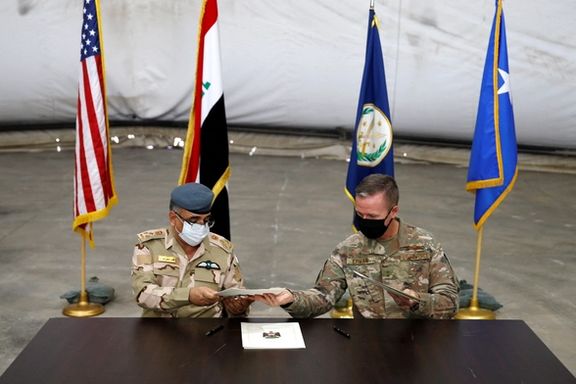
Maj. Gen. Kenneth P. Ekman, Deputy Commander of Combined Joint Task Force-Operation Inherent Resolve, signs documents with Brigadier General Salah Abdullah during a handover ceremony of Taji military base from US-led coalition troops to Iraqi security forces, in the base north of Baghdad, Iraq August 23, 2020.

Talks between Washington and Baghdad on ending the US military presence in Iraq may not be concluded until after the US presidential election in November, Reuters reported.

The two countries in January initiated talks to reassess the US presence in Iraq, formed in 2014 to help fight Islamic State (IS) after the extremist Sunni Muslim militant group overran large parts of the country.

The process to wind up the military coalition came after US forces and Iran-backed Shi'ite Muslim militias engaged in tit-for-tat attacks amid regional conflict linked to the war in Gaza.

Those clashes have now ceased for over a month after retaliatory US air strikes in February.

Backed by Shi'ite parties and armed groups, the government in Baghdad, a rare ally of both Iran and the US, is trying to prevent the country again becoming a battlefield for foreign powers.

The technical talks via a joint military commission are seen by politicians as a way to buy time in the face of differing views over how US-Iraqi military relations should evolve.

Hardline Iraqi Shi'ite armed groups, seen as Iran’s proxies, have called for an immediate exit of US forces while more moderate Shi'ite factions and Sunni and Kurdish parties are concerned their departure could lead to a power vacuum.

Washington does not view the talks as necessarily entailing a withdrawal of US military advisers from the country.

"I don't think the Americans want a full withdrawal. That is clear," former Iraqi Prime Minister Haider al-Abadi, a moderate Shiite politician, told journalists last week.

"Also, I do not thing there is an Iraqi desire among the political forces to dispense entirely with the Americans - even though there is a feeling today that their presence at this time causes more problems than solutions."


Most Viewed

Ghalibaf defends Iran-US talks amid hardline backlash
1
INSIGHT

Ghalibaf defends Iran-US talks amid hardline backlash

2
INSIGHT

100 days after carnage: Iran economy reels from war, inflation, unemployment

3
INSIGHT

A nation in limbo: 100 days after the massacre, has the world moved on?

4
ANALYSIS

From instability to influence: Pakistan’s pivotal role in US-Iran diplomacy

5
ANALYSIS

100 days on: why Iran’s January protests spread across social classes

Banner
Banner

Spotlight

  • War-hit homeowners feel abandoned as Iran’s reconstruction aid fades

    War-hit homeowners feel abandoned as Iran’s reconstruction aid fades

  • 100 days on: the anatomy of Iran’s January crackdown
    INSIGHT

    100 days on: the anatomy of Iran’s January crackdown

  • Ghalibaf defends Iran-US talks amid hardline backlash
    INSIGHT

    Ghalibaf defends Iran-US talks amid hardline backlash

  • 100 days on: why Iran’s January protests spread across social classes
    ANALYSIS

    100 days on: why Iran’s January protests spread across social classes

  • From instability to influence: Pakistan’s pivotal role in US-Iran diplomacy
    ANALYSIS

    From instability to influence: Pakistan’s pivotal role in US-Iran diplomacy

  • A nation in limbo: 100 days after the massacre, has the world moved on?
    INSIGHT

    A nation in limbo: 100 days after the massacre, has the world moved on?

•
•
•

More Stories

US Intel Community Foresees Serious Challenges For Iranian Regime

Mar 12, 2024, 20:40 GMT+0
•
Iran International Newsroom

The death of Iran’s Supreme Leader Ali Khamenei could “challenge” the Islamic Republic, the US intelligence community has suggested in its annual Threat Assessment.

Published Monday, the report says the state in Iran has undergone only a single supreme leader transition in its 45-year history and is mired by “elite factionalism.”

Khamenei –who will be 85 next month– has held the ostensibly elected position by a small group of clerics since 1989. He still seems to have a tight grip on power, despite widespread discontent in the country over corruption, injustice, antediluvian social restrictions, and what many people see as utter incompetence in solving the array of issues they face.

“Iran’s economy continues to struggle amidst high inflation,” reads the 2024 US intelligence community report. ”Most wages are unable to keep pace with the higher prices, leading to declines in households’ spending power.”

But these don’t seem to affect Ali Khamenei who ignores or demonizes the dissenting populace, speaking and tending only to his shrinking group of loyal supporters who prop up the regime by brute force.

Many experts believe that it’s only a matter of time before the regime and its supreme leader come up against another round of widespread protest, like the ones that shook Iran in 2022 after a young woman called Mahsa Amini was stopped on the street for her ‘improper’ outfit and later died in hospital due to a head injury she had sustained in custody.

The ensuing protests –in which more than 550 civilians were killed and at least 20,000 arrested– widened the rift between the regime and the people, leading to an almost complete rupture, illustrated by an historically low turnout in the most recent parliamentary elections that were held early March.

Facing a crisis of legitimacy in Iran, the supreme leader seems to have turned his focus outwards, acting as the leader of non-Iranian armed groups fighting against his most favorite enemies: the US and Israel.

“The resistance is still standing strong and will rub the nose of the Zionists to the ground,” Khamenei said Tuesday, meeting the Quran enthusiasts on the eve of Ramadan –the Muslim month of fasting and self-reflection.

Curiously, his words seemed to be in line with Israel’s assessment that there may be an “increase in terror during Ramadan”, especially in the West Bank. “Iran is working to up the severity of attacks by smuggling in many weapons,” Israeli defense minister Yoav Gallant said Monday in a meeting with Israel’s elite Duvdevan unit.

Iran’s regional ambitions and adventures have also been reflected at length in the US intelligence community’s annual report.

“Iran will remain a threat to Israel and US allies and interests in the region well after the Gaza conflict,” the Threat Assessment reads, “and probably will continue arming and aiding its allies to threaten the United States as well as backing Hamas and others who seek to block a peace settlement between Israel and the Palestinians.”

“While Iran will remain careful to avoid a direct conflict with either Israel or the United States, it nonetheless enabled scores of militia rocket, missile, and UAV attacks against US forces in Iraq and Syria; Hizballah exchanges of fire with Israel on the north border with Lebanon; and Houthi missile and UAV attacks, both on Israel directly and on international commercial shipping transiting the Red Sea.”

The report continues: “Tehran will try to leverage recent military successes through its emboldened threat network, diplomatic gains, its expanded nuclear program, and its military sales to advance its ambitions, including by trying to further bolster ties with Moscow.”


Ex-Iran FM Blasts Taliban As Illegitimate Rulers

Mar 12, 2024, 19:02 GMT+0

Iran's former Foreign Minister Mohammad Javad Zarif has stated that the Taliban's legitimacy remains in question in spite of their ruling neighboring Afghanistan.

In an interview with Faraz Daily, Zarif said the question of the Taliban's legitimacy in Afghanistan remains a highly debated issue both domestically and internationally. He added that “if Iran remains passive in the face of regional dynamics involving the United States, Russia, China, and Pakistan, the matter of Taliban legitimacy could escalate into both an opportunity and a threat for the Islamic Republic.”

He further stated that should the Taliban establish legitimate rule in Afghanistan, Iran would ultimately need to cooperate with its neighbor.

Zarif's remarks come in the wake of his previous welcoming of the Taliban delegation in 2021, where he hailed them expressing solidarity with their fight against "foreign" occupiers.

Tensions persist between Iran and the Taliban, particularly regarding water issues. An Iranian parliamentary delegation's visit to Kabul in August aimed to address concerns about the Taliban's alleged obstruction of the Helmand River flow, affecting Iran's Sistan and Baluchestan region. The Taliban has denied the allegations, exacerbating the water crisis dispute.

In January, the Taliban's foreign minister, Amir Khan Muttaqi, visited Iran and advocated for increased economic collaboration. Muttaqi met with economic activists from Iran and Afghanistan, urging Iranian traders to capitalize on opportunities in the Afghan market.

Nevertheless, critics within Iran have raised concerns about the government's open borders policy, speculating about potential hidden agendas. Some suggest that authorities might be facilitating illegal Afghan immigration to address population decline or to strengthen the military by recruiting young Shiite Hazara Afghans.


US, UK Sanction Opeatives Of Iran-Backed Al-Ashtar Brigades

Mar 12, 2024, 16:17 GMT+0

The United States, in coordination with the UK, imposed sanctions on four individuals in Iran for aiding the Bahrain-based, US-designated terrorist group al-Ashtar Brigades, the Treasury Department said in a statement on Tuesday.

The sanctions were imposed in coordination with Bahrain's government and allege that the targeted individuals "materially assisted, sponsored, or provided financial, material, or technological support for, or goods or services to or in support of" al-Ashtar Brigades.

The US action, taken in coordination with the Kingdom of Bahrain, underscores our collective commitment to disrupting Iran’s destabilizing forces and threats, particularly those which threaten our partners in the region and around the world,” Brian Nelson, US under secretary of the Treasury for terrorism and financial intelligence, said in a statement.

The United States has been taking action against Iran-backed groups in the Middle East to reduce Tehran's influence in the region and to isolate its affiliates. It designated al-Ashtar Brigades a foreign terrorist organization in 2018.

In 2018, the government of Bahrain charged numerous individuals due to terrorism-related activities. A number of these individuals fled Bahrain to evade prison sentences and settled in Iran, which has long supported and continues to serve as a safe haven for terrorist groups.

In recent weeks, Washington and Tehran have also been at odds over the conflict in Gaza and its implications in the region with Iran-backed Houthi rebels in Yemen disrupting commercial shipping in the Red Sea and the US carrying out strikes against them.

(With reporting by Reuters)

Europeans Thwart More Terror Plots Emanating From Iran

Mar 12, 2024, 14:39 GMT+0

European security agencies have thwarted multiple terror plots by Iran-backed extremists, spurred on by the war in Gaza, the latest of which in Italy.

Italian authorities have detained three Palestinians believed to be affiliated with the Al Aqsa Martyrs’ Brigade, a designated terror group by the US and EU, for allegedly planning assaults on civilian and military targets in Europe.

In October, Israeli intelligence chief David Barnea revealed that Mossad and intelligence agencies abroad had foiled 27 attacks on Jewish and Israeli figures over the last year.

In an undisclosed investigation last December, authorities in Austria and Bosnia apprehended two groups of Afghan and Syrian refugees in possession of weapons, including Kalashnikov assault rifles and pistols. Investigators found images of Jewish and Israeli targets in Europe on the suspects’ phones, the latest in a series of Iran-backed plots against Jewish and Israeli targets abroad.


In a recent case uncovered by Swedish authorities, Iranian agents posing as refugees planned the assassination of prominent Jewish leaders in Sweden, leading to their arrest and subsequent deportation.

German intelligence has warned of heightened risks, particularly regarding threats against Jewish and Israeli targets, with extremist groups exploiting the conflict in Gaza for propaganda, recruitment, and fundraising.

Recent raids in Germany and the Netherlands reveal a shift towards plotting attacks within Europe, with concerns raised about the potential exploitation of refugee flows by terror organizations.


Russia, China, Iran Kick Off Joint Navy Drills

Mar 12, 2024, 13:10 GMT+0

Russia, China, and Iran have launched joint navy drills aimed at what they term as bolstering maritime security in the Gulf of Oman and the Indian Ocean.

Dubbed "Maritime Security Belt – 2024," the joint exercise is scheduled to take place from March 11 to 15 in the waters near the Gulf of Oman.

China deployed its 45th escort task force, comprising the guided-missile destroyer Urumqi, guided-missile frigate Linyi, and comprehensive supply ship Dongpinghu.

The drills occur against a backdrop of escalating tensions in the Red Sea, following drone and missile attacks by Iran-backed Houthi rebels in Yemen on international and commercial shipping.

While the US-led coalition has responded with counterstrikes against the militant group on one of the world’s most critical trade routes, China, stationed near the Red Sea in Djibouti, has refrained from officially condemning the attacks.

Meanwhile, Russia's Pacific fleet, led by the Varyag guided missile cruiser and Marshal Shaposhnikov frigate, has arrived at Iran’s Chabahar port to participate in the joint drill.

The Russian defense ministry stated that the exercise will involve ships, boats, and naval aviation from Iran and China, with representatives from several other countries acting as observers.

Reports indicate the participation of more than 10 Iranian Navy vessels and three helicopters in the trilateral naval drill. The joint exercise follows the Maritime Security Belt of last year which featured a similar five-day drill between China, Russia, and Iran in the Arabian Sea.





