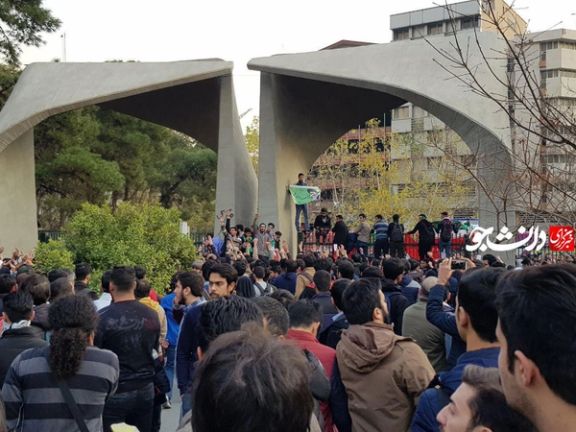
Once again, the hardline chancellor of Tehran University has denied allegations of purging academics based on their political beliefs, instead accusing those dismissed of "moral issues."
In an interview with the semi-official Mehr News Agency on Tuesday, Mohammad Moghimi asserted that not a single academic has been dismissed from Iran’s top state university on political grounds.
“The ethical problems of some professors who make a lot of noise on social media, by the way, has been proven,” Moghimi claimed.
In September 2023, Moghimi asserted that he had “full knowledge” that some academics who had been dismissed had faced lawsuits from students regarding "ethical matters."
The latest wave of academic purges in Iran began during President Ebrahim Raisi's administration. It gained momentum shortly after nationwide protests under the banner of "Woman, Life, Freedom" erupted following the death of Mahsa (Jina) Amini in the custody of the so-called morality police on September 16, 2022. Following Amini’s death, many universities became centers of extensive months-long student protests.
While the law prohibits the military from entering academic institutions, plainclothes security forces and organized militia were extensively deployed to suppress the student protests. Armed plainclothes agents and vigilantes went so far as to attack students inside Tehran’s Sharif University of Technology on October 3, 2022, resulting in the arrest of dozens of students.
Mohammad Moghimi, the chancellor of the University of Tehran
Academics Fired Over Protest Support
Ali Sharifi-Zarchi, a prominent member of the bioinformatics and AI Faculty within the prestigious computer engineering department of Sharif University of Technology, was among the first to be dismissed for his support of dissident students.
Zarchi's revelation of the actions taken against him prompted several other academics, such as Somayyeh Sima, a faculty member in the water engineering department at Tarbiat Modares University, to come forward and share their own experiences.
Numerous academics who were dismissed, terminated, suspended, or demoted for supporting protesting students faced arbitrary accusations. They were accused of “academic sluggishness”, “political immorality and media show-off”, and "defiling" the academic arena with their "factional and even anti-national views" by the ministry of higher education.
The purge has been widely attributed to ultra-hardliners allied with President Ebrahim Raisi, aiming to assert dominance in the political arena by ousting other politicians, officials, and academics. Former moderate conservative Speaker Ali Larijani coined the term "purification" to characterize these plans.
Academic Purges: From 1980 To Today
The history of academic purges in the Islamic Republic dates back to 1980, shortly after the victory of the Islamic Revolution. The newly established government's Cultural Revolutionary Headquarters shut down universities across Iran for three years, aiming to eliminate dissenting voices and impose its Islamic revolutionary ideology on higher education institutions.
During that period, thousands of professors and students were purged for a variety of reasons, including their political affiliations and perceived Western influences, in what became known as the "Cultural Revolution".
Throughout Mahmoud Ahmadinejad's presidency (2005-2013), closely aligned with hardliners, the regime sought to recruit academics who shared the ideological stance of the hardline and religious establishment. Concurrently, it endeavored to eradicate its political adversaries, namely reformists, from academia.
Supreme Leader Ali Khamenei has also repeatedly emphasized that universities must adhere to Islamic principles, asserting that those not aligned with the regime should be barred from teaching. In a speech delivered in July 2015, he stated, "Do not employ unreliable individuals in universities at any cost." He urged, "There are good professors; employ them."
The office of Iran's Supreme Leader Ali Khamenei announced Tuesday the launch of his new Instagram page following the closure of his previous account on the platform.
The office of Khamenei said they “officially expressed their protest to Meta company, and the company has so far refrained from responding to the action."
Last month, Meta, which owns Instagram and Facebook, removed Ali Khamenei's accounts from Instagram and Facebook citing repeated violations of their “Dangerous Organizations & Individuals policy.”
The move was reportedly in response to its explicit support for Iran’s proxy groups in the region, including Hamas and Hezbollah, both designated as terrorist groups by several countries.
A large number of Iranian activists have been calling for the removal of Khamenei's accounts on various platforms.
Platforms like Instagram, Facebook, Telegram, and others remain inaccessible in Iran due to government filtering policies.
Tensions in the region have intensified since Iran-backed Hamas militia in Gaza launched attacks on Israel, with Iran's proxies in Iraq, Syria, Lebanon, and Yemen showing support for the group with attacks against both Israel and US targets.
Men work at a construction site of apartment buildings in Beijing, China, July 15, 2022.
The head of Iran's parliamentary construction commission has announced that Chinese companies are set to enter the Iranian housing market starting from April, raising fears of a resulting financial crisis.
The deal to bring in Chinese companies comes as the Iranian government seeks to gain access to Chinese technologies, but despite potential benefits, concerns arise regarding the substantial debt Chinese construction companies carry, totaling over $390 billion as reported by The New York Times in 2023.
The possibility of bankruptcy post-project launch could lead to heavy legal complications for Iran but amid global sanctions, the desire for foreign investment outweighs the potential risks.
According to Mohammad-Reza Rezaei Kouchi, “Chinese investment in Iran's construction industry will grant them a share in building projects and unit sales.” However, he added that the cooperation model solely involves investment, with Chinese funds entering the market and no plans for utilizing Chinese labor.
Experts say the Chinese housing initiative aligns with the 25-year cooperation agreement between Tehran and Beijing. Signed in 2021, a leaked version of the agreement's final text is quite broad, yet Tehran officials, grappling with an unsolved economic crisis, anticipate it will attract $400 billion in investment.
The Iranian housing sector already faces challenges, with many local companies struggling due to rising costs, inflation, and reduced demand. President Ebrahim Raisi's pledge to build one million housing units annually has failed, especially considering the high average housing prices in Tehran compared to the minimum wage.
The average cost for one square meter of housing in Tehran is roughly 600 million rials ($1,000), far exceeding the monthly minimum wage of about $100.
President Joe Biden speaks next to US Treasury Secretary Janet Yellen during a cabinet meeting in the Cabinet Room of the White House in Washington, June 6, 2023.
The Biden administration on Wednesday issued another sanctions waiver to Iran, unblocking up to 10 billions of dollars in Iranian frozen funds.
The administration notified the Congress it is renewing the sanctions waiver for Iraq to continue buying electricity and natural gas from Iran.
The waiver was offered in 2018 after former President Donald Trump imposed sanction on Iran, while Iraq needed the energy imports. Considering Washington's amicable ties with Baghdad, US administrations allowed the exception to the sanctions, on the condition that Iraq cannot pay Iran in cash hard currencies, but only allow the purchase of humanitarian needs in Iraq.
However, last year, the Biden administration allowed $10 billion in accumulated funds to be transferred to Oman for Iran being able to use the money, ostensibly for non- sanctionable purposes.
A group of Republican House Representatives led by Rep. Bill Huizenga, in aletteraddressed to Treasury Secretary Janet Yellen and Secretary of State Antony Blinken, questioned the rationale behind the Biden administration's decision to renew the 120-day sanctions waiver, allowing Iraq to pay Iran for electricity and facilitating the transfer of Iranian funds from the Trade Bank of Iraq to a bank in Oman.
The lawmakers are asking the Biden administration to provide information on how much cash Iran has been able to access in the months since sanctions were lifted, referring to a December 2023 hearing of the House Financial Services Committee, when Elizabeth Rosenberg, the assistant secretary of the US Treasury Department, acknowledged the existence of "two transactions” by Iran.
Since the US extended the sanctions waiver four months ago, the situation in the Middle East has deteriorated further, amplifying an already tense crisis.
In January, an Iran-backed militia's drone attack in Jordan claimed the lives of three US service members, marking the first American military fatalities from hostile fire amid escalating tensions from Israel's conflict with Hamas.
Increased attacks on vessels in the Red Sea by Iran-backed Houthi rebels have intensified criticism of the administration's handling of Iran. Recently, CENTCOM Commander Gen. Erik Kurilla told the Senate Armed Services Committee that Iran remains undeterred in its support for Hamas, Hezbollah and the Houthis – and is not paying a price for its nefarious activities in the region.
A view from Imam Khomeini International Airport in Tehran
After being implemented in metro stations, university campuses and a raft of public spaces, hijab enforcement by special agents has now been extended to Iran's airports.
Amid concerns about potential altercations between women and hijab enforcers, Reza Nakhjavani, Iran’s Deputy Minister of Roads and Urban Development, claims that hijab enforcement at airports is conducted in accordance with the laws of the country.
“Currently there is no law regarding the prohibition of entry for passengers without hijab onto airplanes, but order and discipline must prevail at airports," said Nakhjavani on Wednesday.
His remarks come amid heightened tensions surrounding the deployment of government-affiliated forces, commonly known as 'hijab enforcers,' particularly in the Tehran metro.
The controversy surrounding hijab enforcement in Iran gained international attention following the death of Mahsa Amini while in morality police custody. Amini's arrest in September 2022, on charges related to 'improper hijab,' sparked nationwide protests and catalyzed the Woman, Life, Freedom movement.
Amini's death was followed last year by another incident involving Armita Geravand, a teenage student, who was assaulted by hijab enforcers in the metro, leading to her eventual death after spending 28 days in a coma.
The situation has further escalated with reports of hijab enforcement forces extending their activities to university campuses, including the University of Tehran. Student councils have reported instances of harassment and intimidation by these forces, who claim to be enforcing dress codes on campus.
The crackdown on mandatory hijab defiance continues despite widespread condemnation, both domestically and internationally, rights groups branding the laws discriminatory and oppressive. The UN said the latest round of hijab laws are nothing less than gender apartheid.
Iran’s ruler Ali Khamenei during a meeting with a group of schoolgirls (February 2023)
A notable paradox in population dynamics has emerged recently in Iran.
On one front, the government aims to increase the population by two-fold – and as soon as possible. To achieve this, it has severely restricted abortion and contraception, and simultaneously promotes pregnancy and childbearing.
But, year after year, individuals are instead opting to have fewer children, standing in opposition to the government's ambitious population policy. In essence, Iranians have effectively countered Khamenei's population policy – and defeated its goals.
Abortion rate undermine Khamenei’s goals
One of the ways Khamenei’s policy has been thwarted is by Iranian women opting for abortion.
Estimating the precise number of abortions in Iran proves challenging. Nonetheless, a senior health expert with the Expediency Council suggests that both legal and illegal abortions total approximately 1.3 million annually, with intentional abortions accounting for around 530,000 cases. Other authorities offer estimates ranging from 250,000 to 650,000 cases per year.
These abortions are carried out either by private clinics or through the use of illegal pills available in the market. While today's younger generation is knowledgeable about contraception methods, the government has eliminated their accessibility from all public facilities in this field.
Iran’s Supreme Leader Ali Khamenei believes Iran’s population needs to increase to 150 million.
A policy driven by nefarious motives
The abortion policy of the Islamic Republic has been quite stringent, though not driven by Islamic Sharia prohibition or a culture of valuing human life. Instead, it has been driven by the aim to boost the population for the establishment of an Islamic empire – despite causing impoverishment and exacerbating the populace's hardships with annual inflation rates ranging around 50%.
Until the fetus reaches 4.5 months of gestation, there are typically no Shariah restrictions according to the fatwas issued by most Shia sources of emulation. In such cases, the mother isn't required to obtain a license and is obligated to pay an atonement. The new population law of the Islamic Republic of Iran, akin to its regulations on loan interests, contradicts fatwas.
Unlike many American conservatives, the authorities of the Islamic Republic do not take a moral stance against abortion nor emphasize the inherent right to life. Over the past 45 years, their focus has primarily revolved around execution, genocide, warfare, and bloodshed.
Their opposition to abortion stems from two primary motives: firstly, they view a large population as essential for achieving superpower status, which aligns with their overarching agenda, and secondly, they seek to maintain a vast army comprised of impoverished, uneducated, and vulnerable individuals for the perpetuation of their oppressive regime and involvement in endless regional conflicts. But, compared to their government, the general populace is more acutely aware of the country's resource constraints, such as limited access to safe water, education, and healthcare.
Khamenei battles ongoing population decline
In the last two decades, Ali Khamenei has expressed dissatisfaction with Iran's population control policiesfrom the 1990s, aiming to counteract the ongoing decline in growth rates since the 1980s, where it stood at 3.91%, by striving to increase the rate from the 1.2% observed in the 2000s.
Consequently, following the enactment of the Family Protection and Youth Population Law in 2020, abortion can only be conducted legally with official permits.
Law vs. Reality
According to Article 56 of the Family Protection and Youth Population Law, an abortion without a license is punishable by fine, imprisonment, and revocation of the medical license, and the coroner’s office is responsible for filing the case for the applicants. The doctor of this office is in charge of reviewing the documents and completing the details of the case. In addition to the punishments stipulated in the Islamic Penal Code, the work license of a doctor, midwife, or pharmacist involved in abortion and their stewards will be revoked and they must pay a fine. But despite these punishments, underground and illegal abortions continue, with the government struggling to enforce its law. Easy access to abortion drugs has also contributed to high abortion rates.
However, societal trends have consistently shifted in the opposite direction. Iran's population growth rate has declined from 1.62% in 2006 to 1.24% in 2016, and approximately 0.7% in 2021. Certainly, around half a million individuals—comprising roughly one million births and half a million deaths—are added to the population annually. But, if current trends persist, the growth rate is projected to reach zero within the next seven years, thereafter turning negative.
The Family Protection and Youth Population Law and its various rewards and punishments for having children and infertility have not been able to change this trajectory. Paradoxically, even the prohibition of prenatal screening has not aided in decreasing abortion rates. The pervasive sense of economic hardship and despair regarding the future weighs heavily on the minds of mothers across all 31 provinces – with this overwhelming burden prompting them to undergo abortions despite the associated risks and financial strain, all of which are borne out of their own pockets.
Thus, Ali Khamenei and the Islamic Revolutionary Guards (IRGC) cannot rely on population growth to bolster their influence. To sustain their oppressive regime, they depend on maintaining a populace mired in poverty and unemployment. Their aspirations for empire-building hinge on depleting the resources of the people, impoverishing them for conflicts with Israel and America, and funneling billions annually to proxy groups and sympathetic governments in Syria and Yemen. Additionally, to support the Quds Force, they must rely on Shiite populations in Afghanistan, Pakistan, Iraq, and Lebanon. Ultimately, their pursuit of power relies on a strategy of impoverishment and manipulation that will also extend beyond Iran's borders.