• العربية
  • فارسی
Brand
  • Iran Insight
  • Politics
  • Economy
  • Analysis
  • Special Report
  • Opinion
  • Podcast
  • Iran Insight
  • Politics
  • Economy
  • Analysis
  • Special Report
  • Opinion
  • Podcast
  • Theme
  • Language
    • العربية
    • فارسی
  • Iran Insight
  • Politics
  • Economy
  • Analysis
  • Special Report
  • Opinion
  • Podcast
All rights reserved for Volant Media UK Limited
volant media logo

Former Officials Offer Roadmaps For Post-Election Iran
Iran International Newsroom
Mar 3, 2024, 12:21 GMT+0Updated: 10:59 GMT+0
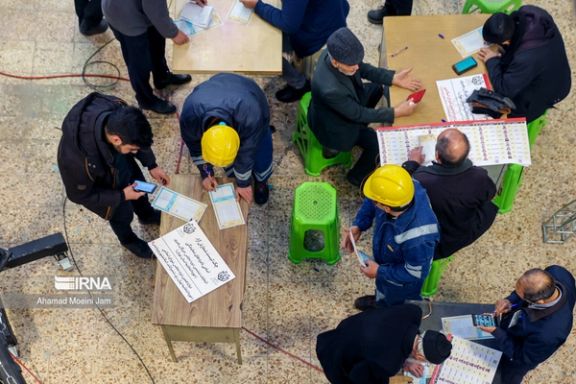
Iranians voting in elections on March 1, 2024

Several top politicians in Iran warned ahead of the lackluster elections on March 1 that popular rejection of the highly manipulated electoral system could prove costly for the regime.

Alongside these warnings, they have offered roadmaps and guidelines aimed at navigating the potential challenges arising from the political impasse.

Despite the government’s claim of a 40-percent turnout, scattered voting results announced since Friday indicate a lower turnout and an unprecedented number of blank ballots.

One day before the elections, former Majles Speaker Ali Larijani emphasized the urgent need for a "national unity government" to address the looming challenges both regionally and internationally. He stressed the importance of forming coalitions at various political levels and fostering cohesion and empathy among the people as crucial steps towards steering the country out of its current predicament.

Iran’s former parliament Speaker Ali Larijani (3rd left) standing in line to vote in elections on March 1, 2024
100%
Iran’s former parliament Speaker Ali Larijani (3rd left) standing in line to vote in elections on March 1, 2024

Larijani's nuanced message struck at the core of Iran's foreign policy, which has resulted in international isolation and the imposition of sanctions, culminating in a five-year-long economic crisis.

Larijani also advocated for the strategic use of "protest votes," suggesting that casting blank ballots or supporting candidates outside the leading ultraconservative camp could serve as a wake-up call to the government. However, he cautioned that such actions might come at a significant cost to both the government and the nation, potentially paving the way for a dictatorship if left unaddressed.

Furthermore, Larijani warned against the disillusionment of the people, asserting that it could signal the onset of authoritarian rule. He urged the government to ensure that despite the biased vetting process that sidelined reformist and moderate candidates, there are still avenues for representing the rights and aspirations of dissatisfied voters.

At the same time, Larijani, who led the parliament for 12 years, underscored the importance of voter participation in effecting change within the country's political landscape. He urged the populace to engage in the electoral process as a means of holding the government accountable and advocating for reforms, cautioning that abstaining from voting could empower a minority to seize power.

In addition to Larijani’s warnings and recommendation, former government spokesman Ali Rabiei proposed a post-election roadmap for reform-minded Iranians. He emphasized the need for coalition-building and collective action to rectify the shortcomings of the electoral system and safeguard Iran's freedoms and improve governance.

Rabiei stressed that the consolidation of conservative political power alone would not address Iran's underlying issues or alleviate the current political impasse. Instead, he advocated for the unity of reformist and moderate forces to navigate the challenges posed by the prevailing political climate.

Nevertheless, Iranian voters also harbor disillusionment toward Reformists who have advocated for gradual change for over a quarter of a century, yet failed to achieve tangible results, ultimately witnessing the regime's complete takeover by hardliners.

Meanwhile, a video surfaced on social media featuring Iranian sociologist Hatam Ghaderi quoting Ruhollah Khomeini, the Islamic Republic's founding leader, regarding the imposition of the 1905 constitution that put an end to absolute rule and established a constitutional monarchy. Khomeini argued that people preferred an Islamic government, not a constitution established seven decades earlier. Dissidents and many Iranian now make the same argument, saying that they are not bound what their grandfathers and fathers preferred 45 years ago, and want a regime change.

Pointing out that protests in Iran cost lives, Ghaderi said: "Now the people do not want the Constitution of the Islamic Republic. They do not want the guardianship of the Supreme Leader. How can they say we do not want this Constitution without fearing repression or getting killed or shot in the eye, and without thousands of people being jailed?"


Most Viewed

Hardliners push Hormuz ‘red line’ as US blockade tests Iran’s leverage
1
INSIGHT

Hardliners push Hormuz ‘red line’ as US blockade tests Iran’s leverage

2

Iran International says it won’t be silenced after London arson attack

3
VOICES FROM IRAN

Hope and anger in Iran as fragile ceasefire persists

4

US sanctions oil network tied to Iranian tycoon Shamkhani

5

Iran halts petrochemical exports to supply domestic market

Banner
Banner

Spotlight

  • Hardliners push Hormuz ‘red line’ as US blockade tests Iran’s leverage
    INSIGHT

    Hardliners push Hormuz ‘red line’ as US blockade tests Iran’s leverage

  • Ideology may be fading in Iran, but not in Kashmir's ‘Mini Iran'
    INSIGHT

    Ideology may be fading in Iran, but not in Kashmir's ‘Mini Iran'

  • War damage amounts to $3,000 per Iranian, with blockade set to add to losses
    INSIGHT

    War damage amounts to $3,000 per Iranian, with blockade set to add to losses

  • Why the $100 billion Hormuz toll revenue is a myth
    ANALYSIS

    Why the $100 billion Hormuz toll revenue is a myth

  • US blockade targets Iran oil boom amid regional disruption
    ANALYSIS

    US blockade targets Iran oil boom amid regional disruption

  • Iran's digital economy battered by prolonged blackout
    INSIGHT

    Iran's digital economy battered by prolonged blackout

•
•
•

More Stories

Iranian Bodybuilder Wins 2024 Arnold Classic

Mar 3, 2024, 10:52 GMT+0

Hadi Choopan, known as the Persian Wolf, won the 2024 Arnold Classic as Iranian bodybuilders continue to take home medals on the world stage.

Following his triumph, Choopan took a moment to address Arnold Schwarzenegger, the godfather of modern day bodybuilding, saying, "When I was a kid, I spent a lot of money to watch Arnold's movies. My biggest wish was to see Arnold up close and take a picture with him. Today, we are standing on a stage together, and the legend of my dreams is giving me an award."

The 36-year-old expressed his gratitude, stating, "It's an honor for me that the world's greatest bodybuilder is giving me a medal today. I am very happy to see you and stand next to you, and I am honored to have a picture with you."

The competition took place on Saturday in Ohio, witnessed by a sold-out crowd.

In November, the Iranian bodybuilding team won nine gold, five silver, and nine bronze medals at the men's World Bodybuilding Championship in Spain.

The sport has seen hardliners slam the 'nudity' with Mohammad Sadegh Koushki calling on President Ebrahim Raisi to suspend bodybuilding competitions altogether back in September. 

Dozens Of Iranian Journalists Prosecuted In February

Mar 3, 2024, 10:29 GMT+0

During the past month, Iran arrested at least 35 journalists and media directors according to Defending the Free Flow of Information (DFI), a 40% surge compared to the previous month.

Of the 35, seven were detained, with two transferred to prison. Eight more were summoned to judicial and security institutions.

Governmental entities lodged complaints against six journalists, one convicted by the press court and 12 receiving sentences ranging from imprisonment to fines and deprivation of their journalistic profession.

The most common charges included “disseminating falsehoods" and "propaganda against the system” among others.

The report also exposes numerous violations of legal rights, such as closed-door trials, property confiscations without warrants, and denial of access to legal counsel. Additionally, six media outlets faced legal scrutiny, with one outlet being seized and three outlets convicted in political and media courts.

As of the end of February, at least 10 journalists remain imprisoned in Iran's facilities, contributing to the nation's status as the world's third-largest jailer of journalists, according to Reporters Without Borders.

Iran has long held one of the world’s worst press freedom rankings, at 178th out of 180 countries.

The International Federation of Journalists has condemned the actions, particularly in the wake of Mahsa Amini's death, reporting over 100 journalists detained and more than 21 sentenced to a total of 77 years in prison.


Economic Turmoil Worsens In Iran As Hardliners Win Election

Mar 3, 2024, 04:01 GMT+0
•
Iran International Newsroom

In response to an unprecedented surge in currency and gold markets in Iran, security agencies clamped down on exchange bureaus, ordering them not post currency rates on Saturday.

Major exchange dealers have even shut down their price announcement boards, according to reports received by Iran International.

Following the parliamentary elections in Iran, the currency and gold markets witnessed historic highs, with the US dollar reaching the 600,000 rial mark at one point during Saturday. Sources in the Tehran market and currency information websites reported that the dollar reached 602,000 rials in the early hours of Saturday trading, marking a three percent increase from Thursday's closing rates.

The dollar's doubling against the rial since March 2022, coupled with failed nuclear negotiations with the US and its European allies, has contributed to this economic turmoil. On Saturday, the euro was traded at 656,000 rials and the British pound at 764,000 rials in the free market, indicating increases of over three and 2.5 percent, respectively, compared to Thursday's rates.

Moreover, the price of 18-carat gold surged to around thirty million rials per gram, reflecting a 3.5 percent increase from the previous week.

An Iranian cleric casts his vote during parliamentary elections at a polling station in Tehran, Iran, March 1, 2024.
100%
An Iranian cleric casts his vote during parliamentary elections at a polling station in Tehran, Iran, March 1, 2024.

Observers and experts had anticipated further economic complications following the parliamentary elections, which amid voter apathy and lack of competition, propelled hardliners to gain absolute majority in the legislature.

The continuous devaluation of the rial, particularly since the US withdrawal from the JCPOA nuclear deal in 2018, has fueled inflation and plunged millions into poverty. The economic crisis has eroded the government's legitimacy, with a historic low voter turnout in the March 1 elections.

Meanwhile, according to Iran’s Statistical Center, the prices of canned tuna and red meat in February increased by 133% and 100%, respectively, compared to the same period last year.

In a report published on Saturday, Etemad daily analyzed the data provided by Iran’s Statistical Centre on the state of the food market. Entitled “The Three-Digit Inflation of the Proteins,” the report reviewed the average prices of 53 selected food items in urban areas.

Of these, 48 items have increased in price over the past 12 months. Some of these items recorded a three-digit annual inflation rate, with canned tuna at the top of the list with a 133% price increase.

Next in line is red meat which has an annual inflation rate of about 100%. The price of one kilogram of lamb meat in February last year was 2,850,000 rials ($5.7), which increased to 5,360,000 rials ($10.72) in February 2024.

According to the report, the prices of chicken meat and salmon have also risen by 55% and 65%, respectively, in the same period.

Meanwhile, Eqtesad 24 daily reported that nearly one-third of Iranians struggle below poverty line. The report projected a concerning escalation in poverty rates, foreseeing that by the end of the current Iranian year [March 20], “the proportion of individuals below the poverty line could soar to 37 to 40 percent.”

The forecast attributes the surge to the combination of soaring inflation rates and stagnant wages, exacerbating the financial strain faced by many Iranians.

In January, Iran announced that the new base monthly salary would rise to approximately $200 with a 20-percent increase. However, the constant decline in the value of the rial now pegs it to around $160.


Raisi Re-Elected To Iran’s Assembly Of Experts

Mar 2, 2024, 23:07 GMT+0

President Ebrahim Raisi was re-elected to Iran’s Assembly of Experts with more than 82 percent of the valid votes in South Khorasan province, reported the IRGC-affiliated Tasnim news agency.

The number indicates an 8-percent increase in his vote share compared to the previous election, Tasnim added. Raisi was unopposed in the electoral district.

This will be his third consecutive term representing the province in the Assembly of Experts, which is tasked with choosing a successor to Iran’s 84-year-old Supreme Leader Ali Khamenei in the event of his death.

In January, Iran’s Guardian Council barred all candidates from running in the Assembly of Experts election in South Khorasan except Raisi.

According to Moussa Salimi, the secretary of the election office in the province, of the five people that had registered to run in the election, one withdrew, and three others were disqualified by the Guardian Council. The last candidate was an unknown individual with little chance of getting votes.

The move sparked a backlash among Iranian social media users, with many rejecting it as a mockery of the principle of elections.

Earlier in February, the opposing candidate said his aim was not to win against raisi but make the elections more real.

Iran’s parliamentary and the Assembly of Experts elections were held Friday while many political activists, opposition parties and large sections of the public had boycotted the event.

The IRGC-affiliated Fars news website claimed a voter turnout of more than 40% in the controversial elections, despite numerous reports indicating lackluster participation.

PEN America Denounces Sentencing Of Iranian Grammy Winner

Mar 2, 2024, 20:17 GMT+0

PEN America has strongly condemned the imprisonment of Grammy-winning Iranian vocalist Shervin Hajipour, who has been sentenced to three years and eight months behind bars.

The group has called for Hajipour's immediate release, urging the authorities to dismiss his sentence and the expunge all charges from his record.

Julie Trébault, director of Artists at Risk Connection, expressed deep concern over Hajipour's sentencing, denouncing it as another “attempt to suppress the independent voices who channel the demands of the Iranian people for basic freedoms.

“The Iranian government is attempting to silence a powerful movement spearheaded by musicians who believe in freedom and women’s rights,” added Trébault.

During Iran's parliamentary elections on Friday, Hajipour took to Instagram to share the news about his sentence, revealing his conviction on charges of "propaganda against the system" and "inciting protests." Additionally, he has been subjected to a two-year travel ban and instructed to compose a song focusing on "US crimes" while disseminating related content online.

Hajipour, known for his support of the Woman, Life, Freedom movement, gained international recognition for his protest song "Baraye" ("Because of"), which won the prestigious "Song for Social Change" at the Grammy Award. His arrest in September 2022, following the song's viral success, led to charges of inciting dissent.

The sentencing of Hajipour is part of a broader crackdown on artists and activists in Iran. According to PEN America's Freedom To Write Index, Iran ranks as the world's second-highest incarcerator of writers, with at least 57 Iranian writers arrested in 2022 alone. The international community continues to call for the protection of freedom of expression and the release of unjustly detained individuals in Iran.





