• العربية
  • فارسی
Brand
  • Iran Insight
  • Politics
  • Economy
  • Analysis
  • Special Report
  • Opinion
  • Podcast
  • Iran Insight
  • Politics
  • Economy
  • Analysis
  • Special Report
  • Opinion
  • Podcast
  • Theme
  • Language
    • العربية
    • فارسی
  • Iran Insight
  • Politics
  • Economy
  • Analysis
  • Special Report
  • Opinion
  • Podcast
All rights reserved for Volant Media UK Limited
volant media logo

Israeli Minister Warns Of A New Flare-Up During Ramadan
Iran International Newsroom
Feb 28, 2024, 08:56 GMT+0Updated: 11:00 GMT+0
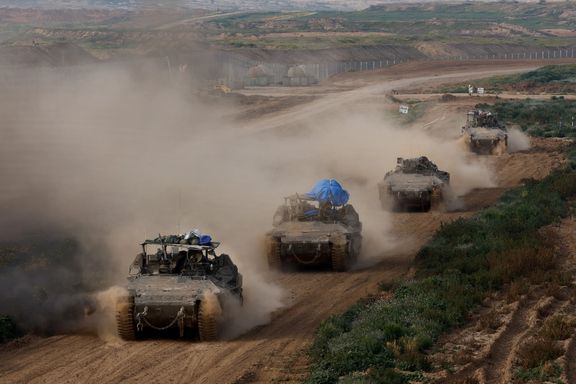
Israeli army vehicles return from the southern Gaza strip, in southern Israel, February 26, 2024.

Israel has raised concerns about Hamas, Hezbollah, and Iran seeking to "unite the fronts" and "inflame the region" during the upcoming Muslim holy month of Ramadan, which begins in two weeks.

“Hamas’s main goal is to take Ramadan, with an emphasis on the Temple Mount and Jerusalem, and turn it into the second phase of their plan that began on October 7,” Israeli defense minister Yoav Gallant said Tuesday. “This is the main goal of Hamas, it is being amplified by Iran and Hezbollah.”

Ramadan is one of the more sacred times for Muslims, when the community comes together in a month of fasting and prayer. It has often been a time of heightened tensions between Israel and Palestinians who seek access to holy sites come but encounter Israeli restrictions and tightened security measures.

Pro-Palestinian rallies are held in some Muslim countries every year on the last Friday of Ramadan, called Quds Day (after the Arabic name of Jerusalem, al-Quds). Iran has been the main force behind promoting the Quds Day as a symbol of continued opposition to Israel.

Smoke rises from a site believed to have been hit by an Israeli strike, in southern Lebanon, in this screen grab taken from a video, February 27, 2024.
100%
Smoke rises from a site believed to have been hit by an Israeli strike, in southern Lebanon, in this screen grab taken from a video, February 27, 2024.

Gallant was speaking to Israeli commanders responsible for operations in the West Bank, where Palestinians fuming at Israel’s onslaught on Gaza would likely face unprecedented measures put in place by the most far right government in Israeli history.

Israel’s minister for national security Itamar Ben Gvir is seeking to prevent Palestinians from praying at the Temple Mount during Ramadan. He is even considering a ban on Arab Israeli citizens below the age of 70, according to the Israeli newspaper Haaretz.

Gallant seems to be opposed to such measures on the grounds that it could inflame Palestinian feelings. He warns against “Irresponsible statements from people who are supposed to be responsible,” most likely addressing Ben Gvir. “We must not give Hamas what it has not been able to achieve since the beginning of the war and converge the combat fronts.”

More than a hundred days since Hamas rampaged Israeli border areas, the Middle East is still grappling with the repercussions. Thousands of Palestinians have been killed or maimed, although there is no independent exact toll on civilian deaths.

Global trade has been hit by ongoing Houthi attacks on commercial ships in the Red Sea. And Hezbollah continues to exchange fire with Israeli troops across the border almost on a daily basis. The only good news is that Iran 's proxies in Iraq and Syria have gone quiet after several rounds of US airstrikes in response to the killing of three American soldiers last month.

On Tuesday, Hezbollah announced that it had launched several rockets at an Israeli aerial surveillance base. One day earlier, the Israeli military had struck targets at the Bekaa Valley, more than a 100 km from the Israel-Lebanon border, where most of the attacks have been concentrated.

It was a clear escalation in a conflict where both sides have shown some restraint despite regular attacks and retaliations.

The United Nations’ peacekeeping mission in Lebanon, UNIFIL, urged both sides to avoid further escalation, according to Reuters, warning that it had observed a "concerning shift" in the exchanges of fire between Israel and Hezbollah.

Hezbollah is widely believed to be the most powerful non-state actor in the region. It is funded and armed by Iran, reportedly capable of hitting any point in Israel with its vast arsenal of more than a hundred thousand missiles. So far, it has not entered the war, fearing harsh response from Israel perhaps, and is likely to stop its attacks if Israel and Hamas agree to the much-anticipated ceasefire.

Most Viewed

100 days after carnage: Iran economy reels from war, inflation, unemployment
1
INSIGHT

100 days after carnage: Iran economy reels from war, inflation, unemployment

2
INSIGHT

Ghalibaf defends Iran-US talks amid hardline backlash

3
EXCLUSIVE

Iranian assaulted in London amid concern over threats to regime critics

4

IRGC fires at Indian vessel in Hormuz

5
INSIGHT

A nation in limbo: 100 days after the massacre, has the world moved on?

Banner
Banner

Spotlight

  • War-hit homeowners feel abandoned as Iran’s reconstruction aid fades

    War-hit homeowners feel abandoned as Iran’s reconstruction aid fades

  • 100 days on: the anatomy of Iran’s January crackdown
    INSIGHT

    100 days on: the anatomy of Iran’s January crackdown

  • Ghalibaf defends Iran-US talks amid hardline backlash
    INSIGHT

    Ghalibaf defends Iran-US talks amid hardline backlash

  • 100 days on: why Iran’s January protests spread across social classes
    ANALYSIS

    100 days on: why Iran’s January protests spread across social classes

  • From instability to influence: Pakistan’s pivotal role in US-Iran diplomacy
    ANALYSIS

    From instability to influence: Pakistan’s pivotal role in US-Iran diplomacy

  • A nation in limbo: 100 days after the massacre, has the world moved on?
    INSIGHT

    A nation in limbo: 100 days after the massacre, has the world moved on?

•
•
•

More Stories

Iran Continues To Offer Safe Haven To Al-Qaeda, US Confirms

Feb 27, 2024, 22:33 GMT+0
•
Iran International Newsroom

Iran continues to allow al-Qaeda to facilitate its terrorist activities, a key communication channel to transfer funds and fighters to South Asia, Syria, and elsewhere, the US State Department told Iran International. 

The State Department said that “Iran continues to deny al-Qaeda’s presence in the country, despite their knowledge of al-Qaeda leadership figures’ activities there," the relationship dating back to as early as 2009. 

The State Department also confirmed remarks by James Rubin, the US special coordinator for the State Department’s Global Engagement Center, who recently talked of “a new partnership between Iran and al-Qaeda" in a briefing in London, saying that Iran is harboring al-Qaeda leaders inside its soil. 

The department also emphasized that “Iran is the leading state sponsor of terrorism, facilitating a wide range of terrorist activities and other illicit activities around the world -- in Bahrain, Iraq, Lebanon, Syria, and Yemen, through militant groups and terrorists such as Hezbollah and Hamas.”

They branded Iran "a primary driver of instability across the Middle East" since the Islamic regime was established in 1979.

Late in January, the United Nations released a report disclosing eight new al-Qaeda training camps and other infrastructure inside Afghanistan as well as five madrasas, or religious schools to teach jihadi ideology. An al-Qaeda leader known as Hakim al-Masri “is responsible for the training camps and conducting suicide bomber training for Tehrik-i-Taliban Pakistan,” the Pakistani branch of the outfit. Al Qaeda has also established a new base “to stockpile weaponry” in the central province of Panjshir. 

The report cited several UN Security Council member states as saying that the key al-Qaeda figures are travelling to provide liaison between the terrorist group’s de facto leader, Saif al-Adel, who resides in Iran, and senior al-Qaeda members in Afghanistan, including Abdul Rahman al-Ghamdi. Al-Ghamdi is one of the suspects in the September 11 attacks, who was unable to participate for unknown reasons. 

(From left to right) Al-Qaeda leaders Saif al-Adel, Abu Muhammad al-Masri, and Abu Abu al-Khayr al- Masri in Tehran, Iran, circa 2015. (Photograph from Anonymous hacking group)
100%
(From left to right) Al-Qaeda leaders Saif al-Adel, Abu Muhammad al-Masri, and Abu Abu al-Khayr al- Masri in Tehran, Iran, circa 2015. (Photograph from Anonymous hacking group)

Seif al-Adel, a former Egyptian special forces officer and a high-ranking member of al-Qaeda with a $10 million US bounty on his head, became the "uncontested" leader of the militant group following the July 2022 death of Ayman al-Zawahiri in a US missile strike in Kabul. 

The Taliban has not formally declared him "emir" because of sensitivity to the concerns of the Taliban authorities in Afghanistan, who haven't wanted to acknowledge that Zawahiri was killed by a US rocket in a home in Kabul, another big blow to the group since its founder Osama bin Laden was killed in 2011. Another UN report said that the Sunni Islamist al-Qaeda is also sensitive to the issue of Adel residing in largely Shiite Iran.

The latest UN report highlighted that “The group maintains safe houses to facilitate the movement between Afghanistan and the Islamic Republic of Iran in the Provinces of Herat, Farah and Helmand, with additional safe house locations in Kabul.” 

In February 2023, then State Department spokesperson Ned Price said, “Our assessment aligns with that of the UN… offering safe haven to al-Qaeda is another example of Iran’s wide-ranging support for terrorism, its destabilizing activities in the Middle East and beyond.”

A day after Washington aligned itself with the UN statement locating Adel in Iran, the regime’s foreign minister, Hossein Amir-Abdollahian, denied he is based in the country. "I advise the officials of the White House to stop the failed game of Iran-phobia, making news about the leader of al-Qaeda and linking him to Iran is laughable," he said. 

According to the US State Department’s Rewards for Justice program, Adel moved to southeastern Iran after bomb attacks on the US embassies in Tanzania and Kenya that killed 224 civilians and wounded more than 5,000 others in 1998. He reportedly lived under the protection of Iran's Revolutionary Guards (IRGC), but in April 2003, Iran placed him and other al-Qaeda leaders under house arrest. In September 2015, Adel and four other senior al-Qaeda leaders were released from Iranian custody in exchange for an Iranian diplomat kidnapped by al-Qaeda in Yemen. They stayed in Iran after their release.

The UN report also confirmed that “the relationship between the Taliban and al-Qaeda remains close, and the latter maintains a holding pattern in Afghanistan under Taliban patronage.” Expressing concerns about the presence of al-Qaeda senior figures in Afghanistan, the UN team said, “the group continues to pose a threat in the region, and potentially beyond.” The report noted that Taliban tries to “reduce the visibility” of its ties with al-Qaeda.

In addition to harboring al-Qaeda leaders, Tehran is also bolstering its relations with Taliban, which agreed not to allow al-Qaeda to operate in areas under their control days after the takeover of Kabul in August 2021. Al-Qaeda is bound to the Taliban by a pledge of allegiance first offered in the 1990s by Osama Bin Laden to his Taliban counterpart Mullah Omar. The pledge has been renewed several times since, although it has not always been publicly acknowledged by the Taliban.

US And UK Issue New Sanctions For Iran’s Militants Abroad

Feb 27, 2024, 15:37 GMT+0
•
Iran International Newsroom

Members of Iran’s IRGC and its proxy, the Houthi militia, have been designated for actions related to the ongoing attacks on shipping and naval vessels in the Red Sea that have disrupted international trade.

Among the list of designations is the Deputy Commander of Iran’s Islamic Revolutionary Guard Corps-Qods Force (IRGC-QF), Mohammad Reza Falahzadeh (Fallahzadeh), and Houthi member Ibrahim al-Nashiri. Falahzadeh has been a key figure for the Quds (Qods) Force in Syria and managed projects worth tens of billions of dollars for the Iranian regime abroad.

Also designated is Iranian Said Al Jamal, a financier who heads a network of front companies and vessels that generate revenue for the Houthis, funding advanced weaponry such as unmanned aerial vehicles and missiles. He was first designated in 2021 for supporting the IRGC-QF.

Senior Houthi figure, Ali Hussein Badr Al Din Al-Houthi, the commander of the security forces, has also been sanctioned along with IRGC Quds Force Unit 190, in charge of transferring and smuggling weapons to organisations, groups and states that are allied with Iran.

Deputy Commander of Iran’s Islamic Revolutionary Guard Corps-Qods Force (IRGC-QF), Mohammad Reza Falahzadeh (Fallahzadeh) (undated)
100%
Deputy Commander of Iran’s Islamic Revolutionary Guard Corps-Qods Force (IRGC-QF), Mohammad Reza Falahzadeh (Fallahzadeh)

IRGC Qods Force Unit 6000, in charge of operations on the Arabian Peninsula with personnel on the ground in Yemen supporting Houthi military activity, and IRGC Qods Force Unit 340, in charge of research and development and providing training and technical support to groups backed by Iran were also on the list.

In November, the Houthis began a naval blockade of the critical international trade route in support of Hamas in Gaza, at war with Israel in the wake of the US and UK-designated terror group’s attacks on southern Israeli communities on October 7. Trade has been disrupted with container costs to some UK businesses alone soaring 300 percent since the blockade began. 

The US Under Secretary of the Treasury for Terrorism and Financial Intelligence, Brian E. Nelson, said: “As the Houthis persistently threaten the security of peaceful international commerce, the United States and the United Kingdom will continue to disrupt the funding streams that enable these destabilizing activities.”

On behalf of Tehran, the IRGC-QF has provided the Houthis with an increasingly sophisticated arsenal of weapons and the training to deploy these weapons against commercial shipping and civilian infrastructure in the region, though they continue to deny involvement, claiming the Houthis are acting independently.

Iranian military officials have also provided intelligence support to target vessels transiting the region, providing key support to enable the Houthis’ maritime attacks against international shipping.

Since mid-November 2023, the Houthis have attempted dozens of strikes targeting vessels in the region after Iran's ruler Ali Khamenei called on Muslims to blockade Israel.

Initially claiming to only target Israel-linked vessels, the Houthis last week announced they would now be targeting the US and UK linked vessels in retaliation for their support of Israel.

As the blockade gets ever more global, Denmark's shipping and logistics company, Maersk, one of the world’s largest, released a statement on Tuesday warning clients they should prepare for disruptions to last into the second half of the year and to build longer transit times into their supply chain planning.

Major container shipping companies have switched Suez Canal-bound ships to the longer route around Africa's Cape of Good Hope. “Know your best alternative to entering the North American market and be ready to have mitigations in place," Maersk's head of North America, Charles van der Steene, said in a statement.

"Start quantifying and preparing to mitigate shifts in your supply chain costs," he added.

Maersk has added about 6% more vessel capacity to offset delays due to longer transit times around Africa, it said.

The UK foreign office released a statement saying: “Today, we are sanctioning key figures supporting the Houthis, who continue their attacks in the Red Sea. We will not stand by as the Houthis put innocent lives at risk, threaten regional stability and harm the global economy.”

The UK already has more than 400 sanctions designations in place on Iranian individuals and entities, most of which sit under the UK’s new Iran sanctions regime, which came into effect in December 2023 and provides new powers to hold Iran and its proxies to account.

In addition to this, one designation also sits under the Yemen sanctions regime. Introduced as autonomous regulations in the UK in 2020, it enables the UK to hold individuals or entities to account where they threaten peace, security or stability in Yemen.

Last month, the UK and US sanctioned key Houthi figures amid joint strikes from the two allies on on key Houthi sites in Yemen in a series of defensive attacks against the Yemeni militia. It was the first time UK sanctions had been issued against the Houthis since the attacks in the Red Sea began in November.

Iran's Nuclear Program Has No Credible Civilian Purposes, US Repeats

Feb 27, 2024, 12:06 GMT+0

US State Department Spokesman Matthew Miller said the US remains "seriously concerned about Iran’s continued expansion of its nuclear program in ways that have no credible civilian purpose".

During his Monday briefing, he said Iran's continued production of highly enriched uranium remains a major policy concern. The statements came as two confidential reports from the UN's nuclear watchdog were distributed to member states on Monday, providing a grim assessment of Iran's nuclear program.

Persistent obstacles to thorough inspection procedures continue to obscure the true nature of Iran's activities, heightening concerns about the intentions of the Tehran regime.

IAEA head Rafael Grossi said that "public statements made in Iran regarding its technical capabilities to produce nuclear weapons" have only increased "concerns about the correctness and completeness of Iran's safeguards declarations".

Iran's enriched uranium stockpile has now exceeded 5.5 tons, representing an increase of one ton since October. Within the stockpile are 712.2 kilograms of uranium enriched up to 20 percent and 121.5 kilograms enriched up to 60 percent. Notably, the latter category has seen a decrease of approximately 7 kilograms over the past hundred days.

The Wall Street Journal reported that Iran has decided to reduce its stockpile of 60 percent enriched uranium over the last three and a half months "by deliberately diluting the material by mixing it with low-grade 2 percent material", noting that it is the first time the International Atomic Energy Agency has reported a quarterly drop in Tehran's highly enriched stockpile since Iran started production.

According to definitions established by the International Atomic Energy Agency (IAEA), Iran would require a minimum of 42 kilograms of uranium enriched to 60 percent to produce a nuclear bomb.

Iranian authorities have consistently asserted that Iran's nuclear program is solely intended for peaceful purposes. However, nuclear experts overwhelmingly argue that the levels and quantities of enrichment undertaken by Iran since 2021 cannot be justified in the absence of a weapons program.


US Military Thwarts More Attacks By Iran’s Houthis In Yemen

Feb 27, 2024, 09:39 GMT+0

The US military thwarted upcoming attacks to merchant vessels and US navy ships by Iran’s Houthi militia in Yemen amidst its Red Sea blockade.

Central Command, via its official X account, announced the operations, saying, “CENTCOM forces identified the USVs and missiles in Houthi-controlled areas of Yemen, as well as the UAV over the Red Sea, and determined that they presented an imminent threat to merchant vessels and to the US Navy ships in the region.”

Iran's longstanding support for the Houthis has come into focus once again. Despite Iranian assertions of the Houthi group's autonomy, recent events suggest Tehran wields substantial influence over their actions.

Analysts point to parallels between the relative decrease in conflicts in Syria and Iraq following targeted attacks on high-ranking Iranian commanders and US airstrikes. This suggests Iran's adeptness in controlling its proxies when deemed necessary.

Despite a temporary hiatus in Houthi attacks earlier in February, recent incidents indicate a resurgence in targeting commercial vessels, including those of British and American origin.

President Biden's warnings over the past three months have failed to deter the intensifying attacks, with the Houthi group expanding its blockade to include ships from the US and the UK, in addition to those linked with Israel, in allegiance with Hamas in its war against Israel.

Iran-backed Hamas invaded Israel on October 7, spamming a Tehran fueled proxy war.


Iran Denounces UN Investigation, Drawing Parallel With Gaza

Feb 27, 2024, 07:01 GMT+0
•
Maryam Sinaiee

The United Nations’ fact-finding mission, set up in December 2022 following Iran's bloody crackdown on protesters, will release its comprehensive report on March 18.

The mission is also scheduled to release its preliminary report on the International Day of Women (March 8).

In his address to the 55th session of the United Nations Human Rights Council (HRC) in Geneva on Monday, Iran's Foreign Minister Hossein Amir-Abdollahian accused the UN of double standards and criticized it for setting up the fact-finding mission for Iran but not taking any serious action on Israel’s killing of civilians in Gaza.

“We will not forget the outcries in this place months ago under the pretext of an Iranian girl’s death and the formation of a so-called fact-finding mission,” he said.

In her address to the same meeting Monday, the German Foreign Minister Anna Baerbock called for extending the mission’s mandate. “I want to be crystal-clear to those who claim that calling out violations is an interference in internal affairs: Human rights are universal. A life is a life,” she said.

Mahmoud Amiri-Moghadam, director of Oslo-based Iran Human Rights Organization, told Iran International on Monday that it is the outcome of the mission’s investigations that is of great significance and expressed hope that its mandate would be extended for another year.

“The Islamic Republic has always accused human rights organizations and the UN rights bodies of being politically motivated and has never been accountable to them, he said. “But the mission’s report will be a very important message to [Iranian] people who will know the world has heard them …, especially if the mission concludes that [the regime’s actions] were crimes against humanity,” he added.

The UN Human Rights Council voted November 24, 2022, to launch an independent investigation into Iran's deadly repression of peaceful anti-government protests during the Woman, Life, Freedom movement. The motion to form the mission passed with 25 votes in favor, six opposed and 16 countries abstaining from the vote. The following month, members of the mission were announced.

The death of 22-year-old Mahsa Amini in September 2022 in the custody of the morality police unleashed a wave of protests across Iran that lasted until February 2023.

During the protests, security forces killed more than 550 civilians including tens of children. Security forces also blinded scores of protesters with shotgun pellet aimed directly at their faces, and tortured many of the tens of thousands of protesters that were arrested. Many of the victims also claim to have been sexually assaulted during interrogations and in prison.

In the past year Iran has also hanged nine protesters despite widespread pleas at home and abroad not to carry out the death sentences after sham trials held behind closed doors and without due process.

Despite these documented atrocities, Tehran almost immediately announced that it did not recognize the fact-finding mission and would not cooperate with it and summoned the German envoy Hans-Udo Muzel to the foreign ministry to protest Berlin’s key role in urging a special Human Rights Council meeting and the formation of the mission.

The UN Special Rapporteur on Iran Javaid Rehman said in November 2023 that the mandate of the mission goes beyond Iran’s human rights violations during 2022 protest crackdown and even extends into the mass execution of political prisoners in 1980s as well as violations of minority rights.

Members of the mission have not been allowed to visit Iran to collect evidence and speak to victims of the violence or their families. The Islamic Republic has also refused to allow UN special rapporteurs on human rights to visit the country since 1992.