• العربية
  • فارسی
Brand
  • Iran Insight
  • Politics
  • Economy
  • Analysis
  • Special Report
  • Opinion
  • Podcast
  • Iran Insight
  • Politics
  • Economy
  • Analysis
  • Special Report
  • Opinion
  • Podcast
  • Theme
  • Language
    • العربية
    • فارسی
  • Iran Insight
  • Politics
  • Economy
  • Analysis
  • Special Report
  • Opinion
  • Podcast
All rights reserved for Volant Media UK Limited
volant media logo

Conservative Deal Effectively Ends Iran's Election Days Early
Iran International Newsroom
Feb 27, 2024, 19:12 GMT+0Updated: 11:00 GMT+0
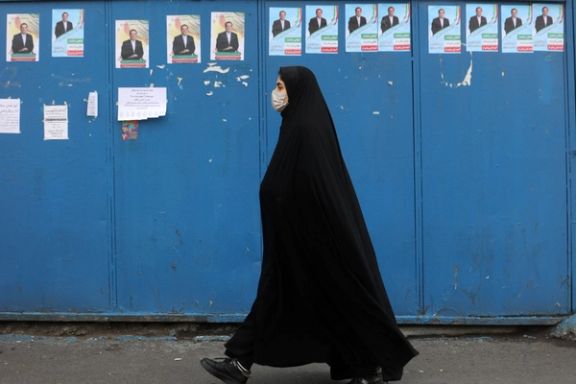
An Iranian woman walks past campaign posters for the parliamentary election in Tehran, Iran, February 27, 2024.

The March 1 parliamentary election in Iran has effectively ended as two leading ultraconservative groups reached an agreement to share the list of 30 candidates for Tehran.

The hardliner Paydari party, currently the strongest in parliament (Majles) and the Speaker Mohammad Bagher Ghalibaf concluded the deal on Sunday, after most Reformists and moderates were banned from running in the elections.

This agreement signifies that the current composition of the Majles will persist for another four years regardless of the exact election outcome. Media reports revealed that Ghalibaf, leader of the Paydari party Sadeq Mahsuli, Tehran's Mayor Alireza Zakani, and former Majles Speaker Gholam-Ali Haddad Adel were involved in the deal, effectively ending over a year of factional infighting among Iran's conservatives.

The presence of Haddad Adel, an insider in Ali Khamenei's inner circle and his relative, also suggests that probably the Supreme Leader intervened at the last moment to save another relative, Ghalibaf remain a leader in the Majles. Nonetheless, other reports also said that Ghalibaf has bribed Paydari to keep his position.

An Iranian man walks past campaign posters for the parliamentary election in Tehran, Iran, February 27, 2024.
100%
An Iranian man walks past campaign posters for the parliamentary election in Tehran, Iran, February 27, 2024.

According to Khabar Online, the outcome of the deal was predictable. Mahsouli had previously stated that any agreement with Ghalibaf would result in the shared list for Tehran having two leaders: Ghalibaf and Morteza Agha Tehrani, the former secretary-general of Paydari. This arrangement materialized immediately after the agreement was reached on Sunday evening. However, the hardliner Paydari is known for breaking deals in the last moment and Ghalibaf should keep his fingers crossed.

Ghalibaf is known as a politician with few allies who have not significantly impacted his status in the Majles. His final list includes his close aide Saeed Ahadian and a few others. Paydari, on the other hand, is described as a pragmatic ultraconservative political group that eliminates its rivals through smear campaigns and focuses on its political interests and gaining influence rather than religious or ideological matters. Entekhab news website in Tehran commented that Paydari “uses religious principles merely as a tool to gain political power. It is pragmatic in its approach and willing to use any means to achieve its goals."

Many Iranians on social media expressed disappointment with this development, as it signifies the continuation of the undesirable status quo and portends a similar scenario in the 2025 presidential elections. They fear that it will ensure the consolidation of ultraconservative government control for several more years.

In addition to the agreed-upon list, there are other lists of candidates for Tehran, each led by a prominent figure. One of these lists is being portrayed by the government as the reformist list, with former lawmaker Ali Motahari as its leading figure. However, Motahari is considered a moderate conservative with hardline views on sensitive issues such as hijab and executions.

The government welcomes Motahari's presence as a critic among the super-revolutionaries at the Majles if he can ever convince voters to vote for him. Meanwhile, by portraying him as a reformer, the government hopes to lure ill-informed reformists to the polls in the absence of real reformist candidates.

Another list is presented by populist propagandist Ali Akbar Raefipour, featuring Saeed Mohammad as its prominent figure, a former high-ranking IRGC officer. The third list is led by former Foreign Minister Manouchehr Mottaki, with Laleh Eftekhari, a lesser-known former MP, accompanying him.

The real competition seems to be unfolding in Iranian cities, where candidates are going to great lengths to campaign. Tactics include offering free food, hosting concerts, organizing shows to discredit rivals, and enlisting eulogists to chant slogans in their favor.

One candidate even brought out a likeness of the hidden Shiite Imam to campaign, while another delivered a speech in English to showcase skills.

Clerics have been distributing campaign posters featuring them in clerical robes for downtown Tehran and in suits for affluent areas like Shemiran. With such varied approaches, ultraconservative voters have a wide array of choices in this election.


Most Viewed

Ideology may be fading in Iran, but not in Kashmir's ‘Mini Iran'
1
INSIGHT

Ideology may be fading in Iran, but not in Kashmir's ‘Mini Iran'

2
INSIGHT

Hardliners push Hormuz ‘red line’ as US blockade tests Iran’s leverage

3
VOICES FROM IRAN

Hope and anger in Iran as fragile ceasefire persists

4

Iran International says it won’t be silenced after London arson attack

5

US sanctions oil network tied to Iranian tycoon Shamkhani

Banner
Banner

Spotlight

  • Hardliners push Hormuz ‘red line’ as US blockade tests Iran’s leverage
    INSIGHT

    Hardliners push Hormuz ‘red line’ as US blockade tests Iran’s leverage

  • Ideology may be fading in Iran, but not in Kashmir's ‘Mini Iran'
    INSIGHT

    Ideology may be fading in Iran, but not in Kashmir's ‘Mini Iran'

  • War damage amounts to $3,000 per Iranian, with blockade set to add to losses
    INSIGHT

    War damage amounts to $3,000 per Iranian, with blockade set to add to losses

  • Why the $100 billion Hormuz toll revenue is a myth
    ANALYSIS

    Why the $100 billion Hormuz toll revenue is a myth

  • US blockade targets Iran oil boom amid regional disruption
    ANALYSIS

    US blockade targets Iran oil boom amid regional disruption

  • Iran's digital economy battered by prolonged blackout
    INSIGHT

    Iran's digital economy battered by prolonged blackout

Tweet unavailable

•
•
•

More Stories

Iranian Rapper Demands Judicial Sentence Amid Torture Allegations

Feb 27, 2024, 17:54 GMT+0

Saman Yasin (Seydi), an Iranian rapper arbitrarily imprisoned for 18 months, has demanded his judicial sentence in a letter addressed to the head of the Judiciary.

In his letter from Ghezel Hesar Prison in Karaj, published on Instagram, he wrote, "For 18 months, I have been imprisoned without any evidence or documentation, and during this time, court sessions have been scheduled for me numerous times but have not been held."

Arrested during the 2022 Women, Life, Freedom uprising, Yasin was originally sentenced to death before the Supreme Court overturned the ruling.

In the letter, Yasin disclosed enduring "mental, emotional, and physical problems" in prison, exacerbated by authorities' refusal to provide medical assistance. His plight is part of a larger pattern among political prisoners, who have spoken out against torture tactics, including the administration of unidentified pills and injections.

Previously, Yasin was subjected to further torture when detained in a mental hospital on the orders of a judge. Punished for smuggling an audio file from prison, Yasin described experiences of being tied to a bed and physically assaulted by security forces.

He said his tormentors sought a false confession regarding possession and use of firearms during the prior year's protests.


Iran Warns Of Crackdowns On Online Dissent On Eve Of Elections

Feb 27, 2024, 14:07 GMT+0

Iran's Cyber-Police (FATA) Chief has issued a warning regarding online political activities ahead of the upcoming elections amid speculation of the lowest turnout since the establishment of the Islamic Republic in 1979.

Clearly aware of the mass discontent with turnout expected to be as low as 15 percent, Vahid Majid said, "Violations in the virtual sphere are being addressed to preserve the celebratory ambience of the elections from being marred by inaccurate content."

Iran continues to suppress dissent on social media. In the wake of a recent terror attack, more than 70 people were arrested for comments on social media about the incident. 

Political dissent has been massively quashed in the wake of the 2022 uprising, with hundreds of Iranians rounded up for social media activity, reaching to the top levels of society with celebrities, satirists and sports stars punished with social media bans, travel bans, bank freezes and even death sentences for social media activism.

Majid's warnings come amid allegations of corruption of the electoral process, with many provinces only having one option on the ballot.

With the regime fearing the international perception of a mass election boycott on March 1, not least amidst a proxy war in the region fueled by Tehran and ongoing criticism of the country's nuclear program, Mehdi Kouchakzadeh, a candidate in the parliamentary elections, said, "If the level of participation drops slightly, the enemies might conclude that nobody supports the government".

His statement comes as over 275 political, social, and cultural activists have collectively announced their decision to boycott the forthcoming elections. Citing concerns over electoral manipulation and the erosion of public governance rights, the activists advocate for electoral reforms to ensure genuine participation and representation.

The announcement of the boycott reflects a broader trend of disillusionment and discontent within Iranian society. Recent years have witnessed a decline in voter turnout attributed to economic challenges, political suppression, and dissatisfaction with the electoral process. Economic hardships, soaring inflation rates, and social unrest stemming from past protests have further exacerbated public frustration.

The severe repression of the protests in 2022, increased surveillance, fueled by the enforcement of hijab laws and internet censorship by authoritarian figures, has also worsened public dissatisfaction.

Iran's GDP Growth Slows Despite Government Spending And Oil Support

Feb 27, 2024, 12:24 GMT+0
•
Dalga Khatinoglu

Data from the Statistical Center of Iran shows that the country’s GDP growth has been slowing, while remaining growth is fueled by higher government spending and more oil production.

According to the Statistical Center’s data, released on February 24, Iran’s GDP growth stood at 5.1 percent in autumn (4Q2023).

This is the second consecutive quarter that the country’s GDP growth slows, while some sectors like agriculture as well as energy (electricity, gas, and water) have even shrunk.

Iran. GDP growth, Oil, Agriculture Gas, electricity, power, Services, Non-oil GDP
100%
Source: Iran’s Statistic Center (%)

However, oil sector experienced a 21.8 percent growth, thanks to increasing shipments to China. OPEC’s data show Iran’s oil production has increased from below 2.7 mb/d in autumn 2022 to 3.16 mb/d in the same period in 2023, but the growth has stopped since November. Therefore, oil production is not expected to remain a major driving force for economic growth in 2024.

Iran was producing 3.8 mb/d and exporting 2.5 mb/d of oil before the United States pulled out of the JCPOA nuclear deal and imposed sanctions in 2018.

Iran's daily oil production export
100%
Source: OPEC, Kpler (mb/d)

The Statistical Center data shows that GDP growth was 7.9 percent in spring 2023, declined to 7.1 in summer and stood at 5.1 percent in the last quarter.

It is important to note that international organizations have estimated somewhat lower numbers for Iran’s GDP growth. According to the International Monetary Fund, Iran had 3 percent GDP growth in 2023 fiscal year, expected to decrease to 2.5 percent in 2024 and plunge to 2 percent in 2025.

Share of sectors in Iran economy GDP
100%
Source: Iran’s Statistic Center

The most important issue in the data is the lion share of the unbridled general government spending in GDP growth.

The general government final consumption expenditure value, based on 2011 fix prices, increased by 16.7 percent during autumn 2023, compared to the same season in 2022.

Meanwhile, the private sector expenditure increased only 3.1 percent, while the gross fixed capital formation (GFCF) grew by 3.4 percent in the mentioned period.

Therefore, the current 5.1 percent GDP growth has been driven mostly by government consumption expenditure growth rather than improvement in private sector or GFCF.

To put it in simple terms, current GDP growth is not based on industrial or employment expansion and does little to alleviate economic pressure on a population that has increasingly lost its purchasing power since 2018. With a persistent 40-percent and higher annual inflation rate for the past five years, millions of people have sunk into near poverty.

The main reason for higher government spending has been the steady devaluation of Iran’s currency, rial, and the ensuing higher inflation. The higher spending is not a sign of more investments or welfare appropriations, but a sign of the government printing more money and inflating its spending numbers.

The reliance of GDP growth on the oil sector and higher government inflation-related spending is clearly seen in the deterioration of people's living conditions. Even regime officials have been sounding the alarm about growing poverty and many loyalist conservatives have been blaming the government of President Ebrahim Raisi, although continuing US sanctions is related to Iran’s foreign policy decided by Supreme Leader Ali Khamenei.

Taliban Trade Delegation Announces $35m Investment In Iran

Feb 27, 2024, 10:45 GMT+0

An Afghan trade delegation has announced construction and investment deals worth $35m in Iran's southern port of Chabahar.

Hassan Kazemi Qomi, Iran's ambassador in Afghanistan, said that the delegation has commenced work on “various projects including commercial, residential, and administrative ventures, backed by a $35 million investment.”

The move comes against the backdrop of Iran's recent measures towards Afghan refugees, including reported widespread expulsions with speculation that the latest move will see many of the illegal workers put through a formal system.

Amid ongoing border tensions, Afghans were in December, banned from living in 16 Iranian provinces.

The influx of Afghan workers, particularly in the construction sector, has faced criticism within Iran, facing allegations of taking jobs away from Iranians amid a deep economic crisis.

Iranian officials have estimated the number of authorized foreign nationals in Iran to be approximately four million, with a significant portion presumed to be refugees.

Since the resurgence of the Taliban in Afghanistan in 2021, Iran has refrained from formally recognizing the Taliban government. Nevertheless, Iran has engaged closely with the Taliban and facilitated interactions such as trade and commerce deals.

Afghanistan's embassy in Tehran has been handed over to representatives of the Taliban.


Iran Denounces UN Investigation, Drawing Parallel With Gaza

Feb 27, 2024, 07:01 GMT+0
•
Maryam Sinaiee

The United Nations’ fact-finding mission, set up in December 2022 following Iran's bloody crackdown on protesters, will release its comprehensive report on March 18.

The mission is also scheduled to release its preliminary report on the International Day of Women (March 8).

In his address to the 55th session of the United Nations Human Rights Council (HRC) in Geneva on Monday, Iran's Foreign Minister Hossein Amir-Abdollahian accused the UN of double standards and criticized it for setting up the fact-finding mission for Iran but not taking any serious action on Israel’s killing of civilians in Gaza.

“We will not forget the outcries in this place months ago under the pretext of an Iranian girl’s death and the formation of a so-called fact-finding mission,” he said.

In her address to the same meeting Monday, the German Foreign Minister Anna Baerbock called for extending the mission’s mandate. “I want to be crystal-clear to those who claim that calling out violations is an interference in internal affairs: Human rights are universal. A life is a life,” she said.

Mahmoud Amiri-Moghadam, director of Oslo-based Iran Human Rights Organization, told Iran International on Monday that it is the outcome of the mission’s investigations that is of great significance and expressed hope that its mandate would be extended for another year.

“The Islamic Republic has always accused human rights organizations and the UN rights bodies of being politically motivated and has never been accountable to them, he said. “But the mission’s report will be a very important message to [Iranian] people who will know the world has heard them …, especially if the mission concludes that [the regime’s actions] were crimes against humanity,” he added.

The UN Human Rights Council voted November 24, 2022, to launch an independent investigation into Iran's deadly repression of peaceful anti-government protests during the Woman, Life, Freedom movement. The motion to form the mission passed with 25 votes in favor, six opposed and 16 countries abstaining from the vote. The following month, members of the mission were announced.

The death of 22-year-old Mahsa Amini in September 2022 in the custody of the morality police unleashed a wave of protests across Iran that lasted until February 2023.

During the protests, security forces killed more than 550 civilians including tens of children. Security forces also blinded scores of protesters with shotgun pellet aimed directly at their faces, and tortured many of the tens of thousands of protesters that were arrested. Many of the victims also claim to have been sexually assaulted during interrogations and in prison.

In the past year Iran has also hanged nine protesters despite widespread pleas at home and abroad not to carry out the death sentences after sham trials held behind closed doors and without due process.

Despite these documented atrocities, Tehran almost immediately announced that it did not recognize the fact-finding mission and would not cooperate with it and summoned the German envoy Hans-Udo Muzel to the foreign ministry to protest Berlin’s key role in urging a special Human Rights Council meeting and the formation of the mission.

The UN Special Rapporteur on Iran Javaid Rehman said in November 2023 that the mandate of the mission goes beyond Iran’s human rights violations during 2022 protest crackdown and even extends into the mass execution of political prisoners in 1980s as well as violations of minority rights.

Members of the mission have not been allowed to visit Iran to collect evidence and speak to victims of the violence or their families. The Islamic Republic has also refused to allow UN special rapporteurs on human rights to visit the country since 1992.





