• العربية
  • فارسی
Brand
  • Iran Insight
  • Politics
  • Economy
  • Analysis
  • Special Report
  • Opinion
  • Podcast
  • Iran Insight
  • Politics
  • Economy
  • Analysis
  • Special Report
  • Opinion
  • Podcast
  • Theme
  • Language
    • العربية
    • فارسی
  • Iran Insight
  • Politics
  • Economy
  • Analysis
  • Special Report
  • Opinion
  • Podcast
All rights reserved for Volant Media UK Limited
volant media logo

Families Of Iran's 1988 Massacre Victims Barred From Cemetery

Feb 25, 2024, 10:54 GMT+0
Supporters of the National Council of Resistance of Iran (NCRI) gather to protest against the government in Teheran and the use of the death penalty in Iran, in front of the Brandenburg Gate in Berlin, Germany, July 10, 2021.

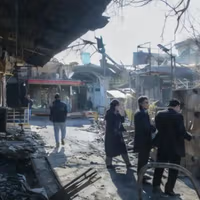
Families of the victims of Iran's 1988 massacre were barred by security forces from entering Tehran's Khavaran Cemetery, leaving them stranded outside locked gates for hours amid ongoing suppression of political dissent.

Mansoureh Behkish, a prominent human rights activist and member of the Mothers of Khavaran group, took to social media to lament the situation, describing how families were left stranded and then returning home with "bleeding hearts and fresh wounds.".

Authorities reportedly demanded families show their national identification cards for entry, a requirement opposed by the families.

The executions were part of a mass crackdown on political prisoners following a fatwa issued by Iran's then-supreme leader, Ruhollah Khomeini, targeting the Mujahedin-e Khalq (MEK), which had engaged in a series of bombings in Iran and aligned itself with Saddam Hussein during the 1980-88 war.

While the exact number of executed prisoners remains unknown, Amnesty International estimates that around 5,000 prisoners were "forcibly disappeared" and "extrajudicially executed" between July and September 1988.

The majority of individuals affected were affiliated with the MEK, though there were also connections to leftist and secular factions such as the Fadaiyan Khalq Organization (FKO) and Tudeh Party. Additionally, members of Kurdish groups, including Komala and the Kurdish Democratic Party of Iran, were among the victims.

This latest incident adds to a series of concerns regarding the treatment of those executed in 1988, with previous reports highlighting efforts by the Islamic Republic to destroy gravesites of the prisoners during that period.


Most Viewed

Ghalibaf defends Iran-US talks amid hardline backlash
1
INSIGHT

Ghalibaf defends Iran-US talks amid hardline backlash

2
ANALYSIS

From instability to influence: Pakistan’s pivotal role in US-Iran diplomacy

3
ANALYSIS

100 days on: why Iran’s January protests spread across social classes

4

War-hit homeowners feel abandoned as Iran’s reconstruction aid fades

5

Iran says no decision yet on talks as Pakistan prepares to host US team

Banner
Banner

Spotlight

  • Iran diplomacy wobbles as factions compete to avoid looking soft on US
    INSIGHT

    Iran diplomacy wobbles as factions compete to avoid looking soft on US

  • The politics of pink: how Iran uses cuteness to rebrand violence
    ANALYSIS

    The politics of pink: how Iran uses cuteness to rebrand violence

  • Bread shortages, soaring prices strain households in Iran, residents say
    VOICES FROM IRAN

    Bread shortages, soaring prices strain households in Iran, residents say

  • 100 days on: the anatomy of Iran’s January crackdown
    INSIGHT

    100 days on: the anatomy of Iran’s January crackdown

  • Ghalibaf defends Iran-US talks amid hardline backlash
    INSIGHT

    Ghalibaf defends Iran-US talks amid hardline backlash

  • From instability to influence: Pakistan’s pivotal role in US-Iran diplomacy
    ANALYSIS

    From instability to influence: Pakistan’s pivotal role in US-Iran diplomacy

•
•
•

More Stories

Pakistani Sunni Militant Arrested In Southern Iran

Feb 25, 2024, 08:51 GMT+0

A leader of the Pakistani Sunni militant group Lashkar-e-Jhangvi (LeJ) has been arrested in southern Iran on charges of involvement in an anti-Shia terror group and attending bomb-making training courses in Pakistan.

Akram Lahori was planning to travel to Sunni majority Qeshm Island, as reported by state media. Lahori, also known as Muhammad Ajmal, was granted bail by a Pakistani anti-terrorism court in October last year, implicated in a 27-year-old murder case involving renowned poet Mohsin Naqvi.

The arrest comes as last month, Iran and Pakistan engaged in mutual strikes targeting what they termed "terrorist" groups in border regions. The Islamic Revolutionary Guard Corps (IRGC) targeted Jaish al-Adl's locations in Pakistan's Balochistan province, while Pakistan retaliated by bombing hideouts of armed Baloch separatists in Iran's Sistan-Baluchestan province. The strikes led to a rapid deterioration in diplomatic relations between Islamabad and Tehran, with both countries withdrawing ambassadors and severing official ties amid heightened rhetoric.

The LeJ is notorious for its anti-Shia stance and affiliations with groups such as Jaish-e-Mohammad and al-Qaeda. It also advocates for the destruction of Christianity, Hinduism, and Judaism. The group gained notoriety with the 1997 attack on the Iranian Centre in Multan, resulting in the deaths of an Iranian and two dozen others. Since then, LeJ has carried out numerous suicide bombings, armed assaults, and kidnappings targeting Shia communities.

It was designated as a Foreign Terrorist Organization by the US State Department in 2001 and listed by the UN as a terror organization in 2003.

US And UK Launch Extensive Strikes Against Iran-Backed Houthis

Feb 25, 2024, 08:15 GMT+0

US and British forces carried out strikes against more than a dozen Houthi targets in Yemen on Saturday, the latest round of military action against the Iran-backed group attacking shipping in the region.

The United States has carried out near daily strikes against the Houthis, who control the most populous parts of Yemen and have said their attacks on shipping are in solidarity with Palestinians as Israel strikes Gaza.

The Houthis began their attacks in mid-November after Iran’s Supreme Leader Ali Khamenei urged Muslim nations to blockade Israel. Initially they claimed to be targeting vessels bound for Israeli ports but after weeks of drone and missile attacks it appears that Houthis fire at any ship they can.

The strikes have so far failed to halt the Houthis' missile and drone attacks, which have upset global trade and raised shipping rates.

A joint statement from countries that either took part in the strikes or provided support, said the military action was against 18 Houthi targets across eight locations in Yemen including underground weapons and missile storage facilities, air defense systems, radars and a helicopter.

US Defense Secretary Lloyd Austin said the strikes were meant "to further disrupt and degrade the capabilities of the Iranian-backed Houthi militia."

"We will continue to make clear to the Houthis that they will bear the consequences if they do not stop their illegal attacks, which harm Middle Eastern economies, cause environmental damage and disrupt the delivery of humanitarian aid to Yemen and other countries," Austin said.

The strikes were supported by Australia, Bahrain, Canada, Denmark, the Netherlands and New Zealand.

Al Masirah TV, the main television news outlet run by the Houthi movement, said on Saturday that US and UK forces carried out a series of strikes in the capital, Sanaa.

It quoted an unnamed Houthi military source as saying the renewed raids were "a miserable attempt to prevent Yemen from providing support operations to the Palestinian people in Gaza."

Earlier this week the Houthis claimed responsibility for an attack on a UK-owned cargo ship and a drone assault on a US destroyer, and they targeted Israel's port and resort city of Eilat with ballistic missiles and drones.

The group's strikes are disrupting the vital Suez Canal shortcut that accounts for about 12 percent of global maritime traffic, forcing a longer, more expensive route around Africa.

No ships have been sunk nor crew killed during the Houthi campaign. However, there are concerns about the fate of the UK-registered Rubymar cargo vessel, which was struck on February 18 and its crew evacuated. The US military has said the Rubymar was carrying more than 41,000 tons of fertilizer when it was hit, which could spill into the Red Sea and cause an environmental disaster.

The European Union has launched a naval mission to the Red Sea "to restore and safeguard freedom of navigation".

The United States has a parallel coalition, Operation Prosperity Guardian, aimed at safeguarding commercial traffic in from attacks by the Houthis.

With reporting by Reuters

Iran Election Poses Threats to Security Due To Unfairness: Study

Feb 25, 2024, 04:17 GMT+0
•
Iran International Newsroom

A study published in the Iranian government-owned National Security Monitor suggests that the upcoming elections present both threats and potential benefits for the regime's survival.

Authored by Farzad Poursaeed and originally titled "Elections and National Security in the Islamic Republic," the study was re-published by the Iranian official news agency (IRNA) under the headline: "National security and the double-edged sword of elections."

According to IRNA, most of the threats associated with the upcoming elections stem from the country's political structure.

The study, employing careful language due to government restrictions, suggests that while free and fair elections could enhance national security by ensuring comprehensive representation and peaceful resolution of people's demands, previous elections have often led to periods of street unrest in Iran over the past decade.

Additionally, the study highlights the lack of political parties in Iran as a major source of instability, posing a significant threat to the regime.

Furthermore, the study emphasizes that well-conducted elections can confer legitimacy on the regime by enabling the appointment of competent officials while removing inefficient and corrupt individuals. Criticism of inefficiency and corruption within the government has been voiced by many insiders in recent years.

Moreover, the study asserts that good elections foster solidarity between the people and the government. However, it fails to acknowledge widespread commentary in the Iranian media about the growing gap between citizens and the government, exacerbated by the government's failure to address demands following the 2022 nationwide protests.

Economist Hossein Raghfar  (undated)
100%
Economist Hossein Raghfar

Recent observations suggest that this gap is a primary factor contributing to declining voter turnout in Iranian elections. Additionally, the study notes that political instability resulting from the exclusion of certain political factions from the electoral process is a fundamental flaw in Iran's election system, leading to short-lived and sporadic political party activities.

Meanwhile, prominent Iranian economist Hossein Raghfar said in an interview with Rouydad24 that the prevailing dissatisfaction in the Iranian society is a product of the system of governance in Iran. Raghfar accused infiltrators and profiteers within the Iranian government of exacerbating social problems through illogical policies, resulting in unemployment, recession, inflation, poverty, and inequality. He warns that these conditions will inevitably lead to social unrest.

In the meantime, the government remains unresponsive even to prominent regime insiders such as former president Hassan Rouhani. On Thursday, the former president wrote his 3rd letter to the Guardian Council calling on the ultraconservatives in charge to explain why they have disqualified him from running in the next round of the Assembly of Experts elections on Friday. The only answer he got was that the Council only responds to complaints and Rouhani's letters were not categorized as such.

In another development, the liberal National Front of Iran announced on the same day that it will not take part in the March 1 election, calling it "unreal" and "unhealthy". Announcing the boycott, the National Front said that free political parties, freedom of assembly, freedom of press and media, do not exist in the Islamic Republic and citizens cannot vote for the candidates of their choosing.

While the media remains under government censorship, hundreds of dissidents are either in prison or face indictments. Most Reformist and relatively moderate candidates have been barred from competing in these elections.

Ex-Official: Rouhani’s Election Disqualification Politically Motivated

Feb 24, 2024, 23:57 GMT+0

A reformist politician has said the decision to bar former president Hassan Rouhani from running for re-election at the Assembly of Experts was politically motivated.

The decision to disqualify Rouhani was the result of a coordinated attempt, said Mohammad Ali Abtahi, a senior aide to former president Mohammad Khatami, in an interview with ILNA news website in Tehran on Saturday.

Abtahi hailed the former president as “a veteran administrator,” further adding that he could play a significant role at the Assembly of Experts at times of crisis.

Rouhani was the strongest actor “within the framework of succession issues,” Abtahi stated vaguely in reference to the constitutional role of the Assembly of Experts to choose a successor to Iran’s 84-year-old Supreme Leader Ali Khamenei. His ambiguous statement failed to elucidate whether Rouhani could himself be considered as a successor to Khamenei or could exert his influence to elect the next leader.

The Guardian Council announced Rouhani’s disqualification on January 24th. Since then, the former president has appealed three times to the Guardian Council to demand the reasons behind this decision.

Earlier in November, Rouhani for the first time discussed possible arrangements to handle the situation after Khamenei's death.

Using the mildest language to evade Khamenei’s and his hardliner supporters' anger, he said, "May the Supreme Leader live long, but as the time passes, the day we would never want to come is more likely to arrive and the Assembly of Experts has to decide on the naming of the next Supreme Leader."

Many contend that the move to bar Rouhani was a deliberate attempt on the part of the hardliners to secure an easy and smooth transition of power to their preferred leadership candidate.

Iranian Films Awarded At Berlin International Film Festival

Feb 24, 2024, 21:41 GMT+0

Two Iranian films have been awarded prizes at the 74th Berlin International Film Festival (Berlinale) with one of them secretly made focusing on the topic of hijab.

The movie "My Favorite Cake," crafted by Iranian directors Behtash Sanaeeha and Maryam Moqadam, has been honored with the prestigious International Federation of Film Critics (FIPRESCI) award.

Despite encountering travel restrictions, Moqadam and Sanaeeha's second collaboration at the Berlinale captivated audiences and critics alike, earning recognition for its portrayal of contemporary Iranian life and defiance of mandatory hijab.

It depicts the everyday lives of Iranians free from governmental censorship, portraying scenes that were previously considered cinematic taboos, such as men and women shaking hands, touching, embracing, and consuming wine.

In a statement issued on Saturday, Moqadam and Sanaeeha expressed their gratitude for the accolade, lamenting their absence during the ceremony due to travel constraints. Actress Leili Farhadpour, representing the filmmakers, delivered their sentiments during the FIPRESCI award presentation.

Simultaneously, "Shahid," directed by Narges Kalhor, claimed the Forum section award, marking a historic moment as the first Iranian film to win the distinction since its introduction in 1986. "Shahid" delves into dark comedy, drawing from Kalhor's personal narrative as she confronts bureaucratic hurdles in Germany while seeking to shed the title "Shahid" from her family name.

Exploring themes of women's rights within a patriarchal religious society, both "My Favorite Cake" and "Shahid" illuminate the complexities of Iranian existence, resonating with international audiences at the Berlin International Film Festival.