• العربية
  • فارسی
Brand
  • Iran Insight
  • Politics
  • Economy
  • Analysis
  • Special Report
  • Opinion
  • Podcast
  • Iran Insight
  • Politics
  • Economy
  • Analysis
  • Special Report
  • Opinion
  • Podcast
  • Theme
  • Language
    • العربية
    • فارسی
  • Iran Insight
  • Politics
  • Economy
  • Analysis
  • Special Report
  • Opinion
  • Podcast
All rights reserved for Volant Media UK Limited
volant media logo

Iran’s Supreme Leader Must Return His Medals Over Doping
Iran International Newsroom
Feb 23, 2024, 16:51 GMT+0Updated: 11:01 GMT+0
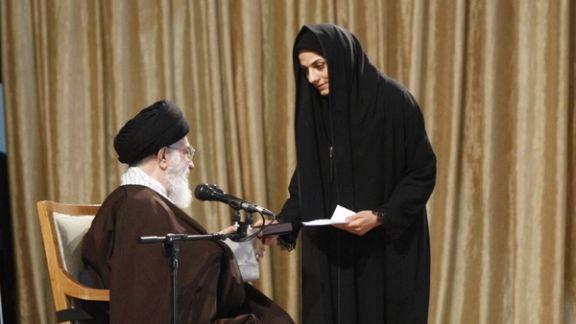
Iranian Wushu champion Maryam Hashemi giving her medal to Supreme Leader Ali Khamenei

An Iranian Wushu champion who had previously presented all her medals to the Supreme Leader has been busted for doping, with the international federation ordering her to return the medals. 

Maryam Hashemi, a proud member of the Revolutionary Guards (IRGC) in the Kurdish majority city of Kermanshah, had dedicated her world championship gold medal to Ali Khamenei in 2019 and in return received his Keffiyeh, a symbol of allegiance with Iran’s ruler. 

"The first time I dedicated my medal to the Supreme Leader, I made a vow to myself that I will present every valuable medal I earn to him," she said in 2019. In total she had given five medals from international events to Khamenei and met with him at least seven times.

The first time she gave her medal to Khamenei was in 2013, when she made headlines for her unconventional behavior during a meeting with the country's most senior figure. Without saying anything, she got up and walked over to the Supreme Leader and handed him her medal, against set protocols. 

In spite of the shame, Hashemi, who was given a four-year ban from all athletic competitions after she was found guilty of doping the anabolic steroid nandrolone in the 2019 championship in China, has now resurfaced after her ban expired in October and is looking for sponsors for her city’s team. 

Maryam Hashemi's doping test result  (file)
100%
Maryam Hashemi's doping test result

Shahrbanou Mansourian, another Iranian wushu champion, was hit with a 28-month ban from participating in any domestic and international competitions only for blowing the whistle on Hashemi’s doping and complaining that she had been fast-tracked through the national team qualifiers and picked up for the squad unfairly. “Hashemi was defeated in three qualifying contests in front of an audience of 2,000. However, they still chose her for the world competitions,” she said. 

The martial artist, who consistently maintained her allegiance to the Islamic Republic principles including advertisement for wearing hijab, is just another example that athletes who are on the side of the regime play by a different set of rules amid an ingrained culture of cheating. 

A well-known case is Hossein Rezazadeh, an Olympic champion and World Weightlifting champion who has been selected as the Iran Sportsperson of the Year award four times, more than any other athlete in the country's history. He has been found guilty of doping several times but unfettered to his career as he used to climb on the podium with a framed photo of Khamenei numerous times. "Our (Muslim) religion forbids doping," he famously said.

When he was at the helm of Iran’s weightlifting national team, the country’s squad was mired with cases of doping allegations. In December 2009, Iran’s weightlifting federation permanently banned Rezazadeh and the national team's technical staff from any professional activity in the field due to systematic doping for national athletes. A few days later, he was appointed as the head of the federation. 

Iran’s ruler Ali Khamenei kissing weightlifting champion Hossein Rezazadeh (undated)
100%
Iran’s ruler Ali Khamenei kissing weightlifting champion Hossein Rezazadeh

The undue influence the Islamic Republic exerts over athletes has been aggravating the dichotomy of those with and against the regime in Iran, where several athletes face suspensions and legal actions for simply criticizing the authorities. The schism between the popular athletes who have chosen to be on the side of people and the ones who have been vocal supporters of the regime has especially been deepening since the 2022 protests. A large number of athletes at different levels have been persecuted for expressing solidarity with the nationwide protests following the death of Mahsa Amini in police custody in September 2022. Several of these have since been forced into exile in sports from chess to football.

Amidst growing tensions between the government and the populace, football, the most popular sport in the world, has morphed into a battleground for ideological conflict. A special predicament is the support for the Iranian football (soccer) team, whose members met with President Ebrahim Raisi just before leaving for Qatar for the World Cup in 2022. Later it was revealed that the players were given permits to import foreign cars without paying taxes. In spite of this, they refused to sing the national anthem at the games in Doha, causing mass outrage in Tehran for the rebellion. In their following match, they sang the anthem.

A growing number of Iranian athletes have been defecting from the Iranian squad to represent other countries in international competitions. Around 30 Iranian athletes have defected in recent years, seeking asylum in other countries while the trend is gaining momentum following the 2022 protests. In addition to dress code restrictions, another issue forcing Iranian athletes to defect is Tehran’s policy of not allowing them to compete against Israelis.



Most Viewed

Iran International says it won’t be silenced after London arson attack
1

Iran International says it won’t be silenced after London arson attack

2
VOICES FROM IRAN

Hope and anger in Iran as fragile ceasefire persists

3

Iran halts petrochemical exports to supply domestic market

4
INSIGHT

How Tehran bends its own red lines to boost state rallies

5

US arrests Iranian national over alleged Basij-linked visa fraud

Banner
Banner

Spotlight

  • Hardliners push Hormuz ‘red line’ as US blockade tests Iran’s leverage
    INSIGHT

    Hardliners push Hormuz ‘red line’ as US blockade tests Iran’s leverage

  • Ideology may be fading in Iran, but not in Kashmir's ‘Mini Iran'
    INSIGHT

    Ideology may be fading in Iran, but not in Kashmir's ‘Mini Iran'

  • War damage amounts to $3,000 per Iranian, with blockade set to add to losses
    INSIGHT

    War damage amounts to $3,000 per Iranian, with blockade set to add to losses

  • Why the $100 billion Hormuz toll revenue is a myth
    ANALYSIS

    Why the $100 billion Hormuz toll revenue is a myth

  • US blockade targets Iran oil boom amid regional disruption
    ANALYSIS

    US blockade targets Iran oil boom amid regional disruption

  • Iran's digital economy battered by prolonged blackout
    INSIGHT

    Iran's digital economy battered by prolonged blackout

•
•
•

More Stories

White House Accuses House Speaker Of Helping Iran By Denying Ukraine Aid

Feb 23, 2024, 16:49 GMT+0

The White House escalated its criticism of Republican US House Speaker Mike Johnson on Friday, accusing him of benefiting Iran and Russia by not putting a national security bill that gives aid to Ukraine up for a vote.

Iran has provided Russia with a large number of powerful surface-to-surface ballistic missiles, six sources told Reuters this week, deepening the military cooperation between the two US-sanctioned countries.

Iran is "actively enabling Russia's war in Ukraine and its attacks against Ukrainian cities," deputy press secretary and senior communications adviser Andrew Bates said in a memo viewed by Reuters that will be distributed publicly Friday.

"President Biden is standing up to Iran. But where is Speaker Johnson's supposed commitment not to 'appease Iran' in all this? Nowhere. Instead, his inaction is benefiting Putin and the Ayatollah," the memo says.

Russian President Vladimir Putin (left), Iran’s Supreme Leader Ali Khamenei (center) and President Ebrahim Raisi in Tehran on July 19, 2022
100%
Russian President Vladimir Putin (left), Iran’s Supreme Leader Ali Khamenei (center) and President Ebrahim Raisi in Tehran on July 19, 2022

Top Biden administration officials spent last weekend in Europe trying to soothe jitters over the prospect of US military aid to Ukraine ending, assuring counterparts from Paris, Berlin and Kyiv as the war enters its third year that Washington will somehow come through.

In previous negotiations with Republicans in Congress over the debt ceiling and other spending, the Biden White House has mostly avoided sharp public criticism as it focused on behind-the-scenes negotiation. But it has targeted Johnson frequently, accusing him in a Valentine's Day poem of threatening border security.

The Senate last week approved a $95 billion bill providing assistance for Ukraine, Israel and Taiwan by an overwhelming 70-30 vote, with 22 Republicans joining most Democrats in voting "aye."

Johnson sent the House home for a two-week recess without bringing the measure up for a vote, saying "we're not going to be forced into action by the Senate."

He says any package of international military and humanitarian assistance must also include measures to address security at the US border with Mexico after Republicans blocked a version of the bill that included the biggest overhaul of US immigration policy in decades.

Senate Republicans and Democrats have joined those urging passage of the aid bill. Many believe it would pass the House with bipartisan support if Johnson would allow the chamber to vote.

"Putin has signaled he could attack NATO countries the United States is obligated to defend if he succeeds in Ukraine," the memo warns.

"If House Republicans facilitate Ukraine's defeat, America could face costs infinitely more expensive than the bipartisan investments we need to make in Ukraine's capacity to defend themselves," it reads.

Former President Donald Trump, frontrunner for the Republican presidential nomination and a long-standing critic of the NATO alliance, has in recent weeks threatened to abandon some European allies if they were to be attacked by Russia.

(Reporting by Reuters)


Exiled Prince: Young Iranians Seek Regime Change In Iran

Feb 23, 2024, 14:26 GMT+0

Iran’s exiled prince Reza Pahlavi has said that the new generation of Iranians have given up on reforming the clerical regime and see their future in putting an end to the Islamic Republic.

In an interview with Jewish Journal in late January and published on Thursday, Pahlavi said the new generation is realizing that the root cause of their problems is the Islamic system of government, which cannot be reformed.

Prince Pahlavi, who is a leading figure of opposition to the Islamic Republic, has long maintained that the people of Iran need to decide what form of government should replace the clerical political system in the future, regardless of if they choose monarchy or a republic.

He emphasized on the importance of non-violent methods of struggle against the regime, and insisted that in case of regime change, “80 percent of the government bureaucracy” should continue doing its job.

“I’ve been a student of Gene Sharp and the nonviolent civil disobedience movement, and I know people sometimes say that this regime is merciless. But I say, no. There has to be, at some point, a difference between us and them,” he argued.

The Islamic Republic has intensified its repression since 2017 and specially after the 2022-23 nationwide protests, killing more than 2,000 protesters in 2019 and in the latest round of street demonstrations.

In his interview, Pahlavi also said that if one day he returns to Iran, he will first visit the poorest and most underprivileged regions, such as the southeastern Sistan-Baluchistan province.

Iran Watches As Caspian States Boost Oil, Gas Production

Feb 23, 2024, 13:02 GMT+0
•
Dalga Khatinoglu

Iran is the only littoral state in the Caspian Sea that does not extract oil or gas, unlike Russia, Azerbaijan, and others, which have invested over $160 billion in Caspian fields.

All littoral states, except Iran, are aiming to increase oil and gas production from these fields in 2024. They collectively produced over 1.2 million barrels per day of oil and 50 billion cubic meters per year of gas from these fields in 2023.

BP’s vice president for the Middle East and Caspian communications and external affairs told Iran International that it plans to drill 24 wells in the Azerbaijani section of Caspian Sea in 2024, with one already nearing completion.

Bakhtiyar Aslanbayli added that the BP-led consortium is also preparing to launch a new platform in Azeri-Chirag-Guneshli (ACG) oil block. It also plans to drill a deeper well (4,200 meters) in ACG’s gas layer in late 2024 to start producing the dry gas from this field in the first quarter of 2025.

Iran remains the only Caspian littoral country that does not produce hydrocarbons from the sea. Despite attempts in the past, including seismic research and drilling wells, Iran has faced technical challenges and setbacks. The country's section of the Caspian Sea, with depths of up to 1,000 meters, presents significant technical and financial hurdles for exploration and development.

Southern Caspian Energy Prospects
100%
Southern Caspian Sea energy fields

BP delivered 2 billion cubic meters (bcm) of associated gas from this oil block to Azerbaijan in 2023, but for first time it is preparing to produce dry gas from its deeper layer as well.

BP-led consortiums invested more than $5.1 billion in Azerbaijan’s offshore Shah Deniz gas field and ACG. These fields share more than 95% of the country’s oil and gas production.

French TotalEnergies also inaugurated another offshore gas field, Absheron, for Azerbaijan in July 2023 with initial 1.7 bcm/yr of gas and 12,000 b/d of ultra-light oil, called gas condensate. Azerbaijan’s state-run Socar and TotalEnergies have invested $1 billion in this project and plan to increase investments to quadruple the prodcution level by 2026.

Socar itself drilled 17,000 meters of oil and gas wells in other fields during 2023 as well. Azerbaijan produced 612,000 b/d of oil and 48 bcm of gas in 2023, almost totally from Caspian fields. It has absorbed more than $95 billion foreign investment in its Caspian oil and gas projects during 1996 to 2023.

Ilham Shaban, the director of Baku-based Caspian Oil Research Center told Iran International that Kazakhstan produced 407,000 b/d of oil and 1 bcm of gas from offshore Kashagan field in 2023. Italian Eni, the operator of this field, is preparing to start drilling in offshore Abay block, southwest of Kashagan in 2024.

Eni-led consortium has invested $60 billion in Kashagan, the biggest oil reservoir in Caspian Sea, as of now.

Qatari UCC Holding recently signed an $11 billion contract with Kazakhstan, including the construction of two gas processing plants for Kashagan with a capacity of 3.5 billion cubic meters per year. Additionally, Dragon Oil from the UAE, the only operating company in Turkmenistan’s offshore fields, plans to boost its oil production from Turkmen offshore fields to 100,000 barrels per day by early 2026, having invested around $6 billion in the projects.

Dragon Oil is currently producing 60,000 b/d of oil from Turkmen offshore fields and eyes boosting this volume to 100,000 b/d by early 2026. It has invested about $6 billion in Turkmen offshore oil and gas projects as of now.

In the Russian side of the Caspian, Lukoil has inaugurated Valery Grayfer field in 2023 after operating Korchagin and Filanovsky offshore fields during recent years. It produced about 150,000 bpd of oil in 2023 from Caspian fields and plans to start development of Khazri field in 2024. Lukoil has discovered 11 oil and gas fields in the Russian section of Caspian Sea.

Iran has divided its exploration area in Caspian sea to 46 blocks
100%
Iran has divided its exploration area in Caspian sea to 46 blocks

Iran Still Waits

Iran conducted drillings in its shallow waters during the Soviet era and in 1990s without any result.

Iran has carried out seismic tests in 4000 square kilometers of the Caspian Sea at blocks 6,7,8 and 21 from 2003 to 2005, but the research vessel Pejwak caught fire and burned in 2005 and the exploration operations stopped.

After that Iran started to drill three wells in some blocks by its Amir Kabir drilling rig. However, its crane crashed in 2015 and now it is idle in Iranian waters.

After signing the JCPOA nuclear deal in 2014, Iran initiated negotiations with several international companies for Caspian projects, but no concrete results were achieved. With only 0.5 billion barrels of proven and probable reserves in the Caspian Sea, according to the US Energy Information Administration, Iran's upstream activity in the region remains limited. Despite claims of discovering a gas field in 2012, Iran's exploration and development efforts in the deep waters of the Caspian Sea face substantial challenges without foreign investment and expertise.


Iranian Hackers Threaten 2024 US Elections, Warn Cybersecurity Firms

Feb 23, 2024, 12:48 GMT+0

American cybersecurity company CrowdStrike has issued a warning regarding potential interference by Iranian state-sponsored hackers in the upcoming 2024 US elections.

In its annual report, the renowned cybersecurity firm has predicted that the Islamic Republic, known for its interest in meddling in US political events, may be planning to interfere in the forthcoming elections in the country.

The firm referred to Information Operations by Iran-backed hackers in late October 2020, a few weeks before the last US presidential election, saying that Iranian threat actors conducted varied targeted operations against US entities. “They sent threatening emails to voters, alleging to represent a far-right US political group and directing recipients to vote for a specific candidate.”

According to the report, Iranian threat actors also disseminated a video falsely alleging to show“overseas actors fabricating ballots, implying one particular political party would seek to exploit security vulnerabilities and compromise voting systems.”

The most common malicious activities targeting elections have historically involved information operations including Distributed Denial-of-Service (DDoS) attacks and website defacements — against state and local government entities. This trend is highly likely to continue in 2024.

The report also said that in the second half of 2023, “Iran-nexus adversaries and Middle East hacktivist adversaries were also observed pivoting cyber operations in alignment with kinetic operations stemming from the 2023 Israel-Hamas conflict.”

Although Iranian cyber operations have historically focused on Israel, the number of faketivist personas leveraged against Israeli targets has increased since the onset of the Israel-Hamas conflict.

Earlier in the month, Microsoft also warned that Russia, Iran, and China are likely to plan to influence the upcoming elections in the United States and other countries in 2024.

Iranian Hostage's Daughter Launches Campaign Against Executions

Feb 23, 2024, 11:36 GMT+0

Gazelle Sharmahd, daughter of a dual-nationality prisoner sentenced to death in Iran, has launched a global campaign dubbed "CutTheRope" to protest against the surg in executions in Iran.

Jamshid Sharmahd, a 68-year-old software developer and California resident, was abducted by Iranian agents during a visit to the United Arab Emirates in 2020 and forcibly taken to Iran. In February 2023, the Iranian judiciary sentenced him to death on charges of endangering national security.

Sharmahd, who holds German and Iranian citizenship, was convicted of heading a pro-monarchist group named Tondar accused of a deadly bombing incident that occurred in 2008 at a religious center in Shiraz, killing 14 and injuring 215 more.

Drawing support from a coalition of families of prisoners, human rights activists, and political figures, the movement against capital punishment in Iran has gained traction globally.

Among the prominent supporters of Sharmehd's campaign are Yasmine Pahlavi, wife of Iran’s exiled Prince Reza Pahlavi, as well as Kylie Moore-Gilbert and Nazanin Zaghari-Ratcliffe, two former political prisoners in Iran.

The campaign encourages individuals to share photos or videos of themselves with the hashtag #CutTheRope as a symbol of protest against executions in Iran.

According to Human Rights Activists News Agency, in 2023 alone, at least 791 citizens, including 25 women and two juvenile offenders, were executed -- a 33 percent increase compared to the previous year. Additionally, reports from Amnesty International revealed that from January 2012 to July 2023, over 5,000 individuals, including 57 children, were executed in Iran.

United Nations Secretary-General António Guterres had previously warned the UN General Assembly about the escalating execution rates in Iran, urging immediate action to address the concerning trend.