• العربية
  • فارسی
Brand
  • Iran Insight
  • Politics
  • Economy
  • Analysis
  • Special Report
  • Opinion
  • Podcast
  • Iran Insight
  • Politics
  • Economy
  • Analysis
  • Special Report
  • Opinion
  • Podcast
  • Theme
  • Language
    • العربية
    • فارسی
  • Iran Insight
  • Politics
  • Economy
  • Analysis
  • Special Report
  • Opinion
  • Podcast
All rights reserved for Volant Media UK Limited
volant media logo

Iran Convinced Proxies In Iraq To Stop Attacks, Report Claims
Iran International Newsroom
Feb 18, 2024, 08:33 GMT+0Updated: 11:03 GMT+0
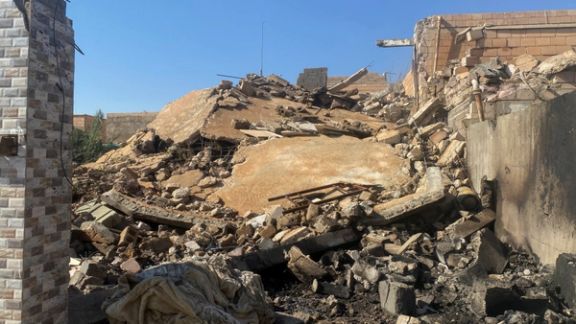
The aftermath of a US retaliatory attack in Iraq. February 2024

A report by Reuters states that the commander of Iran’s Quds Force, Esmail Qaani, traveled to Iraq in late January to convince allied militants to suspend attacks on US forces.

Qaani met with representatives of several Iran-backed groups in Baghdad airport on January 29, one day after a drone launched by the same groups killed three American soldiers at an outpost near the Syria-Jordanian border. The report quotes Iranian and Iraqi militia sources.

Qaani told the militias they should lie low, to avoid US strikes on their senior commanders, destruction of key infrastructure or even a direct retaliation against Iran, the sources said. Iran was also concerned about direct US retaliation against its own military, within the country or in the region, such as Iranian warships lurking near Yemen.

While one faction did not initially agree to Qaani's request, most others did. The next day, elite Iran-backed group Kataib Hezbollah announced it was suspending attacks.

Since February 4 there have been no attacks on US forces in Iraq and Syria, compared to more than 20 in the two weeks before Qaani's visit, part of a surge in violence from the groups in opposition to Israel's war in Gaza.

If this version of events is true, it could explain why Washington hesitated six days before launching military retaliation at bases under the overall command of the Quds Force in Syria and Iraq. During this crucial period, according to reports, many key IRGC and militant personnel vacated bases believed to be likely targets of an American retaliatory strike. Many observers at the time criticized the Biden administration for the delay, while the US has large naval forces in the region ready for action since war broke out between Israel and Hamas.

Qaani (L) and other IRGC commanders with Supreme Leader Ali Khamenei in January 2020
100%
Qaani (L) and other IRGC commanders with Supreme Leader Ali Khamenei in January 2020

However, Qaani’s alleged role in convincing Iran’s proxies in Iraq to suspend attacks, clearly did not extend to Houthis in Yemen, who have continued targeting commercial shipping and even Western navies in the Red Sea region. If Qaani’s argument about the cost of US retaliation dissuaded the militants, no such change of heart has occurred among the Houthi leadership who have come under air strikes but remain adamant to continue attacks against shipping.

Iran’s proxies in Iraq have been used for years as a means of pressure on the United States, with periods of aggression and relative calm, depending on factors such as secret talks or nuclear negotiations with Iran. These attacks intensified in 2019, when the Trump administration implemented “maximum pressure” sanction against Tehran. As militant activity reached a peak in December 2019, Trump ordered the targeted killing of Qasem Soleimani, Iran’s top Middle East military and intelligence operative who had made the Quds Force and its proxy militias into a serious force across the region.

The Iranian regime, meanwhile, has spearheaded a campaign to push the small US military presence out of Syria and Iraq. Its proxy forces use the issue to justify attacks, although their recent attacks have been in support of Hamas.

The Reuters report also argues that the tense situation prevailing up until early February played into the hands of the Iraqi government, which initiated a new push to end the US military presence in the country, which is used by pro-Iran groups to create tensions.

With Iran bracing for a U.S. response to the Jordan attack, Qaani made the visit quick and did not leave the airport, "for strict security reasons and fearing for his safety," the senior Iraqi security source said.

The strike in 2020 that killed former Quds Force leader Qassem Soleimani outside the airport followed an attack Washington also blamed on Kataib Hezbollah that killed a U.S. contractor, and at the time sparked fears of a regional war. Along with Soleimani, the drone killed former Kataib Hezbollah leader Abu Mahdi al-Muhandis.

Both Tehran and Baghdad wanted to avoid a similar escalation this time round, nine sources told Reuters. "The Iranians learned their lesson from the liquidation of Soleimani and did not want this to be repeated," a senior Iraqi security source said.


Most Viewed

State media slam Araghchi's Hormuz tweet, say it let Trump claim victory
1

State media slam Araghchi's Hormuz tweet, say it let Trump claim victory

2
OPINION

The Hormuz get out of jail card turned to a grave

3

Iran International says it won’t be silenced after London arson attack

4
INSIGHT

How Tehran bends its own red lines to boost state rallies

5

Iran halts petrochemical exports to supply domestic market

Banner
Banner

Spotlight

  • Too early to tell who is winning Iran war, experts say
    PODCAST

    Too early to tell who is winning Iran war, experts say

  • How Tehran bends its own red lines to boost state rallies
    INSIGHT

    How Tehran bends its own red lines to boost state rallies

  • Iran blackout cripples freelancer, small business incomes
    VOICES FROM IRAN

    Iran blackout cripples freelancer, small business incomes

  • Ideology may be fading in Iran, but not in Kashmir's ‘Mini Iran'
    INSIGHT

    Ideology may be fading in Iran, but not in Kashmir's ‘Mini Iran'

  • US blockade enters murky phase as tankers spoof signals and buyers hesitate
    ANALYSIS

    US blockade enters murky phase as tankers spoof signals and buyers hesitate

  • Why the $100 billion Hormuz toll revenue is a myth
    ANALYSIS

    Why the $100 billion Hormuz toll revenue is a myth

•
•
•

More Stories

Rifts And Challenges Weaken Religious Reformism In Iran

Feb 17, 2024, 23:20 GMT+0
•
Majid Mohammadi

Two pivotal developments are casting significant doubt on the viability of religious reformist movements in Iran, that have tried to present a more liberal view of Shia Islam.

Firstly, the "Women, Life, Freedom" movement, which operates independently of religious affiliations, renders religious reformism largely irrelevant. Secondly, the impending sham elections scheduled for March 1, have divided reformists on whether to engage or boycott, further undermining their cohesion and leadership.

For over two decades, Abdulkarim Soroush has been a leading advocate for modern interpretations of Shia sacred texts. Meanwhile, as an ex-political prisoner and disciple of the late Hossein Ali Montazeri, Mohsen Kadivar has emerged as a prominent figure in religious traditionalism. Montazeri, once Khomeini's designated successor, was sidelined by the security establishment. Now, Soroush and Kadivar find themselves engaged in a religious and political rivalry, each vying to position themselves as an alternative to secular figures like Prince Reza Pahlavi.

Religious reformist Abdolkarim Soroush. 2021
100%
Religious reformist Abdolkarim Soroush

The dispute between Soroush and Kadivar, stemming from theoretical disagreements over the interpretation of religious texts, has escalated. Kadivar has excommunicated Soroush and Mohammad Mojtahed Shabestari, while Soroush has called for Kadivar’s public repentance. However, amidst these theological debates, many Iranians, particularly those actively opposed to the regime, have shifted their focus away from such issues. Nevertheless, Soroush and Kadivar persist in their efforts to sway politically motivated believers within Iran, despite residing on the East Coast of America.

This ongoing debate holds significant importance for observers of Iranian politics and society. It sheds light on the fate of the reformist project of the 1990s, which aimed not only to challenge the authority of Shia clergy in interpreting texts but also to introduce political and social reforms. Initially viewed as a promising alternative to religious authoritarianism, reformism gained momentum, leading to significant political shifts, such as Mohammad Khatami's election victory in 1997. However, subsequent events, including the Green Movement's defeat in 2009, marked the decline of religious reformism, paving the way for other political movements.

Reformist cleric Mohsen Kadivar during a religious gathering in the US. Undated
100%
Reformist cleric Mohsen Kadivar during a religious gathering in the US.

Internationally, Mohammad Khatami's presidency was initially welcomed by Western governments and the UN, who saw him as a moderate seeking dialogue and cooperation. During this time, figures like Soroush gained attention in Western academia for their efforts to reinterpret Islam. Books and academic dissertations were written and published about his project on the ‘de-shariatization’ of Islam and the negation of totalitarian Islamism through the channel of new religious interpretations.

However, the regime’s suppression of the reformist-led Green Movement in 2009, was the end of the religious reform movement, and after that, its ideologues were sidelined by the opposition constitutionalist or secular republican movements. Instead of supporting the secular, libertarian, and nationalist discourse of the Woman, Life, Freedom movement, the religious reformists opposed women leaders and constitutionalists, and as a result mostly isolated themselves. Even before recent protests, Western governments, academia and think tanks had concluded that the engine of reformism and religious moderation had broken down and could no longer be an alternative discourse for the Islamist expansionism. For this reason, for a decade, the technocrat lobby of the Islamic Republic gradually took the place of the pioneers of religious reformism in Western academia, think tanks, and media.

Domestically, during Hassan Rouhani's administration, hopes for de-escalation with the West diminished, polarizing Iranian society between pro-Khamenei factions and those advocating for regime change. Figures like Soroush and Kadivar found themselves increasingly marginalized within this landscape, as the political discourse shifted away from religious reformism.

As the social credibility and access to power of reformists has waned, internal strife has intensified among different factions. The current tension between Soroush, Shabestari, and Kadivar underscores the decline of alternative religious discourses in the face of the government's totalitarianism. This rift becomes especially apparent on the eve of the upcoming elections, where reformers' attempts to participate are met with skepticism, reflecting the disillusionment of a population weary of political Islam and religious reformism.

Iran’s Judiciary X Account Permanently Blocked

Feb 17, 2024, 22:59 GMT+0

The judiciary department of the Islamic Republic of Iran has announced that its social media account on X has been suspended.

In response to a user's report, X stated that the Mizan account has been blocked due to "hate speech" and violation of the network's regulations.

The move follows the execution of Mohammad Ghobadlou, one of the detainees of the 2022 nationwide protests, on January 23. Users began reporting the Mizan account on X following the news.

Moreover, after facing accusations of violating US sanctions by receiving money for premium accounts from users under US sanctions, X took action. The network removed blue and gold badges from Iranian regime linked media outlets such as Press TV, IRNA, Tasnim, Al Alam, and HispanTV.

Iranian activists have long urged major social media companies to ban accounts related to the Islamic Republic, especially multiple accounts run by Supreme Leader Ali Khamenei's office, that have occasionally engaged in hate speech.

The Tech Transparency Project had criticized X's managers for providing paid services to accounts affiliated with the Islamic Republic, pointing out that the US Treasury Department had sanctioned media outlets such as Tasnim and Press TV.

Confirming the badge removal, Press TV acknowledged the changes on its English, Arabic, and Spanish news network accounts. Blue badges on the X social network signify accounts that pay a fee, while gold indicates official organizations.

The development comes after Meta, the owner of Instagram and Facebook, recently blocked the official accounts of Ali Khamenei, the Supreme Leader of the Islamic Republic of Iran. Ali Khamenei's Persian-language Instagram account had amassed over five million followers, while the English-language account had over two hundred thousand followers before being blocked by Meta.

Zarif Ridicules Iranian Anti-Regime Protests

Feb 17, 2024, 20:43 GMT+0

Referring to Iran’s protest movement in 2022, former foreign minister Mohammad Javad Zarif has said those involved thought the Islamic Republic would fall with a few slogans.

Addressing a meeting called “The New Order of the World” in the capital city Tehran, he accused the demonstrators of “wishing too much,” adding that it is a general characteristic of Iranian society.

Iran witnessed massive protests after Mahsa Amini, a 22-year-old woman, was killed in September 2022 while she was in morality police's custody. According to reports, more than 500 demonstrators were killed by regime’s security forces in a few weeks.

Zarif also discussed the increasing wave of emigration from Iran, saying many are idealistically after finding a paradise in foreign countries.

“They do not know that they and their spouses have to work day and night so that they might be able to purchase a 60-meter house in installments,” he claimed.

Zarif’s remarks come against the backdrop of what some experts call Iran’s “emigration crisis.” Earlier in the month, Secretary-general of the Iranian Medical Society Mohammad-Reza Zafarqandi warned about emigration of elite workforce and professionals from various medical and non-medical sectors amid economic crisis, noting that vital signs pointing to an emigration crisis have reached a critical level.

Over the past weeks, Zarif has tried to espouse positions close to those of the establishment in Iran in an attempt not to fade away from the country’s political stage, according to observers.

Last week, he claimed the popularity of Iran's Palestinian proxy, Hamas, has “greatly increased” in the wake of the atrocities of October 7. In January, Zarif also voiced support for Iran’s regional proxy groups, dubbed the “Axis of Resistance.”

Iranian Hackers Target Mideastern Experts In Spear-Phishing Attacks

Feb 17, 2024, 18:21 GMT+0

Washington-based cybersecurity firm Volexity has revealed that Iranian hackers have been launching spear phishing attacks against Middle Eastern policy experts.

Researchers at Volexity said Iranian-origin threat actor CharmingCypress (aka Charming Kitten, APT42, TA453) has been collecting political intelligence against foreign targets, particularly focusing on think tanks, NGOs, and journalists.

“In their phishing campaigns, CharmingCypress often employs unusual social-engineering tactics, such as engaging targets in prolonged conversations over email before sending links to malicious content," the firm said.

In one case of spear-phishing campaign mentioned by the security firm, CharmingCypress went so far as to craft an entirely fake webinar platform to use as part of the lure. Spear phishing is when cybercriminals send emails that look like they are from a trusted source to trick specific people or departments in a company to steal secret information. CharmingCypress controlled access to the webinar platform, requiring targets to install malware-laden VPN applications prior to granting access.

In September and October 2023, CharmingCypress engaged in a series of spear-phishing attacks in which they masqueraded as the Rasanah International Institute for Iranian Studies (IIIS). CharmingCypress registered multiple, typo-squatted domains (rasaneh-iiis[.]org) for use in these attacks that are similar to the organization’s actual domain, rasanah-iiis[.]org. Rasanah International Institute for Iranian Studies is a research institute in Riyadh, Saudi Arabia, focusing on Iran’s politics.

“Inspecting the fake webinar portal shows the threat actor invested a significant level of effort,” Volexity said, adding that “The portal included the logo of the impersonated organization within a full web portal interface."

Iranian Film Defying Censorship Receives Standing Ovation At Berlinale

Feb 17, 2024, 18:19 GMT+0
•
Iran International Newsroom

The non-conformist Iranian film “My Favorite Cake” was premiered on Friday at the 74th Berlin International Film Festival (Berlinale), where it received a 7-minute standing ovation.

Behtash Sanaeeha and Maryam Moqadam, the co-directors of the film, dedicated “My Favorite Cake” to “the dignified and free women of Iran.”

Produced secretly over the past two years in Tehran, the film has defied the Iranian regime’s draconian censorship rules and regulations by depicting women without compulsory hijab.

It represents normal lives of Iranians without government censorship, including such long-held cinematic taboos as men and women shaking hands, touching, hugging and drinking wine.

On Friday, the second day of the Berlin Film Festival, the press conference for "My Favorite Cake" was held without the attendance of the co-directors, who have been barred from leaving the country by the Islamic Republic. According to reports, the conference proceeded with photos of the two filmmakers on their empty seats as a gesture of commemoration.

During the press conference, Leili Farhadpour, one of the actors of the film, read Sanaeeha and Moqadam’s statement in their absence.

“We have come to believe that it is no longer possible to narrate the story of Iranian women by conforming to such strict rules as compulsory hijab,” the statement said, further adding that the red lines have for long precluded “the representation of the real lives of Iranian women as complete human beings.”

They added that Iranian filmmakers have been for many years facing stringent rules and red lines, the rejection of which can lead to arrests, long professional bans and complicated legal procedures.

In order to show one aspect of the reality of Iranian society which has been “lost in different layers of censorship” for years, we decided to cross all these red lines and we accept the consequences of our decisions, Sanaeeha and Moqadam stressed.

“My Favorite Cake” portrays the everyday lives of middle-aged women in contemporary Iran, with a special focus on the loneliness of a woman on the verge of old age.

The protagonist of the film is a 70-year-old woman, a role played by Leili Farhadpour, who experiences a new love following her husband’s death.

It has been a taboo for the Iranian cinema to show old women fall in love again, Farhadpour said during the film’s press conference in Berlin.

Referring to the regime’s strongly-policed red line to depict women always with hijab in Iranian films, even in their homes or while taking a shower, Farhadpour tauntingly added: “Women do not wear hijab when they sleep and the audience laughs when they [female actors] go to bed wearing a hijab in movies,” that are forced to implement censorship rules.

According to her, it was in the middle of filming “My Favorite Cake” that the Woman, Life, Freedom movement started in Iran in 2022.

“From the very beginning, the work was to be made in this way without women having to wear hijab,” she stressed.

Four months ago, Iranian security forces stormed the house of the film’s editor and confiscated all the computer and electronic archives of the film.

On September 30, the police forces seized the passports of Sanaeeha and Moqadam when the couple wanted to travel to France to continue to work on the completion of “My Favorite Cake.” Since then, a legal case has been filed against them.

Earlier in the month, Berlinale directors Carlo Chatrian und Mariëtte Rissenbeek called on the Islamic Republic of Iran to allow the two filmmakers to leave the country and attend the festival.

“The Berlinale is a festival fundamentally committed to freedom of speech, freedom of expression and freedom of the arts … and the festival is shocked and dismayed to learn that Moghaddam and Sanaeeha could be prevented from traveling to the festival to present their film and meet their audience in Berlin,” said Chatrian and Rissenbeek in a joint statement.

“We call for the Iranian authorities to return the passports and to end all restrictions” for the filmmakers, the statement went on to say.






