• العربية
  • فارسی
Brand
  • Iran Insight
  • Politics
  • Economy
  • Analysis
  • Special Report
  • Opinion
  • Podcast
  • Iran Insight
  • Politics
  • Economy
  • Analysis
  • Special Report
  • Opinion
  • Podcast
  • Theme
  • Language
    • العربية
    • فارسی
  • Iran Insight
  • Politics
  • Economy
  • Analysis
  • Special Report
  • Opinion
  • Podcast
All rights reserved for Volant Media UK Limited
volant media logo

Hardliners In Iran Say Not Voting Is A 'Cardinal Sin'
Iran International Newsroom
Feb 16, 2024, 04:18 GMT+0Updated: 11:04 GMT+0
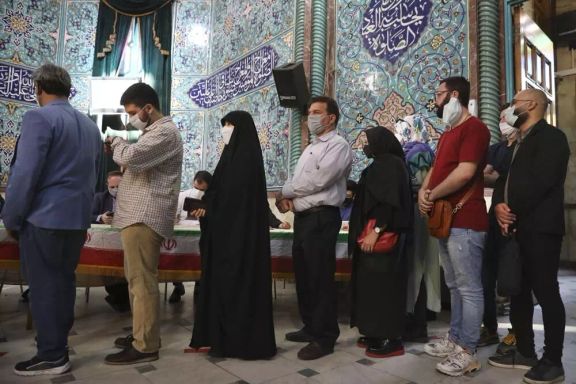
Several Iranians standing in line to cast their votes in an election

An influential hardliner in Iran has threatened the Reformists that they might be barred from next year's presidential election if they continue to boycott the March parliamentary vote.

Hossein Shariatmadari, the editor of hardline daily Kayhan and Supreme Leader Ali Khamenei's representative at the flagship hardline newspaper who made the threat, has no executive position and no responsibility about the elections.

Shariatmadari's threat came two days after Iran's main collective reformist organization, the "Reform Camp of Iran" announced in a statement that reformist parties and groups will not take part in the parliamentary elections in Tehran because the system is biased against Reformists and elections in Iran are not free and fair.

Iran’s ultraconservative election watchdog, the Guardian Council, has banned almost all Reformists from running in the March 1 parliamentary vote. The reformists were effectively banned from taking part in the previous parliamentary election in 2020 and the presidential election in 2021.

The general dissatisfaction among voters about the deteriorating economic and political situation in Iran and a completely uncompetitive election has led to predictions of extremely low turnout on March 1.

Hossein Shariatmadari, the editor of hardline daily Kayhan (undated)
100%
Hossein Shariatmadari, the editor of hardline daily Kayhan 

However, Shariatmadari also insisted earlier in the week, without presenting any evidence, that turnout in Tehran will be 20 percent higher than what it was in 2020. This comes while all forecasts in Iran put the expected turnout between 8 to 15 percent.

During the past weeks, hardliners in Iran have been doing whatever they could to encourage people to go to the polls. Khamenei's leading religious singer Saeed Haddadian said on state TV that not taking part in elections is a cardinal sin in Islam! Earlier Hossein Shariatmadari had said that voting in elections is tantamount to Jihad! Many clerics who are on the payroll of the state have also made extravagant statements about the urgency to vote and in praise of Iran’s ruler Ali Khamenei.

Earlier in this week, former lawmaker Hedayatollah Khademi told the press that after his disqualification for the upcoming elections, he was approached by go-betweens from the Guardian Council who demanded $120,000 to have his qualifications endorsed by the clerics at the election watchdog. Khademi said that various go-betweens wanted 100 billion rials to have his credentials approved by the Guardian Council. He added: "The figures they demanded were almost similar. They wanted 100 billion rials, or 300 standard gold coins, or $120,000."

Meanwhile, it was disclosed by hackers who targeted the parliaments servers that the current ultraconservative lawmakers receive a monthly salary of over 2 billion rials per month, or about $4,000.

That is more than 20 times the salary of an ordinary government employee. Following the hacking, the parliament held closed-door sessions on Wednesday and banned the entry of journalists. Subsequently, the parliament claimed that what the lawmakers actually receive is one tenth of what the hackers have claimed. This comes while the hackers have published the parliament's own documents about the lawmakers' salaries.

In the meantime, reports from Tehran say that while less than two weeks remain before the voting day, even the conservatives who have been allowed to run, have not been able yet to form any alliance to determine who will be on their lists of candidates particularly in the significant constituency of Tehran.

The reports said that a fierce battle is going on over the speakership in the new parliament. What is clear is that the ultraconservative Paydari party is adamant to replace the current Speaker Mohammad Bagher Ghalibaf. If they manage to do so, they will literally take over the entire legislature.


Most Viewed

Ideology may be fading in Iran, but not in Kashmir's ‘Mini Iran'
1
INSIGHT

Ideology may be fading in Iran, but not in Kashmir's ‘Mini Iran'

2
INSIGHT

Hardliners push Hormuz ‘red line’ as US blockade tests Iran’s leverage

3
VOICES FROM IRAN

Hope and anger in Iran as fragile ceasefire persists

4

US sanctions oil network tied to Iranian tycoon Shamkhani

5

Iran halts petrochemical exports to supply domestic market

Banner
Banner

Spotlight

  • Hardliners push Hormuz ‘red line’ as US blockade tests Iran’s leverage
    INSIGHT

    Hardliners push Hormuz ‘red line’ as US blockade tests Iran’s leverage

  • Ideology may be fading in Iran, but not in Kashmir's ‘Mini Iran'
    INSIGHT

    Ideology may be fading in Iran, but not in Kashmir's ‘Mini Iran'

  • War damage amounts to $3,000 per Iranian, with blockade set to add to losses
    INSIGHT

    War damage amounts to $3,000 per Iranian, with blockade set to add to losses

  • Why the $100 billion Hormuz toll revenue is a myth
    ANALYSIS

    Why the $100 billion Hormuz toll revenue is a myth

  • US blockade targets Iran oil boom amid regional disruption
    ANALYSIS

    US blockade targets Iran oil boom amid regional disruption

  • Iran's digital economy battered by prolonged blackout
    INSIGHT

    Iran's digital economy battered by prolonged blackout

•
•
•

More Stories

Iran Continues Persecuting Members Of Baha’i Religious Minority

Feb 15, 2024, 22:25 GMT+0

Amid the Iranian regime’s systematic persecution of the Baha’i religious minority, a Baha’i citizen has been sentenced to nine years in prison, as others languish in prison.

According to reports on Thursday, Tehran's Revolutionary Court headed by notorious Judge Abolqasem Salavati sentenced Kayvan Rahimian to five years of imprisonment, six years of the deprivation from social rights and a total fine of 500 million rials ($1,000). He was accused of engaging in “deviant education or propaganda activities that contradict or disrupt the sacred law of Islam.”

Moreover, he was handed down another 4-year sentence over the allegation of “assembling and conspiring to commit a crime against national security.”

Karimian has been in Evin Prison since July 18, 2023, when he was arrested by security forces. A translator, psychologist and professor at the Baha’i virtual university, he had already served a 5-year sentence for teaching young Baha’i students. He was released six years ago.

The Iranian regime has barred the Baha’i community, which it labels as heretics, from studying at universities and academic institutions.

Meanwhile, Nooshin Mesbah, another Iranian Baha’i citizen, has been taken to Vakilabad Prison in Mashhad to serve her one-year sentence. She was convicted by Mashhad’s Revolutionary Court for her alleged membership in a group “aimed at undermining the order and security of the country.”

In December, the Baha'i International Community (BIC) issued a statement accusing Iran of employing brutal tactics to persecute the country's Baha'i religious minority.

Nine Iranian political prisoners warned in November that in the event of the expansion of the ongoing Middle Eastern conflict, the Iranian regime would intensify its crackdown against civil and political activists, women and student movements, as well as religious minorities such as the Baha'i community.

Iran's Culture Minister Says Music Promotion Not Regime Policy

Feb 15, 2024, 20:53 GMT+0

Iran's Culture Minister stated on Thursday that music and musical works cannot be promoted, given the opposition of the clerical government that creates "constraints."

Speaking about balance between the pressures from the clerics and the growing demand for diverse cultural expressions, Mohammad Mehdi Esmaili emphasized the need for governmental decisions amidst conflicting interests.

"On one hand, we face pressure from the religious community, and on the other hand, we witness the taste and eagerness for new and innovative fields, and in the position of governance, we must decide."

"In no upstream document of the Islamic Republic of Iran after 45 years has there been any discussion about music,” he added.

The remarks come against the backdrop of ongoing tensions between fundamentalist religious factions and proponents of cultural diversity. Since the 1979 Revolution, pop music has been labeled as "haram" or forbidden, leading to a flourishing underground music scene and a penchant for foreign-based artists among Iranian music enthusiasts.

Despite restrictions on performances within the country, Iranian fans display remarkable enthusiasm for concerts by their favorite diaspora singers, often traveling abroad to attend. The trend has created a global community of Iranian music aficionados, with foreign-based artists overshadowing their domestic counterparts in popularity.

Moreover, concerts by Iranian expatriates serve as platforms for amplifying the voices of Iranian protesters, garnering international attention and support. However, Iranian state-run media has consistently criticized the artists, accusing them of exploiting popular protests for personal gain.

Iran's FM Calls For Islamic Emergency Meeting Over Gaza

Feb 15, 2024, 19:27 GMT+0

Iran's Foreign Minister Hossein Amir-Abdollahian has called for an urgent meeting of the Council of foreign ministers of the Organization of Islamic Cooperation (OIC) to address the situation in Gaza.

He made the plea during a phone conversation with OIC Secretary General Hissein Brahim Taha on Thursday, Iranian state media reported.

The call for the meeting comes amid mounting international apprehension over Iran's backing of militant groups exacerbating tensions in the region.

Iran-backed Hamas launched an invasion of Israel on October 7, resulting in the deadliest single day for Jews since the Holocaust. The subsequent retaliation by Israel, backed by US support for its right to self-defense, has escalated into a regional proxy conflict.

Iran's proxies in Syria, Lebanon, Iraq, and Yemen have joined the fray in solidarity with Hamas in Gaza. Despite Tehran's continual denial of involvement in the October 7 attack, which claimed the lives of 1,200 people, predominantly civilians, and led to the capture of over 250 hostages taken to Gaza, Iranian officials continue to engage in public meetings with Palestinian militant groups long known to be supported, armed, and trained by Iran.

On Tuesday, Amir-Abdollahian held a meeting with Hamas' political bureau head, Ismail Haniyeh, in Qatar.

The meeting came during a whirlwind tour of the region, which commenced last Friday. During his visit to Doha, where Hamas maintains a significant presence, Amir-Abdollahian held separate discussions with Qatari officials, including his counterpart, and the Emir of Qatar.

The conclusion of his regional tour in Qatar came after engagements with regime-backed militant leaders in Syria, including discussions with President Bashar al-Assad.

Huge Explosion Hits Chemical Factory Near Tehran

Feb 15, 2024, 18:27 GMT+0

A huge explosion has occurred at a chemical factory, apparently a solvent manufacturing facility, in Shahriyar, west of Tehran, Iranian state media reported Thursday night.

According to Fars news agency, the explosion took place at Salar Chemistry Company, about 30 kilometers west of the capital Tehran.

Mohsen Hamyani, the CEO of the Qods Municipality Fire Department, said that several fuel tanks exploded at the factory, adding that firefighters are currently extinguishing the fire and preventing it from spreading to other tanks.

Confirming that the fire is very large, he said that the cause of this explosion is currently unclear, and determining its cause requires the assessment of experts.

Earlier in the week, Iran's main gas pipeline network was struck by at least two explosions at different locations, with government officials labeling it as "sabotage". The scale of damage and disruption caused by multiple gas pipeline explosions became increasingly apparent the following day, as homes and industries in several large provinces were impacted.

The Iranian Ministry of Petroleum attributed the explosions along gas pipelines in multiple regions of Chaharmahal and Bakhtiari and Fars provinces to sabotage operations by “destructive elements and enemy conspiracies” aimed at disrupting gas supply to major provinces.

It is unclear if the blaze in the chemical plant is the result of a mishap or intentional. Since mid-2020 many acts of sabotage have happened in Iran targeting nuclear, military and industrial facilities.

Canada Opposition Leader Denies Role In Visa Case Of Iran Speaker’s Son

Feb 15, 2024, 18:06 GMT+0

The office of Pierre Poilievre, Canadian lawmaker and the leader of the opposition Conservative Party, has told Iran International that he has provided no recommendation letter in support of granting visa to the son of Iran’s parliament speaker.

Earlier in the week, a Canadian Federal Court document emerged on social media indicating that in 2022, Es’haq Ghalibaf, the son of Iran’s parliament speaker and former IRGC commander, Mohammad-Bagher Ghalibaf, filed for the judicial review of the processing time of his immigration application and the federal court ruled that his application should be granted.

The document also revealed that Polivier's office made "repeated inquiries" about the progress of his application. They were unsubstantiated reports that the lawmaker provided him with a recommendation letter. Many Iranians have demanded an explanation from Poilievre, questioning why the lawmaker intervened in this case.

Poilievre’s office rejected the allegation about a recommendation letter, saying “no offers or letters of support were ever provided” for Es’haq Ghalibaf.

“In this case, a constituent inquired about the status of an application on behalf of the applicant [Es’haq Ghalibaf], which the office provided as it would for hundreds of other cases for the over 130,000 residents which it serves. This is a normal and routine function of a constituency office and had absolutely no bearing on the outcome of the case,” the office added.

“Conservatives continue to be very concerned about Canada being used as a safe haven for associates of the regime in Tehran to hide,” the office stressed, further urging Canadian Prime Minister Justin Trudeau to take action against the agents of the Iranian regime who “harass, intimidate, and coerce” Canadian citizens with impunity.

Poilievre is a staunch critics of the Islamic Republic in Canada and has supported the designation of the IRGC as a terrorist organization.