• العربية
  • فارسی
Brand
  • Iran Insight
  • Politics
  • Economy
  • Analysis
  • Special Report
  • Opinion
  • Podcast
  • Iran Insight
  • Politics
  • Economy
  • Analysis
  • Special Report
  • Opinion
  • Podcast
  • Theme
  • Language
    • العربية
    • فارسی
  • Iran Insight
  • Politics
  • Economy
  • Analysis
  • Special Report
  • Opinion
  • Podcast
All rights reserved for Volant Media UK Limited
volant media logo

Ideology Of Pure Islamic Rule Serves Power Politics In Iran
Feb 14, 2024, 04:30 GMT+0Updated: 11:04 GMT+0
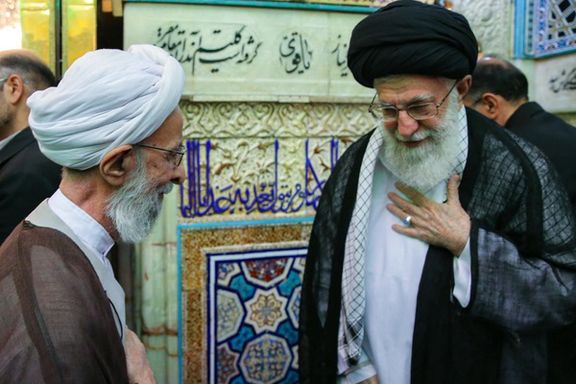
Ayatollah Mohamad Taqi Mesbah-Yazdi (left) and Iran’s ruler Ali Khamenei

The ayatollah who was the fervent proponent of pure Islamic rule as distinct from the Islamic Republic died in 2021, politicians using his ideology were gaining power in Iran.

Iranians had all but consigned Ayatollah Mohamad Taqi Mesbah-Yazdi to the annals of history. However the ascension of President Ebrahim Raisi to power in 2021, following Mesbah-Yazdi's passing that same year, brought the cleric's influence back into sharp focus. The political landscape of Iran shifted once more as Paydari seized control of the government and parliament.

Prior to the 2010s, Mesbah-Yazdi remained largely obscure, save for his association with populist President Mahmoud Ahmadinejad, whose rise to power was aided by Mesbah-Yazdi's disciples. Those familiar with him understood his contentious relationship with the founder of the Islamic Republic, Ayatollah Ruhollah Khomeini, stemming from Mesbah-Yazdi's early opposition to Khomeini's revolutionary ideals before the 1979 Islamic revolution.

Mesbah Yazdi's reluctance to engage in overt political activities until after Khomeini's demise, likely stemmed from this antagonism. It was only with the ascent of Ali Khamenei to Iran's leadership in 1989 that Mesbah-Yazdi emerged from obscurity, advocating for Khamenei's authority as the direct conduit between God and the populace. Mesbah-Yazdi contended that Khamenei's appointment was divinely ordained, bypassing the need for electoral or popular validation, positioning him akin to a prophet who could transmit God's law without intermediary.

An event of the Paydadri party  (undated)
100%
An event of the Paydadri party

In a recent report about Mesbah-Yazdi, Iran’s Rouydad24 website wrote that Mesbah was born in 1934 in Yazd in central Iran where he later studied at the seminary before leaving for An-Najaf in Iraq to continue his studies. However, he returned to Iran after only one year and continued his studies at the religious school of Ayatollah Boroujerdi and then Ayatollah Khomeini.

It was in Qom that he further developed his theory of pure Islamic (Shiite) state partly in collaboration with former President Akbar Hashemi Rafsanjani and former Judiciary Chief Mohammad Beheshti who later disagreed with his radical totalitarian ideas. Later, he studied at the Haqqani Madrasah, which was established in the 1950s as a place to politicize Shiism. The Madrasah is today notorious for producing some of the most violent militant clerics that ruled in Iran during the first decades of the Islamic Republic.

It was at this Madrasah that Mesbah-Yazdi published a journal named Enteqam [Revenge] which propagated hate speech and violence against the secularist monarchy.

His glorification of violence in the 1990s and 2000s, which led to the mass murder of intellectuals by government agents revealed the practical implication of the school of thought he developed during that period. Coupled with a paranoia about "infiltration" by "others" his ideas turned into something sinister and dangerous. Rouydad24, quoted him as having said in July 2002: "Identify the Satanic mercenary elements. Silence any opposition to the Supreme Leader. If they are ignorant, explain the matter to them, but if they have ill intentions, kill them by strangulating them!"

Despite Mesbah-Yazdi's influence on political rhetoric, particularly within the Paydari Party, his ideas often remained superficially understood, with many adherents prioritizing self-interest over ideological fidelity. The prevailing ethos among Paydari members emphasized personal gain, be it financial resources or political power, often at the expense of Mesbah-Yazdi's original principles. His ideology was and remains a useful tool for those who want to monopolize power using a rallying point.

As Paydari consolidates its grip on Iranian politics, the Islamic Revolutionary Guard Corps (IRGC) emerges as a potential counterbalance. With over 70 IRGC officers reportedly serving in the Majles, including influential figures like Speaker Mohammad Bagher Ghalibaf, they represent a formidable force capable of tempering Paydari's dominance, ensuring a delicate equilibrium within Iran's political arena.

According to one of the latest headcounts, at least 24 top officers of the IRGC were members of the outgoing parliament, including Ghalibaf. They may not represent a large bloc, but their influence is undeniable as Khamenei uses them to counterbalance Paydari. 

Most Viewed

Ghalibaf defends Iran-US talks amid hardline backlash
1
INSIGHT

Ghalibaf defends Iran-US talks amid hardline backlash

2
ANALYSIS

From instability to influence: Pakistan’s pivotal role in US-Iran diplomacy

3
ANALYSIS

100 days on: why Iran’s January protests spread across social classes

4

War-hit homeowners feel abandoned as Iran’s reconstruction aid fades

5
INSIGHT

100 days on: the anatomy of Iran’s January crackdown

Banner
Banner

Spotlight

  • Bread shortages, soaring prices strain households in Iran, residents say
    VOICES FROM IRAN

    Bread shortages, soaring prices strain households in Iran, residents say

  • War-hit homeowners feel abandoned as Iran’s reconstruction aid fades

    War-hit homeowners feel abandoned as Iran’s reconstruction aid fades

  • 100 days on: the anatomy of Iran’s January crackdown
    INSIGHT

    100 days on: the anatomy of Iran’s January crackdown

  • Ghalibaf defends Iran-US talks amid hardline backlash
    INSIGHT

    Ghalibaf defends Iran-US talks amid hardline backlash

  • 100 days on: why Iran’s January protests spread across social classes
    ANALYSIS

    100 days on: why Iran’s January protests spread across social classes

  • From instability to influence: Pakistan’s pivotal role in US-Iran diplomacy
    ANALYSIS

    From instability to influence: Pakistan’s pivotal role in US-Iran diplomacy

•
•
•

More Stories

Iran's Foreign Minister Meets Hamas Leader In Qatar

Feb 13, 2024, 22:57 GMT+0

Iran's Foreign Minister Hossein Amir-Abdollahian met with Hamas' political bureau head, Ismail Haniyeh, in Qatar on Tuesday amid the ongoing Gaza war.

Despite its continued denial of involvement in the October 7 atrocities, which resulted in the death of 1,200 mostly civilians, with over 250 individuals taken hostage to Gaza, Tehran continues its public meetings with Palestinian militant groups, long supported, armed, and trained by Iran.

In Lebanon on Saturday, the foreign minister also met leaders of Palestinian militant groups in addition to its biggest proxy, Hezbollah.

He has been on a whirlwind tour of the region which began Friday. While in Doha, where Gaza militants Hamas has long had one of its foreign outposts, Amir-Abdollahian held separate talks with his Qatari counterpart and the Emir of Qatar.

Qatar marked the final leg of the Iranian diplomat's regional tour. In Syria, Amir-Abdollahian had also met with regime-backed militant leaders, in addition to President Bashar al-Assad.

Since the outbreak of the Gaza war, Israel has been increasing airstrikes on Iranian-backed military targets in Syria, with reports of high-level killings of Iranian military personnel since the outbreak of the conflict.

Hacked Documents Reveal Iran’s Strategies To Bypass Sanctions

Feb 13, 2024, 20:01 GMT+0
•
Iran International Newsroom

Documents leaked following the hack of the Iranian parliament’s media arm have uncovered a wide range of Tehran’s strategies to circumvent US sanctions. 

The documents revealed the parliament's coordination with designated Iranian entities and individuals to facilitate their trade activities and conceal their identities and connections from international regulatory bodies. The measures include manipulating purchase documents and customs regulations as well as banking incentives and foreign currency supplies to offset the damages incurred due to sanctions. 

Uprising till Overthrow, closely affiliated with the Albania-based opposition Mujahideen-e Khalq (MEK) organization, said they breached 600 of the main servers of the parliament, commission, main chamber, parliament assistant, parliament bank, and other servers related to administrative functions, via the Khaneh Mellat News Agency.

Among the vast array of internal communications and confidential documents leaked Tuesday is a 14-page letter that outlines numerous methods of bypassing sanctions and supporting sanctioned individuals and entities discussed in a session of Iran’s Sanctions Counteraction Headquarters held in August 2023.

The confidential letter is signed by Mohammad Mirmohammadi, the Deputy for Economic and Technological Affairs of the Secretariat of the Supreme National Security Council, addressed to Mohsen Rezaei, the Secretary of the Supreme Council of Economic Coordination of the Branches of Government. A copy of the letter was also sent to the heads of the three branches of Iran’s government, namely the president and the chief justice as well as the Parliament Speaker. 

A sample page of the document leaked by hacktivist group Uprising till Overthrow (February 2024)
100%
A sample page of the document leaked by hacktivist group Uprising till Overthrow

The Sanctions Counteraction Headquarters was established in 2018 after the US withdrawal from the JCPOA. Es'haq Jahangiri, the First Vice President of the Rouhani administration, announced the establishment of this headquarters, saying, "In the new conditions, country managers do not have the right to surrender to the conditions and must find solutions for selling oil and providing the country's needs." 

According to the leaked letter, the HQ decreed that sanctioned individuals have the "possibility to change their identity for the purpose of continuing their activities." They will also benefit from other facilities such as "financial incentives in banking, insurance, tax, and customs areas."

Another resolution included "provision of protective and security coverage" to all managers, agents, and people working to neutralize sanctions, aimed at "immunizing" them against incurred damages. 

Mentioned in the letter is the provision of legal-judicial services domestically and internationally to support people at risk of retribution for their efforts to evade sanctions. Methods of bypassing the restriction to import sanctioned goods and dual-use goods are also addressed, in addition to practices such as not providing a certificate of origin or accepting a mismatched certificate of origin from non-Iranian businesses, tampering with documents with names inconsistent with the buyer, and changing the name or details of the purchase agreement.

Using foreign intermediaries for sanctioned goods was also introduced as a common practice with customs permitted to change declarations to avoid the disclosure of information about the imported goods. 

Such mechanisms have, over a number of years, effectively established a hidden financial system that has become an integral part of Iran's economy. The authorities of the Islamic Republic have repeatedly acknowledged their efforts to circumvent US sanctions, and some people in Europe and the US have been detained on charges of involvement in this circumvention. 

The timing of the cyberattack is notable as it coincides with the upcoming parliamentary elections, scheduled for March 1st, which have been marred by extensive disqualifications of candidates, raising concerns about the integrity of the electoral process. This isn't the first time Uprising till Overthrow has targeted Iranian government agencies. In June, the group exposed documents from the Iranian presidential system, shedding light on activities of the Revolutionary Guards in suppressing protests.

Iran Launches First Long-Range Ballistic Missiles From Warship

Feb 13, 2024, 19:43 GMT+0

Iran's Islamic Revolutionary Guard Corps (IRGC) said on Tuesday it has launched long-range ballistic missiles from a warship for the first time.

The announcement came during naval exercises with the IRGC deploying two ballistic missiles from the Shahid Mahdavi warship.

The IRGC claims that the missiles can strike targets up to 1,700 kilometers (1,050 miles) away.

"The IRGC has initiated the firing of ballistic missiles in the Gulf of Oman for the first time," state television reported.

IRGC Chief Hossein Salami stated, "The launch of a long-range ballistic missile from the warship was executed with success."

In a warning on Tuesday, Salami said, "In the event of a naval conflict and our ships being targeted, we will respond with equal or greater force."

Additionally, state television reported that the IRGC conducted a simulation of a surface-to-surface ballistic missile strike on Israel's Palmachim airbase from central Iran. The base serves as a critical facility for F-35 fighter jets in Israel.

The military maneuvers unfold amid heightened regional tensions following the eruption of the Israel-Hamas conflict on October 7. Iran, which does not recognize Israel, has long opposed it and supported Palestinian terror groups since the 1979 Islamic revolution.

US Says Tehran-Backed Houthis' Blockade Threatens Iran's Food Supply

Feb 13, 2024, 16:28 GMT+0

A State Department spokesman told Iran International that the Tehran-backed Houthis' Red Sea blockade not only threatens global food supplies but "now directly threatens even Iran’s own supply of food."

It follows an attack on a bulk carrier of corn traveling from Brazil to Iran on Monday. "This is just the latest, absurd example demonstrating that the Iranian regime supports terrorism and destabilizing behavior by groups like the Houthis at the expense of all the people of the region, including the Iranian people themselves," the spokesperson said.

Citing maritime sources, Reuters reported that the attack was the first time a ship headed for Iran was targeted amidst the Red Sea blockade, launched in November.

A regional security official told Reuters that the attack appeared designed to "show Iran does not control the Houthis and they act independently." They added that the Houthis had informed Tehran in advance, though so far Iranian officials are yet to comment on the allegations or the attack itself. 

The Yemeni Houthis joined the proxy war which emerged in the aftermath of Iran-backed Hamas's attack on Israel on October 7. The deadliest day for Jews since the Holocaust, Hamas killed 1,200 mostly civilians and took at least 250 more hostage. Israel's relentless retaliation on the Gaza based militia has led to large swathes of the strip destroyed and around two thirds of the population at least displaced.

In solidarity, Iranian proxies in Iraq, Lebanon, Syria and Yemen have attacked both Israel and US targets, punishment for Biden's support of Israel's right to defend itself in the wake of the October atrocities.

Iranian Protester's Lawyer Summoned For Criticizing Legal Proceedings

Feb 13, 2024, 13:51 GMT+0

The lawyer representing Mohammad Ghobadloo, a protester executed in connection with the 2022 protests in Iran, has been summoned to court for criticizing the handling of his client's case.

Mahdokht Damghanpour, one of Ghobadloo's attorneys, was summoned to the Culture and Media Court after voicing numerous objections to the proceedings of her client's case.

In an interview with Didban Iran, Damghanpour previously stated that her client was executed despite requests from medical professionals and 50 psychiatrists to halt the execution.

She said her client was executed without notifying his attorneys, examining his mental health status again as per the Chief Justice's orders, informing his family, or granting him a final visit.

Ghobadloo was detained during the uprising which followed the death in morality-police custody of Mahsa Amini in September 2022. He was charged with running over a police officer with his car and causing his death, as well as other charges including "corruption on earth" and "waging war against God" in another case.

In a recent interview, Damghanpour claimed Ghobadloo was subjected to beatings and forced to confess before his execution last month.

So far, at least nine protesters have been executed in connection with the Women, Life, Freedom protests.