• العربية
  • فارسی
Brand
  • Iran Insight
  • Politics
  • Economy
  • Analysis
  • Special Report
  • Opinion
  • Podcast
  • Iran Insight
  • Politics
  • Economy
  • Analysis
  • Special Report
  • Opinion
  • Podcast
  • Theme
  • Language
    • العربية
    • فارسی
  • Iran Insight
  • Politics
  • Economy
  • Analysis
  • Special Report
  • Opinion
  • Podcast
All rights reserved for Volant Media UK Limited
volant media logo

IRGC Deputy Commander: We Settle Scores On A Daily Basis
Iran International Newsroom
Feb 10, 2024, 17:11 GMT+0Updated: 11:05 GMT+0
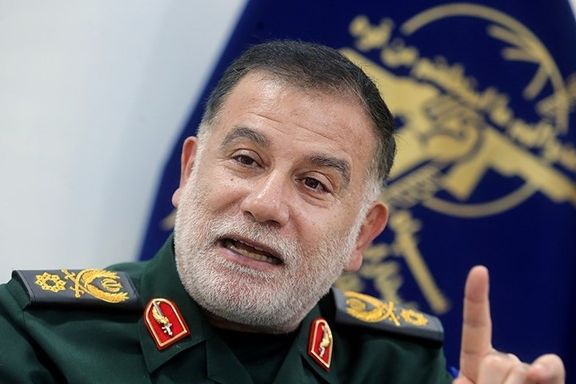
IRGC general Abbas Nilforoushan speaking in October 2021

The IRGC's deputy commander for operations, General Abbas Nilforoushan has said the IRGC keeps tabs on its enemies' activities and settles scores with them on a regular basis.

Nilforoushan told Etemad Online website in Tehran this week that the enemies are aware of IRGC's policy, which appears different from Revolutionary Guard’s declared strategy about its retaliatory measures. Chief Commander Mohammad Ali Jafari announced in 2016 that IRGC’s retaliation policy was not to react immediately, but act at a time and place of its choosing.

That was part of its asymmetrical warfare doctrine which often brought the Guards under criticism for "inaction" against attacks on their forces particularly in Syria.

The United States has launched precision strikes in the past few weeks against IRGC-linked bases in Syria and Iraq, as Israel has targeted senior officers based in Syria.

Nilforoushan now says that no attack on Iran's interests will remain unanswered, adding that Iran's response will come "on the spot" exactly where the attacks have taken place. This comes while since the killing of IRGC Quds Force commander, Qasem Soleimani, in 2020, IRGC has been criticized both in Iran and abroad for failing to properly respond.

Nilforoushan claimed that during the past 45 years, the IRGC has been striving to create some sort of balance with its enemies in terms of combat operations, influence and image building. He reiterated that IRGC's arch enemy during this period was the United States.

A drone belonging to IRGC-backed Houthis in Yemen
100%
A drone belonging to IRGC-backed Houthis in Yemen

He boasted that unlike the pre-1979 era, when Iran was dependent on the United States, during the past 45 years, the Islamic Republic has become the biggest missile power in West Asia. Nilforoushan further claimed that the region's geopolitics has effectively changed as Iran became a regional power. He boasted that Iran, China and Russia were the world's strongest powers while US power has been diminishing.

The senior IRGC officer further claimed that the United States is not likely to remain a big power in the future, insisting that the most the US can do is to prevent its own downfall.

In the wake of the Israeli-Hamas conflict, some Iranian hardliners have boasted about Iran's increased military strength. However, simultaneously, they have begun retracting previous assertions regarding Iran's influence over proxy groups in Iraq, Syria, Lebanon, and Yemen. Recently, Interior Minister, Ahmad Vahid, emphasized that the United States must acknowledge its waning ability to meddle in the internal affairs of other nations.

Vahidi made the statement while US attacks on pro-Iranian militia positions in Iraq, Syria and Yemen were widely welcomed both in the region and in the international community as a measure in the interest of security of the region and international commercial navigation.

Meanwhile, former IRGC Commander Mohsen Rezaei has said the United States has come to the conclusion that it can restore security in the region only with the cooperation of the Islamic Republic, which has stayed out of direct involvement in the current conflict.

Rezaei also denied Iran's influence among its proxy groups in the region and said Iran was not involved in their attacks on US bases in the region. He claimed that Iran's influence is mainly about deterring attacks on the Islamic Republic.

In his interview, Nilforoushan emphasized that Israel has recognized the unlikelihood of a direct military clash between Iran and the United States. He asserted that Israel has also acknowledged its incapacity for a military showdown with the Islamic Republic and has opted to engage Iran solely in the ambiguous realms between other conflicts.

Furthermore, Nilforoushan emphasized the imperative for Iran to safeguard its intelligence assets and prevent their compromise to external entities. However, he overlooked the numerous Israeli assaults on Iranian installations in Syria and Israel's evident intelligence advantage concerning Iran's nuclear endeavors.

Most Viewed

Ghalibaf defends Iran-US talks amid hardline backlash
1
INSIGHT

Ghalibaf defends Iran-US talks amid hardline backlash

2
VOICES FROM IRAN

Bread shortages, soaring prices strain households in Iran, residents say

3
ANALYSIS

From instability to influence: Pakistan’s pivotal role in US-Iran diplomacy

4
ANALYSIS

100 days on: why Iran’s January protests spread across social classes

5

War-hit homeowners feel abandoned as Iran’s reconstruction aid fades

Banner
Banner

Spotlight

  • Is Iran entering its Gorbachev moment?
    INSIGHT

    Is Iran entering its Gorbachev moment?

  • Iran crackdown reaches cemeteries as graves of slain protesters defaced
    EXCLUSIVE

    Iran crackdown reaches cemeteries as graves of slain protesters defaced

  • Iran diplomacy wobbles as factions compete to avoid looking soft on US
    INSIGHT

    Iran diplomacy wobbles as factions compete to avoid looking soft on US

  • The politics of pink: how Iran uses cuteness to rebrand violence
    ANALYSIS

    The politics of pink: how Iran uses cuteness to rebrand violence

  • Bread shortages, soaring prices strain households in Iran, residents say
    VOICES FROM IRAN

    Bread shortages, soaring prices strain households in Iran, residents say

  • Ghalibaf defends Iran-US talks amid hardline backlash
    INSIGHT

    Ghalibaf defends Iran-US talks amid hardline backlash

•
•
•

More Stories

Iran’s FM: Regional Peace Will Be Resorted Only If Gaza War Stops

Feb 10, 2024, 16:18 GMT+0

Iran’s foreign minister has criticized the US stance towards the Israel-Hamas conflict, stressing that peace will be restored to the region only id Israel’s military campaign in Gaza ends.

“The US is simultaneously moving in two directions: The first is to continue to send weapons [to Israel] … and the second is to talk about a political solution,” said Hossein Amir-Abdollahian Saturday during a joint press conference with his Lebanese counterpart Abdallah Bou Habib in Beirut.

“If the US wants peace in the region, the solution is to stop the crime and genocide in Gaza and the West Bank,” Amir-Abdollahian pointed out, further adding that the war has had “no tangible gains” for Israel and its supporters

According to Iran’s foreign minister, Tehran and Beirut have never sought to expand the war as they believe that it cannot be the solution.

Earlier in the day, Amir-Abdollahian met with Hezbollah leader Hassan Nasrallah and Lebanese caretaker Prime Minister Najib Mikati.

Iran provides significant support to Hamas and Hezbollah, as well as several other groups in the region designated as terrorist organizations, including Iraqi Shiite militias, Islamic Jihad in Gaza, and the Houthis in Yemen.

Upon his arrival in Beirut on Friday, Iran’s top diplomat pledged continued support for Hezbollah, emphasizing the interdependence of Lebanon's security with that of the Islamic Republic and the wider region.

Though Iran has avoided any direct military involvement in the Israel-Hamas conflict, the regime has used its proxy groups to attack Israeli and American targets in the Middle East.

Ahmadinejad Eyes A Return To Office, Former Aide Says

Feb 10, 2024, 15:18 GMT+0

A former adviser to Iran’s ex-president Mahmoud Ahmadinejad said that the controversial politician might consider running for president or accept the vice presidency in the future.

Ahmadinejad’s main goal is to run for the presidency in 2025, Abbas Amirifar stated, adding, “His perception, even his delusion, is that the government has failed to control inflation and high prices, so the system has no other way but to stand behind him” and back his candidacy.

According to Amirifar, if Ahmadinejad registers as a presidential candidate, the Guardian Council will definitely disqualify him in the vetting process because “the system no longer trusts him.”

In the case of disqualification, he may support some of his allies, such as Gholamhossein Elham and Abdolreza Sheikholeslami, during the presidential campaign and may even accept the vice-presidency in an attempt not to fade away from Iran’s political scene, Amirifar went on to say.

Amirifar, a cleric, was once recognized as Ahmadinejad’s exorcist. He also served as the head of the cultural council and the cultural advisor during Ahmadinejad’s 8-year presidency.

Amirifar later distanced himself from Ahmadinejad as the populist figure incurred the wrath of Supreme Leader Ali Khamenei and was removed from his inner circle.

Abdolreza Davari, another of Ahmadinejad’s former aides, claimed in December that Sadegh Mahsouli, the leader of Iran’s ultra-hardliner Paydari Party, is paving the way for the return of the former president to politics.

In an interview with the IRGC-affiliated Fars news agency, Mahsouli praised Ahmadinejad, calling him “charismatic” and a person with “innate management capabilities” and a good command of many things, including the economy and diplomacy.

The Guardian Council barred Ahmadinejad twice from running in Iran’s presidential elections in 2017 and 2021.

Iran Urges FIFA To Suspend Israel's Football Team Over Gaza War

Feb 10, 2024, 13:30 GMT+0

Iran has called on the International Association of Football Federations (FIFA) to ban Israel from international competitions over the war in Gaza, Iranian state media reported.

In a letter sent to FIFA, Iran’s Football Federation accused Israel of committing war crimes and killing civilians in Gaza, including football players, coaches and referees. The military operations in Gaza have annihilated “countless sport facilities” and football infrastructure, the letter further added.

Urging the full suspension of Israel’ football team, Iran’s Football Federation said such a “brilliant and enduring” move can pave the way for the cessation of Israel’s military campaign and the delivery of humanitarian aide to Gaza.

Israel already allows hundreds of trucks to deliver humanitarian assistance to Gaza daily.

Iran-backed Hamas invaded Israel's border regions on October 7 in what was the most deadly single day for Jews since the Holocaust. The Iranian government immediately praised the invasion and ordered street celebrations, with large banners erected within hours, suggesting Tehran had known in advance of the attacks which killed 1,200 mostly civilians and saw 240 taken hostage to Gaza.

Since then, Israel's relentless retaliation and the US support for its right to defend itself has led to Iranian proxy attacks on US interests. Though Iran has avoided any direct military involvement in the Israel-Hamas conflict, the regime has used its proxy groups, such as Yemeni Houthis and Hezbollah, to attack Israeli and American targets in the region.

New Revelations Emerge About IRGC Recruiting British Muslims

Feb 10, 2024, 12:46 GMT+0
•
Iran International Newsroom

New revelations emerged about Iran’s clandestine activities in the West, as the Daily Mail reported on Friday that Tehran is recruiting British Shias to spy on Jews and dissidents in the UK.

Citing Israeli and British officials, the report said that IRGC agents approach British Muslims visiting holy Shia sites in Iran and Iraq to recruit them for espionage purposes.

“They are told to return to the UK and gather information on prominent British Jews or targets such as synagogues,” as well as regime opponents the report added.

Kasra Aarabi, of the United Against Nuclear Iran advocacy group, remarked that the IRGC has focused on employing British Muslims mostly originating from Lebanon, Iraq and Pakistan because UK-based Iranians are usually secular and anti-regime and thus, will not cooperate with Tehran’s malign schemes.

Aarabi referred to annual Arbaeen religious mass gathering in the holy Iraqi city of Karbala as an occasion in which the IRGC recruiters are very active as the event gathers annually up to 20 million Shia pilgrims from around the world. Approximately 400,000 Shia Muslims live in the UK.

People march during the Shiite Arbaeen religious occasion in Iraq, in 2023
100%
People march during the Shiite Arbaeen religious occasion in Iraq, in 2023

Following Hamas’ October 7 onslaught, Israel has repeatedly warned the UK against the potential attacks by the Iranian regime and its proxies on British soil, an Israeli official announced. Back in October, it was also reported that Iran’s agents were stirring up unrest in the UK through Gaza protests.

Daily Mail added that according to experts, some Iranians who have entered the UK apparently on student visas are in fact the regime’s spies.

“We do not know the scale of Iranian agents inside Europe and the UK, but all it takes is for one to slip through the net,” Daily Mail quoted an unnamed source as saying.

Meanwhile, a British government official confirmed that the IRGC has resorted to UK-based organized criminal networks when it intended to murder or kidnap its targets on British territory. According to Daily Mail, the IRGC has adopted such a policy as it is very hard for Iranian spies to operate freely in the UK.

In an interview with Iran International TV, political analyst Damoun Mohammadi called on European states to adopt a tougher stance with regard to Tehran’s conspiracies against Iranian dissidents abroad, warning that Europe’s inaction can result in the success of the regime’s plots to intimidate its opponents.

According to the analyst, the Islamic Republic has been targeting its opponents in European countries since it came to power in 1979 but it has recently increased its malign operations as the activities of the foreign-based dissidents have expanded significantly.

UK’s ITV revealed in December 2023 that the IRGC was plotting to assassinate two Iran International television anchors in London in 2022 amid Iranian anti-government protests.

Following ITV’s report, British Foreign Secretary David Cameron summoned Iran’s chargé d’affaires. Iran must be sent “an incredibly clear message that this escalation will not be tolerated,” Cameron stressed.

Last year, Iran International temporarily relocated its television broadcast from London to Washington, DC, due to terrorist threats. The decision to suspend Iran International's broadcasting from the British capital was made after the arrest of an Austrian national named Mohammad-Hussein Dovtaev on February 13, 2023.

He was detained while filming outside the network’s premises. The Central Criminal Court of England sentenced Dovtaev to 3.5 years behind bars for attempting to collect information “likely to be useful to a person committing or preparing an act of terrorism.”

In October 2023, Ken McCallum, the Director-General of MI5, the UK’s security service, stated that amid the war between Iran-backed Hamas and Israel, the Islamic Republic may be exploring new ways to threaten the security of Britain.

“Iran has been a rising source of concern and a rising source of task for MI5 over the last 18 months or so in particular,” McCallum then said.

Amnesty International Urges Iran To Halt Execution Of Protester

Feb 10, 2024, 12:22 GMT+0

Amidst mounting concerns over the fate of detained protester Reza Rasaei, Amnesty International issued a warning to Iranian authorities regarding his imminent execution.

Rasaei, who denies any involvement, faces the specter of death following his conviction in connection with the killing of an agent during a protest in Kermanshah province, on November 18, 2022.

The Iranian state media identified the agent as a member of the Revolutionary Guard, further complicating Rasaei's case. In addition to the disputed murder charge, Rasaei has been sentenced to one year in prison and 74 lashes for "disrupting public order."

Emphasizing the grave injustice surrounding Rasaei's trial, Amnesty International has called for immediate action from the Iranian regime. The organization asserts that Rasaei's death sentence was handed down following a severely unfair trial, marked by coerced confessions.

In a statement issued on Friday, Amnesty urged Iranian authorities to “immediately halt any plans to carry out Rasaei’s execution and quash his conviction and death sentence and release him unless he is charged with an internationally recognizable criminal offence and is given a fair retrial without recourse to the death penalty excluding torture-tainted confessions.”

The statement further implored Iranian authorities to ensure his access to his family, legal representation, and adequate medical care. Additionally, Amnesty called for measures to protect Rasaei from further torture or ill-treatment and urged an investigation into his allegations of torture, with perpetrators brought to justice through fair trials.

Rasaei's case highlights broader issues facing Iran's marginalized Kurdish and Yarsan ethnic and religious minorities. Yarsan adherents, including Rasaei, have faced ongoing challenges, including difficulties in registering their religious affiliation, restrictions on constructing places of worship, and fears of persecution for practicing their faith.