• العربية
  • فارسی
Brand
  • Iran Insight
  • Politics
  • Economy
  • Analysis
  • Special Report
  • Opinion
  • Podcast
  • Iran Insight
  • Politics
  • Economy
  • Analysis
  • Special Report
  • Opinion
  • Podcast
  • Theme
  • Language
    • العربية
    • فارسی
  • Iran Insight
  • Politics
  • Economy
  • Analysis
  • Special Report
  • Opinion
  • Podcast
All rights reserved for Volant Media UK Limited
volant media logo

Iranian Student Unions Decry Death Sentences Of Protesters
Iran International Newsroom
Jan 19, 2024, 16:16 GMT+0Updated: 11:11 GMT+0
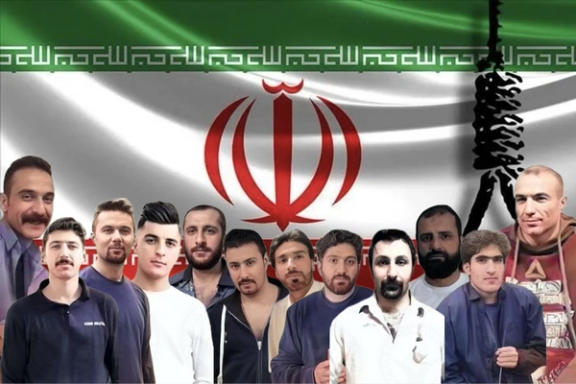
A collage picture of several Iranian political prisoners in danger of imminent execution

Seventeen student groups across Iran have issued a joint statement against death sentences for several political prisoners, labeling them "state-sponsored murder."

In a joint statement released Thursday, the student activists asserted their refusal to remain silent under any circumstances, stating, "We will not tolerate executions, and we will obliterate the executioner government."

The signatories, who identified themselves as "fighters and revolutionaries of Women, Life, Freedom,” also urged nationwide protest rallies against the recent surge in executions throughout the country.

A recent report by the Norway-based Iran Human Rights (IHRNGO) group disclosed a shocking 33-percent increase in executions in Iran last year, with at least 791 individuals put to death. Over one-fifth of those executed belonged to the predominantly Sunni Baluch community, indicating a disproportionate impact on ethnic minorities. According to the US-based Human Rights Activists News Agency (HRANA), at least 12 prisoners in Iran charged with political or security-related offenses now face death sentences.

The student unions further vowed support for people currently facing execution, including Reza (Gholamreza) Rasaei, Mojahed (Abbas) Kourkour, Mansour Dahmardeh, Farshid Hossein-Zehi, Vafa Azarbar, Mohammad Faramarzi, Pejman Fatehi, and Mohsen Mazloum, eight political prisoners condemned to death by Iran's Supreme Court.

Among them, Mohsen Mazloum, Pejman Fatehi, Vafa Azarbar, and Hojir Faramarzi are Kurdish political prisoners sentenced to death by Branch 26 of the Tehran Revolutionary Court.

Kourkour is among the detainees of the nationwide uprising in Izeh, arrested on December 20, 2022 during an armed attack by security and law enforcement forces on a village near Izeh. The judiciary identifies him as the "main suspect" in the killing of 10-year-old Kian Pirfalak, but Kian's family steadfastly maintains that the perpetrators were government forces. The situation has raised international concern over the due process and human rights in Iran.

Rasaei faces accusations of "murder" in connection with the death of Nader Beirami, the head of intelligence in Sanandaj, during a protest in the city on November 17, 2022. According to the human rights group Amnesty International, Rasaei was subjected to an "unfair trial" on October 7 in Kermanshah province with his forced confessions under torture. His mother, Azardokht Haqjouyan has said her son's extensive 1,500-page case file had been reviewed within a week.

Rasaei hails from Iran's marginalized Kurdish and Yarsan ethnic and religious minorities. The Yarsan faith, also known as Ahl-e Haqq, is among the oldest Middle Eastern religious traditions, with an estimated three million followers in Iran, primarily in the western Kurdish regions, and an additional 120,000 to 150,000 in Iraq, known as Kaka'i. Yarsan adherents have encountered various challenges, including difficulties in registering their children as Yarsan at birth, restrictions on constructing places of worship, and the constant fear of persecution for printing their holy book.

According to the signatories of the statement, "The government, through creating fear and terror by issuing and implementing execution orders, is seeking an escape from the escalating political, cultural, economic, and international crises." They claimed that the Islamic Republic believes that by executing protesters and dissidents, it can intimidate society, suppress the revolution, and quell protests. The student organizations, however, denounced such a belief as a delusion and emphasized their commitment to the destruction of the Islamic Republic.


Most Viewed

100 days after carnage: Iran economy reels from war, inflation, unemployment
1
INSIGHT

100 days after carnage: Iran economy reels from war, inflation, unemployment

2
INSIGHT

Ghalibaf defends Iran-US talks amid hardline backlash

3
EXCLUSIVE

Iranian assaulted in London amid concern over threats to regime critics

4

IRGC fires at Indian vessel in Hormuz

5
INSIGHT

A nation in limbo: 100 days after the massacre, has the world moved on?

Banner
Banner

Spotlight

  • War-hit homeowners feel abandoned as Iran’s reconstruction aid fades

    War-hit homeowners feel abandoned as Iran’s reconstruction aid fades

  • 100 days on: the anatomy of Iran’s January crackdown
    INSIGHT

    100 days on: the anatomy of Iran’s January crackdown

  • Ghalibaf defends Iran-US talks amid hardline backlash
    INSIGHT

    Ghalibaf defends Iran-US talks amid hardline backlash

  • 100 days on: why Iran’s January protests spread across social classes
    ANALYSIS

    100 days on: why Iran’s January protests spread across social classes

  • From instability to influence: Pakistan’s pivotal role in US-Iran diplomacy
    ANALYSIS

    From instability to influence: Pakistan’s pivotal role in US-Iran diplomacy

  • A nation in limbo: 100 days after the massacre, has the world moved on?
    INSIGHT

    A nation in limbo: 100 days after the massacre, has the world moved on?

Tweet unavailable

•
•
•

More Stories

Pakistan Calls On Iran For Closer Cooperation After Tit-For-Tat Strikes

Jan 19, 2024, 13:44 GMT+0

Pakistan expressed its willingness to work with Iran on "all issues" in a call between their foreign ministers on Friday after both countries exchanged drone and missile strikes on militant bases on each other's territory.

The tit-for-tat strikes by the two countries are the highest-profile cross-border intrusions in recent years and have raised alarm about wider instability in the Middle East since the war between Israel and Hamas erupted on October 7.

However, both sides have already signalled a desire to cool tensions, although they have had a history of rocky relations.

A statement from Pakistan's foreign office said Foreign Minister Jalil Abbas Jilani had spoken to his Iranian counterpart, Hossein Amirabdollahian, on Friday, a day after Pakistan carried out strikes in Iran.

Iran said Thursday's strikes killed nine people in a border village on its territory, including four children. Pakistan said the Iranian attack on Tuesday killed two children.

"Foreign Minister Jilani expressed Pakistan’s readiness to work with Iran on all issues based on spirit of mutual trust and cooperation," the statement said. "He underscored the need for closer cooperation on security issues."

The contact follows a call between Jilani and his Turkish counterpart in which Islamabad said "Pakistan has no interest or desire in escalation".

The contacts come as Pakistan's Caretaker Prime Minister Anwaar ul Haq Kakar began a meeting of the National Security Committee, with all the military services chiefs in attendance, a source in the prime minister's Office told Reuters.

The meeting aims at a "broad national security review in the aftermath of the Iran-Pakistan incidents", Information Minister Murtaza Solangi said. Kakar cut short a visit to the World Economic Forum in Davos and flew home on Thursday.

UN Secretary-General Antonio Guterres urged the two nations to exercise maximum restraint. The U.S. also urged restraint although President Joe Biden said the clashes showed that Iran is not well liked in the region.

Islamabad said it hit bases of the separatist Baloch Liberation Front and Baloch Liberation Army, while Tehran said its drones and missiles struck militants from the Jaish al Adl (JAA) group.

The militant groups operate in an area that includes Pakistan's southwestern province of Balochistan and Iran's southeastern Sistan-Baluchestan province. Both are restive, mineral-rich and largely underdeveloped.

(Report by Reuters)

Iranians Slam Government For Weak Response To Pakistan’s Airstrike

Jan 19, 2024, 11:57 GMT+0
•
Maryam Sinaiee

Iranians have taken to social media to express their anger about authorities’ attempt to downplay the significance of Pakistan’s retaliatory airstrike in Iran.

Pakistan claimed the airstrikes were against alleged militant hideouts several kilometers inside Iranian borders at multiple locations in Saravan area which left at least twelve casualties, including several children.

This type of military confrontation between the two countries is unprecedented. Pakistan's airstrike, which occurred a day after the Revolutionary Guards (IRGC) similarly targeted what it claimed were hideouts of Sunni militants in Pakistan's Baluchistan with missiles, marks the first attack by a foreign country inside Iranian soil since the end of the Iran-Iraq war (1980-1988).

“Missiles were fired into the Iranian soil after 35 years. No one can any longer boast of having protected the country from aggression. This is the result of allowing a group that constantly injects radicalism inside and abroad to grow, a self-appointed radical group that has got its hands on money and the media and has infiltrated decision-making structures,” political sociologist and social media researcher Mohammad Rahbari tweeted. 

Pakistan’s response Thursday to IRGC’s attack has been very firm, but many believe the Iranian authorities and state media’s reaction has been disproportionately mild and from a position of weakness.

People gather near rubble in the aftermath of Pakistan's military strike on an Iranian village near Saravan, Sistan and Baluchestan Province, Iran, January 18, 2024.
100%
People gather near rubble in the aftermath of Pakistan's military strike on an Iranian village near Saravan, Sistan and Baluchestan Province, Iran, January 18, 2024.

Iranian authorities, including Interior Minister Ahmad Vahidi and state media, have largely avoided referring to Pakistan as the perpetrator of the attack. Instead, they are describing the airstrikes as "explosions in a village in the border area."

“Three or four kilometers inside Iranian borders is not different from Tehran or Esfahan. The child that was killed is Iranian. He is a guest in our house even if he is not Iranian by virtue of [identity] documents. Security, in an equal manner, is the right of all residents of Iran,” Mohammad-Reza Javadi-Yeganeh, university professor, tweeted.

Shortly after the attack, Ameneh Sadat Zabihpour, a senior IRIB journalist with very close ties to security and intelligence bodies, implied that Iran and Pakistan had coordinated the attack. Her claim has also angered many.

“And they think national power is not undermined if they tell the media [the attack] ‘had been coordinated’ and they can whitewash everything in this manner,” Rahbari wrote. “After hours I have yet not managed to digest these foul reactions.”

The authorities’ insistence on calling the victims of the attack “foreign nationals”, a term they always use to refer to Afghans in Iran, has also been very conspicuous and angered many. Some local sources claim the victims are among the undocumented Iranians living in the southeastern province of Sistan and Baluchestan.

The Shiite clerical regime has refused to issue national identity cards to thousands of Sunni Baluch people over the years, but its television and some loyalists have pretended that the Pakistani attack was not a problem, since those killed were not Iranians. This has prompted the most angry reactions on social media.

“How degenerate must a regime be to call Iran's children non-Iranians. Why? It cannot give a military response to Pakistan; therefore, it tries to gloss over the attack on Iranian soil and the killing of civilians. Pakistan's attack paved the way for other countries [to attack Iran] and showed how weak this regime is,” Youth of Isfahan Neighborhoods, a small dissident group in Esfahan, tweeted.

“To us, being a fellow countryman … is not a worthless piece of paper that you call a birth certificate. To us, those women and children are fellow countrymen even if they were Afghans or Pakistanis, the same way that you are un-Iranian and strangers whether you were born in Najaf [in Iraq as some Iranian politicians are] or in Esfahan,” another tweet with 2K of likes said.

Netherlands Summons Iran Ambassador Over Killed Child In Erbil Attack

Jan 19, 2024, 11:46 GMT+0

The Dutch government on Friday summoned the Iranian ambassador to the Netherlands following the death of a Dutch baby in an attack by Iran on Erbil, Iraq.

A Dutch child of less than one year old had died in attacks by Iran on Erbil, Dutch Foreign Minister Hanke Bruins Slot said in a statement.

She added she had asked her Iranian counterpart Hossein Amir-Abdollahian for clarification and had summoned the Iranian ambassador.

Amirabdollahian, in comments quoted by Iran's state media, told Bruins Slot: "We don't have documentary proof about the killing of a child at the Mossad terrorist compound in northern Iraq."

"We are drawing the Dutch government's attention to the genocide and massacre of thousands of Palestinian women and children in Gaza," he added in the phone call.

Iran's IRGC launched missile and drone strikes on three neighboring countries in about one day. In the attack on Iraqi Kurdistan's capital Erbil, Iran destroyed the house of a well-know Iraqi Kurd, killing him and his family, including a toddler.

Provincial officials in Pakistan said two children were also killed in the IRGC's attack in Pakistan.

Having hit several locations in Syria and Iraqi Kurdistan Monday, IRGC missiles and drones targeted Pakistan Tuesday, in an operation that Iran said was against two bases of the Sunni militant group Jaish al-Adl.

Iran’s missile strike in Iraq, however, is likely to deepen worries about worsening instability across the Middle East since the war between Israel and Hamas started on October 7, with Iran's militant proxy forces also entering the fray from Lebanon, Syria, Iraq and Yemen.

Virginia Man Sentenced To 24 Months For Exports To Iran

Jan 19, 2024, 10:49 GMT+0

The United States Department of Justice has sentenced a man to prison for shipping heavy equipment to Iran in violation of US sanctions.

Jalal Hajavi, a 60-year-old resident of Sterling, Virginia, was sentenced to 24 months in prison followed by three years of supervised release for his involvement in a scheme to export industrial goods from the United States to Iran. The shipments were routed through the United Arab Emirates (UAE) and he had a co-conspirator located in Iran, according to the statement released Thursday.

Hajavi was convicted by a jury in September 2023 for violating the International Emergency Economic Powers Act (IEEPA) and the Iranian Transactions and Sanctions Regulations (ITSR), smuggling, and unlawfully exporting and reexporting goods to Iran without a license.

Assistant Attorney General Matthew G. Olsen of the Justice Department’s National Security Division said, “Mr. Hajavi illegally shipped industrial equipment to the Iranian regime, smuggled restricted goods through the UAE to Iran, and caused a shipping company to submit false information to the US government.”

According to Assistant Secretary for Export Enforcement Matthew S. Axelrod, “Shipping items to Iran is against the law, regardless of whether done directly or by way of a third country.”

“Hajavi’s conduct was particularly egregious because he was previously informed on at least two occasions that his conduct was prohibited,” saidUS Attorney Ryan K. Buchanan for the Northern District of Georgia.

Iranian Intelligence Announces Arrests For Deadly Twin Bombing

Jan 19, 2024, 09:55 GMT+0

Several ISIS-affiliated “terrorists” have been arrested in Iran, according to the Intelligence Ministry, in connections with a recent twin bombing that killed nearly 100 people.

Iranian state media published the statement on Friday, that claimed several men belonging to different cells were identified and detained. The Afghanistan branch of the Islamic State group claimed responsibility for the January 3 bombings in Kerman during a memorial ceremony at the tomb of IRGC’s Qasem Soleimani. He was killed by a US drone strike in Baghdad in January 2020.

The deadly attack in Kerman prompted harsh criticism of Iran’s security and intelligence organizations for failing to anticipate and prevent the incident, while they were busy enforcing hijab on women. Since then, officials have made several claims of arrests. However, the Friday statement contained slightly more detail than previous claims.

Stating that ISIS is Israel’s creation, a claim often made by Tehran officials, the intelligence ministry said they arrested two people who entered the country after the January 3 bombing, intending to stage new attacks. It also said that people directly linked to the Kerman bombing were arrested and caches of explosives and weapons seized.

It is often very difficult to verify such statements by Iranian security forces, as access and information is strictly controlled. So far, none of the detainees have been reliably identified. Authorities have provided some names, which might be just pseudonyms.

Following the Kerman incident, Iran launched ballistic missiles earlier this week on targets in Iraqi Kurdistan, Syria and Pakistan, saying it was avenging a series of attacks in Iran. Pakistan retaliated by striking a rural area in southeastern Iran, leading to high tensions in the region.





