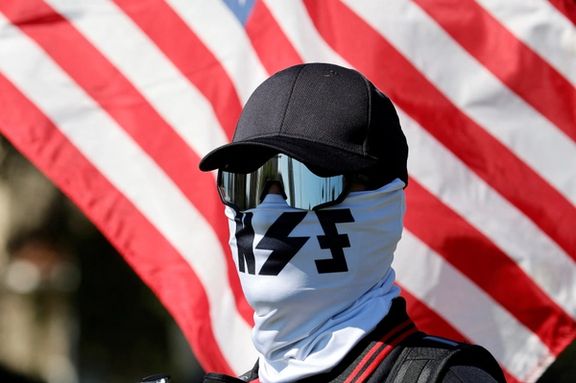
A member of the white nationalist group NatSoc Florida protests against U.S. support for Israel, in response to the war between Israel and Hamas, in Lady Lake, Florida, US, October 21, 2023.
Defending the rights of the Palestinians should not turn into an anti-Semitic hate crusade, as we have witnessed since the Hamas terror attack on October 7.
In January 1991, as the Gulf War loomed, I was a college student in Italy, witnessing a tumultuous period in the Middle East. The eight-year-long Iran-Iraq War had just concluded in 1988, and it was evident that Iraq's military might stand no chance against the American-led coalition of 42 nations. However, to my astonishment, my Arab classmates, predominantly Lebanese and Syrians, were fervently cheering for Saddam Hussein, firmly convinced of his imminent triumph over the US and its allies.
When I expressed skepticism about Iraq's prospects against such overwhelming odds, they were resolute, insisting that "Saddam has a plan." Even as we watched the news, seeing Saddam's tanks and army being decimated, my classmates continued to chant "Allahu Akbar," confident that Saddam would soon launch an attack against the US and its allies. This anecdote illustrates the lengths to which people can go to protect one of their own, often disregarding basic principles of truth, facts, decency, and fairness.
This episode from my college days reveals a disturbing truth about how pride, honor, tribal loyalty, and culture can sometimes overshadow moral principles. Suddenly, Saddam Hussein's past transgressions seemed to fade into insignificance. The atrocities committed during the eight-year war against Iran, the invasion of Kuwait, the brutal treatment of the Kurdish people, and even the suffering inflicted upon his fellow Iraqis ceased to matter. What became paramount was Saddam's defiant stance against the United States and his refusal to withdraw troops from Kuwait.
People wearing anti-semitic clothes wave Nazi flags, as they protest outside the Tampa Convention Center where Turning Point USA’s (TPUSA) Student Action Summit (SAS) is being held, in Tampa, Florida, US, July 23, 2022.
Fast forward to today, and we find a troubling pattern of antisemitic protests sweeping across the world, all under the guise of defending the people of Gaza. These protests, while ostensibly about solidarity with Palestinians, have taken on a disturbingly anti-Semitic and anti-US tone. It is essential to separate legitimate criticism of Israeli policies from the blatant hatred directed at Jews, as these protests frequently conflate the two.
Furthermore, it is concerning to note that some pro-Gaza protesters openly express support for terrorist groups like Hamas, the Houthi rebels, and Hezbollah, glorifying the brutal attacks of October 7, 2023, and chanting slogans like “from the river to the sea, Palestinians will be free,” and "Jihad." These slogans are not innocent chants.
Michael Calvin McGee, a scholar known for his work on the role of ideology and ideographs in political discourse, underscores ideology's subtle and pervasive nature within language and discourse, reminding us that even seemingly innocuous interactions can carry underlying political implications. Understanding this aspect of language is essential for recognizing how ideology shapes our perceptions and behaviors in society.
Hamas, the Houthi rebels, and Hezbollah have been designated as terrorist groups by various countries and international bodies due to their involvement in acts of violence, terrorism, and the promotion of extremist ideologies. Associating with such groups and glorifying them undermines the credibility of the protests and raises serious security concerns.
Pro-Palestinian demonstrators protest during the ongoing conflict between Israel and the Palestinian Islamist group Hamas, near the Israeli embassy in London, Britain, October 9, 2023.
Hamas and other Gaza militants captured some 250 people during their deadly October 7 attack on southern Israel. They killed some 1,200 other people, most of them civilians, and have been responsible for launching rocket attacks on Israeli civilian population, leading to the loss of innocent lives on both sides. The Houthi rebels in Yemen have caused a humanitarian catastrophe with their violent actions, while Hezbollah has been involved in numerous acts of terrorism across the Middle East. Chanting "Jihad" in support of these groups sends a chilling message and undermines any legitimate grievances related to the Israeli-Palestinian conflict.
These developments should serve as a wake-up call to those participating in or sympathizing with such protests. While it is essential to advocate for the rights and well-being of Palestinians, aligning with extremist groups only deepens the divisions and exacerbates the suffering of all parties involved. Peaceful dialogue and diplomacy are the only viable paths toward a lasting resolution in the Israeli-Palestinian conflict, and they should be prioritized over expressions of hatred and support for terrorism.
The situation in Gaza is undoubtedly complex, marked by a long history of conflict and suffering on both sides. Palestinians have endured hardships, and their plight deserves attention and empathy. However, using their suffering as a pretext for anti-Semitic expressions and actions is inexcusable.
The protests around the world have seen an alarming rise in incidents of anti-Semitism. Synagogues have been vandalized, Jewish businesses targeted, and innocent Jewish individuals harassed. This wave of hatred against Jews is unjustifiable and condemnable. It is vital to emphasize that being critical of Israeli government policies should never be a license for bigotry or hatred toward Jews as a whole.
Just as my Arab classmates rallied behind Saddam Hussein in the face of his transgressions, we are witnessing a similar phenomenon on a global scale. Protesters, driven by their convictions or misled, are prioritizing their cause above all else, even at the expense of perpetuating hatred against an entire community. This parallels the selective amnesia displayed by my classmates, who chose to ignore Saddam's actions in favor of his defiance against the United States.
It is essential to call out and condemn these actions unequivocally. Combating anti-Semitism should be a collective effort, irrespective of one's stance on the Israeli-Palestinian conflict. We must recognize that anti-Semitism, like any form of hatred, erodes the moral fabric of society, leading to violence, discrimination, and division.
Education and dialogue are crucial to addressing this issue effectively. People should be encouraged to engage in respectful conversations about the Israeli-Palestinian conflict, acknowledging its complexities and seeking peaceful solutions. It is essential to recognize that specific Quranic verses, such as those related to the Battle of Khaybar, contain elements of "hate speech." Muslims must embrace the imperative of letting go of grievances that have persisted for centuries, particularly those stemming from historical conflicts involving Prophet Mohammad and Jewish tribes.
Indeed, it is disconcerting that certain individuals find it acceptable to chant "from the river to the sea." Millions of dollars in Qatari aid flew into Gaza to enhance its inhabitants' lives. Regrettably, these funds were misappropriated by Hamas, who diverted resources toward tunnel construction, acts of aggression against Israel, and the abduction of innocent civilians. This support for terrorist entities must be brought to an end, fostering an environment conducive to peace and stability.
It is disheartening to see the legacy of hatred and tribal loyalty repeating itself in today's world, with anti-Semitic protests cloaked as support for Gaza. It is incumbent upon all of us to denounce anti-Semitism and ensure that the pursuit of justice for any group does not come at the expense of fostering hatred towards another.
The opinions expressed by the author are not necessarily the views of Iran International
Iran's foreign minister has rejected accusations of supporting Houthi rebels in Yemen, responsible for disrupting global trade through attacks on commercial vessels.
In an interview with CNBC at the World Economic Forum in Davos, Hossein Amir-Abdollahian claimed that people from Yemen and other regional countries defending the Palestinians are acting independently in spite of Iran having backed the group militarily and financially for years.
“The people of Yemen and other countries in the region who defend the Palestinian people are acting according to their own experience and through their own interests, and they are not receiving any orders or instructions from us,” he said, though the order to blockade Israel came publicly and directly from Iran's Supreme Leader.
It followed Israel's relentless retaliatory attacks on Gaza in response to the October 7 massacres in which 1,200 mostly civilians were murdered by Iran-backed Hamas and over 250 more taken hostage.
The Houthi militia initiated dozens of drone and missile attacks on Israeli territory and shipping in the Red Sea since November. On Monday, the Houthis launched an anti-ship ballistic missile at a US-owned commercial vessel, as reported by the US Central Command. The Red Sea accounts for 12% of global shipping.
In the ongoing conflict, Iran supports Hamas in its confrontation with Israel and continues to supply weapons to the Lebanese militant group Hezbollah which has targeted Israel's north in support of Hamas. Responding to the Houthi attacks, the US and its allies have initiated strikes against Houthi targets in Yemen.
Amir-Abdollahian also cautioned the US against “tying their destiny” to Prime Minister Benjamin Netanyahu's fate, asserting that Washington's full support for Israel is a root cause of insecurity in the region.
A group of Iranian intelligence forces during a military parade in Tehran
In spite of Iranian denials, the Australian government admits it is “concerned” by Iran’s ongoing espionage activities.
A spokeswoman for Australia’s Home Affairs Department told Iran International: “Last year, the Australian Government made it clear that it is concerned by reports of harassment and monitoring of people in Australia by foreign governments, including Iran.”
Earlier this month, The Australian Financial Reviewpublished an interview with the Islamic Republic’s Ambassador to Australia, Ahmad Sadeghi, during which he rejected claims by Australia's Home Affairs Minister Clare O’Neil that the Iranian government had been spying on dissidents in Australia, insisting they were safe from harm or kidnapping.
However, last year, O’Neil revealed that Australia had disrupted the activities of suspected Iranian intelligence who had conducted surveillance of the home of an Iranian-Australian dissident, as well as their family, part of a wider global crackdown in the wake of the 2022 uprising.
"I just want to step back and say this again: we have here someone living in our country who is being followed, watched, photographing their home invaded by people at the direction of a foreign power. This is happening in Australia, and this is something ASIO was onto like a shot," O'Neil said last year.
And the threat does not seem to have disappeared. “Espionage and foreign interference represent a serious threat to Australia’s security and the integrity of our national institutions,” the Department of Home Affairs told Iran International this week.
While stressing it is not only Iran which represents a threat, other nations such as China are equally troubling, the spokeswoman added: “It is unacceptable for any foreign government to target members of our community in ways that prevent individuals exercising their fundamental rights and freedoms in Australia. We will continue to take strong action to deter foreign interference, protect the Australian community and uphold our laws and values.”
Tina Kordrostami, an Australian-Iranian woman, spoke out about her own ordeal after experiencing harassment on Australian soil by a suspected regime agent in December 2022 amidst the protests.
Not only was she followed, but a strange man got into her car while stationary, issuing threats.
Kordrostami's father also started receiving threats against her life, and she found herself under surveillance, with unidentified men taking photographs of her during rallies and public events.
After she made the revelations to Iran International, several other Australian-Iranians since broke their silence, highlighting how the Iranian regime monitors their activities in Australia. This has raised concerns among the community, who are now demanding protection from the Australian government.
While Australia has been among the nations to sanction Iran in the wake of both the brutal crackdown of protesters since 2022, and Iran’s arming Russia in its invasion of Ukraine, it has not stepped up to designate Iran’s Revolutionary Guard Corps which has had foreign plots foiled in countries from the UK to Cyprus and Azerbaijan.
TheAustralian Shadow Assistant Foreign Minister expressed disappointment in November that Australia has not listed Iran's Islamic Revolutionary Guard Corps (IRGC) as a terrorist organization.
"It's incredibly disappointing that governments like Australia have not yet listed Iran's IRGC as a terrorist organization up to this point," she told Iran International, not least for its backing of regional proxies such as Hamas in Gaza and Hezbollah in Lebanon and its destabilizing effects now felt across the Middle East and beyond.
Some of the materials seized and unpacked by USCENTCOM
US Navy forces intercepted a small vessel transporting advanced lethal aid from Iran to replenish Houthi forces in Yemen.
“US Navy SEALs operating from USS LEWIS B PULLER (ESB 3), supported by helicopters and unmanned aerial vehicles (UAVs), executed a complex boarding of the dhow near the coast of Somalia in international waters of the Arabian Sea, seizing Iranian-made ballistic missile and cruise missiles components. Seized items include propulsion, guidance, and warheads for Houthi medium range ballistic missiles (MRBMs) and anti-ship cruise missiles (ASCMs), as well as air defense associated components,” said CENTCOM in a statement on Tuesday.
This marks the first interception of lethal Iranian-supplied advanced conventional weapons destined for the Houthis since their attacks on merchant ships began in November 2023.
Additionally, it's the first interception of advanced Iranian-manufactured ballistic missile and cruise missile components by the US Navy since November 2019. Providing, selling, or transferring weapons to the Houthis violates UN Security Resolution 2216 and international law.
Considering the small vessel unsafe, US Navy forces sunk it. The fate of the 14 dhow crew members will be determined in accordance with international law.
Since mid-November, the Houthis have directed their attacks toward commercial vessels, a response to Israel's offensive in Gaza. This has resulted in the closure of a significant maritime route, causing disruption to the global flow of goods. The initiation of the attacks coincided with a call from Iran's Supreme Leader, Ali Khamenei, urging the blockade of Israel.
"It is evident that Iran continues to ship advanced lethal aid to the Houthis, actively promoting instability in the region, in direct violation of UN Security Resolution 2216 and international law," remarked General Michael Erik Kurilla.
A view of a damaged building following missile attacks, in Erbil, Iraq, January 16, 2024.
Multiple foreign diplomatic missions in Iraq have condemned Iran's assault on Erbil on Monday.
The US Ambassador to Iraq, Alina L. Romanowski, said the missile strikes on the Iraqi Kurdistan Region were “reckless and indiscriminate attacks on civilians" which violated Iraq's sovereignty.
The UK's Ambassador to Baghdad, Stephen Hitchen, also condemned the aggression against Erbil, denouncing it as a breach of Iraq's sovereignty and territorial integrity. Hitchen extended condolences to the victims' families and expressed support for the Kurdistan Regional Government.
His sentiments were echoed by UK Foreign Secretary David Cameron who issued a statement on X condemning the Iranian attacks as "unprovoked and unjustified actions," constituting a violation of Iraq's territorial integrity. Germany, France, and the Netherlands also condemned the assault.
Canada's Ambassador to Iraq, Kathy Bunka, and Japan's envoy to the country, Futoshi Matsumoto, joined in condemning the attack. Matsumoto stressed the importance of respecting Iraqi sovereignty and peace by all parties, while Bunka conveyed condolences to the victims' families and the injured.
The incident occurred late on Monday when Iran's Islamic Revolutionary Guard Corps (IRGC) launched 10 ballistic missiles, purportedly targeting the "spy headquarters" of anti-Iran groups in Erbil. The attack resulted in a minimum of four fatalities and 17 injuries.
Iraq's foreign ministry also denounced the Iranian aggression against Erbil, taking diplomatic action by summoning the Iranian charge d'affaires in Baghdad, delivering a protest note condemning the attack. Additionally, Iraq recalled its ambassador to Tehran for consultations in response to the recent Iranian attacks on Erbil.
Nasser Kanaani, the spokesperson for the Iranian foreign ministry, asserted that the attacks aimed “at defending the country's sovereignty and security, combating terrorism.”
Iran's Supreme Leader Ali Khamenei during a meeting in Tehran on January 16, 2024
Despite international criticism of Houthi attacks in the Red Sea, the leader of the Islamic Republic commended and praised the militia.
In a speech on Tuesday, Ali Khamnenei claimed that the Houthis have struck a blow to the "vital arteries of Israel."
The Shiite Houthi group in Yemen, known as Ansarullah, which has long enjoyed significant financial and military support from the Islamic Republic, has committed dozens of attacks on global shipping, including US and Israeli linked vessels since November.
US and British forces jointly targeted dozens of positions of the militants in response to Houthi attacks on international shipping routes in the Red Sea and the Gulf of Aden last Thursday.
Subsequently, the US President announced that Washington had delivered a "private message" to Iran regarding the Houthis and their attacks on commercial ships in the Red Sea, which is a major trade passage, forcing many companies to go longer, more costly routes. The Iranian Foreign Minister confirmed receiving the message but stated that the Houthis would continue their attacks in the Red Sea until the end of the Gaza conflict.
In his speech to Friday prayer leaders in Tehran, Ayatollah Khamenei, who first called for the blockade in the wake of the Gaza war sparked by Hamas's invasion of Israel on October 7, praised and prayed for the "struggle and resistance" of the Shiite Houthis, urging it to "continue until victory."
He said, "What they did in supporting the people of Gaza is commendable. They struck blows to the vital arteries of the Zionist regime, without fearing the United States."
Khamenei's comments recall his statements about the extremist group Hamas in response to its attack on Israeli soil on October 7 when he said, "We kiss the foreheads and arms of the resourceful and intelligent designers [the operation] and the Palestinian youth." Hamas has also long been supported financially and militarily by Iran in its battle against Israel and the West.