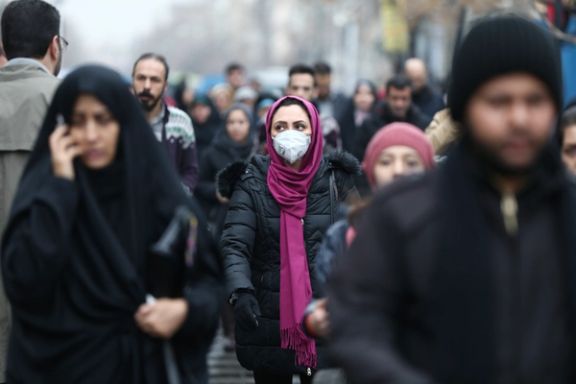
An Iranian woman wearing a protective mask to prevent contracting a coronavirus walks at Grand Bazaar in Tehran, Iran February 20, 2020.
A former official in Iran's Covid Taskforce says the country’s Covid deaths were nearly twice the figures authorities reported for the first two years of the pandemic.
Speaking to the reformist Etemad newspaper, Ali-Akbar Haghdoust, head of the Covid Taskforce’s epidemiology committee, said estimates based on some studies, including a study by Ardabil Medical Sciences University published in early March 2023, shows that 240,390 Iranians died from Covid between February 2020 and February 2022 against the official figure of 136,166.
According to Haghdoust, other studies have shown that real number of deaths from Covid ranged from 45.2 to 49.4 percent higher than official figures.
“It does not entail much negative consequences to say this today, but many experts and specialists in the field of health and even other fields such as economics and politics, who criticized the government for untrue reports of Covid infections and deaths between 2020 and 2022 were harshly treated, because questioning the official figures proved health authorities were hiding the facts,” he said.
Iran was the second country in the world after China to declare an epidemic in February 2020 and reported nearly 145,000 Covid deaths, the Middle East’s highest official level, and 7.5 million confirmed cases.
Iranian women wear protective face shields and masks as they walk in Tehran Bazaar in Tehran, Iran April 6, 2021.
Researchers tracking the pandemic globally have noted that “excess deaths” reflect many factors, including those indirectly due to Covid including a stretched health system, but allegations abounded at the time that Iranian authorities were deliberately under-reporting Covid deaths.
A study published by the Lancet in March 2022 suggested that in the first two years of the pandemic − up to December 31, 2022 −there were globally 18 million excess deaths, with only 6 million officially attributed to Covid.
Many Iranians also blamed Supreme Leader Ali Khamenei for putting a ban on importing vaccines developed in the United States and Britain in January 2021, for causing many more Covid deaths than if vaccination efforts of the government of President Hassan Rouhani had not been delayed for months.
Iran's Supreme Leader argued that these vaccines had to be avoided because these countries could be testing their vaccines on other nations and urged developing vaccines domestically.
Khamenei's ban was supported by hardliners who following his lead said Iranians could not be used as "guinea pigs" to test Western vaccines. The Rouhani administration reluctantly backed off and looked for joint production with Cuba, purchases from several countries including China, Russia, and India, and using homegrown vaccines as they would become available.
At the time, the US-German Pfizer, US-made Moderna and the British-made AstraZeneca were the only vaccines approved internationally, although Bahrain and the United Arab Emirates had already approved the use of China’s Sinopharm which was later imported by Iran too. Sinopharm accounted for over 80 percent and AstraZeneca for around 10 percent of all vaccinations in Iran.
Vaccination picked up when hardliner Ebrahim Raisi assumed the presidency in August 2021 and vaccines that had been ordered began to arrive. In September 2021 only around 14 percent of Iranian had been vaccinated.
Some of the country’s vaccine producers, including the state-owned Barekat Foundation, received hundreds of millions of dollars to start their vaccine development program from scratch despite having had no experience in the field. None of the several vaccines developed domestically was ever approved by the World Health Organization.
Homegrown Covid vaccine factories, however, began shutting down in mid 2022 for lack of demand as many who were vaccinated with foreign vaccines refused to get homegrown ones as boosters.
Iranian rapper Toomaj Salehi has been sentenced to further jail time as the regime cracks down on dissent, holding the celebrity as an example to the nation.
He has been convicted to "one year imprisonment, two years passport annulment, and participation in a behavioral management course," as revealed by his lawyer on Monday. Amir Raisian, sharing the announcement on social media, explained that Salehi's conviction is linked to "propaganda against the system" and the rapper's grievances against case officers.
As the regime continues to battle dissenting voices, prominent figures such as Salehi have been punished harshly, with many receiving jail time, travel bans and bans on work, to deter the public from further protest.
Salehi's lawyer penned an open letter to Gholamhossein Mohseni Ejei, the head of the judiciary, characterizing the legal proceedings as "the strangest and most extraordinary." The lawyer raised questions about the process's conformity to criminal procedural laws.
Salehi, initially released on bail on November 18 after enduring 252 days in prison, found himself back in custody just 12 days later. This followed the release of a video in which Salehi detailed the torture he endured during his imprisonment. The rapper, in the video, cited the experiences as the basis for his complaints against prison officials and government-affiliated media.
Salehi's social media account reported on December 14 that he suffered "severe damage to the eyes and face" during his latest arrest by government forces, contradicting official statements and raising concerns about the adherence to the law during the violent incident in Babol.
Salehi gained fame for his protest songs that tackled social issues and government injustices in Iran. His first arrest in October 2022 was a component of a wider crackdown on political dissidents of the regime, a response to the protests triggered by the death of Mahsa Amini in morality police custody.
The suicide of six workers at a petrochemical plant in Iran in less than two years is viewed by a prominent economist as an extreme form of protest.
Hossein Raghfar, an economist at Tehran's Al- Zahra University, known for his research on poverty in Iran, expressed this perspective in an interview with the Didban-e Iran news website after two workers, Javad Norouzi and Mostafa Abbasi, attempted suicide at the Ilam Petrochemical Plant in Ilam Province. Their attempt was by hanging themselves, and although they were rescued by colleagues, they are reportedly in critical condition in the hospital.
Raghfar believes the widespread corruption in the government and mismanagement of the economy, mostly controlled by regime insiders, drive some workers to the desperate act of suicide.
The two workers were among thirteen workers the company announced Thursday it wanted to lay off. Colleagues also told ILNA website that the two men hanged themselves at the plant to make a point so that authorities could not claim family issues had driven them to suicide.
Economist Hossein Raghfar
In July another employee of the company, Heydar Mohseni, a married father of two, took his own life after receiving a dismissal order after eighteen years of service. This was the fourth such incident within a period of twelve months.
With around 2,000 employees, Ilam Petrochemical Plant is the largest private sector petrochemical company in the west of Iran. However, its production, inaugurated in 2020, is currently only at around fifty percent of its nominal capacity due to feed procurement issues.
Workers have reported receiving very low wages for harsh working conditions, with irregular payments. Like many Iranians, they have also had to endure austerity resulting from an inflation rate of well over 40 percent in the past three year.
Hossein Raghfar stated that "self-destruction and suicide are one of the most acute and extreme forms of protest to the chaos caused by wrong economic policies." He attributed the prevalence of depression and extreme actions to the perception of widespread financial corruption in government systems, which can lead to anger, rage, and, ultimately, suicidal acts as a form of protest and rebellion when economic and social policies erode hope in the future for many people.
Company officials say the workers who attempted or committed suicide were contract workers and declined to take responsibility. However, this is what most oil and petrochemical sector companies do, by not offering permanent employment. Their owners and managers are mostly well-connected people, who get away with violating rules and regulations.
Other workers told ILNA that for a month there had been talk of laying off thirteen workers, all of whom had an employment record of between eight and eighteen years. Workers claim laying off these workers for redundancy is only an excuse to replace them with others.
“The petrochemical plant is our only hope. The only place we can work. Where can we find work if we are sacked from here,” ILNA quoted workers as saying.
“You cannot violate the job security of workers with 8 to 18 years of service by pointing a finger at contractors and arguing that contractors leave, so the workers [in their employment] must leave, too,” Farshad Esmaili, labor law expert, told the Iranian Labour News Agency (ILNA).
“Outsourcing, dropping the value of labor, temporization [of employment] and deregulation which are the characteristics of neo-liberal economy, are policies that lead to worker suicide,” he said.
Ilam has one of the highest rates of unemployment among Iranian provinces as well as the highest rate of suicide in the country in all but three years over the past three decades.
Iran's Alborz warship has entered the Red Sea at a time of soaring tensions on the key shipping route amid the Israel-Hamas war and Houthi attacks on vessels.
Iranian state media did not give details of the Alborz's mission but said Iranian warships had been operating in open waters to secure shipping routes, combat piracy and carry out other tasks since 2009.
Yemen's Iran-backed Houthis have been targeting vessels in the Red Sea since November to show their support for the Palestinian Islamist group Hamas in its war with Israel.
In response, many major shipping companies have switched to the longer and more costly route around the Africa's Cape of Good Hope rather than pass through the Suez Canal, which handles about 12% of global trade.
The Alborz warship entered the Red Sea via the Bab al-Mandab Strait, IRGC-affiliated Tasnim news said, without saying when. There were unconfirmed reports on social media it arrived late on Saturday.
The Alvand class destroyer had been a part of the Iranian navy's 34th fleet, alongside the Bushehr support vessel, and patrolled the Gulf of Aden, the north of the Indian Ocean and the Bab Al-Mandab Strait as far back as 2015, according to Iran's state-run Press TV.
The US Fifth Fleet said it could not speak for the Iranian Navy or comment on the unconfirmed reports of the Iranian vessel's movements.
Houthi militants attacked a Maersk container vessel with missiles and small boats on Saturday and Sunday, prompting the company to pause all sailing through the Red Sea for 48 hours.
The head of Iran's Navy, Shahram Irani, was quoted in Iranian media on December 2 as saying that the Alborz was carrying out missions in the Red Sea.
Iran's Defense Minister Mohammad Reza Ashtiani said on December 14 in reference to the Red Sea that "nobody can make a move in a region where we have predominance".
A moderate conservative politician in Iran asserts that the concepts of reformism and conservatism have lost their meaning for the people, struggling for a living.
Former lawmaker Heshmatollah Falahatpisheh told the press that both of the main political factions in Iran have fallen victim to their leaders' opportunism. He charged that leaders of both factions have exploited their members with populist policies that only served their personal interests.
Falahatpisheh did not name anyone in the two leading factions, but Iranian protesters have been voicing their disillusionment and disappointment about conservatives and Reformists in major protests in Iran since 2018 by chanting "It's all over for both reformists and conservatives."
He said that populism and prioritizing personal gains by key politicians have become the perils of political participation at election times. He added that major politicians of both camps can no longer exercise any influence on the voters.
Falahatpisheh further argued that the opportunists have always had short-term interests in politics and never tried to leave a lasting impact on the people's lives. "Their greed for power and wealth has done a lot of damage to the country," he said. To support his point, Falahatpisheh pointed out that the members of both of leading political factions have been involved in major financial corruption cases.
Former lawmaker Heshmatollah Falahatpisheh
Nonetheless, and although Iranian media commentators and politicians generally believe that there is no room for participation and competition in the upcoming parliamentary election for Iran's reformists, all of whose candidates have reportedly been barred from running for the parliament, still, part of the reform camp, in particular three moderate parties, are keen to take part in the March 1 elections.
This comes while major reformists parties and their leading politicians have said that they are not going to take part in the elections. Reformist leader and former president Mohammad Khatami has said that there is no point in political participation when the regime is not prepared to introduce any change in the political system. Jailed reformist figure Mostafa Tajzadeh has openly talked about boycotting the elections.
According to Nameh News, however, three moderate reformist parties, the Executives of Construction Party led by Hossein Marashi, Neda-ye Iranian Party led by Shahaboddin Tabatabai, and the Moderation and Development Party led by former Vice President Mohammad Bagher Nobakht are determined to nominate their candidates for the upcoming elections.
No well-known reformist or moderate candidates have been allowed to run in the first phase of the vetting by the Interior Ministry, and insiders of the reform camp say there is no one left to run. However, some Reformists say they will look for moderate faces among those whose qualifications will be endorsed by the Guardian Council in January. The Moderation and Development Party which is close to former President Hassan Rouhani says it will name 16 candidates for the list of 30 candidates for the seats that represent Tehran. They probably hope that the other two parties will fill the other 14 slots in the list as well as several others in the provinces.
Although conservative politicians usually dismiss plans and even wishful thinking of the Reformists and moderates to take part in the election, conservative activist Mohammad Ali Pourmokhtar has told Nameh News that conservatives should be weary of a surprise comeback by the reformists.
Pourmokhtar added that Reformists might be able to benefit from the situation if conservatives cannot achieve a consensus among themselves and announce several lists of candidates rather than one.
Such a surprise is not unprecedented. In 1997 when Iranian conservatives and their leaders were almost certain that they were going to win the presidency, a hitherto unknown reformist figure Mohammad Khatami's landslide victory took the entire conservative camp by surprise. In the parliamentary elections, a substantial win means to have around half of the 290 seats at the Majles.
"This is not conceivable at least at this point," a seasoned Iran analyst told Iran International.
A general view of a gas station in Tehran during a nationwide disruption caused by a cyberattack, December 18, 2023
An Iranian parliamentarian claims that the information security cooperation agreement between Iran and Russia is advantageous for Tehran in spite of ongoing cyber attacks.
In a statement to local media, Abolfazl Amouei, a member of the Iranian Parliament and spokesperson for the National Security Commission stated that "Russia is contributing to the cybersecurity of the Islamic Republic of Iran."
The approved bill, originating from an agreement signed three years ago by former Iranian Foreign Minister Mohammad Javad Zarif and Russian Foreign Minister Sergei Lavrov, consists of nine articles. It primarily addresses joint efforts to counter cyber threats, strengthen information security measures, and foster cooperation between the two nations. Notably, the legislation includes a clause specifying the exchange of information and collaborative prosecution of criminal offenses between Iran and Russia.
The deepened political, military, communication, and cyber ties between Tehran and Moscow have elicited concerns among Western nations and their allies. Microsoft's Threat Analysis Center (MTAC) recently issued a warning about potential collaborative efforts by Russia, Iran, and China to influence upcoming elections, including the 2024 United States elections. The warning highlighted the possibility of authoritarian regimes targeting "election infrastructure, campaigns, and voters" through cyber means.
Iran's government networks have been hit multiple times by hacking groups, increasing in the wake of the 2022 uprising, while in December, its gas station networks were hit, reducing activities by 70 percent.