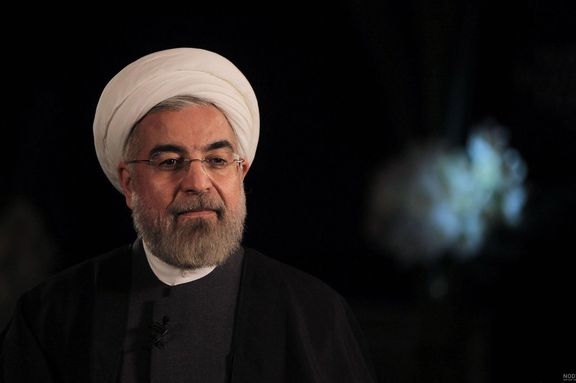
Iran's former president Hassan Rouhani has accused hardliners in power of preferring low-turnout parliamentary elections in March to keep control of the legislature.
“The ruling minority will establish itself better if we don't participate in the elections and minimal elections are held … There is a minority that does not want the majority to go to the ballot box,” Rouhani said in a speech at a meeting with a group of clerics and seminarians on Wednesday.
Rouhani’s website published the text of his speech on Saturday, shortly after Supreme Leader Ali Khamenei in a speech to a large group of hand-picked people from Kerman and Khuzestan provinces stressed the importance of voting in the upcoming elections.
In addition to electing a new parliament, the March 1 vote will also select the eighty-eight clerics of the Assembly of Experts that must choose Khamenei’s successor.
Blaming the opposition for discouraging people from voting, Khamenei insisted that the solution to the country’s problems is voting to form a “strong parliament” and that elections could prevent “dictatorship, chaos, insecurity, and turbulence (anti-government protests)”.
Rouhani registered to run in the elections of the Assembly of Experts at the last moment. He has been a member of the council for three consecutive terms since 1999. The last time that he was elected to the council was during his second presidential term in 2016 when he ran on a slate headed by the moderate former President Akbar Hashemi-Rafsanjani.
Presidents Ebrahim Raisi (left), Supreme Leader Ali Khamenei (2nd left), former president Hassan Rouhani and former parliament speaker Ali Larijani
President Ebrahim Raisi joined the council eight later than Rouhani, in 2007.
Agahi-ye No, a reformist bi-monthly, has claimed that several influential figures including the reformist former vice president, Esh’aq Jahangiri, former moderate conservative speaker of the parliament Ali Larijani, and moderate conservative former speaker Ali-Akbar Nateq-Nouri advised Rouhani to run again.
Last week, the Secretary General of the pro-Rouhani Moderation and Development Party, Mohammad-Bagher Nobakht, who also served as the Rouhani administration’s spokesman, said Rouhani is trying to put together a list of sixteen candidates for the Council seats from Tehran but has no intention of doing the same for the parliamentary elections.
Rouhani's website featured a headline that emphasized a sentence from his speech: "Sometimes not voting in elections is a kind of vote." This statement has been perceived by some of his opponents as an encouragement to abstain from voting.
In an editorial on Sunday, the ultra-hardliner Bultan News attacked Rouhani for “proposal not to participate in the elections, on the same day that the Leader of the Revolution stresses participation.”
However, in his speech the former president argued that by not voting, people may be indirectly expressing their opinion about candidates who are not considered competent. In the absence of suitable candidates, it is hard to encourage people to go the ballot boxes, he stated.
“We should try to encourage people to participate and take [appropriate] measures so that those who come to the polls can vote for at least a few people instead of casting blank ballots,” he said referring to the unprecedented blank and void votes that made up at least 10 percent of the vote in the 2021 presidential elections.
Convinced that hardliners committed to Khamenei’s policies will cruise to victory with the help of the Guardian Council, which has barred most other insiders, many Iranians are showing very little interest in the upcoming elections.
A poll recently conducted by the semi-official Iranian Students Polling Agency (ISPA), found 27.9 percent of those polled saying they would definitely vote against 36 percent who said they would not under any circumstances. 21.9 percent said they had made no decision yet.
Swedish EU employee Johan Floderus attends a court session in Tehran, Iran, December 20, 2023.
Iran's hardline newspaper Kayhan, has warned that Johan Floderus, a Swedish man currently held in Iran, would receive "significant and regrettable convictions".
The publication, recognized as the official mouthpiece for the leader of the Islamic Republic of Iran, likened the cases of Floderus and Hamid Nouri, a former Iranian prison official held in Sweden for his role in the 1988 massacre of political prisoners.
Floderus, like most foreign prisoners, has been accused among other crimes of "collaboration with Israel". He is one of an unknown number of foreign nationals or dual-nationals held in Iran under its policy of hostage diplomacy.
Currently facing charges of "corruption on earth," a serious Sharia accusation that could lead to a death sentence, Floderus is ensnared in a case that mirrors the lack of transparency characterizing numerous detentions of foreigners in Iran.
Detained in April 2022 on espionage charges during a visit to Iran, Floderus is navigating a legal process marked by limited transparency, raising concerns about a potential hostage situation. His detention has now surpassed 600 days.
Last week witnessed a Swedish court upheld the conviction of Nouri in a first of its kind. It is the first time a member of government has publicly been brought to justice for the tragedy which saw the murder of thousands.
Russian President Vladimir Putin shakes hands with Iranian President Ebrahim Raisi during a meeting in Moscow, Russia December 7, 2023.
Reactions in Tehran to Moscow's support for Arab claims over three Iranian islands continue, with a lawmaker suggesting that Russia prefers Iran to remain isolated in the world.
Referring to the islands of Greater and Lesser Tunbs and Abu Musa in the Persian Gulf, MP Ahmad Avaei, a member of the National Security and Foreign Policy Committee, said President Ebrahim Raisi's reaction to Russia is weak. “It is surprising that Iran does not exhibit a strong reaction to Russia's actions," he said.
Avaei demanded a serious review of Iran's foreign policy and a more thorough examination of the possible damages inflicted by such political maneuvers by Russia.
Meanwhile, former Foreign Minister Javad Zarif stated during a gathering that it is natural for Russia to act according to its own interests. "If we offered excessive concessions to Russia with the wrong mindset, we should not expect similar behavior from Moscow," he said.
In spite of Iran and Russian getting ever closer since the Ukraine war, Avaei said Iran could not expect loyalty from Russia, which has historically been a fair-weather ally, from the Iran-Iraq war when it sided with Iraq to the latest dispute. “The Russians have always been the way they are, and one should not think that they have changed," he said. "They feel that this move contributes to their income, given Russia's strong interest in petrodollars, surpassing even their interest in dealings with Iran."
The declaration has dozens of articles, most of which are merely repeated from one event to the other, calling for "bilateral negotiations or the International Court of Justice, in accordance with the rules of international law and the United Nations Charter, to resolve this issue in accordance with international legitimacy".
Iranian media, opposition activists and ordinary Iranians usually view theregime’s reactions as not strong enough. On Friday, Foreign Minister Hossein Amir-Abdollahian held a phone call with his Russian counterpart Sergey Lavrov, who reportedly reassured Iran that "The sovereignty and territorial integrity of the Islamic Republic of Iran has always been respected by Russia and Moscow's official policy in this regard should never be doubted."
A plenary meeting of the 6th session of the Russian-Arab Cooperation Forum, Marrakesh, Morocco, December 20, 2023
The three Persian Gulf islands have historically been part of Iran, proof of which can be corroborated by historical and geographical documents. However, the United Arab Emirates has repeatedly laid claim to the islands, describing the situation as “the continued occupation by the Islamic Republic of Iran.”
The three islands fell under British control in 1921 but on November 30, 1971, a day after British forces left the region and just two days before the UAE was to become an official federation, Mohammad Reza Shah sent the Iranian navy to secure all three. Iranian forces remain on the islands, with only Abu Musahaving a civilian populationwhich is less than two thousand.
During the past few years, each time Russia declares its alignment with the Arab states, the domestic political scene in Iran is abuzz with comments about how Moscow exploits its ties with Tehran.
Avaei also pointed to Iran's economic interests in relation to Russia and said that the relationship with Moscow not only does not have economic benefits for Tehran but also harms Iran because Russia sells goods at a higher price to Iran."
The lawmaker also referred to Iran’s 2015 nuclear deal with world powers, saying that Russia is not aiming for the resolution of issues or the enhancement of Iran's global relations. “Russians prefer an isolated Iran that only has ties with them,” Avaei underlined.
The Supreme Court of Iran has officially confirmed the death sentence for Mojahed Kourkour, a protester detained during the Women, Life, Freedom protests.
Mojahed (Abbas) Kourkour was taken into custody on December 20, 2022, following violent clashes between protesters and security forces near Izeh. Earlier this year, the judiciary issued a death sentence for Kourkour, designating him as the "main suspect" in the case involving the killing of 10-year-old Kian Pirfalak.
Pirfalak's family have explicitly blamed government forces for their son's death. On the evening of November 16 last year, the family's car, carrying Kian, his parents, and three-year-old brother Radin, was targeted by plainclothes individuals in Izeh. Kian’s father sustained severe injuries and was paralyzed during the shooting. Authorities claim the family car was attacked by "terrorists".
Contrary to official statements, Zeynab Molaei-Rad, Kian's mother, asserted that their car was shot by security forces and released a photo of herself with her hands in the hands of Kourkour's mother. Maysam Pirfalak, Kian's father, who was severely injured during the incident, also released a video rejecting the allegations against Kourkour following the judiciary's announcement.
Negar Kourkour, Mojahed's sister, said her brother's case had been transferred from the first branch of the revolutionary court in Ahvaz to a court in Izeh, southwest of Iran.
A cleric teaching a class n an Iranian elementary school
The ministry of education in Iran has announced the appointment of 3,000 male and female seminary students as teachers amidst a purge of the country's schools.
The move aligns with the ministry's broader initiative, known as the "Mosque, School, and Home" program, which includes plans to establish seminary-affiliated schools.
The development coincides with an ongoing transformation in the education system, marked by a significant "purge." Reports from September indicated the replacement of over 20,000 principals as part of the "transformation plan," implemented in the aftermath of anti-government demonstrations in 2022.
Education Minister Reza Morad Sahraei has refuted allegations of purging administrators, stating that some are retiring while others are being replaced by new individuals.
Ministers in President Ebrahim Raisi's administration have underscored the "revolutionary" nature of the education ministry. The collaboration between Iran's seminaries and the ministry of education extends to the "Amin" plan, initially focused on Qom but now encompassing other cities. Under this plan, 21,000 seminary graduates have been recruited to teach in 7,000 schools across the country.
The central branch of Shahr-e Ketab, Iran’s largest chain of book and music stores, in Tehran
Iran's Police closed down one of the country’s leading bookstores in Tehran on Friday for allowing women without “proper” Hijab to participate in a cultural event.
In a statement posted on its website, Shahr-e Ketab (Book City), a flagship chain bookstore, revealed that the police department in charge of overseeing retail shops, restaurants and similar businesses had sealed its central store in Tehran.
The police cited a “failure to abide by regulations of trade and interior ministry’s [directives]” as the reason for the closure of the popular bookstore in the heart of the capital.
Shahr-e Ketab, Iran’s largest chain of book and music stores, is a non-profit organization that operates dozens of modern bookstore-cafes across the country. In addition to selling books, it holds various cultural events.
“The Book City of Tehran was closed down over a few strands of hair!” Mohammad-Taghi Fazel-Meybodi, a prominent cleric who opposes coercion of women to wear the hijab, said in a tweet Friday. He questioned the religious and legal justification for suspending cultural centers and businesses over such minor issues and criticized the authorities for disgracing the country.
The central branch of Shahr-e Ketab, Iran’s largest chain of book and music stores, in Tehran
Fazel-Meybodi, like many others, also criticized the government for prioritizing the enforcement of hijab rules over addressing more pressing issues such as corruption and economic improvement. He suggested that the money spent on enforcing the compulsory hijab could have been better utilized to combat embezzlement and rising prices.
In recent months, authorities have increased pressure on businesses and retailers to enforce hijab rules and have warned or shut down thousands of businesses.
The closure of businesses for hijab-related issues, a tool used by authorities for four decades, is aimed at pressuring them to police women's hijab compliance, allowing the police and other authorities to avoid direct confrontation and potential clashes with citizens over hijab observance.
Many among Iranian women are increasingly refusing to wear the hijab even at the risk of being deprived from services in government offices, hospitals, and other public areas or their vehicles being impounded by the police for weeks.
On Friday an airport police official, Mohsen Aghili, said women who do not fully adhere to the “sharia-dictated hijab”, would no longer be served at airports.
After weeks of denial by various officials including the mayor of Tehran and the interior minister, the Secretary of the Supreme Cultural Revolution Council, Abdolhossein Khosropanah, on Friday confirmed that hijab enforcers are indeed organized by the council’s “Hijab and Chastity Taskforce” in coordination with the interior ministry.
Hijab enforcers, uniformed women in black veils, are sometimes accompanied by male plainclothes cameramen who record hijab breaches. They were initially stationed at metro stations in August but are now seen patrolling other public places, such as parks and busy streets, and admonishing women whose appearance does not conform to the dictated hijab rules.
Khosropanah also demanded gender segregation in universities and claimed that “the world has realized that gender segregation in different areas [of society] ensures better performance and security of both genders.”