• العربية
  • فارسی
Brand
  • Iran Insight
  • Politics
  • Economy
  • Analysis
  • Special Report
  • Opinion
  • Podcast
  • Iran Insight
  • Politics
  • Economy
  • Analysis
  • Special Report
  • Opinion
  • Podcast
  • Theme
  • Language
    • العربية
    • فارسی
  • Iran Insight
  • Politics
  • Economy
  • Analysis
  • Special Report
  • Opinion
  • Podcast
All rights reserved for Volant Media UK Limited
volant media logo

Fierce Competition Continues Between Iran’s President And Speaker
Iran International Newsroom
Dec 9, 2023, 21:18 GMT+0Updated: 11:23 GMT+0
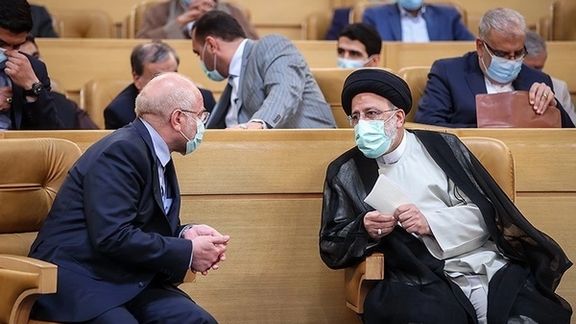
Parliament Speaker Ghalibaf and President Raisi in April 2022

President Ebrahim Raisi and Parliamentary Speaker Mohamad Bagher Ghalibaf denied their differences during a meeting at the Iranian parliament earlier this week.

Nonetheless, despite the denials, disputes between the media outlets affiliated with the two sides appear to be escalating.

But power struggles is not limited to the executive and legislative leaders. There were indications in the latest news conference of Iranian Judiciary Chief Gholamhossein Mohseni Ejei on Thursday about possible differences between him and Raisi.

Speaking about a major financial corruption case, Ejei revealed that Raisi's statement about handing over nearly 60 government officials to the Judiciary for their involvement in the case was not true. Ejei made it clear that "The government has named no one for involvement in the case."

In another development, according to Khabar Online, while Raisi has spoken about coordination of efforts between the parliament and the government, Ghalibaf has expressed concern that a difference of tastes between the two are likely to turn into disputes."

The website wrote that when Ghalibaf and Raisi met on Tuesday morning, pro-Ghalibaf newspaper Sobh-e No's editorial against Raisi's performance had already been published. The editorial called Raisi's supporters "super revolutionaries" and pointed out that Raja News, a website maintained by a close relative of Raisi has been attacking Ghalibaf for a few days.

Judiciary chief Ejei and President Raisi. Undated
100%
Judiciary chief Ejei and President Raisi. Undated

The pro-Ghalibaf daily further added that he and Ejei agree that the country's most important problems are about the economy. Consequently, the country needs legislations to prevent financial corruption cases in which government officials are regularly involved.

Nearly all fingers point at Raisi as the man responsible for the latest corruption case. Many have said that if the affair took place during the last two years of the Rouhani administration (2019-2021), Raisi should have prevented it as Judiciary Chief at the time. And if it took place during the past two years, then Raisi as president will be in a worse position as his share of the responsibility will be even bigger.

Government media outlets including Iran newspaper, the only mention Ejei and Ghalibaf in connection with the corruption case. They never say anything about Raisi, Khabar Online observed.

Media close to Ghalibaf, on the other hand, attack Raisi’s supporters in the ultraconservative Paydari party who constitute a powerful bloc in parliament, trying to increase their seats in the March elections.

However, rivalry between Ghalibaf and Raisi goes beyond the upcoming parliamentary election as both men know very well that Ghalibaf's main objective is to win the Presidential election in 2025. Ghalibaf is also aware that in any election in Iran he will have far more votes than Raisi. His calculation is based on the precedence left after the 2013 Presidential election when he was forced, by Khamenei’s men, to drop out of the race, to give Raisi a chance to win that election. Raisi, however, lost to relatively moderate Hassan Rouhani.

Meanwhile, Ghalibaf's supporters have accused the Raisi Administration of trying to intervene in the March election. To take revenge on Raisi, Ghalibaf’s men in parliament changed the Development Plan submitted by Raisi’s administration beyond recognition. Subsequently the president complained to Khamenei that what the parliament has approved cannot be implemented.

Despite all their differences, both Ghalibaf and Raisi told the press after their meeting that "We will not let others to take advantage of the difference in the two branches of the state. This will never happen!" As Khabar Online noted, regardless of what they say, it is difficult to believe pleasant words from any side. The two men's body language during the meeting, and the continuation and rather escalation of the war of words in their media outlets tell another story.


Most Viewed

Ghalibaf defends Iran-US talks amid hardline backlash
1
INSIGHT

Ghalibaf defends Iran-US talks amid hardline backlash

2
VOICES FROM IRAN

Bread shortages, soaring prices strain households in Iran, residents say

3
INSIGHT

Iran diplomacy wobbles as factions compete to avoid looking soft on US

4
ANALYSIS

The politics of pink: how Iran uses cuteness to rebrand violence

5
ANALYSIS

From instability to influence: Pakistan’s pivotal role in US-Iran diplomacy

Banner
Banner

Spotlight

  • Is Iran entering its Gorbachev moment?
    INSIGHT

    Is Iran entering its Gorbachev moment?

  • Iran crackdown reaches cemeteries as graves of slain protesters defaced
    EXCLUSIVE

    Iran crackdown reaches cemeteries as graves of slain protesters defaced

  • Iran diplomacy wobbles as factions compete to avoid looking soft on US
    INSIGHT

    Iran diplomacy wobbles as factions compete to avoid looking soft on US

  • The politics of pink: how Iran uses cuteness to rebrand violence
    ANALYSIS

    The politics of pink: how Iran uses cuteness to rebrand violence

  • Bread shortages, soaring prices strain households in Iran, residents say
    VOICES FROM IRAN

    Bread shortages, soaring prices strain households in Iran, residents say

  • Ghalibaf defends Iran-US talks amid hardline backlash
    INSIGHT

    Ghalibaf defends Iran-US talks amid hardline backlash

•
•
•

More Stories

Iranian Nobel Peace Laureate's Children Express Concerns Over Reunion

Dec 9, 2023, 20:33 GMT+0

As Iranian Nobel Peace Prize laureate Nargess Mohammadi remains imprisoned, her children express apprehension about the possibility of reuniting with their mother.

In a press conference held in Oslo, Mohammadi's children expressed immense pride in her unwavering advocacy for women's rights as they prepared to accept the prestigious award on her behalf.

The 17-year-old twins, residing in Paris, are scheduled to receive the honor at Oslo's City Hall and deliver the Nobel Peace Prize lecture om their mother's behalf. In a letter sent from prison, Mohammadi reaffirmed her commitment to the cause of human rights, even in the face of potential death, expressing that she missed her children the most.

Kiana Rahmani, who last saw her mother eight years ago, expressed a pessimistic outlook on the prospect of a reunion, stating, "Maybe I'll see her in 30 or 40 years, but I think I won't see her again." She emphasized that despite this, her mother's legacy would endure in her heart and within their family.

Mohammadi, 51, earned the Nobel Peace Prize on October 6, a symbolic rebuke to Tehran's theocratic leadership, which subsequently condemned the award.

In her message from prison, Mohammadi acknowledged imprisoned journalists and emphasized, "In the darkness cast over information and the people of Iran, despite the shutdown of media outlets, our activism persists."

Speaking about the detention of over 100 journalists during the Women, Life, Freedom movement, she highlighted that in the past 20 years, at least 200 newspapers have been shut down, and 800 journalists have been detained.

Mohammadi addressed journalists, stating, "Independent media are our best allies in the fight against the destructive policies of the Islamic Republic."

Iranian Cleric Says Most Actresses In Hollywood Are Victims Of Rape

Dec 9, 2023, 16:30 GMT+0

An Iranian cleric in charge of ideological enforcement claims that 94% of Hollywood actresses in the United States have experienced sexual assault and rape.

In a Saturday ceremony in Tehran, Abdolhossein Khosropanah, the secretary of the Supreme Council of the Cultural Revolution, made the startling claim saying the statistic is the highest rate of violence against women in the US.

However, notable for his assertion was the absence of any source or evidence to support the claims. Khosropanah went on to state, "Human rights have been restricted to propaganda games," dismissing criticism of Iran's own violations.

His comments come in the wake of a recent UN General Assembly committee resolution that criticized Iran for various human rights violations, including discrimination against and harassment of women and girls. The resolution, initially introduced by Canada, condemned the Iranian regime's misogynistic policies and practices, urging Tehran to cease its discrimination against women.

Despite international criticism, the Iranian regime has continued to tighten legislation, particularly targeting hijab and 'chastity' laws. The crackdown coincides with a growing number of women in Iran rejecting the mandatory headscarf and restrictions on their public appearance. Surveillance has intensified, and recent tragic incidents, such as the death of 16-year-old Armita Geravand, echo the concerns raised by the Women, Life, Freedom movement, sparked by the death of Mahsa Amini last year while in morality police custody.

Iran's MeToo movement has been active in shedding light on systemic sexual abuse within the country's legal system, with women facing constant threats of sexual violence both on the streets and in prison. 

Why Iran Consumes Five Times More Gas Than Turkey?

Dec 9, 2023, 16:30 GMT+0
•
Dalga Khatinoglu, Umud Shokri

As a significant winter gas shortage looms in Iran due to increased household usage, officials are once again highlighting the nation's substantial gas consumption.

A report from ISNA news agency on Friday revealed that Iran stands as the world's fourth-largest consumer of gas in the world, surpassing even Canada, recognized as an industrialized and cold climate country.

Iran annually produces approximately 260 billion cubic meters of gas, with 18 billion cubic meters allocated for export and the remainder consumed domestically. Notably, Iran also experiences losses of 25 billion cubic meters during the production and transportation stages.

In comparison, Iran's gas consumption is five times higher than Turkey's and double that of Canada's, due to lack of energy diversity. For instance, Turkey and Canada generate 35 times and 30 times more solar and wind energy than Iran, respectively.

Moreover, Turkey and Canada outpace Iran by producing nine times and 53 times more electricity from hydroelectric power plants. In essence, Iran's energy landscape lacks diversity, with 68% of the country's energy consumption relying on gas, while this figure is 26% for Turkey and 31% for Canada.

Natural Gas Wastage in Iran

According to World Bank and the International Energy Agency, Iran flares 18 billion cubic meters of gas annually (bcm/yr) due to lack of gas collection equipment in oil fields. Additionally, there is 7 bcm/yr gas leakage in transmission and distribution network.

100%

In simpler terms, Iran's gas losses during production and transmission alone equal half of Turkey's total gas consumption.

Moreover, Iran supplies 70 bcm/yr of gas to power plants, nearly 1.5 times Turkey's total gas consumption. The efficiency of Iran's thermal power plants is 33%, and a significant portion of the received fuel is wasted during the conversion to electricity. Furthermore, 13% of the country's electricity, equivalent to 49 terawatt-hours, is lost during the transmission and distribution stages, equal to half of Iran's household electricity consumption. This is also due to lack of investments in new equipment and technology.

The efficiency situation in the industrial, petrochemical and commercial sectors, which collectively consume around 110 bcm/yr of gas, is no better than that of the country's power plants.

In recent years, Iranian authorities have blamed the public for electricity and gas shortages, emphasizing the need to increase energy carrier prices. This is despite the residential sector in Iran accounting for only 27% of the country's electricity consumption (equivalent to 100 terawatt-hours) and 25% of its gas consumption (60 bcm).

Severe Gas Shortages

Iran faces severe gas shortages during winters as household gas consumption naturally increases significantly. Last year, Iran experienced a daily shortage of 250 mcm of gas, and this year, the imbalance is expected to reach 300 mcm/d.

With 33 trillion cubic meters, Iran has the world's second-largest natural gas reserves and is the third-largest global gas producer. However, most of the gas produced goes to waste.

One of the reasons for the high gas losses is the very low energy prices in the country. The power, industrial, petrochemical, and even the household sectors do not have much incentive to increase efficiency, reduce energy consumption and save more energy. Oil, gas and electricity production and distribution is controlled by the state.

A 12-fold depreciation of the value of the rial over the past decade has made energy even cheaper compared to other countries. If the government had raised the prices of energy carriers in line with the depreciation of the rial, the country would have faced hyperinflation like Venezuela, and there would have been a significant risk of widespread public protests.

100%

According to estimates by the International Energy Agency, Iran had gas subsidies of $45 billion in 2022. In other words, the difference between the country's consumer gas price and global prices in 2022 was about $45 billion.

Iran also had subsidies of $30 billion for electricity and $52 billion for petroleum products last year. Iran with $127 billion fossil fuel subsidies ranks the second after Russia in the world.

The figure accounts for 36% of the country's total gross domestic product in 2022.

Iranian Authorities Prevent Mahsa Amini's Family From Leaving Country

Dec 9, 2023, 11:10 GMT+0

The family of Mahsa Amini, set to receive the Sakharov Prize from the European Union, were not allowed to leave Iran for France for the award ceremony.

Mahsa Amini, a 22-year-old woman, was apprehended by Iran's morality or hijab police on the street in mid-September 2022. Within hours, she was transported to the hospital with critical head injuries, ultimately succumbing to the trauma three days later. The incident swiftly ignited widespread protests across the nation.

Mahsa Amini's father, mother, and brother were informed at Imam Khomeini Airport that they were prohibited from leaving the country, and their passports were confiscated.

The European Union had announced on October 19 that Mahsa Amini, along with the Women, Life, Freedom movement, would be honored with the prestigious Sakharov Prize.

The Amini family has been under intense pressures from security forces since Mahsa's death. similar to intimidation and gag orders enforced by Iranian intelligence against other families whose young members were killed by the government.

On the anniversary of Amini's killing, her father was temporarily detained on September 16 by security forces for intimidation purposes. Following threats and warnings, he was eventually released. Reports from social media and local Kurdish sources suggested that Amjad Amini, Mahsa's father, faced restrictions on leaving his house for a certain period.

Amjad Amini and his wife, Mojgan Eftekhari, had earlier called for a gathering to commemorate the anniversary of Mahsa’s death at her gravesite in a cemetery in Saqqez, west of Iran.

Iran International received information that Amjad Amini was summoned multiple times by the Saqqez Intelligence Office after announcing the ceremony marking his daughter's death, undergoing hours of interrogation.

Swedish Diplomat Detained In Iran Faces Harrowing Conditions

Dec 9, 2023, 08:48 GMT+0

Johan Floderus, a 33-year-old Swedish citizen and EU diplomat, has been held captive in Iran for the past 18 months, prompting his family to speak out about the severe conditions he faces.

With no routine consular visits or phone calls during his 600 days of detention in Tehran's Evin prison, Johan has resorted to hunger strikes at least five times, as revealed by his father, Matts Floderus.

Matts detailed the dire circumstances Johan is enduring in an interview with The Guardian. According to him, Johan is confined to a cell without a bed and compelled to sleep under constant lighting. Routine access to phone calls, books, and essential food supplements has been consistently denied.

Expressing the family's distress, Matts shared his wife's hope for Johan's release in time for Christmas, highlighting the devastating impact of the situation on their lives. He emphasized Johan's arbitrary detention, stating that he has committed no wrongdoing and should be released to leave the country.

He said the Iranians had “taken Johan for no reason” and “should ensure he has full human rights while there and they should release him and let him leave the country right away”.

Iran routinely arrests foreigners and dual citizens to use them as bargaining chips against Western countries. The United States released $6 billion of Iran's blocked funds this year to free five hostages.

Johan, an alumnus of Oxford, previously worked on the Afghanistan desk of the EU’s external services department. He was detained on April 17, 2022, in what seems to be a deliberate strategy by Iranian authorities, possibly aimed at leveraging his release against Iranian prisoners in the West or extracting financial concessions.

Johan's family awaits an imminent court hearing in December to learn of the charges against him.





