• العربية
  • فارسی
Brand
  • Iran Insight
  • Politics
  • Economy
  • Analysis
  • Special Report
  • Opinion
  • Podcast
  • Iran Insight
  • Politics
  • Economy
  • Analysis
  • Special Report
  • Opinion
  • Podcast
  • Theme
  • Language
    • العربية
    • فارسی
  • Iran Insight
  • Politics
  • Economy
  • Analysis
  • Special Report
  • Opinion
  • Podcast
All rights reserved for Volant Media UK Limited
volant media logo

Can Hamas Military Wing Be Eradicated?

Navid Hamzavi
Navid Hamzavi

Iran International

Dec 5, 2023, 11:43 GMT+0Updated: 15:25 GMT+0
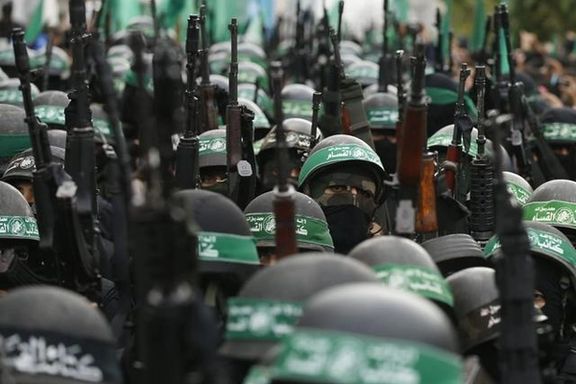
Forces of al-Qassam Brigades, the armed wing of Hamas, in a military parade marking the 27th anniversary of Hamas founding, in Gaza City, on December 14, 2014

You don’t find many saying it loud, but Hamas might not be eradicated unless its military wing the Qassam Brigades is completely dismantled.

What Is Izz Ad-Din Al-Qassam Brigades?

In the emblem of the Izz ad-Din al-Qassam Brigades, a Hamas-style soldier is depicted, holding a rifle in one hand and the Quran in the other looking toward the Dome of the Rock. The flag next to the soldier reads "There is no God but Allah" accompanied by a Quranic verse positioned at the top of the emblem: "Therefore, you did not slay them, but Allah slew them."

Izz ad-Din al-Qassam Brigades
100%

The name is derived from Izz ad-Din al-Qassam, a cleric born in Syria and killed in Palestine either in a shootout with British forces in 1935 or was captured in November 1937 and executed by the British. Different sources offer the two versions of history. Qassam viewed Islam as a tool for resistance against Western colonization. He formed a military group to engage in jihad and combat against the British and Jews.

Izz ad-Din al-Qassam Brigades-Ahmed yassin-sinwar
100%

Embryonic Phase

The formation of the Qassam Brigades dates to 1984 when Ahmed Yassin, the founder of Hamas, established a small group called the Mujahidoun al-Flistinion (The Palestinian Fighter). The group's activities were exposed, leading to Yassin's arrest and a 15-year prison sentence. Just 11 months later, Yassin was released in a prisoner exchange and founded another armed organization called al-Majd (Glory) . The leaders of al-Majd were Yahya Sinwar, now a celebrity and on the top op Israel’s wanted list, and Rawhi Mushtaha. On February 16, 1989, Hamas forces abducted an Israeli soldier. Clues once again led to Sheikh Yassin, resulting in his return to prison. While Yassin was in prison, the new military organization of Hamas, Izz ad-Din al-Qassam, was set up in 1990, the initial cell was established in the Rafah, Gaza Strip. Its first commander was Salah Shehadeh, a holder of a brown belt in Japanese wrestling.

Many attribute the founding of the military wing of Hamas in the West Bank to Saleh al-Arouri, who currently resides in Lebanon. The initial military cell of Izz ad-Din al-Qassam in the West Bank was shaped under the leadership of Mohammad Abu Tir, once recognized for his distinctive ginger beard. The real powerhouse of Hamas' military muscle though is all happening down in the Gaza Strip.

Qassam Brigades-early-commanders (file photo)
100%

Mohammed Deif; The Mastermind In The Shadows

The top operator leading the Qassam Brigades is none other than Mohammed Deif, right up there on Israel's most-wanted list. For his own security he's never caught snoozing in one spot for more than a night, hence his alias "Deif" or "Guest." When Salah Shehadeh got taken out by Israel, Deif stepped up to be the position of commander. Despite numerous attempts to knock him off, he's said to be still around and operating as an elusive figure. Reportedly after Israeli airstrikes in Gaza, he is in a wheelchair and has lost an eye. Some even reckon that if he's still alive, spotting him is like finding a needle in a haystack. He is said to be the mastermind behind Hamas' operations and the architect of the intricate tunnel network beneath the Gaza Strip.

Qassam Brigades-Mohammed Deif (file photo)
100%

Can Qassam Brigades Be Eradicated?

The Qassam Brigades do not generally disclose the number of their forces, but this number is estimated to be between twenty to thirty thousand troops. This is more than double the estimate from twenty-three years ago.

A high-ranking Israeli military official reported on 1st December, 56th day of war, that at least 10 out of 24 Hamas battalions have suffered significant damage. Additionally, more than 50 mid-level commanders and an estimated 5,000 fighters are believed to have been killed. It indicates that there is still a long way to go to defeat the Hamas military wing. The intensive phase of the ground offensive is expected to continue into early 2024 as part of a year-long or more campaign planned by Israel against Hamas.

Qassam Brigades Pre-War Force Estimate (file)
100%

Israel has set its objective to eradicate Hamas, committed to pursuing this goal for as long as necessary. Nonetheless, in the event of successfully neutralizing Hamas and its military wing, there remains no foolproof guarantee that a different hardline faction won't rear its head. The Islamic Republic of Iran and its proxy groups in the region appear keen on providing support, both ideologically and financially, potentially paving the way for the emergence of a new player in the enclave.

To take down the Qassam Brigades, it’s crucial to squeeze their cash flow, especially those from Iran, their primary military supporter. According to Economist, Hamas's financial empire generates over $1 billion annually. $750 million of that $1 billion is believed to come from abroad, according to Israel’s official. This substantial funding is a key factor in sustaining Hamas's current stockpile of arms and resources. The United States estimates that Iran contributes $100 million annually to Palestinian Islamist groups, primarily in the form of military assistance. Israeli officials claim that a minimum of $500 million annually, originates from Hamas's investments, including firms registered in various countries across the Middle East.

HAMAS Financial Snapshot: Surpassing the 1 Billion Dollar Mark in Annual Income (file)
100%

Getting on top of this challenge calls for a worldwide endeavor, intricately connected to both the ideological chessboard and the broader Palestinian puzzle -- a puzzle that has cast a devastating impact on both Israelis and Palestinians alike. As the Book of Proverbs wisely states, "The spirit of a man will sustain his infirmity; but a wounded spirit, who can bear?"

To wipe out the Qassam Brigades and dismantle Hamas for good or prevent the ‎emergence of any other Islamic extremist group, three big challenges need to be ‎tackled: their radical Islamist ideology, the Palestinian issue, andthe funding sustaining such entities. Navigating talks on Hamas-like ideological entity needs sharp minds, especially to figure out what the Islamic Republic of Iran's up to.

Even if Israel manages to get rid of Hamas, sorting out the Palestine problem means shaking up the peace talks and giving the two-state solution a fresh spin. Plus, putting a stop to Hamas's military wing needs a global effort, especially trimming their cash flow from Iran and Qatar. Post-Hamas, maintaining vigilant oversight is crucial to ensure Iran and its allies don't stir up any radical trouble, making sure that any peace process stays on track.


Most Viewed

100 days after carnage: Iran economy reels from war, inflation, unemployment
1
INSIGHT

100 days after carnage: Iran economy reels from war, inflation, unemployment

2
INSIGHT

Ghalibaf defends Iran-US talks amid hardline backlash

3
INSIGHT

A nation in limbo: 100 days after the massacre, has the world moved on?

4
ANALYSIS

From instability to influence: Pakistan’s pivotal role in US-Iran diplomacy

5
ANALYSIS

100 days on: why Iran’s January protests spread across social classes

Banner
Banner

Spotlight

  • War-hit homeowners feel abandoned as Iran’s reconstruction aid fades

    War-hit homeowners feel abandoned as Iran’s reconstruction aid fades

  • 100 days on: the anatomy of Iran’s January crackdown
    INSIGHT

    100 days on: the anatomy of Iran’s January crackdown

  • Ghalibaf defends Iran-US talks amid hardline backlash
    INSIGHT

    Ghalibaf defends Iran-US talks amid hardline backlash

  • 100 days on: why Iran’s January protests spread across social classes
    ANALYSIS

    100 days on: why Iran’s January protests spread across social classes

  • From instability to influence: Pakistan’s pivotal role in US-Iran diplomacy
    ANALYSIS

    From instability to influence: Pakistan’s pivotal role in US-Iran diplomacy

  • A nation in limbo: 100 days after the massacre, has the world moved on?
    INSIGHT

    A nation in limbo: 100 days after the massacre, has the world moved on?

•
•
•

More Stories

US Sends Mixed Signals After Houthi Attacks In Red Sea

Dec 5, 2023, 08:50 GMT+0
•
Iran International Newsroom

The US government’s reaction to attacks on vessels in the Red Sea on Sunday has been a mixture of blaming Iran and downplaying the threat to the US Navy.

The episode began when three commercial vessels came under attack from Iran-backed Houthis on Sunday. USS Carney responded to the vessels’ distress calls and shot down three drones. It too got targeted, according to some Pentagon reports. But later the Pentagon claimed they were not sure if US warships are being targeted by the Houthis.

However, in a presser Monday afternoon, national security advisor Jake Sullivan pointed the finger at Iran.

“We have every reason to believe these attacks, while they were launched by the Houthis in Yemen, are fully enabled by Iran,” he said, reiterating an earlier statement from Centcom.

Sullivan added that talks are being held with US allies to set up “a maritime task force of sorts” to ensure safe passage for ships in the Red Sea.

The Biden administration has been trying hard to avoid direct confrontation with Iran –and a potential escalation of war in the region. But continued targeting of American troops and interests is making this strategy untenable.

Lara Seligman of Politico tweeted that “An hours-long firefight involving U.S. commercial vessels in the Red Sea this weekend has left some U.S. officials frustrated by what they see as the Biden administration’s deliberate downplaying of a major threat to American forces.”

Middle East expert Charles Lister also tweeted, “Two DOD sources told me today that the Biden White House has placed (in the words of one) ‘every possible handcuff’ on DOD’s ability to respond to Iran proxy attacks.”

We do need to be more aggressive and push back against Iran,” said Senator Joni Ernst Monday. “This would continue to escalate if we have such a milk-toast response from this administration.”

Biden critics say his approach has emboldened Iran and its proxies. On the Capitol, some call his strategy “appeasement” and are pushing for tougher actions.

“What is it going to take for the Biden administration to take action to stop Iran,” asked Congressman Mike Waltz in an interview with Fox News Monday. “Our sailors under direct fire from Iranian-made missiles & drones deserve better.”

In the past few weeks, the Houthis have attacked several vessels in the Red Sea and launched drones and missiles towards Israel. But they had avoided targeting the Americans – until last weekend.

The more recent wave of Houthi attacks can thus be read as a clear escalation, which could make it harder for Biden and his team to shrug off the role of the regime in Tehran as well as the link to the war on Gaza.

Despite clear messaging from the Houthis in Yemen, both the US and Israel seem to prefer to portray the Red Sea debacle as a separate issue unrelated to Israel's attacks in Gaza. Yet neither have ruled out the possibility of a military response to Houthi attacks.

“If we make the assessment or feel the need to respond, we will always make that decision at a time or place of our choosing,” a Pentagon official was quoted as saying by Politico.

The US has struck back at Iran proxies in Iraq and Syria several times in recent weeks. On Sunday, a US drone killed five militants in Iraq, whom, according to the Pentagon, were preparing to “launch a one-way attack drone.”

Monday afternoon, Centcom published another statement detailing yet another rocket attack on a US base in Syria on the weekend. “There were no injuries to personnel or damage to equipment,” the statement said, confirming that 15 rockets had been fired from “a fuel truck modified to launch up to 20 rockets” in Iraq.

Addressing the ongoing attacks by Iran proxies on American troops across the Middle East, Senator Pete Ricketts blamed the Biden administration and reiterated what seems to be a growing consensus in Washington. “The only thing they understand is strength,” he said. “And when we project weakness like we are, we’re only encouraging them to continue to attack us.”

Britain Condemns Iran’s Role In Red Sea Attacks

Dec 4, 2023, 17:37 GMT+0

Britain joined the United States in condemning the attacks on commercial shipping in the Red Sea on Monday, blaming Iran for supporting the Houthi militants behind them. 

The UK government also stated that it was committed to ensuring safe shipping in the region.

Three commercial vessels came under attack in international waters in the southern Red Sea on Sunday, in attacks claimed by Yemen's Houthi group. It said it had launched drone and missile attacks against two Israeli ships.

"The UK is committed to ensuring the safety of shipping in the region," the British government statement said, adding that the waters were vital for trade and the incidents showed the importance of the Royal Navy's presence there.

The United States said the attacks were "fully enabled by Iran", sentiments echoed by Britain on Monday.

"Iran has long provided military and political support to Houthi militants and it bears responsibility for the actions of its proxies and partners," Britain said. 

The US Central command had issued a statement on Sunday describing multiple attacks on vessels by Houthis and saying, “We also have every reason to believe that these attacks, while launched by the Houthis in Yemen, are fully enabled by Iran. The United States will consider all appropriate responses in full coordination with its international allies and partners.”

Iranian government IRNA news website on Monday dismissed the British statement, saying Iran is not interfering in the Gaza war and has no proxy forces in the region. However, Tehran always speaks about its “Axis of Resistance”, which includes the Houthis, the Lebanese Hezbollah, Iraqi Shiite militias and Hamas, aiming to destroy Israel and expel the US from the region.


Iran Bans Afghan Migrants From Living In 16 Provinces

Dec 4, 2023, 16:43 GMT+0
•
Maryam Sinaiee

Amid tensions over the presence of millions of Afghans in Iran, the Supreme National Security Council (SNSC) has banned them from nearly half of all provinces.

Announcing the news on Saturday, Hamzeh Soleimani, director general for foreign nationals and immigrants’ affairs of the office of the governor of Kermanshah in western Iran told the semi-official Iranian Students News Agency (ISNA) that the ban includes Kermanshah Province.

Since March, authorities in Kermanshah Province have canvassed construction sites, green houses, horse stables and cattle farms where Afghans are usually employed, on nine different occasions, to identify, detain and expel “illegal foreign nationals”, Soleimani said.

The ban which follows protests and unrest in Meybod in the eastern Yazd Province and demands for the expulsion of Afghans, appears to apply to all Afghan citizens in 16 provinces irrespective of their immigration status.

Afghans, often referred to simply as ‘foreign nationals’ by officials and the media, make up the majority of immigrants in Iran.

A significant number of Afghan workers, as well as some employers who had hired them were arrested during the searches in Kermanshah Province, Soleimani said and urged people to report the employment of Afghan citizens in farms and construction sites to the authorities.

Iranian media say the ban includes the northwestern and western provinces of East Azarbaijan, West Azarbaijan, Ardabil, Zanjan, Hamedan, Kordestan, Kermanshah, Ilam, and Lorestan, as well as the northern provinces of Gilan, and Mazandaran.

The southeastern province of Sistan and Baluchestan, a major channel of Afghan immigration to Iran, and the southern Hormozgan province have also been designated as banned zones for all Afghans.

Only 780,000 Afghans living in Iran have official refugee status, leaving the majority undocumented.

Interior Minister Ahmad Vahidi said in October that identity papers had been issued for more than one million Afghans with plans to include more. Vahidi had said in September that the country was home to an estimated five million Afghans.

Another government official, Mohsen Najafikhah, however, told the parliament in October that “foreign nationals” in Iran number over 8 million, or ten percent of the country’s population.

Some estimates suggest the Afghan population may have reached ten million since the Taliban’s takeover of Afghanistan in 2021.

The rapid growth of the Afghan population in Iran in the past two years has become controversial with some media and politicians alleging that authorities are actively encouraging the growth of the Afghan population and warning about a “threat to national security”.

In the past year Anti-Afghan sentiments have rapidly spread in Iran with some ultra-nationalists opposed to the Islamic Republic campaigning on social media for the expulsion of all Afghans on racial grounds.

On Friday, an angry mob of Iranians in Meybod torched the homes of Afghan citizens in the Afghan quarter of the city, known as Afghanabad, forcing the police and security forces to barricade the area to prevent further violence. Another video posted on X showed Afghans fleeing the city in large groups towards the surrounding desert.

Nearly one in eight of the residents of the city of 90,000 are reportedly Afghans.

The incident occurred following the reported death of an Iranian teenager and the injury of another in a street altercation with Afghans. In response, locals took to the streets, expressing their grievances during Friday prayers and calling for the apprehension of the culprits as well as the expulsion of all Afghans from the city.

According to social media accounts, the city's appointed Friday imam, a Revolutionary Guard commander, and the city's governor, who attempted to pacify the demonstrators, were specifically targeted and assaulted.

Arson Attack At MEK’s Political Office In Berlin

Dec 4, 2023, 15:56 GMT+0

An arson attack has targeted the building of the National Council of Resistance of Iran (NCRI) in Berlin Monday morning, the third such attack on the Mojahedin-e-Khalq's (MEK) political arm this year.

The NCRI, based in Paris, promptly attributed the attack to agents of the Islamic Republic.

Police swiftly responded to the incident, launching an operation in the Berlin district of Schmargendorf, as reported by Bild. Initial findings indicated that a side window on the ground floor had been destroyed, and the assailants, yet to be identified, attempted to set the building ablaze.

During the ensuing investigation, law enforcement discovered evidence including petrol cans and a gas bottle. Members of the council managed to extinguish the fire before it could spread to the interior, avoiding injuries. However, the building sustained material damage.

This is not the first instance of aggression against the resistance movement. In 2019, the same building experienced a fire, prompting an examination of potential political motivations. The ongoing police investigation in the current case seeks to unravel the motives behind this latest attack.

In a statement, the NCRI said the ongoing attacks, including two this year, one in May and another in June at a building belonging to the NCRI supporters in northern Paris, would not intimidate the organization, branding the culprits "terrorists and mercenaries of the Quds Force and the Ministry of Intelligence of Iran".

"As the Iranian Resistance has repeatedly stated, appeasement with the mullahs’ regime and actions such as the release of Assadollah Assadi, a terrorist diplomat responsible for organizing a bomb attack at the Iranian Resistance gathering in Villepinte, Paris in June 2018, have more emboldened this regime in terrorist crimes," it said.

Iranian Daily Warns Of Larger Operations By Hamas On Israel

Dec 4, 2023, 15:07 GMT+0

Amid Israel's renewed ground offensive on the Gaza Strip, an Iranian hardline newspaper claims Israelis "still have to see the nightmare of operations larger than October 7."

The firebrand editor of Kayhan newspaper, Hossein Shariatmadari, referenced Khamenei's recent remarks, stating, "Israel is trapped in the quagmire of its attack on Gaza," which was triggered by a surprise invasion of Israel by Hamas on October 7, in which 1,200 mostly civilians were killed and 240 more taken hostage to Gaza.

In spite of the fact half of Gaza is displaced amidst mass destruction from an Israeli retaliation never seen before since Iran-backed Hamas took over the strip in 2007, he said, "Despite all the military assaults and ground incursions into Gaza, Hamas maintains field control." Dozens of Hamas's top commanders have been assassinated and swathes of the strip turned to rubble yet Shariatmadari expressed 'doubt' about a Hamas defeat. Hamas's most wanted live in an extensive underground tunnel network which has also been badly hit by Israeli strikes.

Amidst the comments which mimic regime rhetoric, the Israeli military has issued additional evacuation orders and pledged to strike south Gaza with "no less strength" than the force employed in the north, which has left large areas resembling a moonscape.

Many of Gaza's 2.3 million residents had previously fled to the south following initial orders to evacuate the north in the early days of the conflict.

The Hamas-controlled Health Ministry in Gaza reported a death toll exceeding 15,500 since October 7, with over 41,000 Gazans wounded. While the ministry does not distinguish between civilian and combatant casualties, it noted that 70% of the deceased were women and children.