• العربية
  • فارسی
Brand
  • Iran Insight
  • Politics
  • Economy
  • Analysis
  • Special Report
  • Opinion
  • Podcast
  • Iran Insight
  • Politics
  • Economy
  • Analysis
  • Special Report
  • Opinion
  • Podcast
  • Theme
  • Language
    • العربية
    • فارسی
  • Iran Insight
  • Politics
  • Economy
  • Analysis
  • Special Report
  • Opinion
  • Podcast
All rights reserved for Volant Media UK Limited
volant media logo

Current Pace Of Executions In Iran ‘Appalling’: European Union
Iran International Newsroom
Dec 2, 2023, 14:34 GMT+0Updated: 11:25 GMT+0
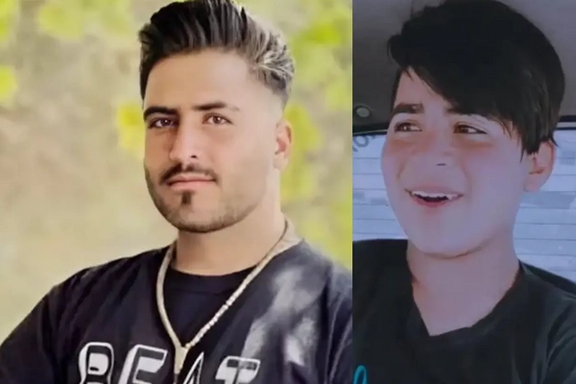
Two young Iranian prisoners hanged this week

Reacting to reports of the execution of a young man and a young protester, the European Union has called on Iran to refrain from any future executions.

Peter Stano, lead spokesperson for foreign affairs and security policy of the European Union, stated on Friday, "There are credible reports that a minor, Hamidreza Azari, and a protester, Milad Zohrevand, were executed in Iran on November 24 and 23 respectively," emphasizing the European Union’s "firm and principled opposition to the use of capital punishment at all times and in all circumstances." Iran has hanged nearly 700 people this year alone.

Stano also underlined that as a party to the International Covenant on Civil and Political Rights and the Conventions on the Rights of the Child, the Islamic Republic is prohibited from imposing the death penalty for crimes committed under the age of 18.

Hamid Azari was hanged on Friday morning at the Central Prison of Sabzevar in the northwestern province of Khorasan-e Razavi for complicity in stabbing Hamidreza Aldaghi to death in a street fight in April.

Human Rights (IHR NGO), a Norway-based Iran Human Rights Organization, claims to have reliable evidence that Azari was only sixteen years and eight months old at the time and seventeen years and three months when he was hanged.

According to IHR NGO, the Islamic Republic has hanged at least 68 other child offenders since 2010.

Iranian authorities called the victim a “martyr” and claimed he was killed while carrying out his religious duty of calling on citizens to follow the Sharia and refrain from forbidden bahvior.

The victim's family, however, asserts that he got involved in the incident that led to his killing to protect a young girl being assaulted by the young boys, including Azari. They have denied any religious motivation or his association with the Basij militia or hardliner religious groups, as claimed by the authorities.

Stano’s statement also mentions Milad Zohrevand, a construction worker who was arrested during last year’s protests in Malayer in the western province of Hamedan and was hanged on November 23 on charges of killing Ali Nazari, a Revolutionary Guard.

Miladvand’s family and friends say he was only in the vicinity of the place Nazari was shot to death. Authorities have not offered any solid evidence of Miladvand’s involvement in the killing.

The young man who was tried and sentenced to death behind closed doors was never given access to a lawyer and his family were pressured by the authorities not to talk to the media about his case. He was hanged without having a chance to meet his family for a last time before his execution.

IHR NGO said on December 1 that the Islamic Republic has executed over 700 in 2023 including at least 176 since October 7 when the war in Gaza started.

IHR NGO urged the international community and especially European countries to “break their silence on the arbitrary execution of more than three people per day by the Islamic Republic.”

“The critical human rights situation in Iran, and the death penalty in particular, must not be compromised for political and regional considerations. The international community’s silence on executions is considered a green light by the Islamic Republic,” IHR NGO said.

Other prisoners, IHR NGO says, have often been hanged in groups of several in various prisons for political crimes, drug offences and murder.

On November 29, for instance, a group of seven prisoners were executed in Ghezelhesar Prison near Karaj. These included Ayub Karimi who was sentenced to death for moharebeh (enmity against God) and efsad-fil-arz (corruption on earth) charges. Two others were sentenced to death for drug-related charges while the remaining four had been sentenced to qisas (retribution-in-kind) for murder.


Most Viewed

100 days after carnage: Iran economy reels from war, inflation, unemployment
1
INSIGHT

100 days after carnage: Iran economy reels from war, inflation, unemployment

2
INSIGHT

Ghalibaf defends Iran-US talks amid hardline backlash

3
INSIGHT

A nation in limbo: 100 days after the massacre, has the world moved on?

4
ANALYSIS

From instability to influence: Pakistan’s pivotal role in US-Iran diplomacy

5
ANALYSIS

100 days on: why Iran’s January protests spread across social classes

Banner
Banner

Spotlight

  • War-hit homeowners feel abandoned as Iran’s reconstruction aid fades

    War-hit homeowners feel abandoned as Iran’s reconstruction aid fades

  • 100 days on: the anatomy of Iran’s January crackdown
    INSIGHT

    100 days on: the anatomy of Iran’s January crackdown

  • Ghalibaf defends Iran-US talks amid hardline backlash
    INSIGHT

    Ghalibaf defends Iran-US talks amid hardline backlash

  • 100 days on: why Iran’s January protests spread across social classes
    ANALYSIS

    100 days on: why Iran’s January protests spread across social classes

  • From instability to influence: Pakistan’s pivotal role in US-Iran diplomacy
    ANALYSIS

    From instability to influence: Pakistan’s pivotal role in US-Iran diplomacy

  • A nation in limbo: 100 days after the massacre, has the world moved on?
    INSIGHT

    A nation in limbo: 100 days after the massacre, has the world moved on?

•
•
•

More Stories

Mounting Worker Demands Lead To Strike In Iran Steel Industry

Dec 2, 2023, 13:58 GMT+0

As the Iranian regime grapples with growing unrest fueled by unmet demands from retirees and workers, protests and strikes continue in different sectors.

Videos on social media revealed that workers at the Esfahan Steel Company halted operations on Saturday, conveying their discontent through organized gatherings and chanting slogans.

Workers at the Esfahan Steel Company had previously gone on strike multiple times last year, citing the "failure to fulfill promises by officials." Their primary demand revolves around an increase in wages, which lag behind those of counterparts in other steel plants.

Last year, workers at the complex presented a ten-thousand-signature letter, urging President Ebrahim Raisi to address the rights of company workers. However, with no substantial improvements, the discontent continues to fuel demonstrations.

The Esfahan Steel Company, serving as a specialized parent company, holds the distinction of being the first and largest producer of construction and rail steel in Iran. With a production capacity of 3.6 million tons of final products, the complex manufactures a diverse range of structural and industrial steel sections.

There were a number of protests in November, including from Iran's Social Security Organization retirees, employees of the Iranian Offshore Oil Company (IOOC), and retirees and employees of the National Iranian South Oil Fields Company.

Amidst the labor unrest, the regime-run Statistics Center of Iran (SCI) reports a household inflation rate of 45.5%. Alarmingly, approximately one-third of the country is experiencing inflation rates exceeding 50%, as indicated by the same report. It is worth noting that the regime's reporting may not fully capture the gravity of the crisis, as it continues to shield the true extent of the economic challenges faced by the Iranian people.

Iranian Official Dismisses Sub-Standard Gasoline's Role In Air Pollution

Dec 2, 2023, 11:12 GMT+0

Amid reports about low-quality gasoline and a surge in air pollution across key industrial hubs in Iran, an official insisted that the low-quality fuel has no impact.

In an interview with the semi-official ISNA news agency, Jafar Salari-Nasab, the CEO of the National Company for the Distribution of Petroleum Products emphasized that “the distributed gasoline meets Euro specifications in terms of quality and octane level.” He highlighted that Euro-grade gasoline, known for its superior quality, is distributed in major cities such as Tehran.

The National Crisis Management Center recently issued a warning about escalating air pollution levels in industrial centers like Tehran, Karaj, Arak, Esfahan, and Tabriz, coupled with a decline in air quality.

Salari-Nasab's comments come in the wake of the Taliban government's standards office rejecting fuel tankers carrying Iranian gasoline, citing substandard quality. According to a recent announcement by the Taliban on November 29, 24 tankers carrying low-quality Iranian gasoline were returned through the Farah border crossing in the last two days. In total, 74 tankers have been sent back from Afghanistan in the past week.

Iran has been grappling with a significant gasoline shortage since last summer, prompting refineries to add substances to base gasoline. The harmful additives have led to the production of non-standard gasoline, contributing significantly to air pollution in the country.

A recent report by Etemad revealed that Tehran experienced only two clear days in the last year, with a simultaneous surge in emergency room visits by residents due to polluted air. Iran currently ranks as the sixth-highest greenhouse gas contributor globally, following China, the United States, India, Japan, and Russia. 

US Urges Iraq To Protect Its Troops From Iran-Backed Groups

Dec 2, 2023, 10:13 GMT+0

Iraq should fulfill its commitments to protect all bases hosting US troops, Secretary of State Antony Blinken told the Iraqi Prime Minister in telephone call on Friday.

“The Secretary called on the Iraqi government to fulfill its commitments to protect all installations hosting U.S. personnel at its invitation and to pursue those responsible for attacks on U.S. personnel in Iraq,” the State Department said in a statement describing the call with Prime Minister Mohammed Shiaa al-Sudani.

The call came after Iranian-backed militant groups in Iraq launched dozens of attacks on military bases hosting US and coalition troops since the October 7 Hamas attack on Israel and the ensuing war in Gaza.

Iran-backed Shiite militants have taken responsibility for the attacks claiming that their actions are in retaliation for US support for Israel in its conflict with Hamas.

The Iranian government has denied any responsibility, claiming that “resistance” groups are acting on their own, angered by the war. However, Iran is in control of all forces it labels as the “Resistance Front” in the region and has repeatedly vowed that their mission is to expel the United States from the region. PM al-Sudani is part of a coalition backed by the Iran-supported groups.

The US military conducted retaliatory strikes against some of the Iraqi groups on November 21, but this has failed to deter the militants. Many critics in the United States have accused the Biden administration of not responding forcefully enough to Iranian-backed groups, some suggesting that retaliation should be directed against the Revolutionary Guard.

Second Arrest Of Iranian Dissident Rapper Sparks Outcry

Dec 2, 2023, 09:28 GMT+0

The re-arrest and violent detention of Iranian rapper Toomaj Salehi have ignited widespread condemnation and concern.

Social media users described his arrest earlier this week as a "kidnapping" and a manifestation of the regime's fear of Salehi's outspokenness as a protesting rapper.

Salehi, 33, was detained by plainclothes on a street in Babol, located in the north of Iran, on Thursday. He was subsequently transferred to an undisclosed location. Salehi's X page reported that the arrest took place without any judicial order and involved "severe physical abuse," with officers allegedly beating him using the butts of their AK-47 rifles and pistols.

The incident comes after Salehi spent over a year in prison, with 252 days in solitary confinement. He had been released on bail on November 18th. In response to his re-arrest, social media users initiated a trending campaign on Friday, with more than 75,000 mentions of Toomaj Salehi on the X social network. Many posts questioned his whereabouts.

Ye-One Rhie, a representative in the German parliament and Salehi's political sponsor, urgently called for his release in a video message. Rhie emphasized the importance of shedding light on the actions of the Iranian regime, stating, "Everyone needs to know what the Iranian regime is doing, that it is not abiding by its own constitution and kidnapping people for no reason."

Salehi gained prominence as an artist known for his protest songs addressing social issues and government injustices in Iran. The 33-year-old rapper was initially arrested on October 30th 2022, as part of a broader crackdown on regime's political opponents.

US Report Labels Iran 'Leading State Sponsor Of Terrorism'

Dec 2, 2023, 09:21 GMT+0
•
Iran International Newsroom

The latest US annual Terrorism Report reiterated that Iran “continued its extensive support for terrorism,” providing funding, training and weapons to militant groups.

The 2023 report issued on November 30, covered the situation in 2022 and declared in its introduction to country reports that “Iran continued to be the leading state sponsor of terrorism, facilitating a wide range of terrorist and other illicit activities around the world.”

The year the report covered coincided with extensive indirect negotiations between Washington and Tehran on Iran’s expanding nuclear program and increasing uranium enrichment. By the end of 2022, a new nuclear deal remained elusive, but the Islamic Republic had stockpiled enough fissile material to build at least three nuclear weapons.

However, while holding talks on the nuclear issue, Iran continued its political and material support for its vast network of militant proxy groups in the region, that were targeting US forces in Iraq and Syria.

Iranian terror threat reached the shores of the United States, according to US federal agencies. “In 2022, Iran increasingly encouraged and plotted attacks against the United States, including against former U.S. officials, in retaliation for the death of Islamic Revolutionary Guard Corps-Qods Force (IRGC-QF) Commander Qasem Soleimani,” the report says. Former Secretary of State Mike Pompeo and former national security adviser John Bolton have been on Iran’s hit list and received additional security protection.

Iran's Supreme Leader Ali Khamenei showing his appreciation to former Quds Force commander Qasem Soleimani. Undated
100%
Iran's Supreme Leader Ali Khamenei showing his appreciation to former Quds Force commander Qasem Soleimani. Undated

The report also accused the Islamic Republic of orchestrating threats against dissidents abroad. “As in past years, the Iranian government continued supporting terrorist plots or associated activities targeting dissidents and other perceived enemies of the regime. A British intelligence agency publicly reported uncovering at least 10 potential threats emanating from Iran’s government to kidnap or kill individuals in the United Kingdom in 2022.”

Iran International television network was the target of some of these plots in 2022, and was forced to temporarily shift its broadcast operations from London to Washington DC under advisement by UK security officials.

“Regionally, Iran supported acts of terrorism in Bahrain, Iraq, Lebanon, Syria, and Yemen through proxies and partner groups such as Hizballah and al-Ashtar Brigades,” the report stated, but also highlighted Iranian threats beyond the Middle East. “Globally, the IRGC-QF and the Ministry of Intelligence and Security remained Iran’s primary actors involved in supporting terrorist recruitment, financing, and plotting across Africa, Asia, Europe, and North and South America.”

Iran’s foreign ministry responded to the US annual report on Saturday, unleashing a series of accusations, condemning Washington of establishing and supporting the Islamic State group. It also used the “terrorist” label for US efforts to support Israel.

Foreign ministry’s spokesman Naser Kanaani rejected the terrorist label for what Tehran calls “The Resistance Front,” comprised of groups supported and controlled by the Islamic Republic. “It is clear to everyone that the United States government is the main culprit in the formation, training, equipping, and guidance of ISIS terrorists. Recently, with comprehensive support for state-sponsored terrorism by the Israeli regime and providing various bombs and deadly weapons to this terrorist regime,” the US has been “a partner in genocide against Palestinian,” Kanaani insisted.

The US report, however, reiterated that Iran’s main vehicle to support militant groups is the Revolutionary Guard’s Quds Force (IRGC-QF). “Iran has acknowledged the involvement of the IRGC-QF in the Iraq and Syria conflicts, and the IRGC-QF is Iran’s primary mechanism for cultivating and supporting terrorist activity abroad.”

The report also emphasized that Iran continued financial and military support for the Lebanese Hezbollah and Palestinian Hamas and Islamic Jihad groups in 2022. It also beefed up the Houthis in Yemen and attacked commercial vessels in international waters in the Persian Gulf region.