• العربية
  • فارسی
Brand
  • Iran Insight
  • Politics
  • Economy
  • Analysis
  • Special Report
  • Opinion
  • Podcast
  • Iran Insight
  • Politics
  • Economy
  • Analysis
  • Special Report
  • Opinion
  • Podcast
  • Theme
  • Language
    • العربية
    • فارسی
  • Iran Insight
  • Politics
  • Economy
  • Analysis
  • Special Report
  • Opinion
  • Podcast
All rights reserved for Volant Media UK Limited
volant media logo

Belgian Police Boost Security For Iranian-Born Lawmaker After Death Threats
Iran International Newsroom
Dec 1, 2023, 05:15 GMT+0Updated: 11:26 GMT+0
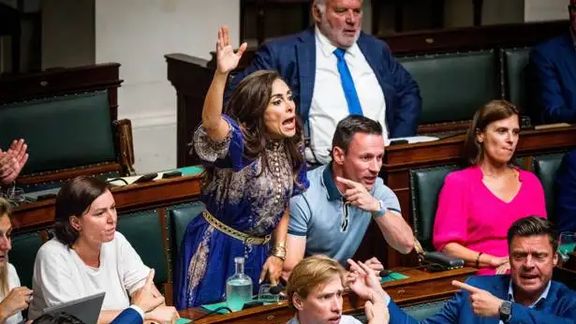
Darya Safai (center) reacts during a plenary session of the Chamber at the Federal Parliament in Brussels in June 2023.

The Belgian police are beefing up security measures to protect Darya Safai, an Iranian-born member of parliament, following death threats she received on social media.

In an interview with Iran International, Safai said that the death threats against her have increased following the Israel-Hamas conflict.

“I should be careful and report any suspicious events around me” to the police, the lawmaker wrote on X.

The police has launched a probe into the nature and sources of the threats.

Safai blamed Islamists for the threats, vowing that she will continue to stand up for freedom.

“It’s incomprehensible that people should make serious threats … instead of responding with substantive arguments. But that is just how Islamists operate,” read her post on X.

Speaking to Iran International, she accused the Iranian regime of orchestrating the threats by promoting Islamist extremism in Belgium and the whole of Europe.

Safai warned that Tehran is trying to target its opponents indirectly under the guise of backing the Palestinian cause.

The alarming rise of extremism and antisemitism have raised serious concerns among European countries, with many of them blaming the Islamic Republic for fostering such activities.

In October, The Times warned that Iranian agents are stirring up unrest in the UK through Gaza protests.

There is direct involvement of the Iranian regime through the physical presence of operatives at protests as well as through disinformation campaigns conducted online, the newspaper said.

Earlier in November, German authorities executed raids on 54 locations connected to the Islamic Center of Hamburg (IZH), suspected of supporting Iran-backed Hezbollah. 

On November 4, Safai condemned attempts to silence her with the label of “Islamophobe,” especially since the current conflict began in the Middle East.

“What the world is experiencing today is much broader than a war between Israel and Hamas. It is a broad war that shows the direction for certain Muslims to ultimately achieve their goals,” she said earlier this month, highlighting the Muslims’ promised goal to conquer the world and establish an Islamic rule. 

Last November, Iran International was warned by London Police that its journalists were under threat from Iranian agents and the police took measures to strengthen security around the network’s offices. A man was arrested in the vicinity of Iran International’s headquarters in February and charged with a terrorism offence.

Safai has been one of the most vocal European lawmakers critical of the Islamic Republic, advocating a tougher stance towards Tehran and its regional and international policies.

She is also one of the staunch supporters of listing Iran’s Revolutionary Guard (IRGC) as a terrorist organization. 

Safai told Iran International on Thursday that she has been under police protection since June after she criticized a formal invitation extended to Alireza Zakani, the mayor of Tehran, to visit Belgium. Her criticism angered Iranian officials, with some reports saying that they might try to target anti-regime activists and figures who openly opposed Zakani’s visit.

Tehran’s mayor was a hardliner member of parliament before becoming a candidate in the 2021 presidential election and withdrawing in favor of the current president Ebrahim Raisi. He also served as the head of IRGC’s Student Basij paramilitary forces and had a prominent role in cracking down on students during popular protests in July 1999.


Most Viewed

Ideology may be fading in Iran, but not in Kashmir's ‘Mini Iran'
1
INSIGHT

Ideology may be fading in Iran, but not in Kashmir's ‘Mini Iran'

2
INSIGHT

Hardliners push Hormuz ‘red line’ as US blockade tests Iran’s leverage

3
VOICES FROM IRAN

Hope and anger in Iran as fragile ceasefire persists

4

Iran International says it won’t be silenced after London arson attack

5

US sanctions oil network tied to Iranian tycoon Shamkhani

Banner
Banner

Spotlight

  • Hardliners push Hormuz ‘red line’ as US blockade tests Iran’s leverage
    INSIGHT

    Hardliners push Hormuz ‘red line’ as US blockade tests Iran’s leverage

  • Ideology may be fading in Iran, but not in Kashmir's ‘Mini Iran'
    INSIGHT

    Ideology may be fading in Iran, but not in Kashmir's ‘Mini Iran'

  • War damage amounts to $3,000 per Iranian, with blockade set to add to losses
    INSIGHT

    War damage amounts to $3,000 per Iranian, with blockade set to add to losses

  • Why the $100 billion Hormuz toll revenue is a myth
    ANALYSIS

    Why the $100 billion Hormuz toll revenue is a myth

  • US blockade targets Iran oil boom amid regional disruption
    ANALYSIS

    US blockade targets Iran oil boom amid regional disruption

  • Iran's digital economy battered by prolonged blackout
    INSIGHT

    Iran's digital economy battered by prolonged blackout

•
•
•

More Stories

Iran’s Raisi Opts Out Of COP28 Due To Israeli Presence

Nov 30, 2023, 22:21 GMT+0

Iran's president claims he will not attend the United Nations Climate Change Conference (COP28) in Dubai, citing the presence of his Israeli counterpart.

Israeli president Isaac Herzog will be in the United Arab Emirates along with around 140 other world leaders for the world's biggest climate summit which begins Friday, to be opened by Britain's King Charles.

Fars News Agency, known for its proximity to the Islamic Revolutionary Guard Corps (IRGC), reported on Thursday that Raisi will not only be absent from the conference but will also not have a representative attending on his behalf.

According to the report, Iran will only participate in the conference at the ministerial level, with the representation led by the minister of energy.

The UAE and Israel normalized relations during the presidency of Donald Trump in the United States when in 2020 the Abraham Accords opened diplomatic ties along with other Arab nations such as Bahrain.

During Herzog's inaugural visit to the UAE last year, the Iran-backed Houthis in Yemen sent a ballistic missile to the Persian Gulf state amidst a period of attacks which killed three. The missile was intercepted by the UAE.

The Houthis' military spokesman said they fired Zulfiqar missiles at Abu Dhabi and launched drones at Dubai.

German Government Silences Iranian Dissidents, Says Masih Alinejad

Nov 30, 2023, 20:21 GMT+0
•
Benjamin Weinthal

The prominent Iranian-American dissident Masih Alinejad on Thursday blasted the German government for seeking to impose a gag order on her meeting to discuss the repression of women in the Islamic Republic.

Alinejad took to X to slam the crackdown on the dissidents’ free speech, stating, “Today I walked out of a meeting with the German government because they tried to censor me. I had a meeting with officials in the German Foreign Ministry. But I was told the meeting had to be kept secret and I couldn't mention it in the media or write about it on my social media. I tried to convince the officials to publicly meet with Iranian delegation that included @simamoradb51053 young woman who had been shot during the Woman, Life, Freedom revolution last year.”

She added, “ When the ministry officials insisted on keeping the meeting a secret, I walked out. I am a women’s rights activist and I stand for transparency. How ironic that German government, with its feminist foreign policy, wants to meet with other feminists but only in secret. The German government is practicing victim blaming. I’ve heard some German officials say I’m too radical and meeting me publicly would be fatal to their Iran policy.”

According to Alinejad, “If standing up for women’s rights and wanting an end for gender apartheid regime in Iran is being radical, then I’m proud to be labeled as such. The German government is helping the Islamic Republic to silence dissidents. I refuse to play their game.

Earlier this week I had many constructive meetings with parliamentarians and ministers from different parties. I have high hope that they can be allies of Iranian women.”

The German MP Norbert Röttgen, who has been spearheading a campaign to sanction Iran’s Islamic Revolutionary Guard Corps and secure the release of German hostages held in Iran, wrote on X about Alinejad. "While this woman is brave enough to take on the Islamic regime of Iran, the Foreign Office is too cowardly to publicly stand with her. Unbelievable and shameful!”

When asked about Alinejad’s criticism of the German government, a spokesperson for Germany’s foreign ministry sent Iran International a statement from Luise Amtsberg, the Federal Government Commissioner for Human Rights Policy and Humanitarian Assistance.

The Green party politician Amtsberg, said “I was looking forward to an open and honest exchange with Masih Alinejad today. I invited her to the Foreign Office. Confidentiality was agreed upon in advance. Both sides have agreed to this framework.

In my experience, conversations that take place confidentially are more substantive - especially when it comes to individual fates. This also encourages people to contact me confidentially.”

Amtsberg added “I very much regret that Ms. Alinejad linked a conversation to the publication of the content of the conversation and broke off the discussion at the beginning. I'm sure we would have had a good conversation.”

The commissioner continued that “My door is always open to activists and civil society. I would have loved to know more about Sima Moradbeigi's story, who accompanied Ms. Alinejad. I will continue to call out the Iranian regime’s serious human rights violations and support Iranian civil society.”

Iranian dissidents have accused Germany’s government of a soggy appeasement policy toward the Islamic Republic of Iran.

Germany refuses to sanction the IRGC as a terrorist movement. The Wall Street Journal famously wrote a series of editorials in 2008 titled “Germany loves Iran” about Berlin’s efforts to enable trade with Iran. Germany continues to retain a flourishing trade relationship with Iran, permitting its banks to make vital transactions to Iran. In 2022, German companies earned over $1billion in trade from Iran.

Iran International reported in August that the giant German engineering multinational Bosch sold 8,000 surveillance cameras to Iran.

IRGC Commander Calls For War Amidst Israel-Hamas Truce Extension

Nov 30, 2023, 19:06 GMT+0

As the Israel-Hamas truce sees a one-day extension, Iran has issued a renewed threat of war against the United States and Israel.

"We fight against America, Israel, and anyone who challenges the grandeur of the Islamic Republic," said the Commander of Iran's Islamic Revolutionary Guard Corps, Hossein Salami on Thursday, repeating a well-trodden narrative against Iran's archenemies.

It is the latest rally cry amidst the war between Israel and Hamas, initiated by the Hamas invasion on October 7, which resulted in at least 1,200, mostly civilians losing their lives, and an additional 240 taken hostage. Retaliatory attacks have left over 15,000 dead in Gaza, with hundreds of thousands displaced.

The current ceasefire, initially set to expire, has been extended by one day, meaning a further 10 hostages and three bodies will be returned to Israel and around 30 more Palestinian prisoners in Israeli jails released. The extension comes after Israel received a list of women and children for potential release, according to the Israeli government.

Iran, a long-time supporter of Hamas both financially and militarily, has refrained from direct involvement in the Gaza war beyond its leaders and commanders' rally cries and incitement. However, its proxy forces continue attacks, citing perceived US support for Israel. At least 60 attacks on US forces have taken place since October 7, and Israel has come under attack from proxy militias in Yemen, Lebanon, Syria and Iraq.

Critics of US President Joe Biden argue that his Iran policy has emboldened the regime and its proxies, who perceive minimal consequences for their actions. While the US military has launched less than a handful of retaliatory attacks in Syria and Iraq, Iran's Revolutionary Guard, controlling proxy forces, has not been targeted.


Iranian Authorities Impound Cars Over Hijab Violations

Nov 30, 2023, 15:58 GMT+0

Police in Tehran have been impounding cars in the latest crackdown against ongoing hijab violations.

Iranian officials confirmed the issuance of police warnings through text messages, alerting citizens to the imminent seizure of vehicles for failing to adhere to compulsory hijab rules. The police directive reportedly extends to over a million citizens, with hundreds of cars confiscated and temporarily prohibited from use.

Amidst a growing crackdown on hijab defiance, Iranian parliamentarians have expanded the government's Hijab and Chastity bill. The proposed legislation, seeking stricter penalties for hijab infractions, faces widespread criticism from human rights groups.

The intensified enforcement of hijab regulations follows protests that have swept across Iran since the death of Iranian-Kurd Mahsa Amini last year. Amini's arrest in Tehran, allegedly for breaching the Islamic republic’s mandatory hijab, ignited the worst uprising of recent history.

Women across the country have been defying the mandatory hijab which has been met with a heavier presence of hijab enforcers in public spaces such as subway stations. Additionally, surveillance cameras have been installed to identify and apprehend individuals violating hijab regulations.

Cleric Says Discussing A Deputy Supreme Leader For Aging Khamenei

Nov 30, 2023, 15:22 GMT+0
•
Iran International Newsroom

Iran's Assembly of Experts, tasked with selecting a successor for the 84-year-old Supreme Leader Ali Khamenei, is reportedly in the process of determining a deputy for him.

The post, initially created following the Islamic Republic's inception, was abolished in 1989 after the fallout between the first leader, Ayatollah Ruhollah Khomeini, and the country's inaugural deputy supreme leader, Ayatollah Hossein Ali Montazeri, who remained under house arrest until his death in 2009.

The absence of a designated successor since 1989 poses a potential threat to Iran's stability, both before and after Khamenei's eventual passing.

Ayatollah Rahim Tavakol, a member of the Assembly of Experts, disclosed on November 28 that a committee within the Assembly has been assigned the task of appointing a deputy supreme leader. While the matter was not discussed in the recent Assembly meeting, Tavakol emphasized the confidentiality of the committee's work, stating that only its members, including himself and the Assembly chairman, have knowledge of the selected candidates. 

Ruhollah Khomeini, the first supreme leader of Iran (center), Deputy Supreme Leader Hussein-Ali Montazeri (right) and former president Akbar Hashemi Rafsanjani (undated)
100%
Ruhollah Khomeini, the first supreme leader of Iran (center), former Deputy Supreme Leader Hussein-Ali Montazeri (right) and former president Akbar Hashemi Rafsanjani

He said, "no one other than the committee members including myself and the chairman of the Assembly know the names of those who have been selected as possible deputy supreme leader. So, there was no discussion about this at the Assembly meeting."

Tavakol made it clear that "what the committee does and whom it choses is a secret." Although he tried his best to be secretive about the matter, when reformist Jamaran News website speculated that President Ebrahim Raisi and Tehran Friday Prayers Leader Ahmad Khatami are the other members of the committee, Tavakol said: "Yes. And I am on the committee too."

He clarified that Khamenei is the sole individual privy to the names of the potential nominees for the deputy supreme leader role. The committee, known as "The Committee to Determine the Next Leader," consists of only three members, raising questions about the roles of the remaining 88 members of the Assembly of Experts.

Rahim Tavakol, a member of Ian's Assembly of Experts (undated)
100%
Rahim Tavakol, a member of Ian's Assembly of Experts

Meanwhile, responding to criticisms about the Assembly of experts presenting reports of its activities to Khamenei rather than keeping checks and balances on the leader's performance as stipulated by Iran's Constitution, he said the Assembly does not interfere with the leader and the institutions that operate under his aegis, nonetheless, there is a two-way relationship between the leader and the Assembly of Experts.

Last week, former President Hassan Rouhani openly spoke about the possibility of Khamenei's death and the importance of the issue of succession. He said, "every day brings us closer to the day of his death although we wish him a long life." 

Despite frequent expressions of support by Khamenei and his loyalists for Hamas since the start of the Gaza war, the Iranian government has decided not to get directly involved and assist its proxy militarily. Khamenei has even softened his position somewhat regarding Israel, showing his overall weak position. There have also been concerns about his health after his meeting with athletes last week, during which he looked and sounded frail.

The interview by Tavakol, could be an attempt to prepare the mood for an announcement about the next leader.

One possible solution is to designate a collective body. However, since 1988, Assembly of Experts has opposed a collective leadership by a group of clerics, as conflict of interests could drag the country into chaos. Consequently, individual leadership by figures like Khamenei's son Mojtaba, President Ebrahim Raisi, and former President Hassan Rouhani are more likely choices, despite their diminished popularity. The ultimate decision, however, remains uncertain, as the people's desires, if considered, present an entirely different narrative. 

There have been numerous calls by former regime supporters in recent years to drastically alter the constitution and either eliminate the position of the Supreme Leader or reduce its power. Popular protests since 2017 have also shown a growing public rejection of Khamenei’s rule and clerical domination.