• العربية
  • فارسی
Brand
  • Iran Insight
  • Politics
  • Economy
  • Analysis
  • Special Report
  • Opinion
  • Podcast
  • Iran Insight
  • Politics
  • Economy
  • Analysis
  • Special Report
  • Opinion
  • Podcast
  • Theme
  • Language
    • العربية
    • فارسی
  • Iran Insight
  • Politics
  • Economy
  • Analysis
  • Special Report
  • Opinion
  • Podcast
All rights reserved for Volant Media UK Limited
volant media logo

German Minister Urges Global Support For Iranian, Afghan Women
Iran International Newsroom
Nov 29, 2023, 15:07 GMT+0Updated: 11:26 GMT+0
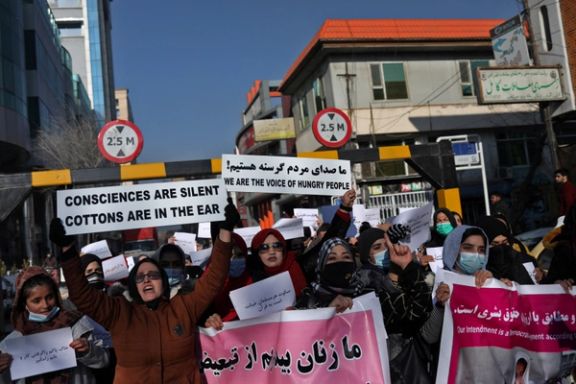
Afghan women shout slogans during a rally to protest against what the protesters say is Taliban restrictions on women, in Kabul, Afghanistan, December 28, 2021.

The German education minister says education is essential for the foundations of women's rights in Iran and Afghanistan, calling for international support.

Speaking to Iran International about ways to empower women in Iran and other authoritarian states, Bettina Stark-Watzinger, the Federal Minister of Education and Research and the Deputy Leader of the Free Democratic Party, praised the efforts by Afghan and Iranian women, pointing out that the fight for freedom is fostered by education, which is “the best way to make people independent.” 

Speaking on the sidelines of an event organized by the Axel Springer Freedom Foundation, an NGO that supports human rights activists through financial support, Stark-Watzinger told Iran International’s Ali Samadi that the first steps for supporting Iranian women would be supporting dissident figures and make the world see “how human rights and women’s rights are violated.”

“We always have to speak up against” such violations, she added, alongside Iranian opposition figure Masih Alinejad and several other activists and officials. 

Addressing Stark-Watzinger, Alinejad voiced appreciation for the German government, which she said has promised to back Iranian and Afghan women in their fight for freedom. 

From left to right: Ralph Büchi (Chairman of the Supervisory Board of Axel Springer SE), Friederike Behrends (Chairwoman of the Management Board of the Deutsche Postcode Lotterie), Roya Mahboob (co-founder of Afghan Girls RoboticTeam), Masih Alinejad (journalist and women's rights activist), Bettina Stark-Watzinger (Federal Minister of Education and Research), Niddal Salah-Eldin (Head of Talent & Culture at Axel Springer SE), Antje Schippmann (Managing Director of the Freedom Foundation)
100%
A group photo of some of the participants of the Axel Springer Freedom Foundation's Award for Courage, Berlin (November 2023)

On the anniversary of the death of Mahsa Amini, whose death in morality police custody triggered a nationwide uprising, German Foreign Minister Annalena Baerbock pledged Berlin's solidarity with the people of Iran.

"Even if the protests have disappeared from the headlines, we will not leave the people of Iran on their own," she said. "We will place the fate of the people in Iran on the agenda in Brussels, New York and Geneva."

"As much as it breaks our hearts, we will be unable to change conditions in Iran from outside, but we will not hold back from giving the people in Iran a voice," Baerbock said at the time. Germany has also backed ongoing EU sanctions on Iran relating not only to its nuclear program but for its brutal suppression of protesters during the Women, Life, Freedom uprising. Baerbock has repeatedly condemned Iranian authorities for human rights violations and is among the most vocal European leaders who speak out against Tehran’s treatment of women and protesters. 

Alinejad recognised the support, and said, “We believe that Iranian and Afghan women are fighting against a common enemy: gender apartheid".

During the event, the Axel Springer Freedom Foundation gave its courage award to Afghan women for their fight against the rule of Taliban, which has been intensifying restrictions on women’s education and social presence since it seized power in August 2021 as US-led forces withdrew after 20 years of war.

Referring to the award, Alinejad said that giving awards alone is not enough. “If you do not take practical steps to remove the Islamic Republic and the Taliban, they will eliminate you on German soil,” referring to assassination attempts she has so far evaded from regime security forces on foreign soil.  

A UN assessment of the women’s rights situation submitted to the 15-member Security Council in November read, "The basic rights of women and girls, including the right to education and to work, and representation in public and political life – are not only fundamental obligations of a state, but also critical to build state capacity for long-term development and economic growth and peace and security.

"Any formal re-integration of Afghanistan into global institutions and systems will require the participation and leadership of Afghan women.” 

Since the Taliban returned to power, most girls have been barred from high school and women from universities. The Taliban have also stopped most Afghan female staff from working at aid agencies, closed beauty salons, barred women from parks and curtailed travel for women in the absence of a male guardian. 

In Iran, since last September's uprising, women have been under increasing oppression as they rebel against mandatory hijab. They have been banned from public spaces, education and faced fines and jail terms for shunning the state laws which has seen a nation rise up.


Most Viewed

Ghalibaf defends Iran-US talks amid hardline backlash
1
INSIGHT

Ghalibaf defends Iran-US talks amid hardline backlash

2
INSIGHT

100 days after carnage: Iran economy reels from war, inflation, unemployment

3
INSIGHT

A nation in limbo: 100 days after the massacre, has the world moved on?

4
ANALYSIS

From instability to influence: Pakistan’s pivotal role in US-Iran diplomacy

5
ANALYSIS

100 days on: why Iran’s January protests spread across social classes

Banner
Banner

Spotlight

  • War-hit homeowners feel abandoned as Iran’s reconstruction aid fades

    War-hit homeowners feel abandoned as Iran’s reconstruction aid fades

  • 100 days on: the anatomy of Iran’s January crackdown
    INSIGHT

    100 days on: the anatomy of Iran’s January crackdown

  • Ghalibaf defends Iran-US talks amid hardline backlash
    INSIGHT

    Ghalibaf defends Iran-US talks amid hardline backlash

  • 100 days on: why Iran’s January protests spread across social classes
    ANALYSIS

    100 days on: why Iran’s January protests spread across social classes

  • From instability to influence: Pakistan’s pivotal role in US-Iran diplomacy
    ANALYSIS

    From instability to influence: Pakistan’s pivotal role in US-Iran diplomacy

  • A nation in limbo: 100 days after the massacre, has the world moved on?
    INSIGHT

    A nation in limbo: 100 days after the massacre, has the world moved on?

•
•
•

More Stories

Iran Executes Kurdish Prisoner As Minority Oppression Continues

Nov 29, 2023, 14:19 GMT+0

Ayub Karimi, a Sunni Kurd and a religious prisoner, was executed early on Wednesday in Karaj's Ghezel Hesar Prison.

Karimi, who had been sentenced to death approximately 14 years ago, was transferred to solitary confinement a week before the execution. Amnesty International had issued warnings in recent days, highlighting the imminent danger of Karimi's execution and urging authorities to cancel the sentence. Despite the pleas, Karimi, along with six other prisoners whose identities remain undisclosed, was hanged Wednesday morning.

Notably, Karimi was denied a final meeting with his family before his execution, mirroring the fate of his co-defendant, Qasem Abasteh, who was executed on November 5.

The human rights organization Hengaw has identified five more religious prisoners facing imminent execution: Davoud Abdollahi, Farhad Salimi, Anwar Khezri, Khosrow Besharat, and Kamran Sheykha. All of them were arrested in 2009 and held in the intelligence ministry’s detention center in Urmia.

In 2015, they were tried and sentenced to death, a verdict confirmed by the Supreme Court in 2020 after prolonged legal battles. Despite a plea for retrial in September 2020, the Supreme Court rejected their request.

The charges against the prisoners include "War against God," "corruption on earth," "support for Salafi groups," and an alleged "murder". However, the accused individuals consistently denied any involvement in the allegations in letters published by human rights organizations.

The situation for minority rights in Iran remains precarious. In July alone, the Kurdistan Human Rights Network reported that Iranian security forces detained at least 54 Kurdish activists and citizens in the western provinces of Iran.


Iran's Chief Banker Announces Plans For Iranian Bank In Syria

Nov 29, 2023, 11:43 GMT+0

The Governor of the Central Bank of Iran revealed plans to open an Iranian bank in Syria as the regime continues to prop up the crumbling Assad regime.

In a meeting with Syrian Prime Minister Hussein Arnous in Damascus on Wednesday, Mohammad-Reza Farzin made the announcement as both nations grapple with severe economic challenges.

Iran, facing a persistent financial downturn since 2018 due to US sanctions following its withdrawal from the JCPOA nuclear accord, has sought avenues to strengthen economic ties with Syria, which is in the throes of years of political and economic uncertainty and war.

Farzin also expressed Iran's intention to remove the dollar from economic and trade transactions between the two countries in the coming years.

Iran has been a significant financial supporter of Syria, spending tens of billions of dollars, a substantial portion of its constrained oil revenues, to sustain President Bashar al-Assad's regime. Estimates suggest that Iran has provided between $30 billion to over $50 billion in material aid to the government since 2011, a period during which Iran's annual oil revenues averaged between $20 billion to $40 billion.

Despite a decade-long effort to preserve the Syrian government, Iran holds a relatively small share of Syria's trade and has lost out to financially stronger players. The Revolutionary Guard, justifying its extensive involvement in the Syrian war, contends that trade and investment in Syria will eventually yield returns, compensating for the substantial financial and human costs Tehran has incurred to support the Assad regime, but so far it has not come true.


Khamenei Says Hamas Attack Also Targeted US Regional Influence

Nov 29, 2023, 11:06 GMT+0
•
Iran International Newsroom

Praising the October 7 Hamas attack on Israel, Supreme Leader Ali Khamenei said on Wednesday that Iran’s policy is not “to throw Zionists and Jews into the sea.”

Speaking at a gathering in Tehran, Iran’s 84-year-old ruler said the “Al-Aqsa Storm” was against “the Zionist regime,” but its real aim was to expunge American influence in the region.

“This historic event, in the true sense of the word, was able to disrupt America's policies in this region, and God willing, this storm will continue and will erase America’s agenda."

Khamenei reiterated Tehran’s long-held policy of demanding a referendum to decide the fate of Palestine and Israel, but at the same time called for the “Al-Aqsa Strom” to be repeated, which was in essence an attack on civilians and widespread and indiscriminate killings.

"The Islamic Republic of Iran is in favor of a referendum in Palestine and respects the opinion of the people. The viewpoint of the Islamic Republic is not to annihilate the Zionists and Jews,” Khamenei said.

Khamenei and his supporters have rejected calls for a referendum in Iran to change the constitution after several rounds of popular anti-regime protests.

During his 34-year rule, Khamenei has made Israel’s destruction the top foreign policy priority of the Islamic Republic, directing vast economic resources to creating, funding and arming militant groups in the region whose aim is to fight the Jewish state. Palestinian armed groups as well as the Lebanese Hezbollah have been sustained by Tehran’s full support.

In his speech, Khamenei harshly condemned the Israeli attacks in Gaza, without mentioning that the campaign began after Hamas killed 1,200 people in Israel, mostly civilians. He insisted that Israel’s military operation has been a disgrace for the United States and other Western countries that have supported it, claiming that 5,000 children have been killed by phosphorus bombs.

After a strong international reaction to the Hamas attack, the Iranian regime tried to argue that it had no foreknowledge of the operation. However, many find it hard to believe that Hamas would engage in such a risky adventure without first clearing it with its most important patron. Claiming no role in the October 7 terror attack, the Islamic Republic has avoided direct military involvement in the ensuing war, despite boasting for years of having a destructive ballistic missile arsenal directed against Israel.

In the same vein, the Lebanese Hezbollah has also avoided a full war with Israel, limiting its activities to border skirmishes.

Khamenei also dismissed US efforts to forge a new Middle east, saying that their plans in Lebanon and the occupation of Iraq have all failed. They were also unable to shape Syria according to their liking, he said, accusing Washington of engineering the revolt against the government of Bashar al-Assad.
"The political geography of the region is undergoing changes, but not in favor of the United States; rather, in favor of the Resistance Front. Yes, the geopolitical map of West Asia has changed, but in favor of the resistance, and the resistance has emerged victorious,” Khamenei said referring to all the proxy forces the Islamic Republic has created and nurtured in the region.

The Hamas attack and the ensuing Gaza war have for now halted the normalization process between Israel and Saudi Arabia, which Iranian officials have highlighted in recent weeks.

Khamenei went on to emphasize that the current trend in the region is to eradicate US influence and power, calling it “American hegemony.”
"Today, politics and orientation in this region are about getting rid of America. One of the clear and prominent signs that is evident today is the Al-Aqsa Storm. Yes, this storm is against the Zionist regime, but it is about getting rid of America," Khamenei declared.

Iranian FM Cites Visa Delay As Obstacle To UNSC Gaza Session Attendance

Nov 29, 2023, 10:11 GMT+0

Iran's Foreign Minister claims that a delayed visa issuance by Washington prevented his attendance at the United Nations Security Council (UNSC) session on the Gaza war in New York.

Scheduled for Wednesday, the UNSC meeting aimed to address the ongoing situation in Gaza following the Hamas invasion of Israel on October 7. At least 1,200 mostly civilians were murdered and 240 more taken hostage. Retaliatory attacks have since left more than 15,000 dead in Gaza and tens of thousands displaced.

Currently, a temporary ceasefire is in place as a hostage release takes place. In return, Israel is allowing the release of Palestinian prisoners in Israel's jails.

Hossein Amir-Abdollahian informed reporters that the United States issued his visa too late, making it logistically impossible for him to travel to New York in time for the session.

"It was planned that this week President Ebrahim Raeisi's official trip to Ankara would take place, and everything was coordinated. However, because the United Nations Security Council had a session regarding the situation in Gaza and the continuation of the ceasefire, the foreign ministers were invited," Amir-Abdollahian stated.

The UNSC session was called upon China's request, as the nation currently holds the rotating presidency. China, traditionally tied to the Palestinian side, has taken a largely hesitant and restrained stance on the Israel-Gaza conflict. This approach is further influenced by China's growing economic relationship with Israel, contributing to its reluctance to take a definitive side in the ongoing conflict.

Iran Denies Role In Sustained Attacks On US Forces In Mideast

Nov 29, 2023, 09:47 GMT+0
•
Iran International Newsroom

After weeks of rocket and drone attacks on US forces in Syria and Iraq, Iran has once again denied involvement in such attacks.

Iran’s ambassador to the UN claimed Tuesday that his country has “never had a hand in actions or attacks against US military forces in Syria or elsewhere.”

American troops in the region have been targeted at least 73 times since Israel began its onslaught on Gaza in response to the Hamas attack of 7 October, which killed 1,200. Iran-backed militant groups in Iraq and Syria have claimed responsibility for the attacks, but Tehran has claimed they are acting independently, angered by the war in Gaza.

However, the Islamic Republic calls these militant groups part of its axis of resistance against the United States and Israel. Almost every armed group that has targeted US forces in recent weeks is backed by or affiliated with the regime in Iran.

And yet Ambassador Iravani flatly denied any Iranian involvement and called such claims “baseless accusations’ – just as an IRGC-affiliated news agency published a video purporting to show images of the aircraft carrier USS Dwight D. Eisenhower being monitored with drones while passing through the Strait of Hormuz.

USS Eisenhower was deployed to the Middle East last month as concerns grew that the war on Gaza could spread across the region. The deployments – including warships and THAAD and Patriot batteries – were meant to deter hostile forces from attacking US personnel and interests.

But they seem to have failed to do so.

While Iran-backed groups have regularly attacked American bases in Iraq and Syria, injuring dozens, the Houthis in Yemen have seized a container ship and frequently launched missiles, including a ballistic missile last weekend that aimed at a US warship in the Gulf of Aden. The US has issued a warning to commercial shipping in the Indian Ocean.

The Pentagon has maintained throughout that it will do whatever it takes to protect American forces. But many on the Capitol have raised questions about the Biden administration's will to address the threats posed by Iran and its proxies.

“President Biden seems to be going out of his way to avoid targeting Iranians or the resources it holds dear,” Senator Tom Cotton posted on X Tuesday. “This weakness only invites more aggression.”

Republicans in Congress have been trying hard to push the Biden administration towards a more forceful stance in dealing with the regime in Iran. Several pieces of legislation have been introduced to limit the President's freedom of action in making concessions to Tehran or reverse his administration’s policies.

One such initiative in the Senate would designate Houthis as a terrorist organization, citing the group’s weekend missile attacks on a U.S. warship as an alarming escalation.

The legislation is led by Senator Ted Cruz and six other Republicans. It will reapply all sanctions on the Houthis that were lifted in 2021 when the Biden administration took office.

“The Biden administration made a day one politically driven decision to dismantle terrorism sanctions against the Houthis and their leaders,” said Senator Cruz. “That decision was an obvious and catastrophic mistake from the very beginning, and it has only become more obvious and more catastrophic as time has gone on.