• العربية
  • فارسی
Brand
  • Iran Insight
  • Politics
  • Economy
  • Analysis
  • Special Report
  • Opinion
  • Podcast
  • Iran Insight
  • Politics
  • Economy
  • Analysis
  • Special Report
  • Opinion
  • Podcast
  • Theme
  • Language
    • العربية
    • فارسی
  • Iran Insight
  • Politics
  • Economy
  • Analysis
  • Special Report
  • Opinion
  • Podcast
All rights reserved for Volant Media UK Limited
volant media logo

European Parliament Condemns Iran's Detentions, Hostage Diplomacy

Maryam Sinaiee
Maryam Sinaiee

Iran International

Nov 24, 2023, 12:52 GMT+0Updated: 11:28 GMT+0
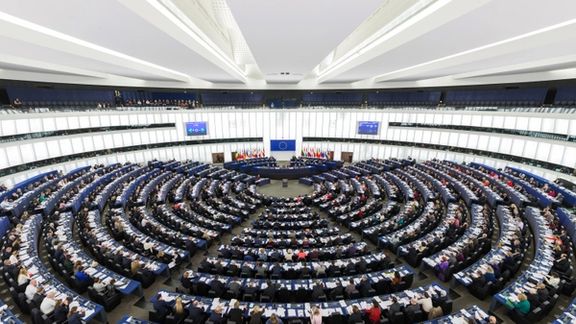
The European Parliament

The European Parliament has condemned the deterioration of the human rights situation in Iran and urged the release of arbitrarily detained activists and foreign nationals.

“Parliament strongly condemns the deterioration of the human rights situation in Iran, and the brutal murders of women by the Iranian authorities, including the 2023 Sakharov Prize laureate Jina Mahsa Amini,” a resolution adopted Thursday by European lawmakers by 516 votes in favor, 4 against, and 27 abstentions said.

Members of the European Parliament also urged the Iranian authorities to immediately end “all discrimination against women and girls, including mandatory veiling, and to withdraw all gender discriminatory laws.”

Arbitrary detention, withholding medical treatment to prisoners, police violence, torture, capital punishment, and the alarming rise in the number of executions was also “strongly condemned” by the European Parliament.

The resolution demanded the immediate release of all victims of arbitrary detention and human rights defenders, including Nobel Peace Laureate Narges Mohammadi, political activist Sepideh Gholian (Qoliyan), women’s right activist Golrokh Iraee, labor activist Nasrin Javadi and political activist Bahareh Hedayat all of whom are held at Tehran’s Evin Prison.

The European Union needs to launch a strategy to counter the Islamic Republic’s “hostage diplomacy”, the resolution said and demanded the immediate and unconditional releases of several EU citizens held in Iran including a Swedish EU diplomat and an elderly Austrian.

What has come to be known as the Islamic Republic’s hostage diplomacy involves the arbitrary arrest of foreign nationals and dual citizens to use them as bargaining chips in dealings with western countries.

Johan Floderus, a young Swedish EU diplomat, for instance, was arrested at Tehran airport in April 2022 after what was described as a private tourist trip with friends.

Iranian authorities have accused Floderus who is also being held at Evin Prison since then of espionage, a charge they often use to justify the arrest of foreigners and dual nationals.

Iran is also holding a Swedish-Iranian doctor, Ahmadreza Djalali (Jalali). Djalali who was arrested in 2016 during an academic visit to Iran was sentenced to death in October 2017 on charge of espionage for Israel.

In April 2022 Iran tried to ramp up pressure on Sweden to free Hamid Nouri who Sweden had put on trial over the mass execution and torture of political prisoners in July and August 1988, by threatening to execute Djalali. Nouri is currently serving a life sentence in Sweden.

The 73-year-old Austrian-Iranian businessman, Massud Mossaheb who is serving a 10-year prison term for vague national security offences is another EU citizen Iran has been holding since 2019.

Despite poor health prior to his imprisonment which required regular specialist medical treatment, Mossaheb has been denied access to adequate medical care and to specialist medical professionals outside prison. 

Members of the European Parliament reiterated their call in their resolution for the initiation of criminal investigations into “crimes committed by the Iranian authorities under universal jurisdiction” while demanding designation of the Revolutionary Guards (IRGC) as a terrorist organization and sanctions against human rights violators in Iran. These include Supreme Leader Ali Khamenei and President Ebrahim Raisi.

The European Parliament also urged the European External Action Service and member states to support the Iranian Sakharov and Nobel Prize laureates.

Prominent lawyer Nasrin Sotoudeh and dissident filmmaker Jafar Panahi jointly won the European Parliament’s Sakharov Prize in 2012. Both have been prosecuted, imprisoned, and banned from leaving the country on charges such as “assembly and collusion [to overthrow the regime]” and propaganda against the Islamic Republic.

Prominent human rights defender Narges Mohammadi won the Nobel Peace Prize in October this year while in prison "for her fight against the oppression of women in Iran and her fight to promote human rights and freedom for all.”

Most Viewed

Ghalibaf defends Iran-US talks amid hardline backlash
1
INSIGHT

Ghalibaf defends Iran-US talks amid hardline backlash

2
ANALYSIS

From instability to influence: Pakistan’s pivotal role in US-Iran diplomacy

3
ANALYSIS

100 days on: why Iran’s January protests spread across social classes

4

War-hit homeowners feel abandoned as Iran’s reconstruction aid fades

5

Iran says no decision yet on talks as Pakistan prepares to host US team

Banner
Banner

Spotlight

  • The politics of pink: how Iran uses cuteness to rebrand violence
    ANALYSIS

    The politics of pink: how Iran uses cuteness to rebrand violence

  • Bread shortages, soaring prices strain households in Iran, residents say
    VOICES FROM IRAN

    Bread shortages, soaring prices strain households in Iran, residents say

  • War-hit homeowners feel abandoned as Iran’s reconstruction aid fades

    War-hit homeowners feel abandoned as Iran’s reconstruction aid fades

  • 100 days on: the anatomy of Iran’s January crackdown
    INSIGHT

    100 days on: the anatomy of Iran’s January crackdown

  • Ghalibaf defends Iran-US talks amid hardline backlash
    INSIGHT

    Ghalibaf defends Iran-US talks amid hardline backlash

  • From instability to influence: Pakistan’s pivotal role in US-Iran diplomacy
    ANALYSIS

    From instability to influence: Pakistan’s pivotal role in US-Iran diplomacy

•
•
•

More Stories

Tehran Suspected To Be Behind Spoofing Attacks On Commercial Flights

Nov 24, 2023, 11:58 GMT+0

Recent electronic interference incidents for commercial flights near Iran have led to "unthinkable" navigational issues that cripple airliners' guidance systems, according to Vice magazine's report.

The GPS signals were “spoofed” in these incidents in order to fool planes into believing they were flying miles away from their actual location.

Reports of these attacks have been appearing since late September when Forbes initially disclosed that an international group of pilots and aviation professionals, Ops Group, was compiling data to be made public.

Over the past five weeks, the Ops Group has tracked more than 50 incidents over the Middle East but also identified a distinct new type.

The group states, that there is currently no solution to this new type of attack "with its potentially disastrous effects and unclear cause.”

While the entities behind the attacks are still unknown, the possible source of this new type of "spoofing" is the eastern periphery of Tehran, according to Todd Humphreys, a University of Texas, Austin, professor who researches satellite communications.

Although milder meddling with airliner navigation systems has been present in the skies over the Middle East and specifically near Syria since 2018, this kind of powerful “spoofing” is new.
"The spoofing corrupts the Inertial Reference System, a piece of equipment often described as the brain of an aircraft,” the report said.

A Canadian news outlet revealed in 2021 that Iran jammed GPS when it shot down an airliner over Tehran. Iran's Revolutionary Guards shot down a Ukrainian civilian airliner, flight PS752 on January 8, 2020.

Former IRGC Officer Admits To Providing Hamas Military Training

Nov 24, 2023, 10:22 GMT+0

A former Revolutionary Guard (IRGC) officer, Ezzatollah Zarghami, has admitted to providing military training to Hamas forces, including the use of missiles in the underground tunnels in Gaza.

Zarghami, who now serves as Iran's Minister of Tourism and Cultural Heritage, discussed on Iranian state television on Wednesday how the IRGC provides military support to the "Resistance" forces, including Hezbollah and Hamas.

“The Axis of Resistance,” referring to Tehran-backed forces in the region, includes Palestinian militant groups, Houthis in Yemen, the Lebanese militant group Hezbollah, and others.

Zarghami, sanctioned by the EU for his role as the head of Iranian state TV, explained that he was in charge of providing the Fajr-3, a medium-range ballistic missile, to Palestinian and Lebanese militias.

"I say this with pride, and we don't fear anyone. As the Leader [Ali Khamenei] says, we help oppressed people wherever we see them," he said.

Iranian authorities have denied any direct involvement in the Gaza war, which began on October 7 when Hamas launched a massive terror attack from Gaza into Israel, resulting in at least 1,200 deaths, mostly civilians, and the taking of about 240 others hostage.

Following the attack, Israel launched a major offensive into Gaza, claiming, according to the Hamas-run health ministry, more than 14,000 lives.

After seven weeks of war, Israel and Hamas have initiated a four-day ceasefire and the release of some hostages, with both sides stating that the break is only temporary.

Execution Of Another Protester Sparks Outrage Among Iranians

Nov 24, 2023, 10:14 GMT+0
•
Iran International Newsroom

The execution of Milad Zohrevand, a young Iranian protester on Thursday, has shocked and angered anti-government activists and dissidents in Iran and abroad.

Zohrevand was secretly executed in the Malayer prison in the western province of Hamedan while his family were not allowed to see him for one last time. Hengaw Human Rights Organization said in a statement that Zohrevand had not been notified that his execution.

The 21-year-old was married and became a father while serving time in prison. It is not clear if he ever had the opportunity to see his newborn child before his death.

In June, Zohrevand was sentenced to death in connection with the “murder” of an IRGC officer named Ali Nazari during the nationwide uprising against the Islamic Republic. Zohrevand was arrested by security forces on October 26, 2022, at the height of the anti-regime protest movement, triggered by Mahsa Amini’s death in the custody of the hijab police.

Gohar Eshghi, the mother of the 35-year-old blogger Sattar Beheshti, who was killed under torture in Evin prison 11 years ago, released a video message after the Zohrevand’s execution.

"You're right; you start working at five in the morning. At the time of the call to morning prayer, you execute the youth or kill them under torture," Eshghi said in the video, addressing Supreme Leader Ali Khamenei, “do not kill these young people."

Executions take place around the time of Muslim dawn prayer in Iran.The time for the call for dawn prayer (called azan or adhan) is now associated with executions for Iranians.

Despite the claims made by the Iranian judiciary, no video has been released so far showing how the IRGC officer was killed. According to human rights activists and organizations, there are many contradictions in the charges levelled against Zohrevand.

Iran’s judiciary and security officials provided different and even contradictory data regarding the number of suspects that were arrested in relation to the “murder” of the IRGC officer.

Zohrevand was reportedly accused by prosecutors of being one of a group of five masked men who shot the IRGC intelligence agent as he confronted students demonstrating at the Malayer Faculty of Medical Sciences in October 2022.

Information received by Iran International indicates that Zohrevand was denied access to a lawyer and other basic rights of an accused throughout his detention. His family was also under intense pressure from the IRGC intelligence service not to make public statements about his case.

The execution comes two weeks after UN Secretary-General Antonio Guterres released a report highlighting a surge in executions in Iran.

According to the report, at least 419 people were executed, including 409 men and 10 women, between January 1, 2023 and July 31, 2023, marking a 30 percent increase compared to the same period last year. Iran is second only to China in the number of executions carried out annually.

At least eight people have been executed by the Iranian regime for their involvement in nationwide protests triggered by the death in custody of Mahsa Amini in September 2022.

Iran-Backed Groups Launch More Attacks On US Forces In Iraq, Syria

Nov 24, 2023, 07:46 GMT+0

Iran-backed militant groups launched four more attacks against US bases in Iraq and Syria on Thursday with rockets and drones, but there were no casualties or damage.

Reuters quoted a US official, who spoke on the condition of anonymity, as saying that US and international forces were attacked at two sites in northeastern Syria with multiple rockets and a one-way attack drone. Since war broke out between Israel and Hamas, Iranian proxy forces have launched more than 70 such attacks, leaving many servicemen injured.

In Iraq, multiple one-way drones were launched at the Ain Al-Asad airbase west of Baghdad and a drone was launched at a base housing US force near Erbil airport in northern Iraq.

A group calling itself the Islamic Resistance in Iraq, which analysts say is a catch-all for several Iran-aligned Iraqi armed groups, had claimed attacks on those locations earlier in the day.

The attacks come the day after the U.S. struck the Iran-aligned Kataeb Hezbollah (KH) armed group south of Baghdad in an attack that KH said had left eight members dead.

The attack was condemned by the Iraqi government as escalatory and a violation of sovereignty.

US officials said the United States had struck Iran-backed groups after an escalation in their attacks that have targeted US and international forces dozens of times. The US has retaliated just a handful of times.

As of Thursday, there had been 36 attacks in Iraq and 37 in Syria, the US military official said.

Iran has avoided direct military involvement in the war, but has used its network of armed groups to target both Israel and US forces in the region.

Iranian Politicians Fear Low Turnout Amid Public Discontent

Nov 24, 2023, 05:58 GMT+0
•
Iran International Newsroom

Some Iranian politicians have lashed out at their hardliner rivals for doubling down on their idea of monopolization of power known as "political purification".

A centrist politician, Mansoor Haqiqatpoor criticized the hardliners who have sway in the parliament and in President Ebrahim Raisi’s government, arguing that real number of those advocating purges and political purification is just 98, explaining sarcastically that "There are only two busloads of them!" 

Hardliners launched their purification campaign earlier this year, seeking to consolidate all political power within the ranks of the Paydari Party. The campaign has gone much further than just the government, with hundreds of university professors, teachers and artists fired or banned from working.

The takeover by hardliner, however, began in early 2020, when the Guardian Council that has the power to vet candidates, disqualified hundreds of individuals from running for parliament. The same trend continued in the 2021 presidential elections, when all serious contenders were barred from running and Ebrahim Raisi cruised to the presidency.

Haqiqatpoor went on to say, "We can confront the advocates of political purification if the people turn up at polls" in the upcoming parliamentary elections" in March 2024.

Iranian politician Mansoor Haqiqatpoor  (undated)
100%
Iranian politician Mansoor Haqiqatpoor

He accused the members of ultraconservative Paydari Party of joining hands with hardliner individuals (meaning clerics) in Qom, the home of Iran's biggest Shiite seminary, and created the alliance that is pursuing the monopolization process on the Iranian political landscape. "They are currently engineering the purification process," he said.

Haqiqatpoor emphasized, "I hope the Guardian Council will confront these hardliners who are promoting the rhetoric of dictatorship." He accused Paydari leader Sadeq Mahsouli of disregarding the capabilities and merits of most Iranians, aiming to limit government membership to his party members. Haqiqatpoor also alleged that Paydari's leaders, wealthy individuals, exploit the country's resources for the benefit of the party.

Referring to Paydari's influence in Imam Sadeq University, Haqiqatpoor said: "The management of all the petrochemical plants of the country has been handed over to Imam Sadeq University alumni." He asked: "Doesn't have Iran any other university?"

He said Paydari is already controlling the government, the parliament, the state television, the ultraconservative Kayhan newspaper, the national Pension Fund and many other institutions. Nonetheless, he characterized Paydari members as "political dwarves."

Regardless of Paydari's all-out onslaught to monopolize political power in Iran and its political rivals' hope in elections as a means of changing the situation, reformist politician Hassan Rasouli told reporters in Tehran that except hardline conservatives who are fiercely competing with each other over winning the next parliament, no one else in Iran shows any interest in the upcoming elections.

Rasouli stated that "There is no movement among other political groups and parties indicating that they have any interest in the elections." He explained that "Three factors need to be present to facilitate a competitive election: People's reasonable satisfaction with the country's political, economic and cultural situation, various groups and parties' representation in the election, and the healthy process of the elections."

He explained that currently, there is a high degree of popular dissatisfaction and unhappiness about the way the government operates. Only a swift action on the part of the government can provide a representative basket of candidates for the voters to choose from.

"Obviously, if this dissatisfaction continues until March 1, no one can have any hope about a high turnout in the upcoming elections," Rasouli reiterated. In that case, he added, the turnout is likely to be even less than the 2020 elections which was the lowest of its kind in Iran in four decades.






