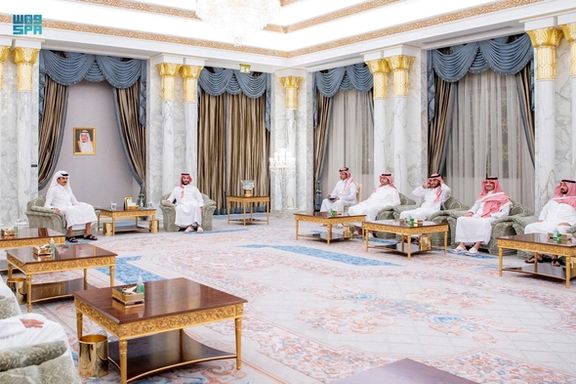
Saudi Crown Prince Mohammed bin Salman receives Qatar's Emir Sheikh Tamim bin Hamad Al Thani upon his arrival in Riyadh, Saudi Arabia, November, 10, 2023.
The news of “a tentative agreement” for the release of some Hamas hostages in lieu of a humanitarian pause has again turned the spotlight on Qatar’s mediating role.
Both Hamas and US officials have already stated that they are very close to a deal. Indeed, if Qatar manages to secure the safe release of about a quarter of the hostages, it will have won Qatar an unparalleled prestige as a humanitarian middle power.
The Hamas-Israel war has so far served to consolidate Qatar’s world-renowned position as a whisperer of regional “rogue actors”. Already having gained recognition for hosting the US-Taliban negotiations and mediating the release of US hostages from Iranian prisons, Qatar needs to underscore that it is not an enabler of “rogue actors” but indeed is their co-opter.
A person stands in front of pictures during a demonstration to demand the liberation of hostages who are being held in the Gaza Strip after they were seized by Hamas gunmen on October 7, in Tel Aviv, November 21, 2023.
Amidst the secret Qatari-US mediated negotiations for the release of hostages, Saudi Arabia is heading an Arab-Islamic Conference delegation to Beijing to woo Chinese support for a ceasefire in the region. Over the years, Saudi Arabia and Qatar have faced criticism from various quarters. Critics of both nations focus on their perceived hegemonic aspirations, alleged support for radical ideologies, including armed groups, and their roles as strategic players in the global energy landscape. However, despite the criticisms, both Saudi Arabia and Qatar have undergone a transformation, evolving from regional rivals to contenders for global middle power status.
In the early 2000s, there was scrutiny of Saudi Arabia for not taking decisive action against Saudi citizens who sponsored armed radical elements and terrorists, thus enabling Al-Qaeda. Others took to task Saudi Arabia’s intervention in the Yemeni civil war (2013-today) whilst discounting the role of Iran’s Shia Imperium. Nonetheless, Saudi Arabia has a solid track record as a conservative, “sober” and “non revolutionary”, foreign policy vis-à-vis the Arab Israeli conflict and the Arab-Western relations. In fact, those who criticize Qatar for enabling “rogue” actors often employ a similar approach to those who criticized Saudi Arabia in the aftermath of 9/11.
Qatar’s quest to attain middle power status has many similarities to that of Saudi Arabia’s. The ever-evolving contours of Qatar’s national security doctrine bear an uncanny resemblance to those that marked Saudi Arabia's rise from an aspiring regional power in the 1970s to today’s global energy powerhouse. Such an approach suggests viewing both Saudi Arabia and Qatar, in the era of Young Arab Powerful Monarchs—Saudi Crown Prince Mohammed Bin Salman (MBS) and Qatari Emir Tamim bin Hamad Al Thani (TBH)—in conjunction with each other rather than in juxtaposition.
A man is pictured in front of a FIFA World Cup Qatar 2022 sign in Doha, November 17, 2022.
The argument is rather straightforward. Qatar seeks to maximize its security by becoming an indispensable global middle power. Long before Qatar, Saudi Arabia sought to become a regional power so that no other player, would underestimate its position. In their pursuit of such inherently identical aspirations, both countries share historical insecurities towards each other as well as other friends and foes: Turkey, US and UK, Iran, Syria, Hamas, Hezbollah, and Yemen. Since the 1990s, both countries have alternated between being on the same or opposite sides of the same conflicts, with the Syrian and Yemeni civil wars.
A territorial dispute, dating back from the days of British protectorate over the Persian Gulf littoral states, simmered between Qatar and Saudi Arabia.
By the mid-1990s border clashes caused Saudi Arabia and Qatar to seek a new settlement. In 2001 a treaty settling the border dispute was signed, though Qatar’s 2017 blockade by Saudi Arabia and the GCC underscored that the border issue has never been truly resolved.
Between 1971 and 1980, with Britain’s departure from the region, Qatar had relied on the conjoined good graces of the Shah of Iran, the US, and Saudi Arabia for its security; mainly following Nixon’s doctrine. From 1980-1990, with the rise of a hostile Shia revolutionary Iran and its war with Iraq, Qatar joined the GCC and relied on the US military presence and Saudi Arabia.
Given such a rich history, the body of scholarship aiming to illuminate Qatari-Saudi/GCC relations is extensive and varied. However, none of these works offer a precise understanding of the national security doctrines of Saudi Arabia and Qatar. Many tend to compare both countries and their divergent visions for the region.
Some, citing Saudi’s intervention in Yemen, identify a doctrinal shift in MBS’ approach to Saudi national security; from a traditionally “defensive one” to an “offensive one”. Yet, such approaches discount Yemeni Houthis’ station as “proto-sovereign” proxy franchise of Iran’s Shia Imperium. Contrary to such an account, historical evidence shows that Saudi Arabia’s defensive war against a proxy war launched from Yemen does not represent a doctrinal shift invented by MBS or King Salman. In fact, in the 1960s, Saudi Arabia withstood a similar proxy onslaught from Yemen by another revolutionary regime in the region: Egypt’s Nasser; a regime that even used chemical weapons against the very Arabs whose defence it professed against “the Zionist entity”, i.e., Israel.
In the end, the literature on Qatar-Saudi/GCC relations seems to miss the forest for the trees.
Shortly after the swift fall of Kuwait, it became clear to Qatar that its security was precarious. The fall of Kuwait at the hands of Saddam Hussein that could only be undone under a US-led coalition must have had a similar psychological impact on Saudi leaders. The question is how the fall of Kuwait and the ensuing events influenced Saudi and Qatari visions of national security. By piecing together various aspects of Qatar’s statecraft in practice, a solid pentagonal national security doctrine emerges. Such a close examination establishes that contours of Qatar’s security doctrine enjoy more similarities than differences to those that have dictated Saudi Arabia’s statecraft:
What emerges out of the scholarship are several simple facts. First, Qatar has been enjoying an economic boost in self-confidence because of its pre-eminent place as a major gas producer. US’ heavy reliance on its Qatari Airbase for its invasion of Afghanistan and Iraq also ensured Qatar that it would not be easily threatened by Saudi Arabia should any quarrel break out between the two.
In the meantime, Qatar sought to appease the Iranian regime, with which it shares its lucrative natural gas field (Qatar owns the lion’s share of it). In dealing with Israel and Iran, Qatar’s leaders began drifting away from the principles of the 2002 Arab Peace Initiative. Earlier, they had sought normalization with Israel (Israel even had a trade office in Doha until its closure in 2009) even though the Palestinian situation still lurched unresolved in the background. Conversely, under King Salman’s predecessor, King Abdullah, Saudi Arabia opposed normalization with Israel before the resolution of the Palestinian issue.
The Arab Spring ushered in an era of chaos and unpredictability and caused Qatar to further steer away from its GCC allies. As Syria and Libya plunged into the mayhem of civil wars, Qatar and Saudi Arabia jockeyed to win the patronage of armed non-state actors. With Turkey and Iran escalating their military presence in Syria, Qatar sought to align itself with Turkey. Qatari and Saudi money eventually brought no dividends as Iran-Russia’s overwhelming intervention on Assad’s behalf sidelined all other parties.
Turkey's President Tayyip Erdogan shakes hands with Qatari Emir Sheikh Tamim bin Hamad Al Thani on the sidelines of the World Cup in Doha, Qatar, November 20, 2022.
Saudi Arabia never forgave Qatar for siding with Turkey- and perhaps blamed the Turkish-Qatari alliance for Assad’s survival. Indeed, as the Yemeni civil war limped on and Syria’s civil war began to subside, Qatar became more friendly towards the Iranian Mullahs, even though it was part of a UAE and Saudi Arabia anti-Houthi coalition. The straw that broke the camel’s back in Saudi-GCC relations with Qatar in 2017 was the culmination of Doha’s constant zigzagging and asserting its own interests vis-à-vis the Saudis.
Qatar’s ever-closer ties with Iran was a key factor in Saudi resentment. Saudi Arabia and GGC subjected Qatar to an economic and air navigation blockade and demanded Qatar to cut ties with “terrorist organizations” and shutter “Aljazeera TV.”
Undeterred by the blockade, Qatar doubled down on tightening relations with Iranian mullahs. In 2018, the IRGC top brass declared their support for Qatar as Qatar limped its way through the blockade. It is thus no wonder that Qatar considered Trump administration’s designation of IRGC as a terrorist organization unacceptable. In view of Trump’s administration’s refusal to mediate on Qatar’s behalf during the blockade, it is obvious why Qatar would become even closer to the ayatollahs and the IRGC.
In fact, when a US drone attack dispatched IRGC General Qasem Soleimani in January 2020, Qatar’s Emir was amongst the first foreign dignitaries to visit Iran to affirm his commitment to “de-escalation” with Iran.
Hamas' October 7 terror attack on Israeli civilians could pose challenges for this patron saint of "rogue" non-state actors. While Qatar initially favored normalization with Israel in the early 2000s without preconditions, it found itself isolated by 2018. As the UAE and Bahrain engaged in US-mediated negotiations with Israel, Qatar insisted on resolving the Israel-Palestine conflict before any normalization of Israeli-Arab relations. Qatar opposed the Abraham Accords, and it likely holds similar sentiments against the Saudi-Israel rapprochement. The hostage-taking incident by Hamas disrupted the normalization process, allowing Qatar to reaffirm its crucial position as host, patron, and interlocutor of Hamas' political leadership. This situation granted Qatar a tactical advantage over Saudi Arabia, showcasing its indispensability as a mediator. The conflict prompted Saudi Arabia to become more proactive, leading a delegation of Arab and OIC countries to China. Qatar now faces the pressing concern of securing the hostages' release, with the Saudis pursuing alternative strategies against Hamas and its patron, Iran, through China. If Qatar successfully secures the hostages' release, it stands to gain a significant diplomatic advantage as a humanitarian mediator. The question remains whether Saudi Arabia, the GCC, the US, and Israel will maintain a conciliatory stance towards Qatar once the dust settles in Gaza.
By the time all the hostages are released, not only will have Qatar enjoyed a distinct leverage to exert upon the rest of its regional rivals, but it will also be able to rely on the US to vouch for it for its pivotal mediatory role. Certainly, Qatar’s accomplishments will have been unparalleled for a state of its size. Yet, all the economic, natural resources, foreign direct investment, and humanitarian leverage that Qatar relies on is still incomparable to Saudi Arabia’s patronage of the holy sites of Mecca and Medina, its historical alliance with the US, and its natural resources and geostrategic locus. Qatar cannot risk recklessly punching above its weight.
In the end, indispensability is in the eye of the beholder. The Yemeni Houthis’ hijacking of a western cargo ship in the Red Sea marks an unwelcome and escalatory development that can implicate anyone who is enabling Iran’s Shia Imperium and its agents in the region. In a world where the United States is willing to station a strategic nuclear submarine, two aircraft carrier naval groups, and an assault aircraft squadron to defend Israel against possible threats, Qatar may wish to question the costs and benefits of hedging its bets with Iran’s Imperium, i.e., the Axis of Resistance. If the US finds Qatar on the wrong side, as an enabler of Iran’s Shia axis, and a culprit of regional instability, then, it may revisit its strategic ties with Qatar at Saudi-GCC’s behest. Such a grave possibility may have already given Qatar’s leaders a pause to return to the fold of GCC; though this time as a middle power.
Qatar has played its regional nemeses against one another, asserting itself over and above all friendships whilst claiming to be no one’s enemy. In fact, Qatar has sought to be an interlocutor on behalf of rogue or non-rogue, regional powers: Iran and Turkey. On the contrary, Saudi Arabia has never sought such a position and sought not be identified with state or non-state “rogue actors”.
Iranian lawmaker Hassan Norouzi claims the regime will open a new military front against Israel amidst the war in Gaza, in spite of Iran denying a direct involvement
Khamenei loyalist Norouzi stated on Tuesday, "Certainly, a new front against Israel will open. This will happen soon, and it is definite. But I cannot provide the details". Iran-backed Hamas invaded Israel on October 7 in a surprise attack which has led to a relentless retaliation for Gaza as a result.
Iran's proxies in Yemen, Syria, Iraq and Lebanon have all since launched attacks on the Jewish state.
The claims by Norouzi follow remarks by Mohsen Rezaei, a former Revolutionary Guard commander and a power insider in Tehran who also declared on Monday that new military fronts would open in the war against Gaza in the coming days.
However, Mahmoud Abbaszadeh, a member of the National Security and Foreign Policy Commission of the Parliament, responded to Rezaei's statements, stating, "Such matters are within the jurisdiction of the leadership, not the Secretary of the Supreme Council of Economic Coordination. They must present evidence for their claim."
Abbasszadeh highlighted that discussions on war, peace, and related matters fall within the powers of the leadership in the Islamic Republic of Iran and are usually discussed by experts in the Supreme National Security Council. He added, "Those who express opinions in this regard probably have information, but I currently do not have any information in this regard."
Iran has denied direct involvement in the war which saw 1,200 mostly civilians killed by Hamas in Israel and 240 taken hostage, including babies, women and the elderly, and over 12,000 Palestinians killed in Gaza. However, Iran has long backed the Sunni proscribed terror group as part of its war against its archenemies Israel and the US.
At the time of publication, the Israeli government announced that there would be imminent news of a deal with Hamas with a possible ceasefire on the table in return for the release of some or all of its hostages.
The US has carried out an airstrike on a vehicle in the proximity of Al-Asad airbase in Iraq which hosts American troops, killing several Iran-affiliated militants.
US forces came under attack at the Ain al-Asad airbase west of Baghdad early on Tuesday and troops responded in self-defense, US military officials said. This was first reported US response in Iraq to dozens of recent attacks. Located in the western Anbar province, Ain al-Asad air base is regularly targeted by militia rockets or missiles since the Gaza war began on October 7.
The attack against Ain al-Asad caused minor injuries and damage to infrastructure, one official told Reuters, another saying American forces used an AC-130 gunship to hit the militants.
Iran-backed militias have been targeting American forces almost daily for over a month, totaling 65 attacks in which about 60 staff have been wounded. They say their operations are in support of Palestinians and will continue as long as the United States backs the Israeli onslaught on Gaza. Thousands of terrorists invaded Israel killing at least 1,200 mostly civilians in the single most deadly day for Jews since the Holocaust. While Iran denies involvement, it funds the group tens of millions each year and supports it militarily.
Deputy Pentagon Press Secretary Sabrina Singh said Tuesday that the US' AC-130 was "already in the area" when the Ain al-Asad airbase was targeted by the missile attack, enabling it to track the point of origin of the attack and killing the Iran-linked militants who fired at the base. She said this is the difference between this retaliatory attack in Iraq and the three previous ones in Syria which "were pre-planned." The majority of US targets are storhouses or shipments of weapons.
Singh was questioned about a call by Senator Lindsey Graham who has called for a direct military action against Iran, instead of its proxy groups in Iraq and Syria. Dodging a direct answer, she said the US targets are selected to hit Iran where it hurts.
The latest military response to attacks against American forces was the fourth time the US carried out an airstrike since the attacks ramped up in October. The other attacks happened on October 26, November 8 and 12, all in Syria.
The Biden administration is under fire by lawmakers and critics for lack of action in dealing with Iran-backed attacks on US facilities across the region.
Earlier on Tuesday, social media accounts linked to Iran-aligned Iraqi militias published a statement in the name of the "Islamic Resistance in Iraq", mourning a member who they said had been killed "in battle" against US forces.
His killing is the first reported casualty in Iraq linked to the Israel-Gaza war, which has drawn in other factions in Iran's network of regional proxies, such as Lebanon's Hezbollah and Iraq's Kataeb Hezbollah.
While Iran has so far stayed out of direct military action in support of Hamas, it has used its proxy forces not only to attack US forces but also targets in Israel and in the Red Sea. Yemen's Houthis have launched drones and missiles against Israel and seized a commercial vessel in the Red Sea on Monday, which is partially owned by an Israeli.
The Mavi Marmara was the lead ship in a six-vessel aid flotilla that were boarded in international waters, about 130km (80 miles) from the Israeli coast in 2010.
A Turkish activist is at the helm of gathering around 1,000 boats in Turkey in a bid to disrupt Israeli marine activity as the Gaza conflict widens.
Amid the war in Gaza, declared by Iran-backed Hamas on October 7, the action echoes the deadly events of more than a decade ago when in 2010, the Israeli navy raided the Turkish Mavi Marmara, dubbed the Gaza Freedom Flotilla, carrying pro-Palestinian protesters aiming to impose a blockade.
After violent resistance, 10 activists were killed and a further 10 military personnel were injured in the incident.
Volkan Okçu is organising the latest mass blockade telling local news site Haber7, that the boats will carry 4,500 people from 40 countries. Among the 1,000 vessels will be 313 boats filled with Russian activists, and 104 filled with Spanish activists, he said.
While it is not backed by the Turkish government, President Erdogan has recalled the Turkish ambassador in Israel and been forthright in his condemnation of the attacks on Gaza in response to the massacre in Israel on October 7, killing 1,200 mostly civilians. A further 240 were taken hostage to Gaza.
Turkey is also host to Hamas, one of the two bases outside Gaza used by political leader Ismail Haniyeh, who is currently in Doha meeting with Red Cross officials to negotiate a ceasefire in return for the release of some of the hostages, which include 40 children, the elderly and the sick.
Okçu told Haber7 that the flotilla is scheduled to leave Turkish coasts on Thursday, first stopping in Cyprus before going next to the Israeli port of Ashdod. The goal he says is to disrupt trade and goods heading to Israel for up to 10 days.
The Turkish activist said there will not be a repeat of the incident of 2010, the flotilla following international law and the vessels sailing under flags of the US, the UK, Luxembourg, Russian, Germany, Spain, Poland, and others.
The Mavi Marmara Freedom and Solidarity Association announced this week its intentions of delivering aid to Gaza. ”We are setting out again towards Gaza as a civil and independent movement in line with the decision we made with the International Freedom Flotilla, of which we are a member,” the association said on its website.
“Our actions against the naval blockade in Gaza adhere to the principles of nonviolence and non-violent resistance," it added.
As the Israeli onslaught of Gaza continues, hundreds of the militia’s commanders assassinated and large swathes of the strip destroyed, Hamas’s political leader in exile, Ismail Haniyeh, said that a truce with Israel was “close”.
In spite of the celebrations of victory by Hamas, the proscribed terror group is being pushed further underground as Israel’s land incursion deepens, unraveling the group’s thousands of miles long terror tunnel network.
It is understood that both sides would agree to release women and children, Hamas to release hostages, and Israel to release those held in its prisons, according to Hama’s Issat el Reshiq.
Mirjana Spoljaric, president of the International Committee of the Red Cross (ICRC), met Haniyeh in Qatar on Monday to "advance humanitarian issues" related to the conflict, the Geneva-based ICRC said in a statement. She also met separately with Qatari authorities.
The ICRC said it was not part of negotiations aimed at releasing the hostages, but as a neutral intermediary it was ready "to facilitate any future release that the parties agree to.” In Israel, families of the captives demand the organisation do more to access the hostages to prove signs of life and address critical health needs.
The flotilla comes as the war on Hamas widens further into the international arena. Iran’s proxy in Lebanon, Hezbollah, conducted its most brutal assault on Israel’s norther border since the start of the war on Monday. Iran’s largest and most powerful terror proxy employed more developed destructive weapons, in spite of Iran’s ongoing official denials of its involvement in the conflict. Top regime officials however have lauded the Hamas attacks and voice support for other groups joining the efforts of “resistance” against Israel.
On Sunday,Iran’s proxy the Houthis in Yemen, hijacked a Japanese-operated cargo ship in the Red Sea. The car carrier, Galaxy Leader, was taken to a Yemeni port, the proxy group believing it was owned by an Israeli businessman. On Monday, Japanese officials announced they were in direct talks with the Houthis after confirming the vessel was operated instead by Tokyo-based firm Nippon Yusen.
Iran’s Supreme Leader Ali Khamenei and top brass during an exhibition showcasing latest drones and missiles made by the Revolutionary Guard’s Aerospace Force on November 19, 2023
As Iran’s ruler Ali Khamenei has remained cautious over direct involvement in the Gaza war, lower ranking officials continue to speak with bluster about defeating Israel.
Mohsen Rezaei, a former Revolutionary Guard commander and a power insider in Tehran, threatened on Sunday that “New fronts will be opened in the Gaza war, and if the situation in remains grave, it would be impossible to prevent reactions by Muslim youth.”
Rezaei, who was speaking to Iran-affiliated Al Mayadeen television, hinted at other groups of the “Resistance Front” getting involved in the war and insisted that Israel will be defeated. Other Iranian officials have made similar claims since Israel launched its attacks on Gaza after Hamas’ October 7 terror attack. However, so far, the Iranian regime has not used its own military forces to respond to Israel.
Khamenei appealed to Muslim states with political ties with Israel on Sunday to at least cut them for "a limited time", state media reported on Sunday, weeks after he called for an Islamic oil and food embargo on Israel.
Iranian politician Mohsen Rezaee
"Some Islamic governments have condemned Israeli crimes in assemblies while some have not. This is unacceptable," Khamenei said before reiterating that the main task of Islamic governments should be to cut off Israel from energy and goods.
"Islamic governments should at least cut off political ties to Israel for a limited time," Khamenei added.
This was a substantial climb-down for a man who has made Israel’s destruction the main ideological linchpin of his 34-year rule. The fact that Iran’s most powerful proxy military group, the Lebanese Hezbollah, has refrained from starting an all-out war against Israel, as Hamas faces a dire situation in Gaza, is another clear sign that Tehran is unwilling to risk everything at this stage.
In the meantime, Iran’s rulers have succeeded in securing the release of as much as $17 billion dollars that was blocked in South Korea and Iraq because of US sanctions. The Biden administration began approving the release of the funds from June, despite domestic opposition, and approved another big chunk this month, as the war raged in Gaza. The most astonishing aspect of Washington’s decision is that it came amid almost daily attacks by Iranian proxy militias on US military bases in Iraq and Syria.
It is not clear if this concession by the Biden administration is what keeps Tehran hesitant to expand the conflict, or it simply feels unease given its precarious situation at home. Since the United States imposed sanction in 2018, Iran faces an intractable economic crisis, which in turn has led to public anger and rounds of protests. The Islamic Republic faces political instability, with the ever-present specter of more popular protests.
After decades of calling for Israel’s destruction, the Islamic Republic seems to have shied away from military assistance to Hamas and is calling for a ceasefire. On Monday, President Ebrahim Raisi wrote to leaders of 50 countries asking them to use their influence to end the fighting. These included, the leaders of China, Russia, Turkey, Kazakhstan, South Africa, Kenya and Jordan. Once again Raisi asked these countries to impose economic sanctions on Israel.
However, during a joint summit between members of the Organisation for Islamic Cooperation and the Arab League in Saudi Arabia's capital on Nov. 11, Muslim states did not agree to impose wide-ranging sanctions on Israel, and Raisi had to put his name to a joint statement that actually endorsed a two-state solution – or Israel’s right to exist.
An F/A-18F Super Hornet jet flies over the USS Gerald R. Ford in the Atlantic Ocean in July 2017.
US Department of Defense chiefs are frustrated by their government’s lack of action in dealing with Iran-backed attacks on US facilities across the region.
Iran-backed militias have been targeting American forces almost daily for over a month, totalling 61 attacks in which at least 59 staff have been wounded. They say their operations are in support of Palestinians and will continue as long as the United States backs the Israeli onslaught on Gaza.
In response, the Biden administration has so far approved three airstrikes on IRGC-affiliated facilities in Syria, the last of which on 12 November killed “seven militants”, according to US officials.
“Are we trying to deter future Iranian attacks like this,” a Pentagon official told the Washington Post on the condition of anonymity. “There’s no clear definition of what we are trying to deter.”
As Iran uses the war in Gaza to fuel its proxies' actions against its archenemies Israel and the US, regime rhetoric is relishing the opportunity posed by the Hamas invasion of Israel on October 7. Thousands of terrorists invaded Israel killing at least 1,200 mostly civilians in the single most deadly day for Jews since the Holocaust. While Iran denies involvement, it funds the group tens of millions each year and supports it militarily.
Handout photo dated July 2, 2013 shows F/A-18C Hornets assigned to the Wildcats of Strike Fighter Squadron (VFA) 131 fly over the aircraft carrier USS Dwight D. Eisenhower (CVN 69) during Carrier Air Wing (CVW) 7’s fly-off in the Atlantic Ocean.
“We have seen the first stage of expansion of the scope of the war by the resistance groups who make their own decisions,” said Iranian Foreign Minister Hossein Amir-Abdollahian Monday, distancing himself from the proxy attacks on Israel and the US which have come from Yemen, Iraq, Lebanon and Syria.
“And if the possible scenarios to stop the crimes of the Zionists do not come to fruition, we will probably witness a new situation in the region,” he warned. On Sunday, Iran's Yemeni proxy, the Houthis, admitted hijacking what it had believed to be an Israeli-owned ship while on Monday, the situation on Israel's northern border had escalated under its proxy Hezbollah.
The Biden administration is mindful of not escalating the conflict and turning it into a full-scale regional war that would inexorably drag in American troops. They have warned Iran and its proxies many times that the United States will not tolerate attacks on its forces and would retaliate. Warships and troops have also been brought to the region to deter further aggression, yet the attacks are continuing unabated.
However, if the attacks on US bases carry on at the current rate, it is only a matter of time before US military personnel get killed, forcing the administration to react.
Some in Washington say Biden's softly-softly approach has emboldened the regime, not least since the recent hostage deal which saw five unlawfully detained US-Iranians released in exchange for the freeing up of $6bn of frozen Iranian funds in south Korea and a possible $10bn more in the offing.
Many attacks on US troops are carried out by one-way drones, which Iran manufactures on a large scale, even giving them to Russia to be used in its war against Ukraine.
“They keep shooting, waiting for us to respond. We don’t, so they keep shooting,” said Senator Kevin Cramer of the Armed Services Committee. “Our posture has to be a little more aggressive than just strictly defensive, because one of these days, we’re going to miss one of those drones.”