• العربية
  • فارسی
Brand
  • Iran Insight
  • Politics
  • Economy
  • Analysis
  • Special Report
  • Opinion
  • Podcast
  • Iran Insight
  • Politics
  • Economy
  • Analysis
  • Special Report
  • Opinion
  • Podcast
  • Theme
  • Language
    • العربية
    • فارسی
  • Iran Insight
  • Politics
  • Economy
  • Analysis
  • Special Report
  • Opinion
  • Podcast
All rights reserved for Volant Media UK Limited
volant media logo

Hezbollah And Israeli Clashes Continue As Iran Blames The US
Iran International Newsroom
Nov 11, 2023, 07:59 GMT+0Updated: 11:32 GMT+0
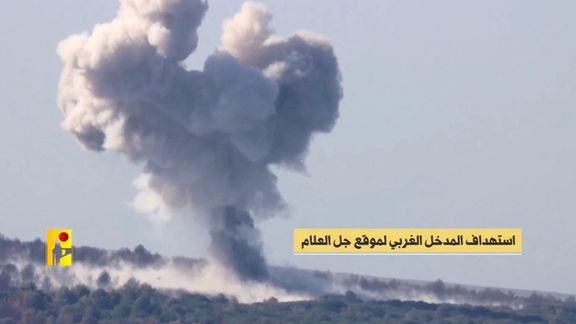
Smoke rises from a purported Hezbollah strike on an Israeli army position at the Lebanese-Israeli border in this still image from video obtained by Reuters on November 4, 2023.

Hezbollah and Israel announced successful mutual attacks on Friday, raising concerns that a month of limited operations could eventually lead to an all-out war.

The Israeli military confirmed it had struck targets in southern Lebanon, in response to drone and missile attacks on its forces. Hezbollah, for its part, published a video purporting to show its aerial operation.

Reporters who have visited the border areas of Lebanon and Israel say the reality on the ground is more serious than many think and that “there is a sense of impending conflict."

Hezbollah leader Hassan Nasrallah is scheduled to speak Saturday at 3pm local time. This will be his second public appearance since October 7.

In his first speech, Nasrallah praised Hamas and denounced Israel but fell short of calling for war. He did say at the end, however, that the current conflict with Israel was of a different order to the previous ones, and that he was leaving all military options on the table.

Most experts say Nasrallah is reluctant to risk a full-blown war with Israel. But some say his second speech could be different, particularly given the scale of killings in Gaza.

On the eve of that speech, Hezbollah media have published a short video featuring soundbites of Nasrallah intercut with images of their operations. The video is titled “And it will not stop at that” –a title that could be read as a signal of potential escalation.

On Thursday, Iran’s foreign minister said that “with the intensification of the war on civilians in Gaza, expansion of the scope of the war has now become inevitable.”

Shortly after, Amir Saeid Iravani, Iran's ambassador to the United Nations, told CNN that the Islamic Republic will not expand this war front.

Put together, the two seemingly contradictory remarks may suggest that the regime in Iran wants to convey that the war would escalate in spite of the decisions made in Tehran.

Iran’s intentions might become clearer this weekend in Riyadh, where President Ebrahim Raisi is expected to meet Saudi Crown Prince Mohammed bin Salman on the sidelines of the summit of the Organisation of Islamic Cooperation (OIC).

Before departing Tehran, Raisi squarely blamed the United States for lack of a ceasefire in Gaza. The Iranian regime has directed his verbal and proxy attacks at the US in recent weeks, with its militant proxies in the region launching more than 40 attacks against American troops in Iraq and Syria.

The two leaders talked on the phone a few days after the start of the Israeli onslaught on Gaza. The two states differ considerably in practice and tone when it comes to dealing with Israel in general and the current conflict in particular.

The Islamic Republic openly supports militant groups fighting with Israel and calls for an oil boycott of that country. Saudi Arabia has demanded that Israel show constraint.

On Friday, MbS accused Israel of violating international law and condemned the “targeting of civilians in the Gaza Strip.”

It remains to be seen whether the two regional powers can agree on a joint course of action or at least get closer in their stance.

Saudi Arabia has so far refused to consider a boycott of, or to break ties with, Israel. Iran, on the other hand, has warned of escalation by inaction.

“My assessment is that if the emergency meeting of the [OIC] in Saudi Arabia does not lead to helping and saving the Palestinian nation, the scope of conflicts in the region will increase,” Raisi said on the eve of his trip to Riyadh.


Most Viewed

State media slam Araghchi's Hormuz tweet, say it let Trump claim victory
1

State media slam Araghchi's Hormuz tweet, say it let Trump claim victory

2
OPINION

The Hormuz get out of jail card turned to a grave

3
INSIGHT

How Tehran bends its own red lines to boost state rallies

4

Iran International says it won’t be silenced after London arson attack

5
VOICES FROM IRAN

Iran blackout cripples freelancer, small business incomes

Banner
Banner

Spotlight

  • Too early to tell who is winning Iran war, experts say
    PODCAST

    Too early to tell who is winning Iran war, experts say

  • How Tehran bends its own red lines to boost state rallies
    INSIGHT

    How Tehran bends its own red lines to boost state rallies

  • Iran blackout cripples freelancer, small business incomes
    VOICES FROM IRAN

    Iran blackout cripples freelancer, small business incomes

  • Ideology may be fading in Iran, but not in Kashmir's ‘Mini Iran'
    INSIGHT

    Ideology may be fading in Iran, but not in Kashmir's ‘Mini Iran'

  • US blockade enters murky phase as tankers spoof signals and buyers hesitate
    ANALYSIS

    US blockade enters murky phase as tankers spoof signals and buyers hesitate

  • Why the $100 billion Hormuz toll revenue is a myth
    ANALYSIS

    Why the $100 billion Hormuz toll revenue is a myth

•
•
•

More Stories

Raisi Heads To Muslim Summit On Gaza Condemning The US

Nov 11, 2023, 07:40 GMT+0

President Ebrahim Raisi headed to Saudi Arabia to attend a summit on the war between Israel and Hamas militants in first trip by an Iranian head of state in years.

Raisi said time had come for action over the conflict in Gaza rather than talk. "Gaza is not an arena for words. It should be for action," he said at Tehran airport before departing for the summit of Arab and Islamic nations in the Saudi Arabian capital Riyadh.

"Today, the unity of the Islamic countries is very important," he added.

It is the first visit to Saudi Arabia by an Iranian head of state since Tehran and Riyadh ended years of hostility under a China-brokered deal in March.

The Iranian regime has rendered financial and military support to Hamas for more than two decades and glorified the October 7 terror attack by holding street celebrations on the same day. However, it has refrained from direct military involvement in the Gaza war, facing warnings from the United States.

"The summit will send a strong message to warmongers in the region and result in the cessation of war crimes in Palestine," Iranian Foreign Minister Hossein Amir-Abdollahian, who is accompanying Raisi, was quoted as saying by a government website.

"America says it doesn't want an expansion of the war and has sent messages to Iran and several countries [to this effect]. But these statements are not consistent with America's actions," Raisi said in the televised comments at Tehran airport.

"The war machine in Gaza is in the hands of America, which is preventing a ceasefire in Gaza and expanding the war. The world must see the true face of America," Raisi claimed.

Bild Places Sign Condemning Anti-Semitism Outside Iran’s Embassy

Nov 10, 2023, 19:45 GMT+0

Best-selling German newspaper Bild has placed a large placard in front of Iran's embassy in Berlin as part of a campaign against anti-Semitism.

The placard, which is mounted on a truck, reads, “As long as you finance the murder of Jews, we will write about it.” The sign also displays an image of Iran’s Supreme Leader Ali Khamenei.

Bild has earlier installed a similar sign with an image of Russian President Vladimir Putin in front of the Russian Embassy.

The Islamic Republic is the main supporter of the Islamist group Hamas, which declared war on Israel on October 7 and killed 1,400 people, mostly civilians, during its multi-thronged attack in Israel. The attack was celebrated by the Islamic Republic, which is considered the main threat to Israel. Regime authorities, including ruler Khamenei, have repeatedly called for the destruction of "the Zionist entity” meaning Israel in the official jargon of the clerical regime.

Last year, German media reported that investigations were underway about the role of nearly a dozen people linked to Iran’s Revolutionary Guards who were accused of launching attacks on Jewish centers.

Earlier in the year, the Berlin Police cancelled for the third consecutive year the "Quds Day" demonstration, an annual anti-Israeli event which takes its name from the Arabic-language name for Jerusalem and is usually held to express support for Palestinians and oppose Israel and Zionism. In Germany there have been repeated discussions about banning rallies to mark the day as anti-Israel and anti-Semitic chants are regularly heard during the events.

Also on Thursday, German Chancellor Olaf Scholz said he was "ashamed and outraged" at a recent wave of anti-Semitic incidents in Germany, warning Berlin would not tolerate such anti-Jewish hatred as he marked the 85th anniversary of the Nazis' “Kristallnacht” pogrom. Scholz was speaking alongside Jewish leaders at a ceremony in a Berlin synagogue, which was attacked with Molotov cocktails in a surge of anti-Semitic incidents that followed the Hamas attack on Israel on October 7 and the subsequent Israeli retaliation.

Iranian Sunni Leader Rejects Regime Claims On Crypto Mining, Starlink

Nov 10, 2023, 18:04 GMT+0
•
Iran International Newsroom

Iran’s top Sunni cleric Mowlavi Abdolhamid has rejected allegations by regime media as a smear campaign aimed at justifying the crackdown on the Sunni minority.

During his sermon, the outspoken Friday prayer leader of Zahedan, the provincial capital of Sunni-majority Sistan-Baluchestan, rejected reports by Revolutionary Guard-affiliated Fars news agency this week about the Makki Jameh Mosque of Zahedan. The mosque has been the center of anti-regime rallies since the Women, Life, Freedom movement started last year.

Citing an unnamed "informed source,” Fars reported Wednesday that officials at the Makki Mosque had imported 80 mining computers with the help of foreign elements and were involved in cryptocurrency mining. Earlier in the week, the IRGC mouthpiece claimed that security forces have seized "two shipments of 22 communication devices and Starlink satellite internet kits sent by the US National Security Agency for Abdolhamid’s office." Fars said five people were also arrested for facilitating the transfer.

Fars said the shipment of these equipment was aimed at "recreating turmoil in Zahedan," "laying the groundwork for secure communication between domestic agents and foreign entities outside Iran," and "facilitating their propaganda and media activities in the virtual space."

The agency did not provide any evidence to support its claims and no security or intelligence agency has repeated or confirmed such allegations.

The Grand Makki Mosque of Zahedan, the largest Sunni mosque in Iran (file photo)
100%
The Grand Makki Mosque of Zahedan, the largest Sunni mosque in Iran

Addressing the false accusations, Abdolhamid stated that media outlets "close to the government and influential bodies" should reconsider their loyalty to the truth instead of “blatantly engaging in lying and making accusations against critics, opponents, advocates of justice, and proponents of legitimate freedoms.”

"Media outlets like Fars News Agency have resorted to baseless accusations and falsehoods against critics. Such disinformation aims more to sideline critics and disturb public opinion. This is not the solution; the solution lies in listening to people's opinions and criticisms."

Abdolhamid added, "It is in the best interest of the nation that newspapers and media outlets remain free. Media is meant to reflect reality,” criticizing the authorities that summon or threaten the public, media owners, and journalists for even slight criticism.

Since the war broke out in Gaza after Hamas' terror attack on Israel on October 7, Abdolhamid has repeatedly rejected the regime’s calls for the destruction of Israel, saying that neither side should be destroyed.

The Sunni cleric has been a voice of moderation and justice since September 2022, when the death in custody of Mahsa Amini sparked the boldest uprising against the Islamic Republic regime. He is a vocal critic of Supreme Leader Ali Khamenei and his absolute authority. Earlier this year, the hacktivist group Black Reward targeted the data servers of Fars news agency, and released several documents to media indicating that Khamenei is dismayed by Abdolhamid’s fiery remarks and ordered underlings to tarnish his reputation. Iran’s Sunni minority is heavily persecuted, and the cleric has long been an advocate of minority rights, to the ire of the regime, as nearly 15 million Sunnis – mainly Baluch and Kurds -- listen to him.

Human rights media outlet Haalvsh, a website dedicated to human rights and events in Sistan-Baluchestan, has reported the presence of military forces and intense security measures around the Makki Mosque since Friday morning.

Regime agents and blocked the roads and streets leading to the mosque, set up checkpoints, and conducted physical inspections of passersby and people who wanted to attend the Friday prayers.

Like every week for over the past year, the citizens held a peaceful demonstration after they left the mosque. The people of the Sistan-Baluchestan, with Zahedan as provincial capital, have been holding weekly protests after security forces opened fire at peaceful protesters, killing nearly 100 on September 30, 2022, a day known as the Bloody Friday of Zahedan.

Iran Says It Won’t Expand War But It Will ‘Inevitably’ Expand

Nov 10, 2023, 15:49 GMT+0

Iran continues to send mixed messages on the Hamas-Israel war, saying to the United Nations that it does not seek to escalate the war, but it inevitably will.

Amir Saeid Iravani, Iran's ambassador to the United Nations, told CNN Thursday that his government has “insisted that we are not going to expand this war front.”

He also claimed Tehran has nothing to do with attacks against US forces mushrooming across the region since Hamas declared war on Israel. “We have said very clearly that Iran is not involving in any attack against the United States forces in the region.” 

Earlier in the day, Iran’s Foreign Minister Hossein Amir-Abdollahian said the continuation of Israel’s retaliatory offensive against Hamas would inevitably lead to an expansion of the conflict.

Such conflicting statements by the Iranian regime have been recurring since October 7, when the Tehran-backed Islamist militants killed 1,400 people, mostly civilians in Israel and ignited the current crisis. Israel has been pounding the enclave to uproot the Islamist group, which has made the war exceedingly bloody hiding deep among the civilian population and underneath the coastal sliver’s non-military facilities.

Iran supports Hamas but says it did not play any role in the October 7 attack. Iran also backs the Hezbollah, a Lebanese militant group that has deep ties with Hamas and Islamic Jihad, another Palestinian faction in Gaza that is also backed by Iran.

Iran provides support to militant groups, giving arms and training in overt and covert ways. 

Pentagon deputy press secretary Sabrina Singh said on Thursday that the US forces have been attacked 46 times since October 17. That includes 24 attacks in Iraq and 22 in Syria, she added. A total of 56 troops have been injured in the attacks, the Pentagon says.

Khamenei Man Says Gaza War Aimed At Destroying Western Civilization

Nov 10, 2023, 13:28 GMT+0
•
Iran International Newsroom

A senior official in Iran has said that Supreme Leader Ali Khamenei and Hezbollah leader Hassan Nasrallah have launched a “war of attrition” to destroy Western civilization.

Alireza Panahian, a cleric and senior official in Khamenei’s office, was quoted by local media as saying during a television program that “With Israel’s destruction, Zionism will not disappear. Currently, Hassan Nasrallah and our leader are waging a war of attrition to uproot it. Western civilization will be destroyed by a war of attrition in this region.”

Panahian is known as a speaker for Khamenei’s office, and he would hardly make such statements without coordination with the Supreme Leader’s inner circle. Usually, Iranian politicians, commentators and media take Panahian’s statements as indication of what Khamenei wants to convey to the public.

Since the October 7 brutal Hamas attack against Israeli border towns, the Jewish state has reacted with overwhelming force, first bombing hundreds of targets in Gaza and then starting a ground invasion of the northern part of the enclave. Israel has declared that the aim of the operation is to eradicate Hamas. Some commentators have argued that Iran did not expect such a strong reaction and overwhelming Western support for Israel.

Alireza Panahian, a cleric and senior official in Khamenei’s office (undated)
100%
Alireza Panahian, a cleric and senior official in Khamenei’s office

The Islamic Republic has been backing Hamas and other Islamist Palestinian groups financially and militarily for the past two decades. Hamas officials have thanks the Iranian regime for its support. It is generally believed that militant Palestinian group would not have launched its terror attack on Israel on October 7 without the knowledge and approval of the Iranian regime.

In addition, the Iranian government celebrated the attack that killed more than 1,000 civilians in Israel and kidnapped more than 200 others. Tehran’s actions and contradictory statements since then have provided more signs of its strong support for Hamas’ actions.

Panahian added that the Western strategy is based on quick victories, but a long war is not part of their culture. He emphasized that followers of Shiite Iran will be the victors of a long conflict.

Asked if he supports a ceasefire, Panahian said, “Yes, a ceasefire in these conditions without the victory of the Zionists is detrimental to them. However, the point is that Hamas, Hezbollah in Lebanon, Yemen, and the resistance do not unveil all their capabilities. This means that a ceasefire poses a significant threat hanging over their heads."

This remark would reinforce the arguments of those who are against a ceasefire at this point, which they say would enable Hamas to survive, regroup and continue terror attacks.

Panahian’s theory of Iran waging a war of attrition is partly based on the calculation that eventually countries will put enough pressure on Israel to agree to a ceasefire before a decisive Hamas defeat.

However, it could also be public posturing to demonstrate that Tehran did not miscalculate in allowing or planning the October 7 attack, since it has decided to mostly watch Hamas’ possible destruction from the sidelines. After all, the Iranian regime has an audience of hardliners at home and allies and proxies in the region and cannot afford to look weak and confused.

Walter Russel Mead argued in an opinion piece in The Wall Street Journal that Iran’s real goal of allowing the Hamas operation was to disrupt Saudi Israeli normalization talks.

“But so far, from a global perspective, the most important fact is that Iran isn’t getting what it wanted from the war. Iran’s objective in arming, training and encouraging Hamas wasn’t solely to cause Israel pain. The real goal was to disrupt the gradual deepening of the strategic ties between Israel and its most important Arab neighbors,” Mead maintained.

He highlighted that countries like Egypt, Saudi Arabia and the United Arab Emirates “have all signaled that they intend, once the storm has passed, to go on working with Jerusalem for a safer, more stable Middle East. Worse from Iran’s point of view, the Arabs are committing to a revived form of Palestinian governance that can exclude Iran’s proxies from both the West Bank and Gaza.”