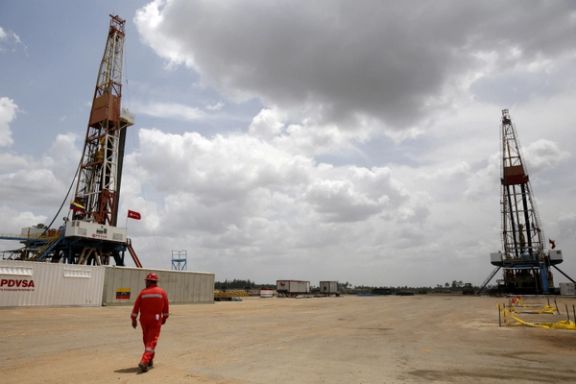
An oilfield worker walks next to drilling rigs at an oil well operated by Venezuela's state oil company PDVSA, in the oil-rich Orinoco belt, April 16, 2015.
Iran's semi-official Fars news agency has stated that Tehran envisions to boost its oil exports to Venezuela, with a target of 860,000 barrels per day within three years.
This plan involves not only exporting oil but also repairing Venezuelan refineries to facilitate this export. The goal is to restore Iran's oil exports to pre-sanctions levels, reaching 2.5 million barrels per day, amid US sanctions.
This is noteworthy given previous efforts by Iranian companies to repair Venezuelan refineries in 2020, particularly the 'Cardon' refinery, which experienced a fire shortly after repairs, and the unsuccessful overhaul of the El Palito refinery.
Iran renewed a €100 million contract for the repair of the El Palito refinery with Venezuela last year, and the facility, operating at 20% capacity, began operations in June 2023. Previously, this refinery had a daily capacity of 140,000 barrels, and it is unclear what its current capacity is.
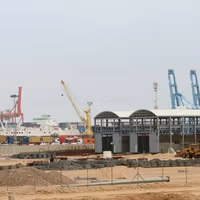
El Palito refinery which belongs to PDVSA is seen in Puerto Cabello, in the state of Carabobo, March 2, 2016.
In recent years, Iran's non-oil exports to Venezuela have remained around $20 million annually, equivalent to less than 0.1% of Iran's total non-oil exports.
Amid serious economic isolation, the Iranian regime clings to any small and insignificant international economic deal to show audiences at home that the government is successful in fighting sanctions and instill hope that the economic crisis can be overcome. Minor deals with developing countries in Asia and Africa are trumpeted as major successes.
Iran also signed a gas condensate barter deal with Venezuelan heavy oil, starting in the fall of 2021. Data from the Commodity Intelligence Company, Kepler, indicates that Iran delivered 28 million barrels of gas condensate to Venezuela until January 2023 and bought extra-heavy crude oil from the country for resale to China.
However, since February this year, with the reduction of US oil sanctions against Venezuela, the country has not received any shipments of gas condensate from Iran. This indicates that as soon as Caracas was offered a reprieve from sanctions, it began procurement from other sources.
Iran's ambition to repair Venezuelan refineries and export crude oil to the country is significant considering its own domestic refinery challenges. Iranian refineries have experienced a 10% decline in the past decade due to insufficient maintenance and upgrades, leading to the conversion of 30% of received crude oil into mazut and bitumen, compared to just 4% in modern refineries.
For instance, Iran's largest crude oil refinery, Abadan, converts 47% of the crude oil it receives into mazut and bitumen. The operation of this refinery is, in principle, not economically viable.
Iran had agreements with South Korean and Chinese companies in the mid-2010s aimed at reducing mazut and bitumen production from refineries to 10%. However, these deals were canceled following the US withdrawal in 2018 from the Obama-era JCPOA nuclear deal, and Iran has faced challenges in modernizing and repairing its domestic power plants.
Iran’s oil exports fell from 2.2 million barrels per day in 2017, to less than 300,000 in 2019, after full US sanctions came into force. However, recently Tehran has succeeded to boost exports close to 1.8 million barrels per day, as the Biden administration has failed to enforce the sanctions. China is the main customer of Iran’s illicitly shipped crude.
Venezuela, once possessing a refining capacity of 1.3 million barrels, has seen its capacity diminish to less than 190,000 barrels per day due to refinery aging and inactivity, exacerbated by US sanctions over the past decade.
Ukrainian President Vladimir Zelensky has accused the Islamic Republic, Russia and North Korea of being involved in the deadly Hamas attacks on Israel.
He said in an exclusive interview with NBC’s Meet the Press that the three countries are “throwing matches into” the long burning fire between Israel and Palestine by supporting Hamas, which sent thousands of troops to invade Israel on October 7 after a barrage of thousands of rockets, in the deadliest single day for Jews since the Holocaust. It has since led to an horrific bombardment of Gaza in which more than 10,000 people have died.
“I’m sure that Russia was behind and sponsoring Hamas. And Iran, too. That’s who is to blame. When we talk about laws, rules, where there are terrorists, there are no rules,” Zelensky added. Just last week, a Hamas delegation was hosted in Moscow and recent evidence showedNorth Korean weaponshave been used in Hamas attacks on Israel.
The authorities of the Islamic Republic have repeatedly denied any role in planning and executing the military operations of Hamas against Israel though it remains one of its biggest backers, financially and militarily.
Ali Khamenei, the Supreme Leader of the Islamic Republic, stated on October 10 that those who believe the attacks by Hamas are conducted by non-Palestinians have made a “miscalculation.”
Zelensky urged the international community to do everything possible to stop the war in the Middle East. While expressing his readiness to travel to Israel, he stated that the trip depends on the developments on the battlefield in Ukraine and the possibility of returning Ukrainians who are detained in Israel.
Nobel Peace Prize laureate Narges Mohammadi during a rally in Tehran
The Nobel Committee has called on Tehran to give medical help to this year's Nobel Peace Prize laureate Narges Mohammadi, on hunger strike in Tehran’s Evin prison.
The imprisoned activist has been on hunger strike since Monday in Evin Prison to protest the lack of medical attention for sick inmates and the jail withholding medical treatment from her because she refused to wear a mandatory head scarf for a hospital visit.
"The requirement that female inmates must wear a hijab in order to be hospitalized, is inhumane and morally unacceptable," the Norwegian Committee said on Monday.
According to a statement released on her Instagram page by Mohammadi's family, she is protesting against what they describe as "the Islamic Republic's policy of procrastination and lack of medical care for the health and lives of prisoners" and "the policy of either death or compulsory hijab for Iranian women."
The women's rights advocate won the award on October 6 in a rebuke to Tehran's theocratic leaders, who accused the Nobel committee of meddling and politicizing the issue of human rights.
The US-based Human Rights Activists News Agency (HRANA) said authorities had not let the 51-year-old go to hospital for heart and lung treatment last week because she had refused to wear a mandatory head scarf for the visit. "This deprivation continues under the order of the prison authorities," HRANA added.
Mohammadi's family, expressing their concerns about her health and physical condition, stated in their announcement that she has needed urgent transfer to a heart and lung center for a week, but after Narges's follow-ups from prison and her lawyer's requests to judicial authorities, the prosecutor has opposed her transfer and refuses to issue the transfer permit.
On October 30, Mohammadi was denied access to proper medical care and a transfer to a hospital for the second time due to her refusal to wear a hijab. Following that, on October 30 and 31, she and some of her fellow inmates staged a sit-in protest in the courtyard of Evin Prison.
"She is willing to risk her life by not wearing the 'forced hijab' even for medical treatment," said a November 1 statement, written before Monday's announcement of the Nobel laureate's hunger strike.
Mahsa Amini, a young woman who was physically assaulted for not wearing compulsory hijab and was killed in a police station in September 2022, and the tragic death of Armita Geravand, a schoolgirl who was subjected to violence by hijab enforcers in the metro and died after 28 days in intensive care, are among the most well-known victims of the compulsory hijab policy of the Islamic Republic.
In recent years, many political prisoners, including Sasan Niknafs, a civil activist, Behnam Mahjoubi, a Gonabadi Dervish religious minority, Baktash Abtin, a poet and filmmaker, and Javad Rouhi, a protester sentenced to death, have lost their lives in prison. The Islamic Republic has not accepted any responsibility for their deaths, which were due to pressure, torture, and the denial of medical care.
In recent years, there have been numerous reports of the lack of medical care for political prisoners and the violation of their right to access proper healthcare by prison authorities in Iran.
According to the Nobel Committee, Mohammadi was recognized for her fight against injustice towards Iranian women and her efforts to promote human rights and freedom for all.
"We are concerned about Narges Mohammadi's physical condition and health," the Free Narges Mohammadi campaign wrote on X, formerly known as Twitter.
A suspect in a security-related case has suddenly died mid-trial in a Revolutionary Court in Tehran.
Fars news agency, with close ties to the Islamic Revolutionary Guard Corps, claimed the suspect had come to the court from his home and "collapsed while defending himself in the courtroom".
Preliminary assessments by emergency personnel suggest that the cause of death was attributed to cardiac arrest but the suspect's body has been transferred to forensic medical authorities for more comprehensive examinations and specialized tests.
Reza Khandan, the husband of Nasrin Sotoudeh, a well-known Iranian lawyer and human rights activist, shared a message on the X media platform on Saturday (November 4). He identified the man as Saeed Khademi.
Khandan wrote that the suspect was born in 1962 and had been summoned for trial on charges including "insulting sanctities" at Branch 29 of the Revolutionary Court, and collapsed in the courtroom. The charges are commonly issued by the regime in its sham trials, not least in tenuous cases relating to security charges.
"His sister has mentioned that he had been under immense stress related to the trial for several days", Khandan wrote.
Iranian President Ebrahim Raisi will travel to Saudi Arabia on Sunday, the first such visit since Tehran and Riyadh agreed to revive diplomatic ties in March.
"President Raisi will attend the Organization of Islamic Cooperation' (OIC) summit in Riyadh, where the issue of Palestine will be discussed," Etemadonline news website in Tehran reported.
World and regional powers have failed to reach any consensus on how to deal with the escalating conflict in the four weeks since fighters from Hamas militants stormed southern Israel on October 7, killing some 1,400 Israelis, mainly civilians, and taking more than 240 people hostage.
The Iranian regime, which has provided financial and military support to Hamas over the years, immediately celebrated the terror attack, but has avoided direct involvement.
Israel has since struck Hamas-controlled Gaza from the air, imposed a siege and launched a ground assault, stirring global alarm over humanitarian conditions in the enclave. At least 10,022 Palestinians, including 4,104 children, have been killed so far in Israeli strikes on Gaza since Oct. 7, the Gaza health ministry said on Monday.
Regional rivals Tehran and Riyadh agreed to resume ties in March under a deal negotiated by China after seven years of hostility, which had threatened stability and security in the Gulf and helped fuel conflicts in the Middle East from Yemen to Syria.
A person burns a picture of US Secretary of State Antony Blinken as supporters of Iraqi Shiite cleric Moqtada al-Sadr protest to denounce Blinken's visit to Iraq, at Tahrir Square in Baghdad, November 5, 2023.
While the Gaza war continues, Iran avoids direct involvement, but continues blaming the United States, as its proxy forces launch attacks against US bases in the region.
Secretary of State Antony Blinken made it clear on a visit to Iraq during a regional tour, that threats from Iran on US assets in the region will be countered, with the backing of the Iraqi government.
Iran-backed Hamas invaded Israel killing 1,400 mostly civilians on October 7, and took at least 241 more hostages into the Gaza Strip.
While the US was quick to voice its support for Israel, backing its right to defend itself and offering military support, Iranian proxies have not only stepped up their attacks on Israel’s borders, but the US has also come under fire in the region.
Over 38 attacks have taken place against US facilities, seeing at least 46 personnel injured, in Syria and Iraq. The US has responded only once, leaving the Biden administration open to accusations of weakness, once again.
US Secretary of State Antony Blinken speaks to the media about his meetings with Turkish counterparts, amid the ongoing conflict between Israel and the Palestinian Islamist group Hamas, before departing from Ankara Esenboga Airport in Ankara, Turkey November 6, 2023.
Two US fighter jets struck weapons and ammunition facilities used by Iran’s Revolutionary Guard Corps and its militia groups in Syria, the Pentagon warning the US will take additional measures if attacks by Iran's proxies continue.
Blinken sent a message to “anyone who might seek to take advantage of the conflict in Gaza to threaten our personnel here or anywhere else in the region: Don’t do it.”
Unabashed, he spoke directly to Tehran. “I made it very clear that the attacks, the threats coming from the militia that are aligned with Iran, are totally unacceptable and we will take every necessary step to protect our people.
“We’re not looking for conflict with Iran – we’ve made that very clear – but we’ll do what’s necessary to protect our personnel, be they military or civilian,” he said, claiming Iraq’s premier, Prime Minister Mohammed al-Sudani, was supportive.
However, following a meeting between al-Sudani and Iran’s supreme leader, Ali Al Khamenei in Tehran, the message looked somewhat more complex.
Iraqi Prime Minister Mohammed Shia al-Sudani meets with Iranian President Ebrahim Raisi and Iran's ruler Ali Khamenei in Tehran, November 6, 2023.
Khamenei, who has also met in recent days with Hamas’ political leader in exile, Ismail Haniyeh, met with the Iraqi premier, also a Shia muslim, in a bid to hedge support.
“As an important country in the region, Iraq can play a major role in putting political pressure on the US and the occupying regime to stop the massacre of people in Gaza and also in starting a new approach in the Arab and Muslim world,” he wrote on X, as the regime continues to draw the US into the fire.
In no uncertain terms, the regime is doing its utmost to blame the US as the Gaza war offers hope to finally bait the bear. "The longer the current war goes on, the evidence showing the direct role of the US in directing the crimes of the Zionist regime in Gaza becomes more pronounced,” he said on Monday.
Speaking on CNN, former national security advisor to ex-President Donald Trump, John Bolton, criticized Biden for calling for a humanitarian ceasefire in Gaza, supporting Israel’s argument that it will only allow the group, proscribed by countries including the US and UK, to regroup.
“The Biden admin is sliding away from its support of Israel. Nobody has taken into account how Hamas and its puppet masters in Tehran are manipulating public opinion in the US and elsewhere,” he said.
He said that not only is one of America’s closest allies under multiple attacks and threats of attacks by what he calls “a coalition of some of America’s greatest enemies”, he said the conflict is “extraordinarily serious”.
“This isn't about the Gaza Strip, it’s about the survival of Israel and threats to the United States,” he said. While the fears of conflict escalating beyond Israel and Gaza are at the top of the global agenda, Bolton said “the conflict has already spread”, blaming Iran for its being at the root of the escalation.
“There is no doubt here that Iran has called the shots from the beginning. We don’t know what their full strategy is but the center of this conflict is with the mullahs in Tehran,” he said. Attacks on Israel have come from Iran-backed proxies in Lebanon, Syria, Yemen and Iraq.
Slamming the lack of action by the Biden administration in the face of mounting aggression, he said Biden’s deterrence tactics had failed as attacks continue.
“If Iranian surrogate groups kill Americans, the Iranians need to pay a price for it. They don’t take our restraint as a good will gesture, they take it as a weakness,” Bolton said.