• العربية
  • فارسی
Brand
  • Iran Insight
  • Politics
  • Economy
  • Analysis
  • Special Report
  • Opinion
  • Podcast
  • Iran Insight
  • Politics
  • Economy
  • Analysis
  • Special Report
  • Opinion
  • Podcast
  • Theme
  • Language
    • العربية
    • فارسی
  • Iran Insight
  • Politics
  • Economy
  • Analysis
  • Special Report
  • Opinion
  • Podcast
All rights reserved for Volant Media UK Limited
volant media logo

Ghalibaf Or Raisi, Which One Is Khamenei's Favorite?
Iran International Newsroom
Oct 29, 2023, 11:47 GMT+0Updated: 12:30 GMT+0
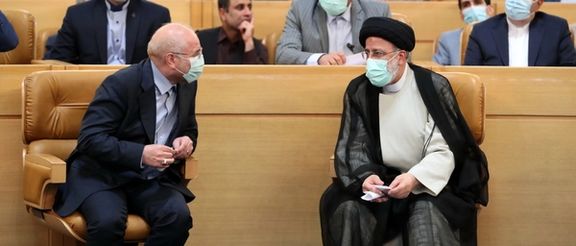
Speaker of the Iranian Parliament Mohammad Bagher Ghalibaf (left) and President Ebrahim Raisi during an event in Tehran

In the midst of the Islamic Republic's political landscape, a Shakespearean drama unfolds, with top characters from within Supreme Leader Ali Khamenei's inner circle.

The central figures in this unfolding narrative are President Ebrahim Raisi, Khamenei’s obedient, handpicked functionary, and former police chief and air force pilot, IRGC General Mohammad Bagher Ghalibaf, who has transitioned into politics, most recently holding the position of Speaker of the Iranian Parliament (Majles).

This ongoing rivalry between the two protagonists is characterized by a level of animosity that seemingly leaves no room for compromise, resembling a "it's either me or you, or both of us must fall" scenario.

Superficially, the drama, as explained in a Khabar Online report, revolves around, among other things, the parliament rejection of the President Raisi's seventh five-year development plan and changes to the government's Hijab law beyond recognition. According to Khabar Online, the Majles has handled government bills in a manner that suggests a lack of faith in the Raisi administration's ability to draft effective legislation.

Iran’s ruler Ali Khamenei (left) and President Ebrahim Raisi   (undated)
100%
Iran’s ruler Ali Khamenei (left) and President Ebrahim Raisi

In recent months, Raisi has written several letters to Khamenei, expressing his grievances regarding the parliament and its Speaker's conduct. Other high-ranking officials, such as Expediency Council Chief Sadeq Amoli Larijani, have also noted that Raisi tends to seek solutions from Khamenei for his government's issues with other officials.

However, it is no simple task the Supreme Leader to decide about the dispute between two of his key obedient officials. Previous governments did not unquestioningly implement all of Khamenei's orders and shoulder all the blame for policy failures without complaint.

Furthermore, Ghalibaf is not just a regime member; he is also a relative who holds a closer connection to Khamenei's wife and his ambitious son, Mojtaba. This dynamic makes it exceedingly challenging for Khamenei to discipline Ghalibaf, who has demonstrated unwavering loyalty when it comes to suppressing dissent and protests, regardless of his government position.

At a deeper level, however, the antagonism is something more than administrative and legislative disputes between the heads of two of the three branches of the Islamic Republic government.

Based on other Iranian media reports, Ghalibaf has still not stomached the fact that he was forced by Khamenei's office to step down as the most popular conservative candidate in the 2017 presidential election in order to raise Raisi's profile and give him a chance to win the election against moderate Hassan Rouhani. During that election, the ultraconservative Paydari Party decided to take advantage of Ghalibaf's absence and continued to support its own candidate, former nuclear negotiator Saeed Jalili, in competition with Raisi and Rouhani.

Iran’s President Ebrahim Raisi (left) and Parliament Speaker Mohammad Bagher Ghalibaf
100%
Iran’s President Ebrahim Raisi (left) and Parliament Speaker Mohammad Bagher Ghalibaf

Paydari Party was convinced that Ghalibaf was the most popular candidate among the trio and believed that in his absence their candidate Jalili was able to win the election. But as it turned out, not only he failed to win the election, his instance on remaining in the race fragmented the conservative vote, leading to Hassan Rouhani’s victory. Ghalibaf's hard feelings against Raisi and Jalili has continued to date.

Reports suggest Paydari is actively preparing candidates for both the parliamentary elections in March 2024 and the presidential election in June 2025. The party's ideal candidate for the parliament is Paydari leader Sadeq Mahsouli, and its man to compete for the next presidency is no one other than Saeed Jalili.

Paydari's hope to win the Majles and the post of its speaker appears to be more realistic than its plans for presidency. Although almost every politician in Iran agrees that Raisi's track record in his first four years in office leaves no room for his at the presidential office in 2025, there is no indication yet of Khamenei's inclination to kick Raisi out of the core of his government. Against all odds, he is more likely to be allowed to run and win the next presidential elections.

While Paydari's prospects for winning the Majles and securing the Speaker's position appear promising, their presidential ambitions are more challenging. Although most Iranian politicians agree that Raisi's track record during his first term leaves little room for his re-election in 2025, there are no indications of Khamenei's inclination to oust Raisi from the heart of his government. Despite the odds, Raisi is more likely to be permitted to run and potentially win the next presidential election.

However, Paydari has previously demonstrated its power to secure the Speaker's position in the Majles. Currently, Ghalibaf has retained this role by making several concessions, including assigning all presidium positions to Paydari. Nevertheless, relations between the party and Ghalibaf have deteriorated, and Ghalibaf prefers to run for the presidency rather than remain a member of the parliament. As far as he is concerned, post-2025, it will be either him or Raisi in the political spotlight.


Most Viewed

Iran negotiators ordered to return after internal rift over Islamabad talks
1
EXCLUSIVE

Iran negotiators ordered to return after internal rift over Islamabad talks

2
INSIGHT

Iran's digital economy battered by prolonged blackout

3
ANALYSIS

US blockade enters murky phase as tankers spoof signals and buyers hesitate

4
ANALYSIS

Why the $100 billion Hormuz toll revenue is a myth

5

US tightens financial squeeze on Iran, warns banks over oil money flows

Banner
Banner

Spotlight

  • Hardliners push Hormuz ‘red line’ as US blockade tests Iran’s leverage
    INSIGHT

    Hardliners push Hormuz ‘red line’ as US blockade tests Iran’s leverage

  • Ideology may be fading in Iran, but not in Kashmir's ‘Mini Iran'
    INSIGHT

    Ideology may be fading in Iran, but not in Kashmir's ‘Mini Iran'

  • War damage amounts to $3,000 per Iranian, with blockade set to add to losses
    INSIGHT

    War damage amounts to $3,000 per Iranian, with blockade set to add to losses

  • Why the $100 billion Hormuz toll revenue is a myth
    ANALYSIS

    Why the $100 billion Hormuz toll revenue is a myth

  • US blockade targets Iran oil boom amid regional disruption
    ANALYSIS

    US blockade targets Iran oil boom amid regional disruption

  • Iran's digital economy battered by prolonged blackout
    INSIGHT

    Iran's digital economy battered by prolonged blackout

•
•
•

More Stories

Iranian MP Accuses CENTCOM Of Directing Gaza War

Oct 29, 2023, 10:48 GMT+0

An Iranian MP has accused the United States' CENTCOM of directing military operations in the ongoing Gaza conflict.

Esmail Kosari, a member of the National Security and Foreign Policy Commission of the Iranian Parliament and a commander in the Islamic Revolutionary Guard Corps (IRGC) stated, "the crimes that America is currently committing are more repugnant than Israel's because the command of the crimes lies with CENTCOM."

The claims follow Iran-backed Hamas' declaration of war on October 7, when thousands of its militia invaded Israel by air, land and sea, killing at least 1,400 and taking 230 hostage in Gaza, including women and children. While Iran denies directing the operation, it funds Hamas at least $!00m a year and backs it with the likes of military and technical support and training.

The US was quick to back Israel's right to defend itself, offering its support and sending warships to the region as Iran's leaders rallied its regional proxies to ready for a multifront conflict, but has called for calm in a bid to prevent regional escalation.

Kosari's unsubstantiated allegations claimed that the “lack of a cohesive spirit within the Israeli regime prompted the US to send CENTCOM commanders to Gaza to direct military operations” though there is no US presence in Gaza, which is solely controlled by Hamas, designated by the US, EU and UK.

His comments come at a time when US facilities in the region have come under increasing attacks from Iran-backed proxies and fears of its largest proxy, Hezbollah, joining the war, are ever present.

Just days ago, Iran's Foreign Minister Hossein Amir-Abdollahian issued a warning regarding the United States' support for Israel during his visit to New York to attend a special session of the United Nations General Assembly. 

In an interview with Bloomberg Television from Iran's mission to the UN in New York, he warned, "The US is advising others to show self-restraint, but it has sided with Israel totally."


Iran's President Accuses Israel Of Crossing ‘Red Lines’ In Gaza

Oct 29, 2023, 09:20 GMT+0

Iranian President Ebrahim Raisi issued renewed threats to Israel and the US after Israel launched a ground offensive in Gaza against Iran-backed Hamas.

"The Zionist regime's crimes have crossed the red lines, which may force everyone to take action," he said, suggesting once again the threat of action from its proxies in the region.

"Washington asks us to not do anything, but they keep giving widespread support to Israel," Raisi stated in his post on X on Sunday morning.

Iran's proxies have continued to target US facilities in the Middle East since the war declared by Hamas broke out on October 7 after its elite forces invaded Israel, killing at least 1,400 and kidnapping at least 230. Its Yemeni proxy, the Houthis, even fired rockets towards Israel, intercepted by the US and Saudi Arabia.

IDF spokesman Daniel Hagari confirmed the ground invasions, explaining they are being carried out "in a phased manner". He said, "This will take time."

Denying its hand in the ever heightening regional tensions, the Iranian president claimed its proxies are "independent" and "do not receive any orders from Tehran", blaming the US.

Iraqi Group Claims Drone Attack On US Base In Syria

Oct 29, 2023, 07:17 GMT+0

An Iran-affiliated group in Iraq claimed Sunday that it targeted a US military base in Syria with drones, Tasnim news website affiliated with the IRGC reported.

There is no independent conformation of the claim, which comes days after the United States launched an air strike against two targets in Syria belonging to Iran’s Revolutionary Guard (IRGC) in retaliation for earlier attacks on US bases.

Since the October 7 terror attack on Israel, Iranian proxy forces in Syria and Iraq resumed rocket and drone attacks against US bases in both countries. After more than 15 such attacks, Washington retaliates in the early hours of Friday, in what was seen as a limited retaliation.

Hours after the US airstrike, Tasnim quoted the Islamic Resistance in Iraq, a pro-Iran militant group, as claiming that two attacks were launched at US bases, but the US military did not report any incident.

In the latest claim, the Iraqi group said it had launched two drones against a US base in in northeast Syria near al-Hasaka. The report did not provide any other detail.

Tensions have sharply risen as the Israel-Hamas war continues into its fourth week, and Iran threatens that its proxy forces will expand the conflict if Israeli attacks on Gaza continue. The United States has dispatched powerful naval strike groups to the region and has warned others not to get involved in the conflict.

Despite bellicose statements, Iran seems to be cautious, as its main proxy force, the Lebanese Hezbollah has so far not opened a second front against Israel.

Celebrity Actresses Banned From Acting In Iran Remain Defiant

Oct 29, 2023, 01:50 GMT+1
•
Maryam Sinaiee

Prominent actresses banned for hijab defiance and supporting protests say not acting is a choice they made to protect their professional dignity before being banned.

“My honor does not allow me to act in [Iran's highly controlled] film industry. Who are you [to ban me]?” Katayoun Riahi said on Instagram in a post that included the photos of the twenty colleagues who were officially banned from acting earlier this week. “I never believed [in the necessity of wearing] the hijab to have ‘removed’ mine now,” she told Iran International TV in November.

“I said goodbye to the world of acting when I was in solitary confinement at Evin prison,” Hengameh Ghaziani, who has also been banned, wrote in an Instagram post. Referring to her interviews with Persian-language media outside Iran, Ghaziani was indicted for “contact with hostile and anti-revolutionary media”.

Pantea Bahram, another banned actress, said in an Instagram story after the release of the list that being banned is the least of her concern, with so many protesters still in prison, and when young girls and boys lost their eyes to the bullets of security forces during the crackdown on protesters in 2022 and 2023.

The ban has met much criticism from others in the film industry. “I feel ashamed of looking at the list in which there are the names of no men. I’m proudly standing with my [female] colleagues until they return [to work],” Mohammad Rezayi-Rad, theater director, announced on Instagram.

A mosaic picture of some of Iranian actresses who were banned for defying mandatory hijab
100%

Iranian actresses are required to cover their hair in the films they play. The ministry enforces the hijab, as well as censorship of content, by rejecting scripts or modifying them and refusing a public screening license if a film does not meet their requirements.

Banned actresses expressed solidarity with protesters and the anti-hijab movement, often posting photos of themselves without headscarves during last year’s nationwide protests following Mahsa Amini's death in custody.

Riahi, 62, and two other celebrity actresses, Golab Adineh and Fatemeh Motamed-Aria, also showed up with no headscarves at the funeral of popular film director, Kiumars Pourahmad, who tragically ended his own life in April.

Speaking to reporters on the sidelines of a cabinet meeting Wednesday Islamic Guidance Minister Mohammad-Mehdi Esmaili confirmed the ban earlier announced by a ministry official in charge of the film industry.

“We announced before that abidance by the hijab is a legal requirement … I have said several times that those who do not abide by the law cannot work [in the film industry],” Esmaili said.

The list of the banned actresses was released on the same day by the director of the supervision department of the ministry’s Cinema Organization, Habib Ilbeigi.

Some of these celebrities, including Riahi, were arrested for their hijab rebellion. Riahi had to apologize for her defiance under duress during her trial last December. Unable to bear the relentless psychological torment, she passed out and had to be taken to hospital by ambulance. The trial was being filmed, apparently for airing on the state television to discourage others from following suit.

Actresses' open rejection of hijab led to some losing roles in TV sitcoms, the cancellation of entire shows, and censorship of their previous films.

In November last year, House of Cinema, formerly known as the Iranian Alliance of Motion Picture Guilds, said 100 filmmakers and other movie, music and theater personalities had been arrested or banned from work since the Mahsa Movement protests began in mid-September 2022.

Iran Believed To Be Agitating British Pro-Hamas Protesters

Oct 28, 2023, 22:45 GMT+1

Iranian agents are stirring up unrest in the UK through Gaza protests, according to a report by the British newspaper The Times.

There is direct involvement of the Iranian regime through the physical presence of operatives at protests as well as through disinformation campaigns conducted online.

A third consecutive weekend of pro-Palestinian protests is being policed in London by more than 1,000 officers. Saturday's rally brought out a 100,000 crowd.

The report about Iranian involvement in protests in Britain follows repeated calls for the UK to ban Iran's Islamic Revolutionary Guard Corps. Currently, the British government is under increasing pressure to intensify its campaign against Iran.

During one of the pro-Palestinian rallies in London a British-Iranian activist who has staged a sit-in protest outside Westminster calling for the IRGC to be proscribed as a terrorist organization, was assaulted by pro-Palestinian demonstrators. Vahid Beheshti, 46, said a Hamas supporter threatened to cut his throat.

While a proscription could still happen, it is unlikely that any change will occur soon, according to The Times. Banning the IRGC would lead to "the loss of intelligence-gathering capabilities" since while the United States and Canada have both banned the IRGC, they are reportedly dependent on Britain's influence in Tehran.

However, the British government has increased sanctions, since Mahsa Amini's death in September 2022, as a response to human rights violations committed by the regime's IRGC forces and specifically pledged to enhance protection for Iranian journalists based in the UK in response to the suspension of Iran International's UK operations, which was based on advice from the London Metropolitan Police, following continued threats to its employees.