• العربية
  • فارسی
Brand
  • Iran Insight
  • Politics
  • Economy
  • Analysis
  • Special Report
  • Opinion
  • Podcast
  • Iran Insight
  • Politics
  • Economy
  • Analysis
  • Special Report
  • Opinion
  • Podcast
  • Theme
  • Language
    • العربية
    • فارسی
  • Iran Insight
  • Politics
  • Economy
  • Analysis
  • Special Report
  • Opinion
  • Podcast
All rights reserved for Volant Media UK Limited
volant media logo

Punish Iran For Terror Support, Says Israeli Ambassador To UN
Iran International Newsroom
Oct 14, 2023, 14:13 GMT+1Updated: 11:46 GMT+0
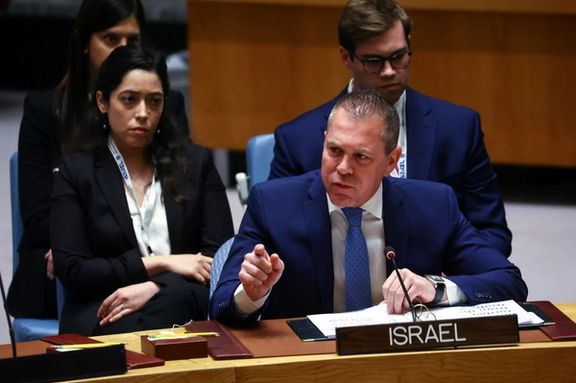
Israel’s Ambassador to the United Nations Gilad Erdan speaks during a meeting of the United Nations Security Council on "The Middle East, including the Palestinian question" at UN headquarters in New York City, April 25, 2023.

Israel's ambassador to the United Nations has called for a credible military threat to punish Iran for its ongoing support of terrorist groups.

In an interview with Iran International, the Israeli UN ambassador Gilad Erdan called the Iranian regime a global threat and said: “The Ayatollah regime today is exactly like the Nazi regime during WWII,” after Israeli civilians were slaughtered in the deadliest single day since the Holocaust last Saturday. 

Erdan said when the leaders of Hamas publicly thank the Islamic Republic for providing them with weapons and funding, there is no need for us to prove Iran’s direct involvement in the offensive against Israel which saw thousands of Hamas militia enter Israel by air, land and sea last Saturday, after a barrage of thousands of rockets, which continues.

A recently resurfaced video of Izz el-Deen al-Qassam Brigades, the armed wing of Hamas, thanking Iranian leaders for providing them with “weapons, money and other equipment” has caused social media controversy, reinforcing the long-standing links between the group and Iranian regime.

“The situation in Gaza is under the responsibility of Hamas which has been oppressing people for the past 18 years and using every dollar that is being transferred to Gaza for humanitarian assistance and using it for its terror machine,” Erdan said.

Despite lauding Hamas' Al Aqsa Flood operation, which has resulted in more than 2,500 deaths in Israel and Gaza so far, Iran's ruler, Ali Khamenei denies any responsibility for the terror attack.

"We kiss the hands of those who planned the attack on the Zionist regime .... but those who claim that the recent victory belongs to non-Palestinians have miscalculated”, he said at a recent military graduation ceremony.

A Palestinian fighter from the armed wing of Hamas takes part in a military parade to mark the anniversary of the 2014 war with Israel, near the border in the central Gaza Strip, July 19, 2023.
100%
A Palestinian fighter from the armed wing of Hamas takes part in a military parade to mark the anniversary of the 2014 war with Israel, near the border in the central Gaza Strip, July 19, 2023.

Iran's Foreign Minister adopts a more assertive tone. Currently, on a regional tour, Hossein Amir-Abdollahian stated that the resistance groups have planned for all possible scenarios warned, if Israel's attacks on Gaza do not cease immediately, the Hamas-Israel conflict might spread to other countries in the Middle East.

As of yet, the United States has not directly blamed Iran for the attack. National Security spokesman John Kirby said on Monday that the White House has not seen "hard, tangible evidence" that Iran was directly involved in Hamas' attacks against Israel.

In contrast, German Chancellor Olaf Scholz said on Thursday that Iran was responsible for helping Hamas grow to the point where it launched the attack on Israel last weekend, and that organizations that backed the Islamist movement would be severely repressed.

Meanwhile earlier this week, the UN Security Council was unable to reach the unanimity needed for a joint statement on the surprise ground and rocket attack on Israel, despite convening an emergency meeting behind closed doors. Members of the Security Council led by Russia were hoping for a broader focus than just condemning Hamas, according to diplomats.

The Iranian regime is a matter of direct concern for Israeli authorities. Prime Minister Benjamin Netanyahu blames Iran for having "encouraged and directed" the incident and Defense Minister Yoav Gallant also holds Iran responsible for funding the group: "Our neighbor is Hamas, the ISIS of Gaza. An organization enjoying the Iranian payroll," he said.

There is a clear incentive for Iran in this attack by Hamas because it coincides with a US-backed initiative aimed at encouraging Saudi Arabia to normalize its relations with Israel, which has been suspended, according to AFP.

According to the Washington-based Foundation for Defense of Democracies, Iran has established a network of at least 19 armed groups along Israel's borders, including in Gaza, the West Bank, Lebanon, and Syria. Hezbollah in Lebanon and Hamas in Gaza are the two largest of these organizations.

Most Viewed

Ghalibaf defends Iran-US talks amid hardline backlash
1
INSIGHT

Ghalibaf defends Iran-US talks amid hardline backlash

2
ANALYSIS

From instability to influence: Pakistan’s pivotal role in US-Iran diplomacy

3
ANALYSIS

100 days on: why Iran’s January protests spread across social classes

4

War-hit homeowners feel abandoned as Iran’s reconstruction aid fades

5
INSIGHT

100 days on: the anatomy of Iran’s January crackdown

Banner
Banner

Spotlight

  • Bread shortages, soaring prices strain households in Iran, residents say
    VOICES FROM IRAN

    Bread shortages, soaring prices strain households in Iran, residents say

  • War-hit homeowners feel abandoned as Iran’s reconstruction aid fades

    War-hit homeowners feel abandoned as Iran’s reconstruction aid fades

  • 100 days on: the anatomy of Iran’s January crackdown
    INSIGHT

    100 days on: the anatomy of Iran’s January crackdown

  • Ghalibaf defends Iran-US talks amid hardline backlash
    INSIGHT

    Ghalibaf defends Iran-US talks amid hardline backlash

  • 100 days on: why Iran’s January protests spread across social classes
    ANALYSIS

    100 days on: why Iran’s January protests spread across social classes

  • From instability to influence: Pakistan’s pivotal role in US-Iran diplomacy
    ANALYSIS

    From instability to influence: Pakistan’s pivotal role in US-Iran diplomacy

•
•
•

More Stories

Iran's Sunni Leader Rejects Regime’s Idea Of Israel's Destruction

Oct 14, 2023, 11:32 GMT+1
•
Iran International Newsroom

Iran's top Sunni leader Mowlavi Abdolhamid has contradicted the clerical regime on the Israeli-Palestinian conflict, saying that neither side should be destroyed.

Abdolhamid distanced himself from the regime’s goal of Israel's annihilation during his Friday prayer sermon, decried the attacks on civilians “that has shocked the world,” without directly mentioning the Tehran-backed Islamist group Hamas.

Hamas unleashed a bloody invasion into Israel on October 7, inflicting the biggest loss of life in one day since the Holocaust. Israel has been pounding Gaza in retaliation for the Hamas rampage in Israel this week that has killed over 1,300 people, the deadliest attack on civilians in the Israeli history. More than 1,800 Palestinians have been killed.

In an apparent condemnation of Hamas attack, he said, "If Muslims disregard international laws, assault women, and kills children, we do not blindly support it. "He noted that extremism by anyone is not tolerable. He emphasized that Israel should also refrain from violating international laws.

The outspoken cleric said, "Anyone with a shred of humanity is deeply affected when seeing these heart-wrenching scenes of human slaughter."

He added, "The reality is that neither Muslims can destroy Israel, nor Israel can eliminate Palestinians. It's not achievable. When something is not achievable, why use force?"

A man carries bags as he walks past a mural symbolising freedom and peace between Israel and Palestinians, in Rondebosch, Cape Town, South Africa, October 11, 2023.
100%
A man carries bags as he walks past a mural symbolising freedom and peace between Israel and Palestinians, in Rondebosch, Cape Town, South Africa, October 11, 2023.

Abdolhamid emphasized the importance of maintaining a "fair stance" and suggested that governments and nations worldwide should strive to resolve differences rather than aligning themselves in this conflict. He said Israelis and Palestinians are two "nations" living alongside each other and also endorsed the idea of establishing two states.

The two-state solution to the Israeli–Palestinian conflict envisions an independent State of Palestine alongside the State of Israel, west of the Jordan River. The boundary between the two states is still subject to dispute and negotiation, with Palestinian and Arab leadership demanding full Israeli withdrawal from territories it occupied in 1967, which is rejected by Israel. 

Abdolhamid’s practical views for a solution to the decades long conflict are in stark contrast to that of the Islamic Republic, which only sees the destruction of Israel as the solution.

In 2015, Supreme Leader Ali Khamenei said Israel must be destroyed in 25 years and the government even set up a countdown clock in Tehran and a few other cities. Many Iranians mock the anti-Israel rhetoric and the ticking clock, but the regime is adamant in pursuing the goal. Regime authorities use every opportunity to stress the necessity of "Israel's destruction," a slogan that has justified Iran’s huge financial and military support to militant groups such as Hamas and Hezbollah, while Iranian increasingly safe poverty and a bleak economic future.

While the Islamic Republic is cheering about the war in Israel, Iranians’ reactions to the regime’s propaganda indicate a complex societal schism. In Iran, once Khamenei dictates the regime's policy themes concerning global developments, other officials, clerics, and his representatives across the country begin to disseminate them.

Earlier in the year, Abdolhamid called for peace between Muslims and Jewish people, stating that "No one should think of the destruction of others, and everyone should think about peace." His remarks came against the backdrop of Iran’s repeated warnings against normalization of relations between Israel and Arab countries.

While Saudi Arabia and Israel had never been closer to a deal to establish official relations, US officials and a lot of pundits are of the opinion that the Hamas attack was meant to disrupt the normalization process.

After Abdolhamid’s sermons on Friday, people in several cities of the predominantly Sunni province of Sistan-Baluchestan took to streets and held anti-regime rallies.

Worker Dies At Parsian Gas Refinery In Southern Iran

Oct 14, 2023, 11:07 GMT+1

A worker has died in a fatal fall at the Parsian Gas Refinery in southern Iran during maintenance work on the flare.

Parsian Gas Refinery, a significant facility located near Mehr in Fars province, plays a crucial role in Iran's gas production, generating 760 million cubic feet of natural gas and 1,500 tons of gas condensates daily.

Similar incidents, including fires, falls, and gas leaks, have been on the rise in Iranian refineries and petrochemical units in recent years.

Just a month ago, Hashemi-Nezhad Gas Refinery Company in Khorasan Razavi province reported two fatalities and five hospitalizations due to a gas leak in one of its units.

Also, an incident during essential maintenance operations at the Pars South Gas Complex's second plant on September 10 led to one fatality and two injuries.

Iran has experienced a series of unexplained explosions and fires in military, nuclear, and industrial facilities, including pipelines and refineries, since mid-2020. Notably, on January 28, a massive fire erupted at an Iranian military industry factory, suspected to be the result of a drone strike in Esfahan. While authorities have not provided full explanations for these incidents, they have often attributed high-profile sabotage attacks to Israel, although Israel has not officially claimed responsibility for these events.

Violence Against Afghan Refugees Causing Serious Concerns In Iran

Oct 14, 2023, 09:48 GMT+1
•
Maryam Sinaiee

Indiscriminate violence against Afghan migrants earlier this month has led to serious concerns of escalation of maltreatment of Afghans in Iran in the coming days.

At least three major instances of violence against Afghans have been reported on social media where the hashtag “Expulsion of Afghans a National Demand” was used to promote Anti-Afghan immigrants’ views.

A large crowd of Iranians on October 6 staged a protest rally outside the local council’s office in Eghbaliyeh, a town of 55,000 in Qazvin Province, wielding sticks and chanting that Afghans should be expelled from Iran. A video posted on social media also showed a small mob of mainly youngsters attacking the homes of the town’s Afghan residents and throwing stones at their windows.

A local police official, Brigadier General Ali Ebrahimi, said that police had arrested nineteen individuals for the violence. Social media users, however, reported the injury of several Afghans. They also claimed police did not take any action to protect the homes of the Afghans during the incident.

A video Iran International TV received on October 7 also showed two Afghan teenagers being treated at a Tehran hospital allegedly after being attacked and wounded by knife. The same video shows a third young Afghan man in the corridors of the same hospital saying he was also stabbed.

The narrator of the video blames the Islamic Republic for allowing mistreatment of Afghans and claims there have been many more similar instances of attacks on Afghans recently.

In another video posted on social media several Iranians are seen assaulting a young Afghan man in Sanandaj, the capital of the western province of Kurdistan where the number of Afghan immigrants has never been high compared to some other regions such as Tehran and eastern provinces. The attacker who is wielding a saber is heard in the video demanding that the Afghan man say he will never set foot in Sanandaj again.

In the past few weeks the government’s political rivals have repeatedly warned about its “open borders” policy and the possibility of hidden agenda with hardliners responding to such criticism by accusing critics of inciting “Afghan-phobia” amid fast-growing anti-Afghan sentiments on social media and violence against the immigrants.

The Islamic Republic adopted an unprecedentedly lenient approach to immigration of Afghans when hardliner President Ebrahim Raisi took office in Iran two years ago and anti-American Taliban formed a government in neighboring Afghanistan.

Some government critics claim authorities are actively encouraging the growth of the Afghan population with incentives such as subsidized energy and food to remedy the problem of population decline or even to bolster its military by recruiting young Shiite Hazara Afghans.

The Revolutionary Guards linked Fars news agency has accused a “shadowy political group” of seeking to cause tension between the Islamic Republic and the Taliban by raising an alarm about the growth of the number of Afghans in the country since the Taliban took over Afghanistan two years ago.

Heshmatollah Falahatpisheh, a former conservative lawmaker and chairman of the parliament’s foreign policy and national security committee is one of the politicians who has repeatedly warned about the security problems that may emerge from increased Afghan immigration in recent months.

Falahatpisheh claims that there is a “mafia” that financially benefits from Afghan immigration. “There is a confluence of trafficking of commodities, narcotics, humans and fuel in eastern borders whose interests are intertwined and have practically blocked the policy of blocking and management of the borders,” he told the reformist Ham-Mihan newspaper Sunday. “As a person who used to have official responsibility for field investigation in eastern borders, I must point out the reality. The country is facing a serious threat to its national security and interests.”

Iran's Sunni Leader Challenges 'Destruction' Of Israel

Oct 14, 2023, 08:51 GMT+1

The outspoken leader of Iran's Sunnis has contradicted the government, stating that the obliteration of Palestinians and Israel's annihilation are unattainable.

Mowlavi Abdolhamid, the Friday Prayer Imam in Zahedan, used his weekly sermon to condemn attacks on civilians without specifically mentioning the militant group Hamas. He stressed that blind allegiance to Islamic groups does not have his approval, affirming, "Extremism from any quarter, when it entails harm to people or children, is unacceptable to us."

Simultaneously, he expressed concern about the current humanitarian situation in Gaza as a consequence of Israel's response to the attacks. The Sunni leader endorsed the concept of a two-state solution for the Palestinian issue, emphasizing the need for a just resolution to the current crisis.

He added, "The reality is that neither Muslims nor Israel, can achieve the destruction of the other one. It's an unattainable goal. Why resort to force when the objective is unattainable?”

His remarks stand in contrast to the stance of the Islamic Republic, which has consistently advocated for the "destruction" of Israel, effectively rejecting the notion of a two-state solution.

In a 2011 conference in Tehran, Iran's ruler Ali Khamenei declared, "Any plan that seeks to divide Palestine is destined for failure."

Iranian authorities exploit every opportunity to underscore the imperative of Israel's "destruction," a slogan that has been accompanied by substantial financial support for militant groups like Hamas and Hezbollah.

However, in the wake of widespread global criticism of Hamas's attack on Israeli territory, Ali Khamenei distanced Iran from the surprising assault in his initial official response.

Iran's Foreign Minister Says Hamas Attack 'Purely Palestinian Operation'

Oct 14, 2023, 08:28 GMT+1

Iran’s Foreign Minister Hossein Amir-Abdollahian has once again claimed that Hamas’ attack on Israel was a purely “Palestinian operation”, although Iran supports the group.

Amir-Abdollahian who was meeting Syrian President Bashar al-Assad in Damascus as part of a regional tour, was quoted as saying that Iranian and Syrian support for the Palestinians is not a secret, but repeated Tehran’s position that it was not directly involved in the attack.

Hamas launched a surprise invasion of southern Israel on October 7, using thousands of forces who killed well over 1,000 Israeli civilians, prompting a siege of Gaza and relentless Israeli bombing of targets in the Palestinian enclave.

The Iranian regime immediately congratulated Hamas, calling the attack a heroic act and organizing street celebration. However, as governments and international media asked if Tehran had a role, Supreme Leader Ali Khamenei tried to distance the regime, saying the attack was a Palestinian operation.

Amir-Abdollahian also told Assad that “the resistance is capable of resisting against the Zionist regime for a long time.”

The Islamic Republic uses the term “Resistance Front” to refer to many of its proxy militant armed groups around the region, and the Syrian regime. Lebanese Hezbollah and Hamas are the largest of these groups receiving hundreds of million dollars a year from Iran, in addition to weapons and training.

The Israeli military has surrounded the Gaza Strip with the aim of an eventual ground operation that according to officials is aimed to eliminate Hamas as a fighting force. Hundreds of thousands of Gazans have been told by Israel to evacuate to safer areas to reduce civilian casualties.