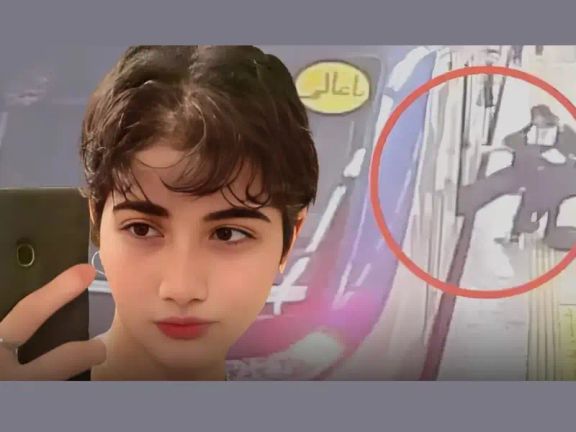
A screengrab from Tehran’s subway CCTV camera showing Armita Geravand being removed from a subway car
Iran's state television has again accused opposition media of spreading false information about a girl falling into a coma after an alleged assault by hijab enforcers.
In its Thursday evening news bulletin, IRIB’s News Channel aired footage released on Wednesday showing Armita Geravand entering a Tehran subway station without covering her hair, waiting with friends, and then being carried out of a metro car unconscious by her friends after collapsing seconds after entering.
State media claims the sixteen-year-old art student fainted, fell, and hit her head on the metro car's entrance. Armita's mother, Shahin Ahmadi, stated in an interview with IRIB that she was "told" her daughter hit her head "on the edge of the metro [car or platform]." Earlier reports suggested she was pushed by a hijab enforcer inside the metro car, causing her fall and head injury.
Hengaw Organization for Human Rights, a Kurdish rights group that published the comatose Armita’s photo at Fajr hospital’s intensive care unit Wednesday, claimed on Thursday that security forces have detained Armita’s mother. Mizan Online, the news agency of Iran’s Judiciary, denied the report shortly after its release.
Security is tense around the hospital, and authorities are not forthcoming about the circumstances surrounding Armita's coma. Meanwhile, the media is filled with concerns from Iranians, foreign activists, and officials, all fearing a scenario similar to Mahsa Amini's death could reoccur.
Iranians have been extensively posting to raise awareness about Armita, making the hashtag of her name in Persian trendy on X (formerly Twitter) with well over 300,000 retweets.
Despite the IRIB's account and interviews with Armita's parents and friends, many in the public remain unconvinced. Social media users believe that state media is concealing the true cause of her head injury to prevent public anger, similar to the 2022 protests following the death of Mahsa Amini in morality police custody.
The state media have not shown any footage from inside the metro car and claim there were no CCTVs to record the incident inside the train.
Two eyewitnesses have, however, confirmed to the Guardian that hijab enforcers were involved in Armita’s injury Sunday morning.
One of the two eyewitnesses has told the Guardian that soon after Armita entered the carriage, a female hijab enforcer started arguing with her because she wasn’t wearing a headscarf. “The chador-clad woman screamed at her asking her why she was not covered,” the witness told the Guardian.
“Armita then told her ‘Do I ask you to remove your hijab? Why are you asking me to wear one?’ Their argument then turned violent. The hijab enforcer started physically attacking Armita and … violently pushed her.”
Another witness told the Guardian that the young girl was still conscious when she fell on the ground. In the video footage shown on state television Armita’s leg appears to be moving.
Witnesses who spoke to the Guardian also claimed they spotted the same hijab enforcer waiting behind the ambulance that took her to the hospital.
Iranian activists and social media users argue that security forces' efforts to restrict access to the hospital, detain a reporter who attempted to interview Armita's mother, and suppress independent media suggest they are trying to conceal the truth about the alleged assault on the young girl.
The interviews with Armita's family were aired during the 8:30 news program on Wednesday. The program's producer, Ameneh Sadat Zabihpour, has faced allegations of collaborating with intelligence organizations to obtain forced "confessions" from activists and others, discrediting them, opposition figures, and groups. Zabihpour and her colleague Ali Rezvani were sanctioned by the United States Treasury in November last year for their involvement in obtaining forced confessions.
Russian President Vladimir Putin and Iran’s ruler Ali Khamenei in Tehran
Russian President Vladimir Putin has expressed a strong desire for closer ties with Iran,announcing plans to establish Russian schools to cater to Iranian students.
“We are making every effort to further develop our relations with Iran, and we will continue to do so in the future,"Putin stated during an event held on Wednesday night in the resort city of Sochi.
He was addressing the winners and finalists of a competition to select the best teacher in Russia, as reported by Russia's Sputnik news agency.
Putin also discussed the possibilityof establishing educational institutions in Iran as part of a broader effort to strengthen ties between the two nations.
The Russian president also emphasized the importance of "soft power" in improving Iran-Russia relations, describing it as a means of promoting culture and education. He stated, “Soft power in the kindest and best sense of this word, the promotion of our culture and our education systems. We will mull this over as well,” according to Russia's TASS media.
The comments are part of a larger set of statements from Putin about the necessity of a multipolar world that is more democratic. Interestingly, he was discussing the need for authoritarian regimes like Russia to challenge the US-led democratic world order. From Moscow's perspective, the world is currently under the "dictatorship" of a US-led model that drives nations into debt, creates economic dependencies, and deprives certain regions of resources for development.
Nations such as Iran, Russia, and China are actively pursuing strategies to reduce their reliance on Western influence and the predominance of the US dollar, aiming to shield themselves from sanctions and Western institutional pressures
Former Iranian president Mahmoud Ahmadinejad at the airport in Tehran on October 5, 2023
Security authorities at Imam Khomeini Airport in Iran thwarted former President Mahmoud Ahmadinejad's trip to Guatemala, seizing his passport and giving him a travel ban.
Stopped by IRGC intelligence officers, Ahmadinejad was traveling to a scientific and research symposium on water resource management, as a guest of the government and the University of Guatemala.
There has long been talk of a travel ban on Ahmadinejad, however, even before the latest designation. Back in 2021, rumors began of the ban being lifted when he took a trip to Dubai, visiting the Dubai Expo. The trip was cut short by Tehranafter the former president began making statements claiming to be the voice of the Iranian people, a press conference in the UAE's party capital being canceled for fear of his gaining political capital and Ahmadinejad swiftly brought back to Iran.
However, the rumors may now be true, the former president designated by the US Department of the Treasury last month, facing allegations concerning the fate of Robert Levinson, a US national who vanished in 2006 after flying from Dubai to Iran's Kish Island. Despite no conclusive information regarding his whereabouts, the US government believes he may have died while in Iranian custody.
Ahmadinejad served as the President of Iran from 2005 to 2013. The DOT claims "During Ahmadinejad’s term in office, MOIS [Ministry of Intelligence and Security] was involved in the detention of several US nationals, including former Federal Bureau of Investigations (FBI) special agent Robert “Bob” Levinson, as well as three US hikers: Shane Bauer, Joshua Fattal, and Sarah Shourd."
However, media outlets tied to the Islamic Republic have reported that it is "Guatemala's fragile political climate" and "security concerns" which led to the stoppage, Ahmadinejad a member of the Expediency Council and an official political figure. "He has been strongly advised against undertaking the journey, taking into account international sanctions and the risk of detention," Khabar Online claimed.
There has been a spike in patients fleeing healthcare facilities in Iran due to the high cost of medical treatment, with some hospitals resorting to imprisoning patients.
In a report published by the Ham-Mihan newspaper on Thursday, a head nurse at a government hospital in Tehran disclosed that, on average, two to three patients per week flee without settling their medical bills. Such occurrences frequently involve patients from the emergency department, including injured construction workers and working class Iranians.
It is not only Iranians mixed up in the scandal, with several patients lacking medical coverage, migrants who lack insurance coverage, unable to pay the higher fees for those not covered. Rising costs of living, shortages of medication, expensive laboratory tests, and hospitalization fees are all compounding the problem.
Some families are even unable to claim dead bodies due to high hospital bills. One such case involved a young Afghan laborer who underwent heart surgery at a Tehran government hospital but did not survive. The hospital issued a $2,000 bill for his friends, who were unable to pay, leading them to abandon his body at the hospital.
In such cases, bodies typically remain in the morgue for several days, and if relatives do not claim them, they are buried anonymously, labeled as "unidentified."
In another section of the report, Mohammad Sharifi Moghadam, the Secretary-General of the Nursing House, mentioned that a large hospital in Tehran has established separate rooms for impoverished patients and keeps them in custody until their medical expenses are settled.
The mother of the teenage girl left comatose after an altercation with morality police on the Tehran subway, has been arrested by Iranian security forces.
The news that 16-year-old Armita Geravand's mother Shahin Ahamadi, was arrested, was revealed on X on Thursday by the Iranian-Kurdish rights group Hengaw. Iranian state media has denied the arrest.
Geravand, who is currently in critical condition, was reportedly involved in a confrontation with authorities in the Tehran metro due to an alleged violation of Iran's hijab law. Geravand lost consciousness when her head struck a pole inside a subway car.
Despite claims by the regime that the teenager's family has viewed video footage from inside the train, her mother denies the claims. It is estimated that over five minutes of footage, including content recorded before Geravand lost consciousness, have been censored by the regime.
Fajr Hospital, where the teen remains in intensive care, is under tight surveillance, with security forces deployed around the facility.
Geravand's classmates are reportedly facing threats from regime security, discouraging them from releasing any photos or information related to the incident.
The Iranian regime has stationed hijab police at all subway stations in Tehran as part of an intensified hijab enforcement campaign as the Women, Life, Freedom movement continues to resist the mandatory hijab.
More than 40 member states of the UN Human Rights Council have expressed "serious concern" over the approval of Iran's new hijab bill it branded "gender apartheid".
The law imposes harsher penalties, including longer prison sentences and higher fines, on women who do not adhere to the country's strict Islamic dress code for head coverings and modest attire. Late in September, Iran’s Parliament announced that the bill was approved for a "three-year trial run"following coordination by the judiciary.
During a Wednesday meeting at the 54th Session of the Human Rights Council (UNHRC), the majority of the 47-member group endorsed a statement, initiated by Canada, condemning the Islamic Republic’s intensified measures to enforce hijab through the new bill. The statement was delivered by Canada’s Ambassador to the Council, Leslie E. Norton.
Raising alarm over Iran’s plans to deepen punishments for women and girls who do not obey its “draconian compulsory dress code,” the member countries decried the regime for seeking “to force non-complying women into an unprecedented social and economic siege", measures including travel bans, denial of education, health facilities and other public services. Private businesses will also be compelled to refuse services to uncovered women.
The signatories also voiced worries about the ever more invasive use of artificial intelligence and facial recognition technology to crack down on women who defy hijab. They say the recently introduced measures worsen the already dire situation for women and girls, “marked by widespread and systematic discrimination in law and practice, in many aspects of their public and private life.”
Referring to the nationwide movement that rallied behind the slogan “Women, Life, Freedom,” the group urged Iranian authorities to heed to the legitimate claims of protesters, and to abide by its obligations under international law, including in matters of women’s rights and gender equality.
“Women and girls of Iran should not be treated as second class citizens and must enjoy the full array of their human rights, free from discrimination, surveillance and fear of retribution,” added the statement.
The move came as an Iranian teenager, Armita Geravand, is in coma following a violent encounter with hijab enforcers at Tehran’s subway. Authorities are handling the situation exactly as they did in the case of Mahsa Amini, with blackouts on CCTV footage, arresting her mother and the journalist who tried to cover the case. Routine denials continue from the highest levels of the regime and massive security is in place around the hospital in which she is in intensive care.
The UNHRC courted global controversy earlier this year when it invited Ali Bahreini, Ambassador of the Islamic Republic of Iran and Permanent Representative to the United Nations, to chair the 2023 UNHRC Social Forum next month. The move gained widespread criticism. The European Parliament said the appointment "is nothing more than a slap in the face given the human rights situation of most Iranians, particularly women, and the repeated executions in the wake of the ongoing protests in the country", in addition to its appalling handling of the pandemic in which it refused to accept Western vaccines at the cost of hundreds of thousands of lives.
The United Nations also came under fire last month for allowing President Ebrahim Raisi to take the stage at the annual General Assembly, giving voice to the regime narrative in which he claimed Iranian women's rights are "unparalleled".