• العربية
  • فارسی
Brand
  • Iran Insight
  • Politics
  • Economy
  • Analysis
  • Special Report
  • Opinion
  • Podcast
  • Iran Insight
  • Politics
  • Economy
  • Analysis
  • Special Report
  • Opinion
  • Podcast
  • Theme
  • Language
    • العربية
    • فارسی
  • Iran Insight
  • Politics
  • Economy
  • Analysis
  • Special Report
  • Opinion
  • Podcast
All rights reserved for Volant Media UK Limited
volant media logo

Iranian President's Wife 'Writing Book' In Rebuttal To Michele Obama
Iran International Newsroom
Oct 1, 2023, 19:05 GMT+1Updated: 11:50 GMT+0
Jamileh Alamolhoda, the wife of President Ebrahim Raisi (2nd left) during an event in Mashhad in September 2023

The title of ‘Iran’s first lady’ has caused a stir as President Ebrahim Raisi's wife denies the role but keeps acting like one in a country with no such tradition. 

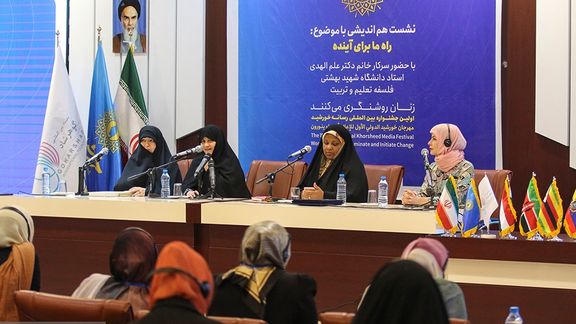
Jamileh Alamolhoda, Raisi’s wife and daughter of the Supreme Leader’s representative in Razavi Khorasan province, hosted an international event this week on the role of women in media in Mashhad -- her hometown and his hardline cleric father’s turf. 

Moderate Iranian news website Rouydad24 talked about Jamileh Alamolhoda’s aspiration to write a book similar to that of Michelle Obama’s. Rouydad24 cited her as saying, “They asked me to write a book similar to this one. I read the book, and it was very beautiful, captivating, and influential. I even showed some parts of it to the president, and he said that writing a book in this field is the right thing to do.” 

The presenters of the event, claiming to have brought together “100 media women from 40 countries,” introduced Jamileh Alamolhoda as “Iran’s first lady” whenever she was about to take the stage. However, she started one of the panels of the event addressing the issue, saying that the wife of the Supreme Leader is actually the country’s first lady because Ali Khamenei is the highest authority in Iran. 

Foreign participants of an event about women in media organized by Jamileh Alamolhoda, President Ebrahim Raisi’s wife, in Mashhad in September 2023
100%
Foreign participants of an event about women in media organized by Jamileh Alamolhoda, President Ebrahim Raisi’s wife, in Mashhad in September 2023

Her statement has drawn a wide range of reactions from the Iranian public and politicians alike, with hardliners speaking out against the existence of such a position in “an Islamic society” and describing it as a construct of Western culture that must not be copied for Iran. 

Several pundits have published opinion pieces about Jamileh Alamolhoda in recent weeks, criticizing her for her double-standard approach about Western culture as she reiterates that Iranian women can best serve the family as a child-bearing housewife, but never misses a chance to accompany her husband on foreign trips.

She keeps denying the existence of the role of the country’s first lady but in practice she follows a Western model for such a role including speaking as such during the UN General Assembly week in New York with global media. She attacks the West's ideas about women and Western-style feminism in society but has announced that she is eying writing a book similar in style to former US first lady Michelle Obama’s memoir Becoming, a number-one best seller in Iran reprinted 37 times.

In a piece for Khabar Online Sunday, Abdoljavad Mousavi decried what he calls “the infatuation of so-called anti-Western officials with the West.” He said a large number of Iran’s hardliners have a superficial and hypocritical view of the West. 

“They chant slogans against the West with passionate fervor, but Western countries are the first choice for their offsprings’ education; they do not recognize the United Nations officially but long for standing at its podium and accompany all their family members in their trip to New York,” the pundit said, referring to Raisi’s large entourage to the US for the UN General Assembly. 

The latest trip of Iran's president and his hijab-cladded wife saw Alamolhoda thrust into the limelight in a global media blitz. To Newsweek, Alamolhoda spoke of the alleged “women’s rights” enjoyed by Iranian women, who for the last year have been protesting the oppressive conditions of living under the regime while hijab rebels remain locked out of public places including transport and education. Alamolhoda -- who firmly believes a woman’s place is as a mother and wife — claimed Western feminism has no place in Iran.

an event about women in media organized by Jamileh Alamolhoda, President Ebrahim Raisi’s wife, in Mashhad in September 2023
100%

Mousavi claimed that attention to the concept of “first lady” among the hardliners stems from “a superficial understanding of the West, Islam, identity, and the Islamic Revolution.” “They vehemently criticize the West and its manifestations, but deep down, they secretly aspire to become Westerners. They strive to imitate them, seek their approval, and conform to their standards.”

Moderate Iranian news website Rouydad24 talked about Jamileh Alamolhoda’s aspiration to write a book similar to that of Michelle Obama’s. Rouydad24 cited her as saying, “They asked me to write a book similar to this one. I read the book, and it was very beautiful, captivating, and influential. I even showed some parts of it to the president, and he said that writing a book in this field is the right thing to do.” 

Hardliner Telegram channel Bisimchi Media – with links to the Revolutionary Guards – slammed Raisi’s wife for using the term about Khamenei’s wife, saying, “In the structure of the Islamic Republic of Iran and its history, we don't have a position called 'First Lady'.” “Are we supposed to mimic these American ideas?" asked the media outlet. 

Tasnim, another IRGC-affiliated media, also rebuked Alamolhoda for her statement about the first lady, saying, "The assumption that with the presidency of an individual in Iran, a special position is created for their spouse according to the country's constitution is certainly a mistake."

Participants of an event about women in media organized by Jamileh Alamolhoda, President Ebrahim Raisi’s wife, in Mashhad in September 2023
100%
Participants of an event about women in media organized by Jamileh Alamolhoda, President Ebrahim Raisi’s wife, in Mashhad in September 2023

Khamenei’s wife, Mansoureh Khojasteh Bagherzadeh, rarely appears in public but several members of her family hold senior positions. Her father was Mohammad Esmaeil Khojasteh Bagherzadeh, a famous businessman in Mashhad and her brother Hassan is a former deputy director of state broadcaster IRIB. In her absence from Iran’s political sphere, the role of a first lady is up for grabs by the president’s wife. 

Mohammad-Reza Bagheri, a state TV host, also criticized Alamolhoda, saying that the first lady of Iran should be chosen from among "mothers and wives of Iran’s martyrs and not the the wives of politicians.”

Implicitly admitting that she will hire a team of ghost writers to pen the book, Alamolhoda added that “it's unlikely that one person wrote this book, and a team of experts was probably involved. The book served as a role model for girls worldwide. It follows the pattern of Cinderella. An ordinary girl moves from ordinary life to the highest worldly position." 

Speaking about Alamolhoda's book in response to Michele Obama, Rouydad24 said she ignores a significant point. Michelle Obama was a representative of the black women in the US -- once among the most persecuted strata of US society – who became America’s first lady. However, Alamolhoda had a silver-spoon upbringing, thanks to her father's links to the regime.

“She is the wife of the former head of the Iranian judiciary and the current president of Iran. She is the daughter of the Friday Prayer Imam of Mashhad, who holds the utmost power in the province,” the article said, arguing that “she has never represented the marginalized and oppressed segments of society.” Alamolhoda holds her social position thanks to her family status and links to regime insiders, making it very difficult for Iranian women to see a “symbol of oligarchy in Iran as a role model.” 

Most Viewed

US blockade enters murky phase as tankers spoof signals and buyers hesitate
1
ANALYSIS

US blockade enters murky phase as tankers spoof signals and buyers hesitate

2

US tightens financial squeeze on Iran, warns banks over oil money flows

3
INSIGHT

Ideology may be fading in Iran, but not in Kashmir's ‘Mini Iran'

4
INSIGHT

Hardliners push Hormuz ‘red line’ as US blockade tests Iran’s leverage

5
VOICES FROM IRAN

Hope and anger in Iran as fragile ceasefire persists

Banner
Banner

Spotlight

  • Hardliners push Hormuz ‘red line’ as US blockade tests Iran’s leverage
    INSIGHT

    Hardliners push Hormuz ‘red line’ as US blockade tests Iran’s leverage

  • Ideology may be fading in Iran, but not in Kashmir's ‘Mini Iran'
    INSIGHT

    Ideology may be fading in Iran, but not in Kashmir's ‘Mini Iran'

  • War damage amounts to $3,000 per Iranian, with blockade set to add to losses
    INSIGHT

    War damage amounts to $3,000 per Iranian, with blockade set to add to losses

  • Why the $100 billion Hormuz toll revenue is a myth
    ANALYSIS

    Why the $100 billion Hormuz toll revenue is a myth

  • US blockade targets Iran oil boom amid regional disruption
    ANALYSIS

    US blockade targets Iran oil boom amid regional disruption

  • Iran's digital economy battered by prolonged blackout
    INSIGHT

    Iran's digital economy battered by prolonged blackout

•
•
•

More Stories

Iran’s Health Ministry Warns of Ageing Population

Oct 1, 2023, 18:37 GMT+1

Iran's Deputy Health Minister Hossein Farshidi issued a warning about the country's ageing population, claiming it will double within the next 20 years.

Speaking on World Elderly Day Farshidi said the demographic change is happening much faster than in many developed countries, where it took over a century to see such a rise in the elderly population.

He attributed the trend to global increases in life expectancy and significant reductions in fertility rates during the 20th century. He stressed that Iran has experienced similar demographic shifts, and if it continues, the elderly population will grow significantly.

Iran's Supreme Leader, Ali Khamenei, has stressed the importance of increasing the country's shrinking population to 150 million. However, Iran has been facing a steady decline in birth rates over recent decades. In the early 1980s, the population growth rate was as high as 4.8 percent, but it has since dropped to below one percent in the past decade.

In the last 10 years, Iran's healthcare system has significantly limited screening tests and legal abortions, and it has completely halted its decades-old family planning programs to increase population. Screening tests introduced in 1991 as part of mandatory premarital blood tests to prevent non-communicable diseases have been abandoned.

The government has also prohibited the sale of contraceptives and taken strict action against healthcare providers who assist in terminations outside the healthcare system, leading to the closure of their clinics.

Iranian Police Say 12 Historical Coins Found In Qom Residence

Oct 1, 2023, 15:58 GMT+1

Iranian police have announced the discovery of 12 historical coins during an inspection of a woman's residence in the religious city of Qom.

Faramarz Bazgir, the commander of the Cultural Heritage Protection Unit in Qom, revealed that among the coins, 10 are silver and date back to the Achaemenid, Parthian, and Sasanian eras, while the remaining two are copper coins from the Safavid period. The suspect in possession of the coins has been handed over to judicial authorities.

In accordance with Iranian law, such historical coins and artifacts are considered part of the national heritage and are prohibited from sale or export unless expressly authorized by relevant authorities.

Iran, renowned for its millennia-old cultural heritage, has faced numerous challenges in preserving and protecting the invaluable artifacts.

Following the Islamic Revolution in 1979, the Iranian regime shifted towards emphasizing Islamic culture and values, occasionally leading to a more conservative stance regarding pre-Islamic artifacts.

Despite efforts, the Islamic Republic has failed to curb the smuggling and illegal trade of historical items, with smuggling networks taking advantage of economic incentives and global demand for Persian antiquities, resulting in the loss of irreplaceable heritage items.

Some historical sites and artifacts have suffered from neglect, insufficient maintenance, and the effects of environmental factors, prompting concerns among archaeologists and heritage conservationists about the state of preservation.

Iranian Media Grapple With Rumors And Hope For Iran-US Direct Talks

Oct 1, 2023, 14:41 GMT+1
•
Iran International Newsroom

A former Iranian diplomat has joined to others in Iran calling for direct talks with the United States, after reports of secret contacts between Tehran and Washington.

Kourosh Ahmadi, in an interview with Khabar Online in Tehran, criticized mediation efforts by Oman and Qatar stating they are inconsistent with Iran's prestige. He emphasized the importance of direct negotiations in diplomatic relations. 

However, his choice of words might not have been politically correct, as he stated, "Having small countries such as Oman and Qatar as mediators between Tehran and Washington is not consistent with the prestige of a great country like Iran." He would have been more accurate if he referred to the size of these countries rather than their political importance.

Ahmadi also argued for disregarding European states as mediators, possibly due to Europe's stance on the mid-October deadline for lifting sanctions on Iran's ballistic missile development activities. According to EU Foreign Policy Chief Josep Borrell, the United Kingdom, France and Germany intend to extend the sanctions indefinitely beyond the October 18 deadline. 

In response, Iran barred eight IAEA inspectors from accessing its nuclear sites, and some government-owned media in Iran called for "revising" Tehran's ties with the E-3, while other outlets and some politicians raised the issue of direct talks with the United States. 

Kourosh Ahmadi, a former Iranian diplomat  (undated)
100%
Kourosh Ahmadi, a former Iranian diplomat

Ahmadi explained that the need for mediators arises from the absence of diplomatic ties between the two countries. Mediators only pave the way for some kind of dialogue and do not play any role beyond that. They cannot alter the essence of disagreements between Tehran and Washington. He suggested that the Europeans may have intervened in the content of the indirect talks between Tehran and Washington. 

Former President Hassan during his election campaign in 2013 had also advocated direct negotiations with the United States, downplaying the need to utilize Europe as a mediator. 

On the opposite end of Iran's political spectrum, the Khamenei-linked hardline daily Kayhan also called for eliminating mediators in a recent article, albeit without explicitly mentioning direct talks.

Ahmadi rejected the idea of using Qatar and Oman as mediators, pointing out their opposition to Iran's ownership of the islands of Greater and Lesser Tunb and Abu Musa. He also expressed reservations about having the E-3 (UK, France, and Germany) as mediators between Tehran and Washington.

According to Rouydad24 website, some of the “rumors and wishful thinking” about direct talks between Iran and the United States are aimed at influencing the forex market in Iran and subsequently controlling the rising prices of essential commodities and housing. 

During the past week, Iran's Foreign Minister Hossein Amir-Abdollahian told the press about several plans by Japan, Qatar, and the Sultan of Oman, to mediate between Tehran and Washington. He also talked about positive signals from the US, possibly in a bid to influence the markets although the markets operate based on facts, not rumors, lies and wishful thinking. 

And as for positive signals from Washington, last week, the United States refused to allow the Iranian Foreign Minister's visit to Washington, apparently in the hope of starting overtures about possible talks. He returned to Tehran after attending the UN General Assembly meeting, where he was caught on cameras watching an Iran-Saudi football match on his cell phone, while President Ebrahim Raisi was desperately stuttering through a run-off-the mill text he was trying to read out to impress a delegates who were present during his speech. 

Israel Strikes Iranian Weapons Shipment Near Damascus

Oct 1, 2023, 14:37 GMT+1

The Israeli Defense Forces (IDF) carried out airstrikes near Damascus Saturday night, specifically targeting an Iranian weapons shipment en route to Lebanon.

The airstrikes were initially reported by news outlets associated with the Syrian opposition and were not officially confirmed by state media.

The airstrikes took place in al-Dimas, located west of Damascus, and their primary targets were locations belonging to the Syrian army and pro-Iranian militia groups. Immediate reports regarding casualties were unavailable, and the extent of damage resulting from the alleged airstrikes remained uncertain.

Social media footage captured explosions, but it is unclear if they were the result of airstrikes successfully hitting their intended targets or part of Syrian air defense activities.

Traditionally, the IDF refrains from commenting on specific strikes conducted in Syria. However, they have openly acknowledged conducting numerous sorties against Iran-backed groups over the past decade, with a primary focus on intercepting arms shipments destined for entities such as Hezbollah in Lebanon. Israel has also openly accused the Syrian military of supporting Hezbollah in the region.

Last month, the Syrian Observatory for Human Rights reported that Israel had targeted arms depots and positions of Hezbollah in Lebanon, as well as other militia groups linked to the Islamic Republic in the rural areas of Damascus province.

Additionally, in February, Iran International obtained exclusive information indicating the establishment of an anti-aircraft defense system in Syrian territory by the Islamic Revolutionary Guard Corps. The development suggested that the Islamic Republic was allocating significant funds from Iran's public budget to safeguard the airspace over Syria, where they support the country's regime.

Iran’s Sistan-Baluchestan Province Is Country's Poorest

Oct 1, 2023, 12:51 GMT+1

Latest figures show Iran's Sistan and Baluchestan Province has the country's lowest annual income.

The province, with a population of around four million, including around 700,000 Afghan nationals, has undergone some of the worst poverty during the current economic disaster facing the regime, including bread and fuel shortages, limited access to drinking water, severe droughts and mass unemployment.

The data was revealed by the Statistical Center of Iran (SCI) which reported that from March 2022-March 2023, the province was Iran's poorest.

According to the SCI report, the average income of rural households in the province, where the majority of the population is Sunni, was just over $900 annually, which is 55.3% lower than the average income of rural households across Iran.

Meanwhile, the annual average income of urban households in the province was nearly $2,200, marking more than a 35.4% deficit compared to the national average income for the past year.

Despite repeated pledges to improve the situation, successive administrations have made limited efforts to invest in the region, create job opportunities, build suitable housing, or establish decent schools.

Narcotics smuggling from Afghanistan also poses a significant problem in the area, leading to hundreds of small-time traffickers facing execution each year under Iran's stringent criminal laws.

During the last year’s protests that followed the death of Mahsa Amini in custody, Sistan and Baluchestan witnessed the highest number of casualties among all 31 provinces.

The Islamic Republic has been grappling with high inflation since 2019, but the inflation experienced in the past Iranian year was markedly more severe than in previous years. According to the SCI report, inflation in the food and beverages sector reached 87% in certain months.