• العربية
  • فارسی
Brand
  • Iran Insight
  • Politics
  • Economy
  • Analysis
  • Special Report
  • Opinion
  • Podcast
  • Iran Insight
  • Politics
  • Economy
  • Analysis
  • Special Report
  • Opinion
  • Podcast
  • Theme
  • Language
    • العربية
    • فارسی
  • Iran Insight
  • Politics
  • Economy
  • Analysis
  • Special Report
  • Opinion
  • Podcast
All rights reserved for Volant Media UK Limited
volant media logo

Iranian Politicians Share Blame For Deepening Crises, Insiders Say
Iran International Newsroom
Sep 19, 2023, 12:14 GMT+1Updated: 11:53 GMT+0
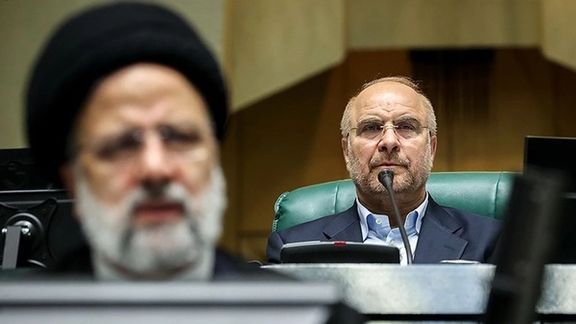
Iran’s parliament speaker Mohammad-Bagher Ghalibaf (right) and President Ebrahim Raisi

A politician close to Iran’s former Speaker Ali Larijani blames the current leader of the parliament for Iran's woes, shared with his ultraconservative rivals.

Speaking particularly about the way the Hijab Enforcement bill was handled by the parliament (Majles), Behrouz Nemati said in an interview with Khabar Online website that Speaker Mohammad Bagher Ghalibaf should accept his responsibility for handing over decision making about the bill to a committee of 15 lawmakers rather than putting it to vote by all the 290 lawmakers. 

The entire Majles, including Ghalibaf are responsible for this non-democratic act, Nemati argued, one day after The Speaker criticized the Paydari party-dominated government in a bid to distance himself from the ultraconservative party and its members at the Majles. Nemati further reiterated that Ghalibaf cannot evade his responsibility for the developments at the parliament. 

Nemati also cautioned against government officials manipulating data to exaggerate President Ebrahim Raisi's "achievements." 

The presidential administration, which is harshly criticized for mishandling the economy and weak governance, has been making outrageous claims about reducing inflation, boosting employment and improving living standards, while tens of millions have sunk deeper into poverty.

Iran’s former parliament Speaker Ali Larijani (left) and incumbent Mohammad-Bagher Ghalibaf    (undated)
100%
Iran’s former parliament Speaker Ali Larijani (left) and incumbent Mohammad-Bagher Ghalibaf

Furthermore, Nemati discussed Ali Larijani's disqualification during the 2021 presidential election, alleging that the Hojjatieh Association, acting like a powerful clan, influenced his disqualification despite his 12-year tenure as the Majles Speaker.

Hojjatieh is a fundamentalist Shia group known for its fanaticism. Even Supreme Leader Ali Khamenei does not want to appear too close to them.

Now, Larijani hesitates to announce his candidacy for the March 2024 parliamentary elections due to concerns that the Guardian Council may disqualify him once more. Ultimately, the Council obeys Khamenei, and only his approval can secure Larijani's candidacy.

Regarding the upcoming elections, Nemati mentioned that approximately 800 reformists have registered to run. These candidates include conservatives aligned with Expediency Council member Mohammad Javad Bahonar, moderate conservatives close to Larijani and former President Hassan Rouhani, as well as neo-cons affiliated with Ghalibaf - all competing against the ultraconservative Paydari Party members.

In an interview with Rouydad24, lawmaker Morteza Mahmoudvand remarked that "Iranian politicians lie about their affiliation. They lie about being conservative or reformist. They all equally benefit from government resources." 

Lawmaker Morteza Mahmoudvand  (undated)
100%
Lawmaker Morteza Mahmoudvand

Nonetheless, he asserted, "There are infiltrators among government officials who aim to facilitate a regime change." However, he refrained from naming specific individuals, but emphasized, "Politicians hold the people's livelihood hostage to their factional interests. They should realize that without these disadvantaged citizens, there would be no country or Islamic Republic."

Mahmoudvand added that a large part of the problems in the country are created by politicians who belong to the leading political factions. They keep blaming the opposite camp for existing difficulties that might have been created even by themselves. This is childish, he said. 

He expressed deep disappointment that in a country as resourceful as Iran, its citizens are unable to afford medical treatment. He criticized government officials for refusing to admit their shortcomings and the ineffectiveness of their management approach.


Most Viewed

Ideology may be fading in Iran, but not in Kashmir's ‘Mini Iran'
1
INSIGHT

Ideology may be fading in Iran, but not in Kashmir's ‘Mini Iran'

2
INSIGHT

Hardliners push Hormuz ‘red line’ as US blockade tests Iran’s leverage

3
VOICES FROM IRAN

Hope and anger in Iran as fragile ceasefire persists

4

US sanctions oil network tied to Iranian tycoon Shamkhani

5

Iran halts petrochemical exports to supply domestic market

Banner
Banner

Spotlight

  • Hardliners push Hormuz ‘red line’ as US blockade tests Iran’s leverage
    INSIGHT

    Hardliners push Hormuz ‘red line’ as US blockade tests Iran’s leverage

  • Ideology may be fading in Iran, but not in Kashmir's ‘Mini Iran'
    INSIGHT

    Ideology may be fading in Iran, but not in Kashmir's ‘Mini Iran'

  • War damage amounts to $3,000 per Iranian, with blockade set to add to losses
    INSIGHT

    War damage amounts to $3,000 per Iranian, with blockade set to add to losses

  • Why the $100 billion Hormuz toll revenue is a myth
    ANALYSIS

    Why the $100 billion Hormuz toll revenue is a myth

  • US blockade targets Iran oil boom amid regional disruption
    ANALYSIS

    US blockade targets Iran oil boom amid regional disruption

  • Iran's digital economy battered by prolonged blackout
    INSIGHT

    Iran's digital economy battered by prolonged blackout

•
•
•

More Stories

Iran's Internet Speed Hits Lowest Point Amid State Disruptions

Sep 19, 2023, 09:35 GMT+1

Iran's internet speed hit its lowest point in the past year compared to other countries globally, according to the latest Speedtest report.

Based on the website’s data from August 2023, the average mobile internet download speed has reached 31.33 megabits per second, showing a more than 6% decrease compared to the previous month. The upload speed has also decreased by approximately 4%.

Iran's broadband fixed internet speed has also experienced a decline. The average fixed internet download speed in August recorded at 11.92 megabits per second, indicating a 1.5% decrease compared to the previous month. The upload speed for fixed internet also shows a declining trend.

On the other hand, Iran's position in the list of surveyed countries regarding internet speed has dropped to the lowest rank in comparison to the past year. In August 2022, Iran was ranked 69th among 145 countries in mobile internet speed, but it has now fallen to 72nd place.

A similar situation has been experienced in fixed internet, with Iran dropping five ranks compared to the previous year. Part of the reason for the decline in Iran's internet speed ranking is the growth of internet speed in other countries around the world.

According to the Speedtest statistics, the United Arab Emirates, Qatar, and Kuwait have been recognized as the top countries in terms of mobile internet speed in the world.

For years, Iranian authorities have restricted citizens' access to approximately half of the top websites in the world. In this regard, surveys by the Tehran E-commerce Association indicate that Iran, after China, has the most restricted internet access in the world.

A New Generation Of Iranian Americans Makes A Political Mark

Sep 19, 2023, 08:03 GMT+1
•
Iran International Newsroom

US lawmakers have been lining up to offer solidarity and support to Iranian Americans on the anniversary of the killing of Mahsa Amini and the nationwide protests.

Amini, 22, was arrested in Tehran because the police felt her hair wasn’t covered properly. She was hit on the head in custody and died in hospital on 16 September 2022.

“Her death was, and remains, a tragedy,” said Senator Bob Menendez, Chairman of the Senate Foreign Relations Committee in a statement, “her murderers’ names will be forever written in the blackest pages of history.”

The ‘state murder’ of Mahsa enraged Iranians, who took to the streets across Iran. The regime employed brutal force to crush the protests. More than 500 were killed, many more injured. Tens of thousands were arrested.

“The international community owes it to them to never let the regime get away with the crimes committed during its brutal crackdown,” Senator Menendez’s statement read. “It owes them our full-throated support as the regime continues to repress the Iranian people to this very day because their bravery is nothing short of inspiring.”

Menendez’s words have been loudly echoed in the Capitol. Senators and Representatives, Republican and Democrat, have spoken or issued statements in support of Iranians.

This is partly because last year’s protests in Iran were simply too big, too consequential, to ignore. Many felt it was ‘the beginning of the end’ of the Islamic Republic.

The recent surge in interest in Iran could also be attributed to party politics in the US. Biden’s Iran policy is unpopular and therefore an easy, efficient attack-line for his political opponents.

But there’s another dynamic at work in Washington: young, educated activists of Iranian origin, inspired and energized by Woman, Life, Freedom movement, are taking it upon themselves to influence US policy towards Iran.

Their efforts have been on display at dozens of protests in major US cities in the past year, and more recently in garnering support for the Mahsa Act in the Congress.

“Against all odds, a new generation of Iranian-Americans is making a positive impact on Capitol Hill, one step at a time,” Sarah Raviani posted on X (formerly twitter) after the bill passed the House on 12 September.

She had spent the preceding days calling Representatives and encouraging others to do so. A week later, she was in Los Angeles, speaking at a rally to commemorate the killing of Mahsa Amini and the beginning of the 2022 protests.

Raviani is only one example, perhaps more prominent than many on social media, but only one among the many who put in the time and effort to effect change.

Scanning through their social media, the new-found army of Iranian-American activists seem to have differences in their background, in their outlook, in their political orientation in the US even. But one wish bonds them together: the end of the Islamic Republic in Iran.

As the United Nations General Assembly gets under way this week, many activists have momentarily turned their attention away from Washington to focus on Iran’s President Ebrahim Raisi, who arrived in New York on Monday morning.

“Absolutely speechless,” wrote one activist, “Ebrahim Raisi will not only be visiting the US to attend @UN, but will be hosting several private meetings & events throughout his stay.”

“This is the same President that was formerly dubbed the Hanging Judge”, wrote another. “This is the President of the same regime that has been systematically hanging protesters over the past year, r*ping & torturing them in prison, and taking out their eyes.”

Several rallies are planned by Iranian-Americans to protest and raise awareness about the Islamic Republic and Raisi. And grassroots activists are the heart of it once more.

Long gone are the days when National Iranian American Council, NIAC, was the only act in town. They traditionally were advocating rapprochement with the Islamic Republic and an end to sanctions. They may still have their connections in Washington, but they seem to have lost their footing within the Iranian-American community.

Any sign of connection with the representatives of the Islamic Republic comes at a hefty price these days.

Same time last year, some successful Iranian-Americans accepted invitations to an event with Raisi. There was a huge backlash within the community, which made most of them apologize and distance themselves from the Islamic Republic.

This year, there seems to be more invitations. And the new army of Iranian-American activists are watching.

Lawyers Demand Release Of Reporters Jailed For Revealing Mahsa Amini's Death

Sep 19, 2023, 06:38 GMT+1

Attorneys for two Iranian journalists kept in jail for nearly a year for first reporting Mahsa Amini’s death in police custody have requested their immediate release.

Niloufar Hamedi’s and Elahe Mohammadi’s lawyers submitted legal requests for their release after one year of “temporary detention”, which even according to Iran’s laws is illegal.

The two journalists – from reformist Iranian dailies Shargh and Ham-Mihan – have been imprisoned for about 350 days because the regime blames them for the nationwide protests that followed Amini’s death in hospital on September 16, 2022, after her arrest by the notorious hijab police.

The Islamic Republic is known to crack down on people who reveal corruption and wrongdoing in Iran, with authorities announcing that reporting the crimes is worse than the crimes themselves.

Hamedi reported about Mahsa Amini struggling for her life in a hospital after receiving fatal head injuries while in custody. When the 22-year-old Amini passed away, residents of Tehran began gathering around the hospital to protest and soon demonstrations spread to many cities. The Women, Life, Liberty movement that began presented the most serious challenge to the Islamic regime in its 44-year history and lasted for months.

Iran’s intelligence ministry and the Revolutionary Guard accused the two reporters of having links with the CIA and foreign governments and conspiring to agitate public opinion against the regime.

Hamedi’s attorney, Partu Borhanpur in an interview with Shargh newspaper said two months have passed since her trial was held and the court has not announced its decision, keeping Hamedi illegally in temporary detention.

Iran Must Rescind Decision To Bar UN Nuclear Inspectors – US, E3, IAEA

Sep 18, 2023, 22:47 GMT+1
•
Iran International Newsroom

The US and three European allies have condemned Iran’s move to bar IAEA inspectors assigned to the country as another step in the wrong direction. 

The United Kingdom, France, Germany -- the so-called E3 -- and the US issued a statement Monday, a few days after the UN nuclear watchdog announced that Iran has withdrawn the designation of several UN inspectors assigned to conduct verification activities in Iran under the Non-Proliferation Treaty Safeguards Agreement. 

Having arrived in New York for the UN General Assembly, IAEA director Rafael Grossi told Iran International’s Arash Alaei Monday that he hopes to meet with Iranian officials “to see if they can regress” this unconstructive move. “I was very critical of this move... it was not constructive; it’s not a step in the right direction. it's not good."

He added that the only way that Iran could dispel any doubts about its nuclear program is to allow the IAEA to inspect, noting that “If they allow us to work, then there will be confidence; otherwise, it will be very complicated.”

Via a rare public statement, International Atomic Energy Agency's Rafael Grossi had decried Iran's "disproportionate and unprecedented" move on September 16, saying that it hinders IAEA oversight of Tehran's atomic activities. Tehran was showing displeasure in the face of a threat by the US and the E3 of another resolution to censure Iran for lack of cooperation with the IAEA. 

In their Monday statement, the US and its allies said, “Iran’s actions will undermine the Agency’s ability to carry out its safeguards mandate effectively,” which constitutes an unnecessary blow to an “already strained relationship between the IAEA and Iran”.

Expressing concern over Iran expanding its nuclear activities, and its deliberate hampering of IAEA’s verification and monitoring activities – mandated under Iran’s NPT Safeguards Agreement, the US and E3 joined Grossi in strongly condemning "unilateral” measure.

“This is at a time when the IAEA has serious, longstanding, and unresolved questions related to undeclared nuclear materials and activities in Iran that Iran has failed to address for more than four years.”

They urged Tehran to “immediately reverse these inspector de-designations and fully cooperate with the Agency to enable them to provide assurances that Iran’s nuclear program is exclusively peaceful.”

UN nuclear watchdog chief Rafael Grossi attends a press conference during the International Atomic Energy Agency 's (IAEA) 35-nation Board of Governors meeting in Vienna, Austria, September 11, 2023.
100%
UN nuclear watchdog chief Rafael Grossi attends a press conference during the International Atomic Energy Agency 's (IAEA) 35-nation Board of Governors meeting in Vienna, Austria, September 11, 2023.

On Sunday, the European Union also urged Iran to reconsider its decision, with the spokesman for EU foreign affairs Peter Stano saying, "The European Union is highly concerned by the ... decision by Iran to withdraw the official designation of several experienced IAEA inspectors to monitor and verify its nuclear program."

"Particularly worrying is the direct and severe impact of this decision on the Agency's ability to conduct its verification activities, which includes the monitoring of the Joint Comprehensive Plan of Action. The EU urges Iran to reconsider its decision without delay," the statement said.

Earlier in the day, US Secretary of State Antony Blinken acknowledged the threat posed by Iran’s nuclear program during a meeting with foreign ministers of the Persian Gulf Cooperation Council member states, who are also in New York for the UN summit.

“We’re cooperating to deter Tehran’s aggression and destabilizing activities, including the threat posed by its nuclear program,” he said, adding, “And we’re working to uphold freedom of navigation, such as through a multinational task force that is protecting ships in the Strait of Hormuz.”

In June, the US Naval Forces Central Command hosted a two-day multilateral maritime security meeting for 90 senior military officers and diplomats from 22 nations, including GCC member-states. The counterterrorism working group and the Iran working group are two of the most active bodies set up under the umbrella of GCC-US partnership. 

US Sanctions Ahmadinejad As It Releases $6 Billion To Iran’s Regime

Sep 18, 2023, 20:47 GMT+1

The US has sanctioned former Iranian President Mahmoud Ahmadinejad for the disappearance of a US citizen 16 years ago, while releasing $6 billion to Iran to free other hostages.

On Monday, as five Iranian-Americans held hostage in Iran for several years were allowed to leave, the United States announced designations for Ahmadinejad and Iran’s Intelligence Ministry.

The move to allow $6 billion frozen in South Korean banks due to US sanctions to be released has been criticized by Republicans, experts and many Iranian Americans as a counter-productive decision that will endanger other Americans and embolden would-be hostage takers.

The sanctions announced today are seen as a move by the administration to counter these criticisms, while Ahmadinejad holds no significant power in Iran and has been isolated by the regime. While criticizing the regime since 2017, the former president has maintained silence for more than a year.

A statement released by the State Department said the US is “designating Iran’s Ministry of Intelligence and Security (MOIS) in connection with the MOIS’s involvement in the wrongful detention of U.S citizens and former President Mahmoud Ahmadinejad for his support to MOIS.” It added, “During Ahmadinejad’s term in office, Iran’s MOIS abducted and detained Bob Levinson with authorization by senior Iranian officials.” Levinson traveled to Iran and disappeared in 2007.

The prisoners released on Monday were arrested on trumped-up charges and convicted for espionage and other security crimes in sham trials without due process of law.





